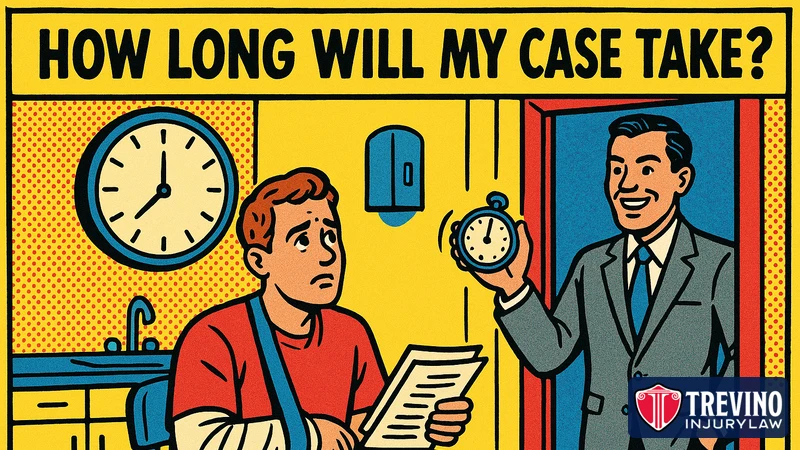
A Texas personal injury case usually settles within several months after your medical treatment ends, while a case that goes to trial can take a year or longer. Your recovery sets the pace, because no one can value a claim until doctors understand the full extent of your injuries.
The insurance company controls much of the timeline. Adjusters request records, question treatment, and make low early offers, betting that financial pressure will push you to settle before your claim is fully documented. A lawsuit adds formal steps such as discovery and mediation, but it also puts the insurer on a court schedule.
Texas law sets an outer limit as well. You generally have two years from the date of injury to file suit, and missing that deadline can end your claim no matter how strong it is. Gathering medical records, bills, and wage proof early keeps your case on schedule.
At Trevino Injury Law, our San Antonio personal injury lawyers track every deadline, build your demand from complete records, and prepare your case for trial when the insurer stalls. Call 210-TREVINO for a free case review. You pay nothing unless we win. Se Habla Español.
What Could Your Personal Injury Case Be Worth?
Answer a few quick questions about your accident. Takes about 60 seconds.
See What My Case Might Be WorthThe insurance company offered less than $20,000. I ended up with over $1 million. — Jackie Galindo
Trevino Injury Law, San Antonio personal injury lawyers, protects your evidence today and keeps your claim moving on your schedule, not the insurer’s. Call 210-TREVINO now for a free case review. You pay nothing unless we win. Se Habla Español.
How Long Does a Personal Injury Case Take in Texas?
Most personal injury cases move through five stages: medical treatment, investigation and demand, negotiation, a lawsuit if needed, and payout. A claim that settles without a lawsuit usually resolves within several months after treatment ends. A case that requires a lawsuit commonly takes a year or more, depending on the court’s docket and how hard the defense fights.
| Stage | What happens | Typical length |
|---|---|---|
| 1. Medical treatment | You treat until your doctor releases you or you reach maximum medical improvement | Weeks to many months, depending on the injury |
| 2. Investigation and demand | Your lawyer gathers records and sends a demand package to the insurer | Several weeks after treatment ends |
| 3. Negotiation | The insurer reviews the demand and exchanges offers | A few weeks to several months |
| 4. Lawsuit and mediation | Filing, service, discovery, depositions, and mediation | Often a year or more |
| 5. Payout | Release, lien resolution, and disbursement from the trust account | Several weeks after settlement |

The stages build on each other, so the first one sets the pace for everything that follows.
Stage 1: Why Does Medical Treatment Come First?
Medical treatment comes first because the value of your claim depends on your medical picture. Maximum medical improvement (MMI) is the point where your doctor expects no further significant recovery. Until you reach MMI, or your doctor can project the future care you will need, neither side knows what your injuries will cost.
Gaps in treatment hurt claims. Insurers argue that missed appointments or a late first visit prove the injury was minor or caused by something else. Seeing a doctor promptly and following the treatment plan protects both your health and your claim.
Settling before treatment ends is risky, because a signed release ends the claim even if you later need surgery or long-term care. Once your medical picture is clear, the case shifts from recovery to proof.
Stage 2: What Happens During the Investigation and Demand?
During the investigation, your lawyer collects the evidence that proves fault and damages, then presents it to the insurer in a demand package. That evidence includes the crash or incident report, photos and video, witness statements, medical records and bills, and proof of lost wages.
Adjusters often call within days of the accident and ask for a recorded statement. You are not required to give one to the other party’s insurer, and anything you say can be used to dispute fault or minimize your injuries.
The demand letter explains how the injury happened, why the other party is responsible, and the full value of your damages, including future medical care and pain and suffering. It typically gives the insurer a deadline to respond, which starts the negotiation stage.
Stage 3: How Long Does Settlement Negotiation Take?
Negotiation usually takes a few weeks to several months, depending on the size of the claim and how strongly the insurer disputes fault or treatment. Claims involving surgery or permanent injury typically take longer, because adjusters need higher-level approval for larger payments.

What Deadlines Apply to Texas Insurance Companies?
When you file a claim with your own insurance company, such as an uninsured motorist or personal injury protection (PIP) claim, Chapter 542 of the Texas Insurance Code sets response deadlines. The insurer generally must acknowledge the claim and begin investigating within 15 days, then accept or reject it within 15 business days after receiving the information it requested. It can extend that decision by up to 45 days if it explains why. These deadlines govern claims against your own insurer, not how fast the at-fault party’s insurer responds.
What Slows Negotiations Down?
- Disputed fault: the insurer blames you for part or all of the accident.
- Ongoing treatment: a recommended surgery or new diagnosis changes the claim’s value.
- Treatment gaps or prior injuries: the insurer argues something else caused your symptoms.
- Limited coverage: low policy limits, or several injured people sharing one policy.
- Lowball tactics: an adjuster refuses to move from an early offer.
When negotiations stall, filing a lawsuit is often the step that moves the case forward.
Stage 4: What Happens If You File a Lawsuit?
Filing a lawsuit starts a court-supervised process with set deadlines. After a Texas defendant is served, the defendant must file an answer by 10:00 a.m. on the Monday after 20 days have passed. Service is often quick, although a defendant who is hard to locate can delay it.
Next comes discovery, where each side exchanges documents, answers written questions, and takes depositions. Discovery is usually the longest part of a lawsuit.
Many Bexar County cases go to mediation before trial. A neutral mediator meets with both sides and helps them work toward a settlement, and most lawsuits resolve at or after mediation without a trial. Our guide to the personal injury litigation process walks through each step. When a case does go to trial, the court’s docket sets the date.
Stage 5: How Long Does It Take to Get Your Settlement Money?
Settlement money usually reaches you within several weeks after you agree to settle. The payout follows these steps:
- You sign a release, the document that ends your claim in exchange for payment.
- The insurer issues the settlement funds, which are deposited into your lawyer’s trust account.
- Your lawyer resolves medical liens, such as hospital liens and health insurance or Medicare reimbursement claims.
- Your lawyer pays remaining medical balances and case expenses, then disburses your share.
The trust account protects your money. Texas lawyers must keep client funds separate from firm funds, and resolving liens before disbursement keeps medical providers from pursuing you after the case closes.
What Is the Deadline to File a Personal Injury Lawsuit in Texas?
The deadline to file a personal injury lawsuit in Texas is generally two years from the date of injury under Section 16.003 of the Texas Civil Practice and Remedies Code. Exceptions can shorten or extend that period. Claims against a government entity require written notice much sooner, often within six months, and some city charters set even shorter notice deadlines.

Negotiating with an insurer does not stop the clock. If settlement talks drag on close to the deadline, your lawyer files suit to preserve the claim.
Quick Answers About Personal Injury Timelines
Does Filing a Lawsuit Mean My Case Will Go to Trial?
No. Most lawsuits settle before trial, often at mediation. Filing suit gives your lawyer subpoena power and court deadlines that push the insurer to negotiate seriously.
Can I Speed Up My Personal Injury Settlement?
You can avoid delays by treating consistently, keeping copies of bills and records, and sending insurer calls to your lawyer. Accepting an early offer is faster, but it usually means accepting less than the claim is worth.
Why Is the Insurance Company Taking So Long?
Insurers delay to review records, dispute treatment, or wait for you to accept a low offer. A demand with a firm response deadline, and a lawsuit when needed, keep the claim moving.
Why Hire a San Antonio Personal Injury Lawyer to Manage Your Timeline?
A personal injury case moves on the insurer’s schedule unless someone pushes back. At Trevino Injury Law, we prepare every case for a Bexar County jury, and we secured a $17 million settlement in a head-on collision case involving three fatalities. Prior results do not guarantee a similar outcome.
Want to Protect the Full Value of Your Claim?
You’ve seen how this affects your case — but this is only one piece of the puzzle. Our San Antonio Personal Injury Lawyer page breaks down what a trial-ready firm does differently.

We track your filing deadline, build your demand from complete medical records, and file suit when an insurer stalls. The sooner we start, the sooner your case can reach a fair result.
Call 210-TREVINO for a free case review. We operate on a strict no-win, no-fee basis. Se Habla Español.
