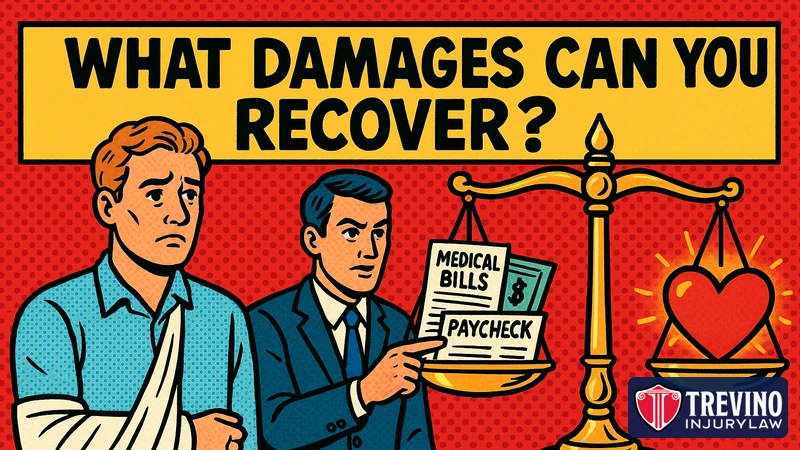
Texas law lets an injured person recover economic damages for financial losses, non-economic damages for pain and other personal harm, and, in rare cases, exemplary damages that punish gross negligence. Most claims are built on the first two categories, and each one requires its own kind of proof.
Insurance adjusters value claims by counting bills and wage records, then discounting everything they cannot see on paper. Pain, lost sleep, and the activities you can no longer do often get the least attention, even though Texas juries can award money for each of them.
Texas also limits some recoveries. Medical expenses are measured by the amounts actually paid or incurred, and exemplary damages are capped by statute. Knowing which category each loss belongs to keeps any part of your claim from being left out.
At Trevino Injury Law, our San Antonio personal injury lawyers document every category of loss, work with medical and economic experts, and prepare your claim for a Bexar County jury. Call 210-TREVINO for a free case review. You pay nothing unless we win. Se Habla Español.
What Could Your Personal Injury Case Be Worth?
Answer a few quick questions about your accident. Takes about 60 seconds.
See What My Case Might Be WorthThe insurance company offered less than $20,000. I ended up with over $1 million. — Jackie Galindo
Trevino Injury Law, San Antonio personal injury lawyers, documents every loss and fights for the full value of your claim. Call 210-TREVINO now for a free case review. You pay nothing unless we win. Se Habla Español.
What Damages Can You Recover in a Texas Personal Injury Case?
You can recover three types of damages in a Texas personal injury case: economic damages, non-economic damages, and exemplary damages. Economic and non-economic damages are compensatory, meaning they repay you for harm you suffered. Exemplary damages are different because they punish the defendant and are available only in limited cases.
| Type | What it covers | Examples |
|---|---|---|
| Economic | Financial losses you can document | Medical bills, future medical care, lost wages, lost earning capacity, property damage |
| Non-economic | Personal harm without a receipt | Pain and suffering, mental anguish, physical impairment, disfigurement, loss of consortium |
| Exemplary | Punishment for gross negligence, fraud, or malice | A drunk driver, or a trucking company that knowingly ignores safety violations |

Economic damages are usually the foundation, because they set a documented baseline for the rest of the claim.
What Are Economic Damages?
Economic damages are the financial losses an injury causes, both past and future. They include:
- Medical expenses: emergency care, hospital stays, surgery, therapy, medication, and medical equipment.
- Future medical care: treatment your doctors expect you to need, often documented in a life care plan.
- Lost wages: income you missed while recovering.
- Lost earning capacity: a reduced ability to earn money in the future because of a lasting injury.
- Property damage: repair or replacement of your vehicle and other damaged property.
Texas measures recoverable medical expenses by the amount actually paid or incurred by you or on your behalf, not the full amount a provider billed, under Section 41.0105 of the Texas Civil Practice and Remedies Code. Because insurance discounts can lower that figure, accurate billing records matter.
Bills tell only part of the story. The harder losses to prove are the ones no invoice captures.
What Are Non-Economic Damages?
Non-economic damages compensate for personal harm that has no fixed price. Texas juries may award money for:
- Physical pain and suffering, past and future.
- Mental anguish: emotional distress such as anxiety, fear, and depression caused by the injury.
- Physical impairment: the loss of activities you could do before.
- Disfigurement: scars, amputations, and other permanent changes to your appearance.
- Loss of consortium: harm to a family relationship, explained in our guide to loss of consortium.
Because no receipt exists for pain, the evidence comes from you, your family, your doctors, and records of how daily life changed. Journals, photographs, and testimony from people who know you help a jury understand the loss.
Insurance letters and court filings sometimes describe these same losses with older legal labels.
What Is the Difference Between General and Special Damages?
General and special damages are older legal terms that overlap with economic and non-economic damages. Special damages are specific, calculable losses such as medical bills and lost wages, and they must be specifically pleaded and proven. General damages are losses that naturally follow from an injury, such as pain and mental anguish.
The labels matter less than making sure every loss is identified and supported with evidence. One category works differently from all the others, because it punishes rather than repays.
When Can You Recover Exemplary (Punitive) Damages in Texas?
You can recover exemplary damages in Texas only when the defendant’s conduct went beyond carelessness. Under Chapter 41 of the Texas Civil Practice and Remedies Code, you must prove fraud, malice, or gross negligence by clear and convincing evidence, and the jury must agree unanimously.

Gross negligence means the defendant knew about an extreme risk and consciously ignored it. Drunk driving and a carrier that keeps an unsafe driver on the road after repeated violations are common examples. Texas caps exemplary damages by statute, and our guide to damage limits in Texas explains how those limits apply.
Whatever the category, damages only count if you can prove them.
How Do You Prove Your Damages?
You prove damages with records, testimony, and expert analysis that connect each loss to the injury:
- Medical records and bills that show diagnosis, treatment, and cost.
- Wage records and tax returns that show lost income.
- Expert testimony from doctors, life care planners, and economists for future losses.
- Photos, journals, and testimony from family and coworkers that show how your life changed.

Gaps in treatment or missing records give insurers room to argue that a loss was minor or unrelated to the crash. Even well-documented damages can still be reduced.
What Can Reduce the Damages You Recover?
Your recovery can be reduced even when the other party is clearly at fault. Texas reduces damages by your percentage of responsibility and bars recovery if you are more than 50 percent at fault under the 51 percent rule.
Insurers may also argue that you failed to mitigate your damages, for example by skipping treatment, and the at-fault party’s policy limits can cap what is practically collectible. Your own uninsured or underinsured motorist coverage can help close that gap.
Quick Answers About Personal Injury Damages
Can I Recover Damages for Emotional Distress in Texas?
Yes. Mental anguish is a recognized category of non-economic damages, but Texas requires evidence of the nature, duration, and severity of the distress, not just a statement that you were upset.
Are Personal Injury Damages Taxable?
Compensation for physical injuries is generally not taxable under federal law, while exemplary damages and some interest usually are. Confirm your situation with a tax professional.
Is There a Limit on Pain and Suffering Damages in Texas?
Texas does not cap non-economic damages in most personal injury cases. Statutory caps apply to exemplary damages and to non-economic damages in health care liability claims.
Why Hire a San Antonio Personal Injury Lawyer to Protect Your Damages?
Every category of damages you fail to document is money an insurer keeps. At Trevino Injury Law, we prepare every case for a Bexar County jury, and we secured a $17 million settlement in a head-on collision case involving three fatalities. Prior results do not guarantee a similar outcome.
Want to Protect the Full Value of Your Claim?
You’ve seen how this affects your case — but this is only one piece of the puzzle. Our San Antonio Personal Injury Lawyer page breaks down what a trial-ready firm does differently.
We identify every category of loss, retain the experts who prove future costs, and present your damages to a jury when an insurer refuses to pay their full value. The sooner we start, the more evidence we can preserve.
Call 210-TREVINO for a free case review. We operate on a strict no-win, no-fee basis. Se Habla Español.
