
At a personal injury deposition, you answer questions under oath from the other side’s lawyer while a court reporter records every word, usually in a conference room or over video, with your own lawyer beside you. Nothing is decided that day, but what you say can be read to the jury at trial.
Insurance companies use depositions to test your story, size you up as a witness, and look for inconsistencies with your medical records. A calm, prepared witness raises the value of a claim. A surprised one can lower it.
In Texas, depositions follow Rule 199 of the Texas Rules of Civil Procedure, which caps each side’s questioning of a witness at six hours.
This guide walks through who attends, how to prepare, what you will be asked, how objections work, and what happens afterward. For where the deposition fits in the bigger picture, see the personal injury litigation process in San Antonio.
What Could Your Personal Injury Case Be Worth?
Answer a few quick questions about your accident. Takes about 60 seconds.
See What My Case Might Be WorthThe insurance company offered less than $20,000. I ended up with over $1 million. — Jackie Galindo
Facing a deposition in your injury case? Call 210-TREVINO for a free, confidential case review. You pay nothing unless we win. Se Habla Español.
What Is a Deposition in a Personal Injury Case?
A deposition is sworn testimony given before trial during the discovery phase of a lawsuit. It lets each side learn what witnesses know, lock in their stories, and judge how they will come across to a jury.
In an injury case, the defense will usually depose you, the injured person. Your lawyer will usually depose the other driver or property owner, and sometimes company employees, police officers, doctors, and expert witnesses.
Who Will Be There?
A deposition is not held in a courtroom, and there is no judge or jury in the room. Expect a small group:
| Person | Role |
|---|---|
| You (the witness) | Answer questions truthfully under oath |
| Your lawyer | Protects you, raises proper objections, and may ask follow-up questions |
| Defense lawyer | Asks most of the questions |
| Court reporter | Swears you in and records every word for the transcript |
| Videographer (sometimes) | Records video that may be shown at trial |
| Other parties (sometimes) | The defendant or a company representative may attend |
How Should You Prepare for Your Deposition?
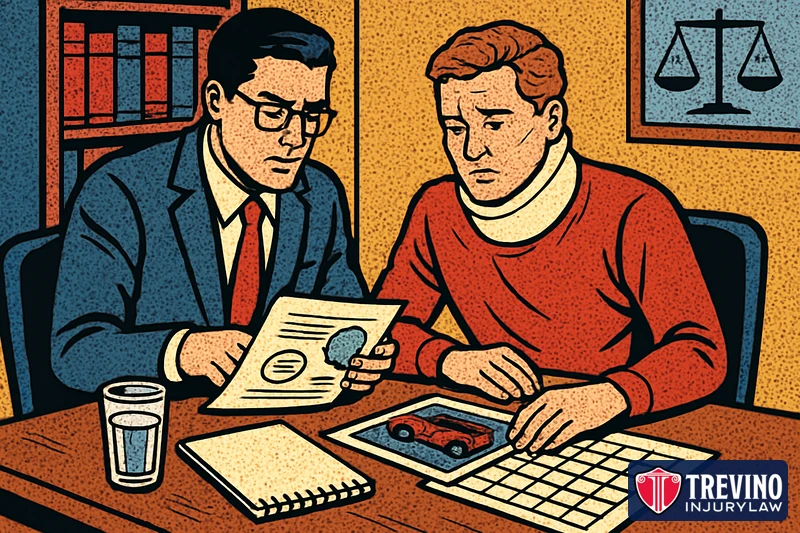
Prepare by meeting with your lawyer, reviewing your records, and practicing short, truthful answers. Your lawyer will explain the topics the defense is likely to cover and how to handle difficult questions.
- Review the crash report, photos, and your medical treatment timeline with your lawyer.
- Go over your prior injuries and medical history; the defense will ask.
- Remember dates and doctors as best you can, but do not guess.
- Bring only what your lawyer tells you to bring.
- Get a good night’s sleep and dress as you would for an important meeting.
- Plan to listen to each full question before answering.
What Questions Will You Be Asked?
Most questions fall into a few predictable categories. The defense is looking for facts, for inconsistencies, and for anything that suggests your injuries came from something other than the crash.
| Topic | Typical questions |
|---|---|
| Background | Where you live and work, your education, prior lawsuits or claims |
| The incident | What happened, where you were going, what you saw and heard |
| Injuries and treatment | Your symptoms, doctors, treatment, and how you feel today |
| Prior medical history | Earlier injuries or conditions involving the same body parts |
| Daily life | Work you have missed and activities you can no longer do |
| Statements | What you told police, insurers, or others after the incident |
Answer only the question asked. “I don’t know” and “I don’t remember” are honest answers when they are true.
How Long Does a Deposition Take in Texas?
Most plaintiff depositions in injury cases take a few hours. Texas Rule 199.5(c) says no side may examine or cross-examine an individual witness for more than six hours, and breaks do not count against that limit.
The deposition is one step in a longer case. See how long a personal injury case takes in Texas for the full timeline.
Can a Deposition Be Done Remotely?
Yes. Texas Rule 199.1(b) allows a party to take a deposition by telephone or other remote electronic means if it gives reasonable prior written notice. Video depositions over a secure platform are now common, especially for witnesses who live far away or have trouble traveling because of their injuries.

Are There Questions You Do Not Have to Answer?
Usually you must answer, even if the question seems unfair, because there is no judge in the room to rule on objections. Texas rules keep objections short: questions may be met only with “Objection, leading” or “Objection, form,” and answers with “Objection, non-responsive.”
Your lawyer may instruct you not to answer only in limited situations, such as to preserve a privilege (for example, your private conversations with your lawyer), comply with a court order or the rules, protect you from an abusive question, or obtain a ruling from the court.

Private conferences with your lawyer during questioning are generally not allowed, except to decide whether to assert a privilege. You can talk during agreed breaks.
What Happens After a Deposition?
The court reporter prepares a written transcript, and you will usually have a chance to review it and note corrections. Both sides then use the testimony to evaluate the case.
What you say under oath is difficult to take back later. In Lujan v. Navistar, Inc. (Tex. 2018), the Supreme Court of Texas held that a trial court may disregard a later affidavit that conflicts with earlier sworn testimony without a sufficient explanation. That is why careful preparation and accurate answers matter so much.
Strong, consistent testimony often pushes the insurer toward a fair settlement or mediation. If the case goes to trial, parts of the transcript or video can be shown to the jury. Your testimony about how the injuries changed your life also supports the damages available in a San Antonio personal injury lawsuit.
Quick Answers
Can I Bring Notes to My Deposition?
Ask your lawyer first. Anything you review to refresh your memory may have to be shown to the other side.
What If I Make a Mistake During My Testimony?
Tell your lawyer. You can often correct an answer during the deposition or note corrections when you review the transcript.
Will the Defendant Be in the Room?
Sometimes. Parties generally have the right to attend, but your lawyer will tell you who to expect.
Do I Get Paid for My Time?
No. As a party to the case, you are not paid for giving a deposition.
Why Hire Trevino Injury Law for Your Deposition?
We prepare clients for depositions the same way we prepare for trial, because the defense is already thinking about how you will look in front of a jury. We review your records with you, practice the hard questions, and sit beside you for every minute of testimony.
That trial-first approach produced a $17 million settlement in a head-on collision case involving three fatalities. Prior results do not guarantee a similar outcome.
Want to Protect the Full Value of Your Claim?
You’ve seen how this affects your case — but this is only one piece of the puzzle. Our San Antonio Personal Injury Lawyer page breaks down what a trial-ready firm does differently.

A deposition is not a trap when you walk in prepared. It is your chance to tell the defense, under oath, exactly how this injury changed your life. Injured families across South Texas trust attorneys who force insurance companies to pay full value to fight for them.
Call 210-TREVINO or request a free case review. Se Habla Español. No Win, No Fee.
