Your personal injury case does not end with polite phone calls to an adjuster. It becomes a formal legal war against a well-funded corporate carrier the second the crash occurs.
The defense team assigned to your file is already deploying accident reconstructionists to minimize their liability, and their lawyers are drafting discovery questions engineered to trap you into admitting fault.
According to firm trial records, forcing a corporate defendant into a Bexar County courtroom recently secured a $536,007 jury verdict after the insurer initially refused to offer fair compensation. Protecting your right to that level of recovery requires a Spoliation Letter, a legal demand that stops the property owner from destroying evidence, which must go out immediately. Texas strictly limits your time to file a formal lawsuit to two years. After that deadline passes, the court permanently dismisses your claim.
What Could Your Personal Injury Accident Case Be Worth?
Answer a few quick questions about your accident. Takes about 60 seconds.
See What My Case Might Be WorthThe insurance company offered less than $20,000. I ended up with over $1 million. — Jackie Galindo
Trevino Injury Law personal injury lawyers will file your original petition immediately and lock down critical evidence before the defense purges it. Call 210-TREVINO now for a free case review. You pay nothing unless we win. Se Habla Español.
The San Antonio Personal Injury Litigation Process Takeaways
- As your San Antonio personal injury lawyer, we preserve critical evidence on corridors such as Loop 1604 to prevent insurers from destroying evidence of liability.
- Trevino Injury Law rejected a $5,000 settlement offer and secured a $536,007 jury verdict in the Arriaga case by taking the defendant to trial.
- The spoliation letter formally triggers trucking companies’ legal duty to preserve black box data or face court sanctions for destroying evidence.
- We compel Bexar County insurance carriers to pay full value by preparing for litigation at the moment of a crash, rather than seeking quick settlements.
For families in San Antonio, this process is the only path to justice when a corporation refuses to accept responsibility for the harm they caused. Most injury victims believe their case ends with a few phone calls, but the reality is a fight against a billion-dollar insurance carrier that begins the moment the crash occurs.
In this article, you will discover the five critical phases of a personal injury lawsuit, from the immediate “spoliation” of evidence in the first week to the final jury verdict at the courthouse. We explain what happens during depositions, how mediation works in Texas, and why we take cases to trial when others settle for pennies.
Phase 1: Immediate Investigation & Preservation (The First 7 Days)
The immediate investigation phase involves securing critical evidence, such as black box data and video footage, within the first seven days before it is legally destroyed or “lost” by the trucking or insurance company. While you are recovering in the hospital, the defendant’s team is already at the scene working to minimize their liability.
We counter this by immediately deploying our own accident reconstruction experts to map the scene at intersections such as Loop 1604 and I-10, or at Culebra Road.
A critical tool we use during this phase is the spoliation letter, a certified legal notice instructing the trucking company to preserve all evidence related to the crash. In Texas, the duty to preserve evidence is triggered when a party knows or reasonably should know that there is a substantial chance a claim will be filed.
This duty was clarified by the Texas Supreme Court in Brookshire Bros., Ltd. v. Aldridge, 438 S.W.3d 9 (Tex. 2014). By sending this letter immediately, we formally trigger this legal duty; if they destroy evidence after receiving it, we can ask the court to sanction them, preventing them from ‘routinely purging’ the smoking gun needed to win your case.
Requesting Body Cam and Dash Cam Footage
Securing video evidence often requires navigating complex bureaucratic hurdles with local law enforcement. We immediately file Freedom of Information Act (FOIA) requests with the San Antonio Police Department or the Bexar County Sheriff’s Office to obtain body cam and dash cam footage.
This raw video often contradicts the defendant’s version of events and establishes liability early, preventing insurance adjusters from later denying liability. While securing evidence builds your case, officially starting the legal battle requires filing a formal lawsuit.
Phase 2: Filing the Lawsuit (The Petition)
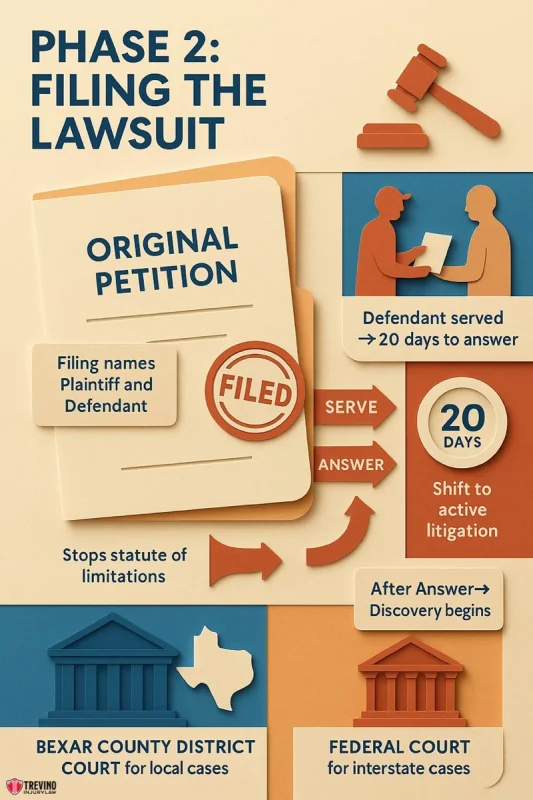
We file the lawsuit by submitting an Original Petition to the Bexar County District Clerk, officially naming you as the Plaintiff and the negligent party as the Defendant.
This document outlines your legal claims, the accident facts, and the specific damages you are seeking from the party who hurt you. Once filed, this action stops the statute-of-limitations clock and formally brings the Texas court system into the case against the insurance company.
After you file the petition, a process server or constable must “served” the defendant with the lawsuit. They typically have roughly 20 days to file an “Answer,” acknowledging the suit. This moment marks the shift from informal negotiations to active litigation, signaling to the insurance carrier that you are serious about seeking full compensation and backed by a law firm ready to litigate.
Selecting the Proper Court
Determining the proper jurisdiction is a strategic decision that can affect your case outcome. For a crash involving two residents in Alamo Heights or Stone Oak, we typically file in the Bexar County District Courts.
However, if the collision involves an interstate commercial carrier or parties from different states, we may file in Federal Court, which operates under different procedural rules and requires specific admission to practice.
Once the defendant has answered the lawsuit, we enter the longest and most critical stage of litigation, where we compel them to disclose their secrets.
Phase 3: The Discovery Phase (Uncovering the Truth)
Discovery is the mandatory exchange of evidence where both sides must answer written questions under oath and submit to face-to-face depositions to establish the facts of the case.
This phase is designed to prevent “trial by ambush,” a tactic strictly prohibited in Texas courts. As established in the landmark case Garcia v. Peeples, 734 S.W.2d 343 (Tex. 1987), discovery ensures lawsuits are decided by the facts, not by what is concealed.
We leverage this legal precedent to demand internal emails, safety manuals, and hiring records, ensuring the defense cannot hide the truth behind procedural walls.
The most intense part of discovery is the deposition. A deposition is a formal interview where the opposing attorney asks you questions in person, under oath, while a court reporter records every word.
We prepare you thoroughly so you can tell your story clearly without being bullied by defense lawyers, and we aggressively depose the negligent driver to expose inconsistencies in their story.
Expert Witness Testimony
To maximize your case’s value, we often retain expert witnesses who provide specialized knowledge to the jury. Medical experts explain the long-term impact of your spinal injury, while accident reconstructionists use physics to prove the defendant was speeding.
In cases involving work injuries or commercial trucks, we may also hire life care planners to calculate the exact cost of your future medical needs, ensuring a quick settlement doesn’t shortchange you.
Discovery reveals the raw facts of the case, but before we enter the courtroom, Texas law usually requires one final attempt to resolve the dispute peacefully.
What Happens After Discovery Ends?
When discovery closes, the case moves into the pretrial stage, where each side tests the other’s evidence before a jury ever hears it. The most common steps are:
- Motions for summary judgment: the defense may ask the judge to rule that there is not enough evidence for a jury to decide the case. A well-built discovery record defeats these motions.
- Challenges to expert witnesses: either side can ask the court to exclude an expert whose methods are not reliable, so expert opinions must be grounded in the evidence gathered in discovery.
- Mediation: Bexar County judges commonly order the parties to mediate before trial.
- Pretrial conference and trial setting: the court resolves remaining evidence disputes and sets the case for trial.
If the case goes to trial, it is usually tried to a jury. Either side can request a jury, and personal injury plaintiffs almost always do. A bench trial, decided by the judge alone, happens only when no party requests a jury.
Phase 4: Mediation & Alternative Dispute Resolution (ADR)
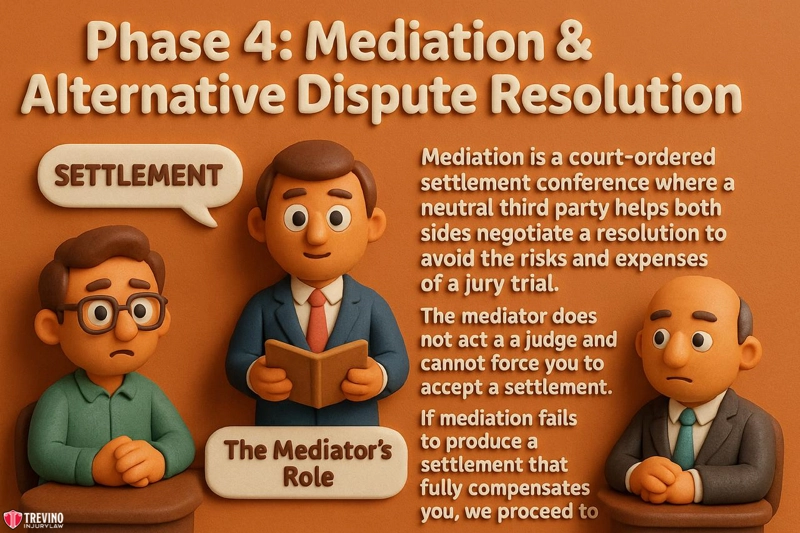
Mediation is a court-ordered settlement conference in which a neutral third party helps both sides negotiate a resolution to avoid the risks and costs of a jury trial. In Bexar County, judges almost always require mediation before allowing a case to proceed to trial. It is an opportunity to settle the case on your terms, rather than leaving the decision in the hands of strangers on a jury.
During mediation, we present our strongest evidence and the “Trial Authority” leverage we have built. Insurance adjusters know which firms actually try cases and which ones fold, so they often offer significantly more money to Trevino Injury Law clients to avoid facing us in court.
If they provide a fair number that covers your needs, we settle; if they lowball you like the $5,000 offer in the Arriaga case, we end the mediation and prepare for battle.
The Mediator’s Role
The mediator does not act as a judge and cannot force you to accept a settlement. Instead, they act as a facilitator, moving between rooms to find common ground between your demand and the insurance company’s offer.
A skilled mediator helps the defense understand the reality of the verdict risk they face, often convincing them to increase their offer to avoid a likely loss at trial.
If mediation fails to produce a settlement that fully compensates you, we proceed to the final arena where your voice is finally heard.
Phase 5: Trial by Jury (The Arena)
A jury trial involves presenting your evidence and witnesses to 12 Bexar County citizens who will decide the final verdict and the amount of compensation you deserve. This phase begins with voir dire, the jury selection process, where we question potential jurors to identify biases and select a fair panel willing to hear the truth.
Unlike settlement mills that fear this stage, we embrace it as the ultimate opportunity to secure justice.
During trial, we cross-examine the defendant’s experts, present evidence of your injuries, and deliver a closing argument that connects your suffering to the law. In Arriaga v. Montemayor, the defense offered only $5,000, but because we took the case to a jury, we secured a verdict of $536,007. This result shows that a jury often values human suffering far more than an insurance algorithm ever will.
The Verdict and Judgment
Once both sides have rested, the jury deliberates and returns a verdict answering two questions: who was negligent, and how much money is owed. If the verdict is in your favor, the judge enters a Judgment, making the award official. While the defense may appeal, a substantial verdict sends a clear message and often requires them to pay interest on the original award.
While the trial represents the climax of your legal battle, understanding the total time investment helps you prepare for the road ahead.
How Long Does a Personal Injury Lawsuit Take in Texas?
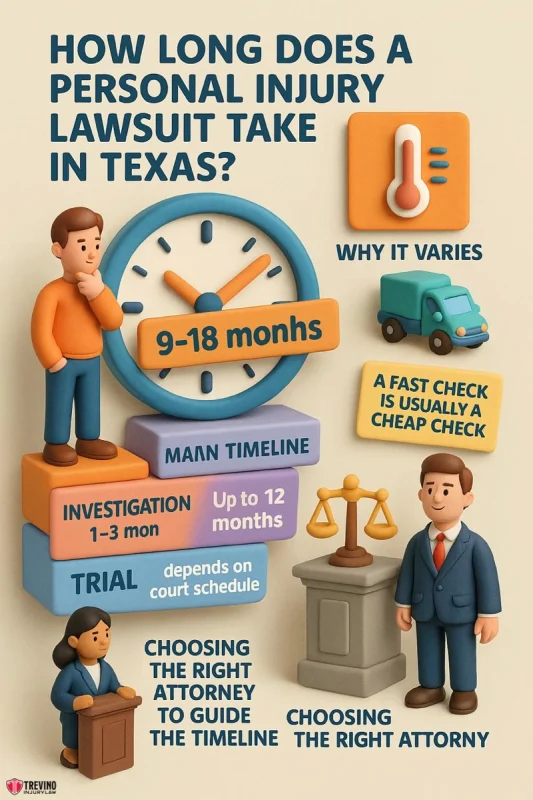
A personal injury lawsuit in Texas typically takes 8 to 14 months from filing to final verdict, though complex trucking cases involving multiple defendants may take significantly longer. The investigation phase alone can take 1 to 3 months, while discovery often consumes up to a year, depending on the court’s docket.
While we push to move cases efficiently, we never rush if it means sacrificing value; a “fast” check is almost always a “cheap” check.
Factors that influence this timeline include the severity of your injuries, as we often must wait for you to reach Maximum Medical Improvement (MMI) before calculating full damages.
Additionally, courts in San Antonio can be backlogged, and scheduling trials requires coordination between judges and attorneys. We keep you informed every step of the way, ensuring you understand whether we are in a holding pattern or actively fighting.
Understanding the timeline is essential, but the most critical factor in your success is choosing the right type of attorney to navigate it.
Why You Need a Trial Lawyer, Not Just a “Settlement” Attorney?
You need a trial lawyer because insurance companies track which attorneys actually take cases to court and offer significantly higher settlements to firms known for winning jury verdicts, whereas “settlement mill” lawyers are known to accept lowball offers just to close files quickly and move to the next client.
The threat of a public trial is the only leverage that truly forces a billion-dollar corporation to pay fair value for a catastrophic injury.
In San Antonio, you likely see billboards for high-volume firms every day along I-10 and Loop 410, promising fast checks. These “settlement mills” operate on volume, often assigning your case to a paralegal and pressuring you to settle before you even file a lawsuit.
At Trevino Injury Law, we take the opposite approach: we prepare every case for litigation from Day 1 because we know a willingness to fight maximizes your recovery. While a trial-ready attorney provides the leverage your case needs, understanding the risks of navigating the legal system alone shows why professional representation is non-negotiable.
What Costs Are Associated with Filing a Lawsuit With A Personal Injury Lawyer?
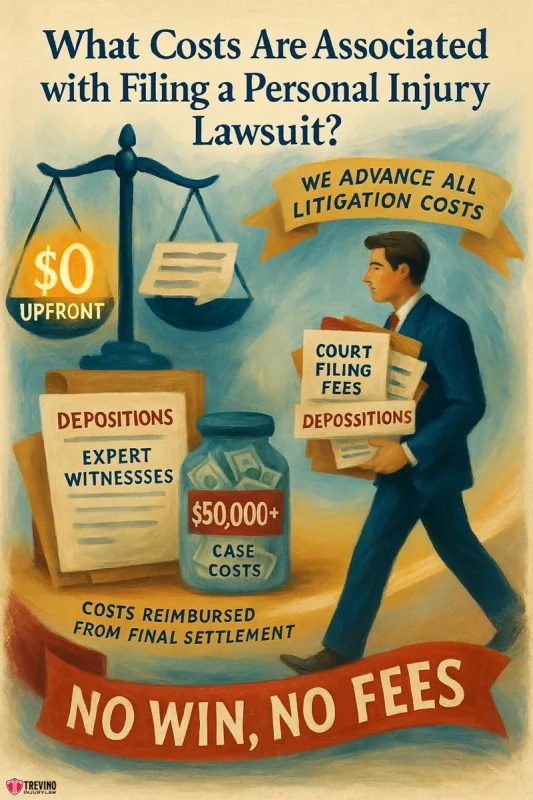
You pay absolutely no upfront costs to file a personal injury lawsuit because reputable trial firms operate on a contingency fee basis, meaning we advance all court filing fees, deposition costs, and expert witness payments, and we only get reimbursed if we win your case.
In complex litigation involving commercial defendants, these expenses can easily exceed $50,000 for accident reconstructionists and medical experts, a financial burden that no injury victim should have to bear alone.
Litigation expenses are distinct from attorney fees; they cover the costs of the lawsuit itself. For a case filed in Bexar County, this includes fees paid to the District Clerk, payments to court reporters for deposition transcripts, and fees for serving subpoenas on witnesses in places such as Leon Valley or Universal City.
We front every penny of these costs to ensure your case is built on professional evidence, not budget constraints.
Do I pay any legal fees if we lose?
No, you owe zero attorney fees and are not responsible for repaying case expenses if we do not secure a financial recovery for you.
Our firm handles every personal injury claim process on a contingency basis, meaning you owe nothing unless your case reaches a successful settlement or jury verdict. Throughout the lawsuit process, our experienced attorneys cover every filing fee, expert cost, and pre-trial expense so you can focus on recovery, not financial risk.
If we cannot reach a settlement, your lawyer will continue fighting to take the case to trial and pursue the justice you deserve.
Are case expenses deducted from my final settlement?
Yes, the law firm is reimbursed for all case expenses advanced from the final gross settlement amount or jury award before the net funds are distributed to you.
After your case goes to trial or reaches a settlement, all advanced costs from the pre-trial process, such as filing fees, expert testimony, and discovery expenses, are reimbursed directly from the gross award. This ensures every detail of your case is fully supported, with no upfront payment required.
Your attorney will file and manage these expenses on your behalf, guiding you through each phase of the lawsuit process so you can focus on recovery while an experienced injury attorney is on your side.
Settlement Negotiation vs. Jury Verdict: Key Differences
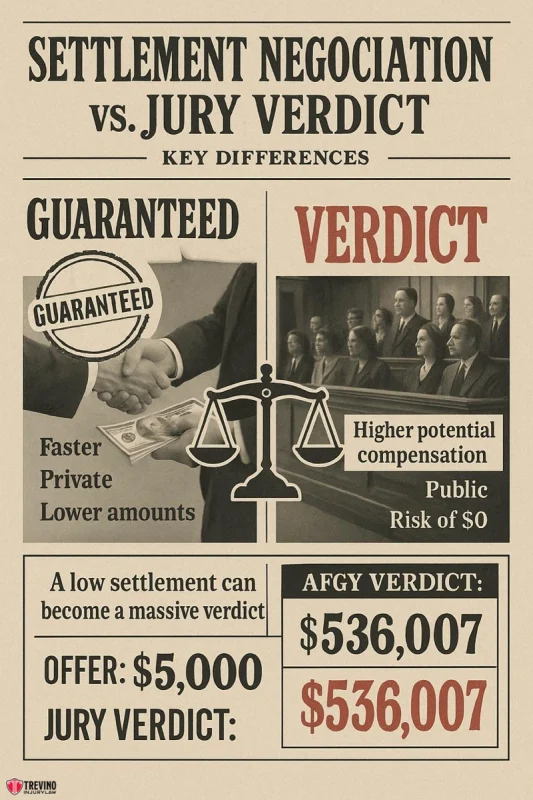
A settlement provides a guaranteed payout agreed upon by both parties without the uncertainty of a trial. In contrast, a jury verdict offers the potential for a much higher financial award but carries the risk of receiving nothing if the jury rules for the defendant.
The choice between settling and fighting is strategic; we weigh the certainty of the offer against the likely court outcome based on the evidence we have gathered.
While settlements are faster and private, verdicts often result in significantly larger compensation because they are not capped by what an adjuster thinks you deserve.
For example, in Jose Simon Arriaga Jr. v. Emily Montemayor, the insurer offered a “final” settlement of $5,000. Still, because we pushed for a verdict, the jury awarded $536,007—over 100 times the settlement offer. This demonstrates that while trials carry risk, they are often the only way to secure the actual value of a life-altering injury.
When an at-fault party refuses to pay what they owe, our legal process ensures justice is served. Reach a fair settlement or take your lawsuit to court with a trusted San Antonio personal injury law team on your side.
What Happens If I Don’t Hire a Lawyer for the Litigation Process?
If you attempt to litigate a personal injury claim without an attorney, defense lawyers will likely have your case dismissed on procedural grounds because the court holds you to the same strict rules of evidence and civil procedure as a licensed professional.
“Pro se” litigants (those representing themselves) are often viewed as easy targets by insurance defense teams, who will use technicalities to block your evidence and strike your pleadings.
Without a lawyer, you may not know how to respond appropriately to discovery requests or defend yourself during a deposition. Defense attorneys will ask trapping questions designed to make you admit fault, effectively destroying your claim before it ever reaches a jury.
In the high-stakes arena of the Bexar County Courthouse, facing a corporate legal team without your own counsel is virtually a guarantee of failure.
What If I Miss the Statute of Limitations Deadline?
If you miss the two-year statute of limitations deadline for filing your personal injury lawsuit in Texas, you permanently lose your legal right to sue the negligent party, and the court will automatically dismiss your case regardless of how severe your injuries are.
This strict time limit generally begins running on the day of the accident. Once it expires, no judge can reopen your case, leaving you solely responsible for all your medical bills and financial losses.
Exceptions to this rule are infrequent and difficult to prove. For victims in San Antonio, waiting to see if an injury “gets better” is a dangerous strategy that often leads to expired rights.
The only way to stop this clock is to file a formal petition, which is why contacting a firm immediately, essentially after a crash on Bandera Road or I-35, is critical to preserving your future.
Why Hire a San Antonio Personal Injury Attorney?
Waiting to see if injuries improve after a crash on Bandera Road only helps insurance adjusters hoping your statute of limitations expires. While they stall and settlement mills look for quick exits, we prepare for war.
Want to Protect the Full Value of Your Claim?
You’ve seen how this affects your case — but this is only one piece of the puzzle. Our Personal Injury Lawyer page breaks down what a trial-ready firm does differently.
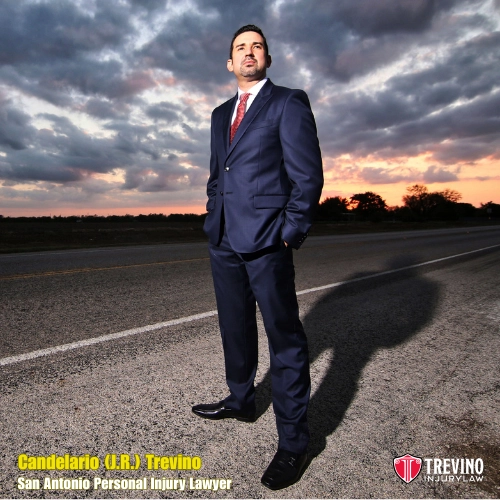
We don’t just file claims; we force negligent parties to pay what they owe. We turned a $5,000 lowball offer into a $536,007 jury verdict by fighting at the Bexar County Courthouse. You need a San Antonio personal injury attorney who will immediately file spoliation letters to preserve black box data before it’s destroyed
Call 210-TREVINO for a free case review. Se Habla Español. We operate on a strict No-Win, No-Fee basis.