
You stop a corporate defense team from erasing the truth by immediately serving a Spoliation Letter, a legal demand that stops the trucking company from destroying evidence. The unalterable digital footprint of the collision, including steering angles, throttle percentages, and brake applications, begins vanishing the moment the tires stop smoking.
Corporate rapid response teams are already deploying to the I-35 crash site to sanitize the scene, seize the Event Data Recorder, and overwrite the driver’s hours-of-service logs before you leave the emergency room. According to TxDOT, Bexar County recorded 18 fatal commercial motor vehicle crashes in 2024. Behind the preliminary police report in those collisions is a fleet manager trying to erase proof of severe fatigue and failed braking attempts.
What Could Your Commercial Vehicle Accident Case Be Worth?
Answer a few quick questions about your accident. Takes about 60 seconds.
See What My Case Might Be WorthThe insurance company offered less than $20,000. I ended up with over $1 million. — Jackie Galindo
You must legally force the preservation of the tractor cab, trailer, and black box data before the mandatory federal data retention period expires. Once that clock runs out, the carrier can legally purge the electronic logs, eliminating your ability to prove negligence.
Trevino Injury Law, our truck accident lawyers, issue these injunctions immediately to lock down the truth. Call 210-TREVINO now for a free case review. You pay nothing unless we win. Se Habla Español.
What Legal Steps Legally Force Trucking Companies to Preserve Crash Data?
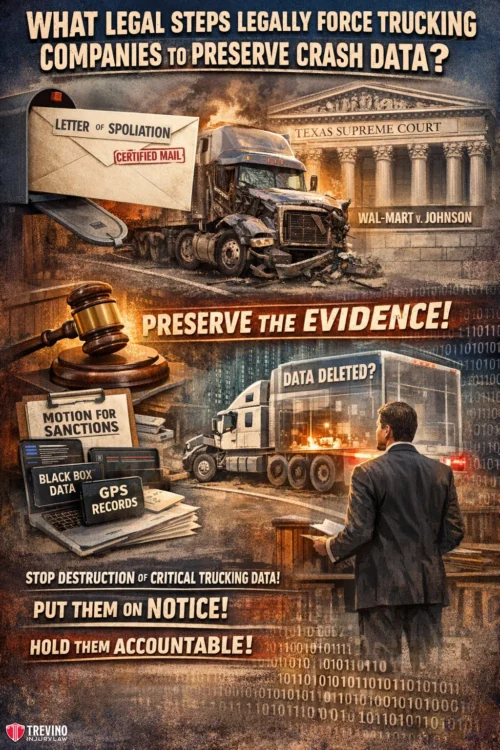
You stop a Negligent Trucking Company from destroying evidence by immediately having your trial lawyer send a formal Letter of Spoliation via certified mail. Under Texas law, a party has a legal duty to reasonably preserve evidence the moment they know, or reasonably should know, there is a substantial chance of a claim.
This foundational standard was affirmed in the landmark Texas Supreme Court case Wal-Mart Stores, Inc. v. Johnson. By putting the corporate defendant on official notice, we create a legally binding obligation to halt all routine data-deletion protocols and secure the vital digital records needed to prove liability.
Unlike standard passenger car collisions, where evidence is largely physical, commercial crashes rely heavily on transient digital footprints.
If a negligent trucking company destroys this data, a San Antonio 18-wheeler crash attorney can file motions in the Bexar County District Court to seek sanctions against the corporation.
This legal maneuver places the defendant on notice that any “accidental” erasure of logs or maintenance records will be treated as an intentional act to hide their driver’s negligence. Understanding this timeline leads to the question of what to include in these demands.
What Information Must a Formal Letter of Spoliation Contain?
A valid spoliation letter must explicitly demand the preservation of the tractor cab, trailer, Electronic Logging Devices, Event Data Recorders, and the driver’s qualification file to prevent the loss of critical liability proof. To make the demand enforceable under Texas law, the letter must clearly outline specific elements:
- The exact date, time, and location of the crash.
- Identification of the specific commercial vehicles involved.
- A comprehensive list of all electronic and physical data required.
- A demand to preserve the driver’s employment and toxicology records.
- Explicit warnings regarding the legal penalties for non-compliance.
This comprehensive demand is necessary to counter corporate tactics utilized immediately after a collision.
How Fast Do Corporate Rapid Response Teams Alter Crash Evidence?
In the immediate aftermath of a truck crash, trucking companies and their insurers dispatch rapid-response teams to the scene. By arriving quickly at dangerous intersections like the Mixing Bowl, they aim to control the narrative before the injured victim can secure legal representation. While you are still receiving emergency care, these teams of lawyers, private investigators, and adjusters are already collecting evidence and building a defense strategy to minimize the value of your claim.
Evidence preservation is one part of the immediate response to a commercial crash. For the broader sequence covering scene safety, carrier identification, medical care, and communications, review the immediate commercial vehicle accident steps in San Antonio.
These corporate defense teams know that crucial evidence can disappear quickly if left unsecured. Because transient digital evidence can be lost or overwritten within hours or days, taking immediate legal action is critical to prevent its destruction. An experienced truck accident lawyer knows you must secure specific proof that the truck driver’s negligence caused the wreck, including:
- Dashcam video footage
- Black box (Event Data Recorder) data
- Electronic Logging Devices (ELD) track hours of service
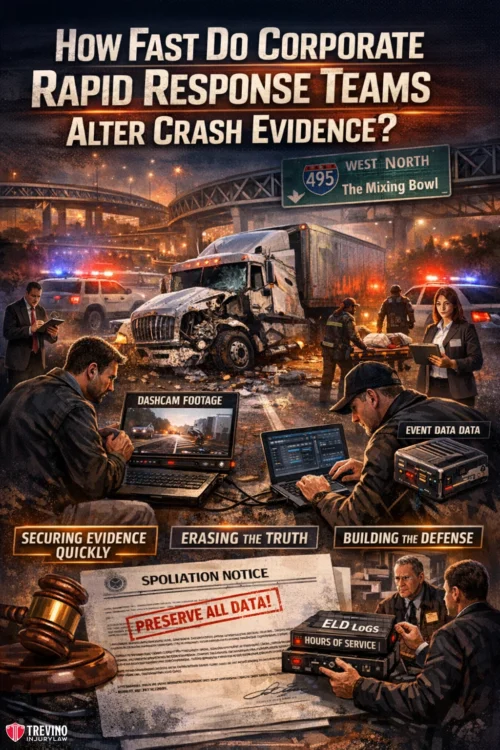
Protecting this data requires sending a spoliation letter immediately. A spoliation letter is a formal legal notice demanding that the trucking company halt all routine data-deletion protocols and preserve the evidence. While federal law requires trucking companies to maintain certain broad records, a targeted spoliation letter creates a specific, undeniable obligation for the trucking company regarding your crash.
Once sent to the trucking company, this letter secures the key evidence that could definitively prove what caused the crash. Taking this step achieves several critical legal advantages:
- Establishes a Strict Duty: It imposes a strict legal obligation on the trucking company to retain all evidence related to the driver and the company.
- Triggers Court Penalties: If the company knew about your injury claim but intentionally destroyed the evidence after receiving a spoliation notice, an experienced truck accident attorney can file motions to seek severe sanctions from the court.
- Enables Emergency Action: In extreme situations, your legal team can use this foundation to file a temporary restraining order to lock down the evidence needed for trial.
Ultimately, you must prove the truck driver’s fault to maximize your compensation. To do that, you need an experienced truck accident trial firm to secure the evidence in a truck accident claim before the insurance company erases the truth.
Which Specific Electronic Evidence Proves Driver Negligence in Court?
Electronic Logging Devices and Event Data Recorders are the primary digital evidence showing that a commercial driver was speeding, braking improperly, or driving while fatigued beyond federal limits, establishing liability. Over the past decade, the commercial trucking industry shifted from easily falsifiable paper logbooks to mandatory digital tracking systems.
While the initial commercial vehicle accident report codes generated by the responding San Antonio Police Department officer indicate only preliminary fault at the scene, securing the underlying digital metrics is mandatory to prevail in court. The stakes in these cases are catastrophic.
According to TxDOT, Bexar County saw 18 fatal CMV crashes and 34 suspected serious CMV crashes in 2024. When a family is facing a wrongful death or a life-altering spinal injury from one of these severe collisions, the initial police report is rarely enough. These digital footprints provide an objective reality that a biased truck driver’s testimony can’t alter, helping us prove liability.
These digital footprints provide an objective reality that a biased truck driver’s testimony cannot alter. The most critical component of this digital footprint is the ELD tracking system.
How Do Electronic Logging Devices (ELD) Expose Driver Fatigue?
Electronic Logging Devices expose fatigue by tracking exact engine run times, revealing when a company forces a driver to violate the mandatory 14-hour workday or 11-hour driving limit. The Federal Motor Carrier Safety Administration (FMCSA) requires these devices to sync directly with the commercial vehicle’s engine, recording driving time automatically to prevent manual tampering.
When a commercial vehicle collision occurs on Loop 1604, analyzing the Hours of Service tracking often reveals a direct correlation between illegal overtime driving and slowed reaction times. While the ELD tracks the hours leading up to the crash, another device tracks the final seconds before impact. To go deeper on the fatigue side of that evidence, review how ELD records can prove truck-driver fatigue in Texas, including duty-status data, GPS cross-checks, and hours-of-service analysis.
What Does the Event Data Recorder (Black Box) Reveal?
The commercial black box provides an unalterable record of the vehicle’s speed, brake application, throttle percentage, and steering angle in the critical five seconds before impact.
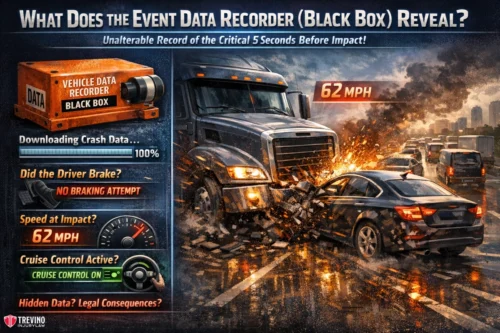
This highly technical crash data overrides conflicting witness testimony by showing exactly what the driver was doing prior to the collision. A download of this data will confirm:
- Whether the truck driver ever attempted to apply the brakes.
- The exact speed of the 18-wheeler at the moment of collision.
- Whether cruise control was active in heavy traffic conditions.
Because this data is so damning, companies may attempt to hide it, raising questions about legal consequences.
What Happens When a Business Destroys Evidence After a Commercial Crash?
When a business intentionally destroys evidence after receiving a preservation notice, Texas courts can impose severe sanctions, including instructing the jury to assume the destroyed evidence would have proven the company’s negligence. This legal doctrine, known as spoliation of evidence, punishes bad actors and helps ensure a fair trial for the injured plaintiff.
If a commercial carrier overwrites its driver’s logs or crushes a damaged cab before an inspection, a semi-truck collision law firm will immediately petition the court for remedies. State precedent strictly defines this penalty and requires specific legal thresholds to be met.
How Do Texas Courts Sanction Intentional Evidence Spoliation?
Under the standard set by Brookshire Bros., Ltd. v. Aldridge, a judge will grant an adverse inference instruction only if we prove the trucking company intentionally destroyed the data to conceal its liability.
An adverse inference instruction is a devastating penalty in which the judge legally orders the jury to assume that the missing ‘black box’ data contained information highly damaging to the trucking company’s defense. However, securing this remedy requires overcoming a strict legal threshold.
In the landmark case Brookshire Bros., Ltd. v. Aldridge, 438 S.W.3d 9 (Tex. 2014), the Texas Supreme Court ruled that a judge will grant this severe sanction only if we prove the corporate defendant intentionally destroyed the data to conceal its liability, or if their negligence in losing the data caused extraordinary prejudice to your claim. We know their playbook, and we aggressively use this precedent to punish bad actors in court.
This effectively shifts the burden and heavily biases the trial in favor of the injured party. While civil courts impose financial penalties, many wonder about the offenders’ criminal liability.
Is Destroying Truck Accident Evidence a Criminal Offense?
While tampering with physical evidence can technically be a criminal offense under Texas Penal Code 37.09, civil litigation focuses exclusively on using the destruction to maximize your financial compensation, not securing jail time for fleet managers. District attorneys rarely prosecute corporate managers for deleted computer files following a crash.
Therefore, a trial attorney’s objective is to weaponize the system’s inherent destruction to force a higher settlement payout. Leveraging these civil penalties ultimately centers on one goal when negotiating with these massive commercial insurers.
What FMCSA Rules Govern Commercial Evidence Retention?
The Federal Motor Carrier Safety Administration (FMCSA) mandates that motor caMotor carriers retain driver logs for at least 6 months and vehicle maintenance records for at least 1 year to ensure compliance with safety requirements. These federal regulations dictate the minimum legal retention period for critical documents before they may be destroyed. An 18-wheeler crash attorney uses these exact statutes to force compliance during the discovery phase. The specific retention periods include:
Driver Record of Duty Status (Logbooks): Must be retained for exactly six months from the date of creation.
Vehicle Inspection Reports: Must be retained for at least 90 days.
Annual Vehicle Maintenance Records: Must be kept for 14 months to track long-term fleet health.
These strict timelines raise common legal questions about liability and proof.
Can You Sue a Trucking Company Just for Destroying Evidence?
No, Texas prohibits suing solely for spoliation; instead, you must use the destroyed evidence as a penalty tool within your primary personal injury lawsuit.
Do Driver Logbooks Always Prove Fatigue in Court?
No, driver logbooks cannot automatically prove fatigue because negligent companies frequently falsify these records, requiring cross-referencing with fuel receipts, GPS data, and toll tag timestamps.
How Does Evidence Preservation Differ for Delivery Vans vs. 18-Wheelers?
While 18-wheelers are governed by strict FMCSA retention rules, last-mile delivery vans often lack electronic logging devices, requiring us to subpoena proprietary routing software and dispatch communications to prove driver pressure. The explosion of e-commerce has flooded neighborhoods like Alamo Heights with commercial delivery vehicles from companies like Amazon, FedEx, and UPS.
These drivers are not always subject to traditional federal hours-of-service logs but are instead pushed to dangerous speeds by algorithm-based delivery quotas. Therefore, a semi-truck collision law firm must adapt its spoliation letters to target handheld-scanner metrics, telematics, and internal dispatch texts rather than traditional black-box data. Regardless of the vehicle type, timing is the ultimate factor.
What If the Black Box Data Was Already Erased Before You Hired a Lawyer?
While 18-wheelers are governed by strict FMCSA retention rules, last-mile delivery vans often lack electronic logging devices, requiring us to subpoena proprietary routing software and dispatch communications to prove driver pressure. The explosion of e-commerce has flooded neighborhoods like Alamo Heights with commercial delivery vehicles from companies like Amazon, FedEx, and UPS.
These drivers are not always subject to traditional federal hours-of-service logs but are instead pushed to dangerous speeds by algorithm-based delivery quotas. Therefore, a semi-truck collision law firm must adapt its spoliation letters to target handheld-scanner metrics, telematics, and internal dispatch texts rather than traditional black-box data. Regardless of the vehicle type, timing is the ultimate factor.
How Does Preserved Evidence Increase Your Final Settlement Value?
Preserved electronic evidence increases your final settlement value by completely removing the insurance adjuster’s ability to dispute liability, forcing them to negotiate based solely on the severity of your injuries rather than debating who caused the catastrophic crash on Culebra Road.
Once we lock down the black box and dashcam footage, the legal narrative shifts entirely. Without this objective digital data, corporate defense lawyers will routinely try to blame the victim, arguing they braked too suddenly or drifted into the 18-wheeler’s lane.
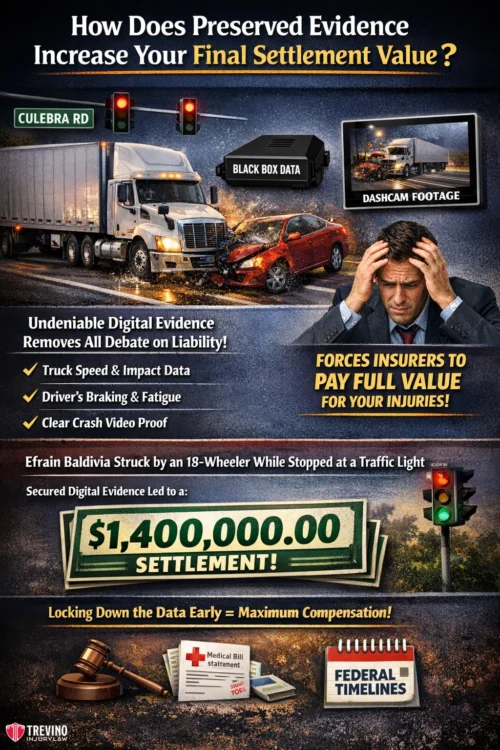
However, when a commercial vehicle accident lawyer presents unalterable proof of the truck driver’s speeding, braking failures, or fatigue, the defense’s strategy instantly collapses. This aggressive approach forces insurance companies to evaluate the real cost of your medical bills and life care plans.
For example, in the case of Efrain Baldivia, who was struck by an 18-wheeler while stopped at a traffic light, securing clear evidence led the carrier to cave before trial, resulting in a $1,400,000.00 settlement. To lock down this data, we must navigate specific federal timelines.
When Are Trucking Companies Legally Allowed to Purge Crash Logs?
Trucking companies may legally overwrite electronic data and destroy paper logs the moment the mandatory six-month FMCSA retention period expires, provided no litigation or Letter of Spoliation is pending.
This is why time is the enemy of every commercial injury claim. If you wait seven months to contact a lawyer, the corporate entity has every legal right to sanitize its records. The moment the clock strikes midnight on that deadline, the data proving they overworked their driver vanishes forever, legally erasing their digital footprint.
Why Hire a San Antonio Truck Accident Lawyer?
Corporate teams sanitize I-35 crash scenes, destroying evidence before victims leave the hospital. You must secure a trial lawyer to demand fair compensation. While settlement mills fold, Trevino Injury Law aggressively litigates against negligent trucking companies and insurance adjusters. We fight for families and force them to pay.
Want to Protect the Full Value of Your Claim?
You’ve seen how this affects your case — but this is only one piece of the puzzle. Our Commercial Accident Lawyer page breaks down what a trial-ready firm does differently.
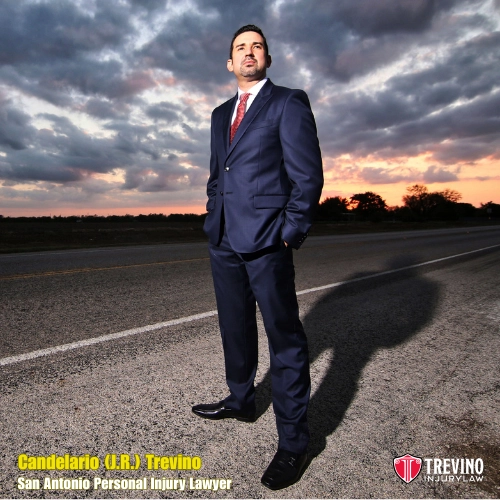
We enforce your rights in the Bexar County District Court by issuing a Spoliation Letter to lock down black box data. Hiring a personal injury attorney who tries cases quickly can collapse the defense’s strategy. We have secured catastrophic victories, including a $17 Million settlement.
Call 210-TREVINO for a free case review. Se Habla Español. No Win, No Fee.