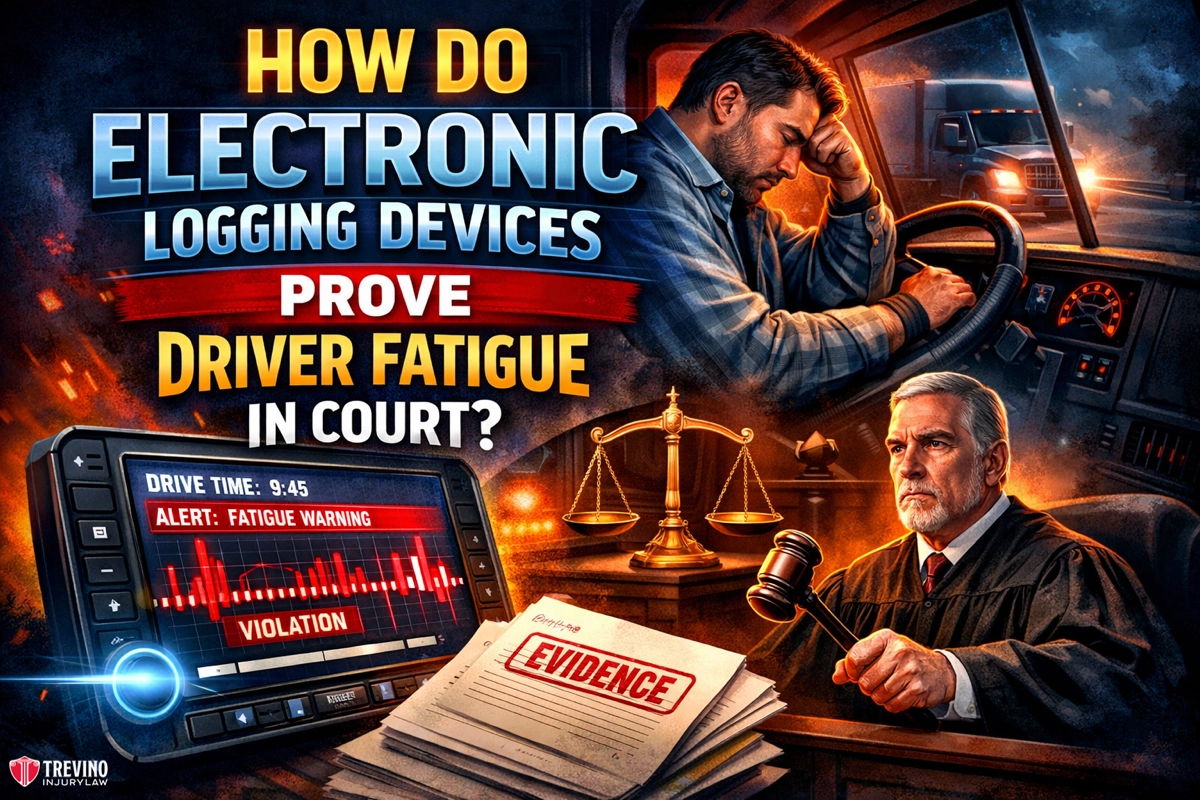
Electronic Logging Devices detect driver fatigue by cross-referencing a commercial truck’s engine power status and satellite GPS data with the operator’s claimed off-duty hours. The exact moment those digital timelines clash, the corporate deception becomes an undeniable, objective fact.
A Negligent Trucking Company is already deploying rapid-response teams to your crash site to sanitize their financial liability. They conceal dangerous hours-of-service violations by actively reclassifying illegal, exhausted highway driving as administrative yard moves to protect their delivery margins.
What Could Your Commercial Vehicle Accident Case Be Worth?
Answer a few quick questions about your accident. Takes about 60 seconds.
See What My Case Might Be WorthThe insurance company offered less than $20,000. I ended up with over $1 million. — Jackie Galindo
Bexar County recorded 2,684 commercial motor vehicle crashes in 2024. Behind the most catastrophic impacts is a corporate dispatcher who forced an untreated, physically exhausted driver to ignore strict federal safety limits and keep the freight moving. That is not an unpredictable tragedy. That is intentional corporate negligence.
That digital footprint vanishes rapidly. A Spoliation Letter, a legal demand that stops the trucking company from destroying evidence, must be formally served before the defense permanently erases the vehicle’s critical black box data.
Trevino Injury Law, our truck accident lawyers subpoena these hidden electronic logs, expose the logbook falsification, and force the insurer to pay. Call 210-TREVINO now for a free case review. You pay nothing unless we win. Se Habla Español.
How Do Electronic Logging Devices Work to Track Commercial Driver Hours?
Electronic Logging Devices automatically record driving time, engine hours, vehicle movement, and miles driven to ensure commercial drivers comply with federal safety regulations and avoid dangerous exhaustion.
Synchronization between the vehicle’s engine and the digital log creates an undeniable record of a driver’s activity before a collision in Bexar County. With the county experiencing a staggering 2,684 total commercial motor vehicle crashes in 2024 alone, this objective digital timeline is critical. When a crash occurs, we use this data to aggressively dismantle the defense’s narrative and prove the exact hours of operation.
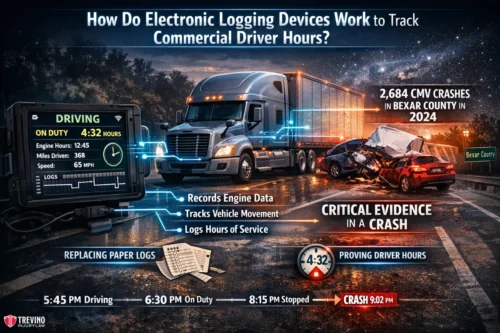
Understanding what an ELD stands for- an Electronic Logging Device- is crucial because these systems replaced easily falsified paper logs to provide an objective timeline of a crash in South Texas.
Which Three Pieces of Information Are Required for an Electronic Logging Device?
Federal regulations require every compliant ELD to automatically record the vehicle’s engine power status, motion status, and total miles driven during the operational shift. Plaintiff trial lawyers utilize these specific data points to cross-reference a driver’s claimed rest periods against actual vehicle movement.
- The engine power status indicates exactly when the truck was turned on or off.
- Vehicle motion status confirms whether the commercial vehicle was actively traveling.
- Total miles driven provides a measurable distance that must align with the permitted driving window.
What Are the FMCSA Hours of Service Limits for Truck Drivers?
The Federal Motor Carrier Safety Administration (FMCSA) restricts property-carrying commercial drivers to a maximum of 11 cumulative hours of driving after 10 consecutive hours off duty. Drivers must also complete their driving within a 14-hour window and adhere to a mandatory 30-minute break rule. Violating these strict limits on long-haul routes through the Eagle Ford Shale creates a severe risk to public safety.
Breaching these federal tracking limits directly results in physical exhaustion, which can lead to catastrophic collisions, raising the question of which specific infractions provide a basis for a lawsuit.
What Specific ELD Violations Prove Driver Fatigue Caused a Crash?
Critical ELD violations that prove driver fatigue include exceeding the 11-hour driving limit, driving after the 14-hour on-duty window, and failing to take mandatory rest breaks, all of which are vital in establishing negligence. Under Texas law, as illustrated by landmark trucking cases like Werner Enterprises, Inc. v. Blake, 611 S.W.3d 600 (Tex. App.—Houston [14th Dist.] 2020), holding a Negligent Trucking Company directly liable requires proving that its drivers failed to exercise ordinary care. The driver qualification file can also direct the investigation toward the company’s hiring decisions. For the corporate-liability side of those records, see fleet-management-company negligent hiring liability in Texas.
When a catastrophic collision involves a commercial truck, the trucking industry relies on corporate defense teams to minimize liability. As your San Antonio accident attorney, we immediately use electronic tracking data to build a strong case. We analyze the driver’s hours-of-service and formal duty-status records to determine whether the driver was pushed beyond safe driving hours.
If the electronic record of duty status indicates the driver exceeded these limits leading up to the crash (or the time of the accident), it provides undeniable evidence of negligence.
This makes documented hours-of-service violations crucial to shift leverage away from the defense and place fault squarely on the corporate defendant. Juries respond strongly to documented safety breaches because these regulatory violations are directly tied to physiological realities.
How We Uncover Logbook Falsification
Because fatigue is a serious threat, we uncover whether a driver violated the federal mandates designed to prevent fatigue to strengthen your truck accident case. We use deep forensic analysis of electronic system data to determine whether the driver was actually exhausted, even when trucking companies argue the driver was working legally.
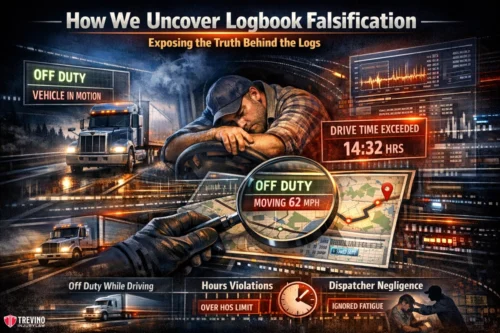
We cross-reference electronic records with GPS and event data to determine if the driver was falsifying their driver logs by looking for specific discrepancies:
- Logging off-duty while the vehicle is in motion.
- Showing the driver was operating the vehicle past the strict HOS limit.
- Identifying patterns that may suggest corporate dispatchers intentionally ignored fatigue.
Using Digital Evidence to Force Maximum Compensation
These digital footprints help prove exactly who is responsible for the accident. In the event of an accident, a plaintiff trial lawyer uses this evidence in court alongside accident reconstruction to force the defense to pay for your medical bills and lifelong damages.
We aggressively secure the following before they are legally erased by the defense:
- The driver qualification file.
- All raw electronic data and black box systems.
- Proof that the driver exceeded the standard of ordinary care.
This precise data shows that the truck driver and their employer prioritized profits over public safety. We use this evidence to litigate to a verdict.
The five most common causes of fatigue-related trucking crashes are illegal scheduling pressures, untreated sleep apnea, night driving disruptions, prescription medication side effects, and sustained monotony on highways.
Fleet management companies implicitly encourage these behaviors to maximize delivery profits, creating a deadly environment on corridors like Loop 1604. The human cost of this corporate negligence is severe. In 2024, Bexar County recorded 18 fatal commercial vehicle crashes and 34 suspected serious crashes.
By forcing drivers to prioritize strict deadlines over necessary rest, these companies trade public safety for higher margins. We litigate to a verdict to hold them fully accountable for the resulting destruction.
- Illegal scheduling pressures force drivers to prioritize deadlines over rest.
- Untreated sleep apnea prevents restful recovery during off-duty hours.
- Night driving disrupts natural circadian rhythms.
- Prescription medication side effects can induce severe drowsiness behind the wheel.
- Sustained monotony on highways can lead to highway hypnosis and slower reaction times.
How Does Driver Exhaustion Compare to Intoxication on Texas Highways?
Medical studies demonstrate that remaining awake for 18 consecutive hours impairs a commercial truck driver’s reaction time, judgment, and visual awareness to the same degree as a blood alcohol concentration of 0.05 percent. This severe cognitive degradation is why proving fatigue through ELD data is treated with the same severity as a drunk driving crash by plaintiff trial lawyers.
Because liability from these severe fatigue-related impairments is so massive, negligent trucking companies aggressively try to manipulate records.
Can Trucking Companies Alter or Fake Electronic Logbook Data?
While modern ELDs are designed to be tamper-resistant, trucking companies still alter data by logging driving time as off-duty “yard moves” or using administrative edits to hide hours-of-service violations. Dispatchers frequently pressure drivers to manipulate status categories to sanitize their digital footprint and keep trucks moving.
Trevino Injury Law possesses the technical expertise to audit these logs and uncover hidden edits that generalist attorneys might miss. Uncovering these manipulations requires deep forensic analysis across multiple data streams to find the truth.
How Do Discrepancies Between ELDs and GPS Prove Logbook Falsification?
Trial attorneys prove logbook falsification by cross-referencing the ELD’s reported off-duty status with toll booth receipts, fuel station timestamps, and satellite GPS tracking showing the vehicle was actively moving.
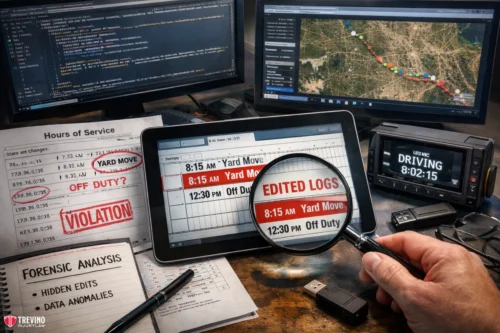
Building an undeniable forensic timeline is crucial to proving intentional falsification and increasing the case’s value. This deception opens the door to punitive damages against the fleet management company, making it absolutely essential to secure the black box data.
Uncovering this intentional deception is vital to calculating the true financial value of your claim, so immediately obtaining digital evidence is paramount to your settlement.
Securing maximum compensation for a fatigue-related commercial crash requires the immediate legal acquisition of the vehicle’s electronic logging device, the engine’s black box data, corporate dispatch communications, and the driver’s qualification file before the negligent trucking company can legally destroy them. Uncovering the technical mechanics of driver fatigue is only the first step in building a winning personal injury lawsuit.
Because corporate rapid response teams are dispatched immediately, the injured victim must hire an aggressive trial lawyer to force the defense to hand over this critical data. We use this exact evidence to expose corporate safety failures, a strategy that helped our firm secure a $17 Million Settlement in an 18-wheeler wrongful death case.
By relentlessly pursuing these corporate defendants and refusing to back down from their aggressive defense tactics, we turn digital records into maximum financial recovery.
Securing this compensation depends entirely on taking immediate legal action before the data is erased. Preserving those records is one part of the broader response after a commercial collision. For the sequence covering scene documentation, medical care, insurance communications, and evidence preservation, see the steps to take after a commercial vehicle accident in San Antonio.
How Do You Legally Force a Trucking Company to Preserve ELD Data?
You legally force a trucking company to preserve electronic logbook data by having your San Antonio personal injury lawyer immediately draft and serve a formal Letter of Spoliation to the corporate defendants, preventing the intentional destruction of the vehicle’s black box systems. This legally binding demand halts the “routine” deletion of commercial records. Under federal regulations, fleet operators are only required to retain these critical digital files for six months.
If an injured victim recovering at Brooke Army Medical Center (BAMC) waits to hire a trial-ready law firm, the definitive proof of driver fatigue is legally erased and permanently lost. We act decisively to lock down this information in the crucial first week. Uncovering exactly how many hours the driver operated the vehicle before causing a wreck on Culebra Road forms the cornerstone of your lawsuit.
By intervening quickly, we secure the exact files needed to establish gross negligence and hold the defense accountable. Without this intervention, companies will exploit legal loopholes to avoid liability.
Can a Commercial Driver Legally Run a Route Without a Logbook?
No, commercial truck drivers cannot legally operate without logging hours, and driving a commercial motor vehicle without an active ELD constitutes a severe federal violation.
Does Falling Asleep at the Wheel Equal a DUI under Texas Law?
No, falling asleep at the wheel is not a DUI in Texas, but civil lawyers treat fatigue-induced crashes with equal severity when seeking damages.
How Do Trial Attorneys Use Logbook Evidence in Bexar County Courts?
Trial attorneys use audited logbook evidence in Bexar County courts to meticulously dismantle the defense’s narrative, definitively proving to juries that the negligent trucking corporation prioritized its delivery profits over public safety, thereby compelling insurance adjusters to offer maximum financial compensation. There is a massive difference between a high-volume settlement mill that accepts early, lowball offers and a trial authority that leverages hard digital facts.
When we present concrete, forensic ELD data to an insurance adjuster, it removes their ability to dispute fault. Because we meticulously prepare every case as if it is going to a jury against Trevino Injury Law, we use this evidence to aggressively combat the common tactic of blaming the injured victim.
Our reputation for using precise technical data to secure multi-million dollar verdicts makes our demands impossible to ignore. However, building this case becomes significantly harder if the evidence is compromised.
What Happens If the ELD Evidence Was Destroyed Before You Hired a Lawyer?
If the trucking company destroys the ELD evidence before you hire representation, your attorney can formally petition the court for a spoliation instruction. The Texas Supreme Court defined this powerful legal remedy in the landmark case Brookshire Bros., Ltd. v. Aldridge, 438 S.W.3d 9 (Tex. 2014), which grants trial courts broad discretion to impose severe sanctions on a corporate defendant for intentionally concealing or destroying discoverable evidence. Under this standard, the judge can direct the jury to assume the missing digital logs contained definitive proof of the driver’s negligence.
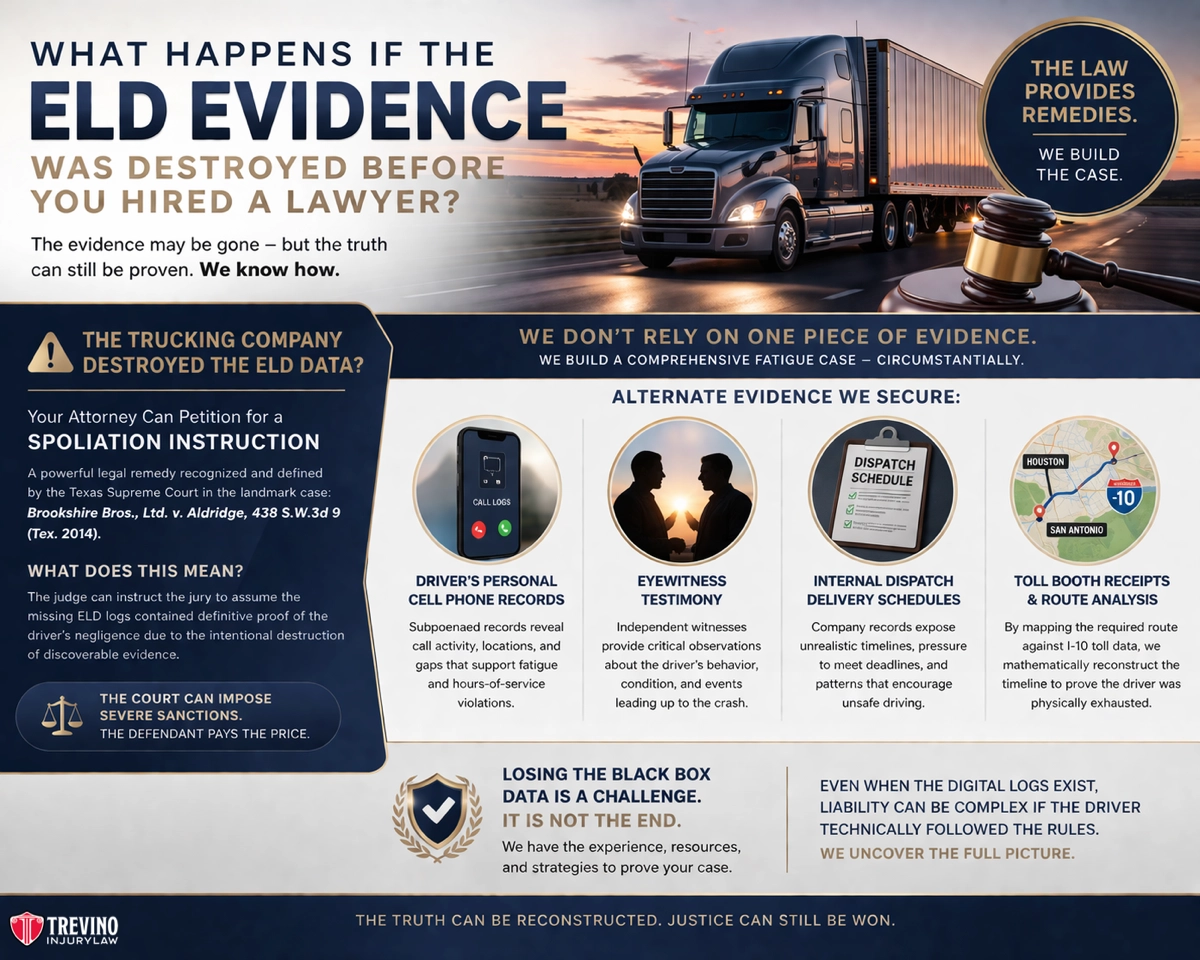
While losing the primary black box data presents a challenge, it does not destroy your personal injury claim. We aggressively build a fatigue case circumstantially by securing alternate evidence:
- Subpoenaing the driver’s personal cell phone records.
- Securing statements through eyewitness testimony.
- Analyzing the corporation’s internal dispatch delivery schedules.
By mapping the required route against toll booth receipts on I-10, we mathematically reconstruct the timeline to demonstrate that the driver was physically exhausted. Even when the digital logs exist, liability can be complex if the driver technically followed the rules.
What If the Truck Driver Was Fatigued But Not Technically Over FMCSA Limits?
Even if a commercial driver did not technically exceed federal hours-of-service limits, their employer can still be held financially liable for negligence if we can prove they intentionally dispatched a driver they knew was exhausted, ill, or physically incapable of safe operation. Compliance with FMCSA limits represents the absolute minimum safety standard, not a blanket defense against liability for a catastrophic crash.
A driver might be technically “legal” but severely fatigued due to underlying health issues or brutal turnaround times. We thoroughly investigate medical histories, looking for records of untreated sleep apnea, and audit internal dispatch communications.
If we discover that the trucking company ignored obvious warning signs of fatigue just to push a load through Downtown San Antonio, we will hold them fully accountable for the resulting destruction.
Why Hire a San Antonio Truck Accident Lawyer?
When fatigued drivers cause catastrophic collisions on I-35, Negligent Trucking Companies manipulate logs to hide their liability. You need a trial lawyer to secure fair financial compensation, not a settlement mill that avoids court. Trevino Injury Law litigates to a verdict. We fight for families and force insurers to pay.
Want to Protect the Full Value of Your Claim?
You’ve seen how this affects your case — but this is only one piece of the puzzle. Our Commercial Accident Lawyer page breaks down what a trial-ready firm does differently.
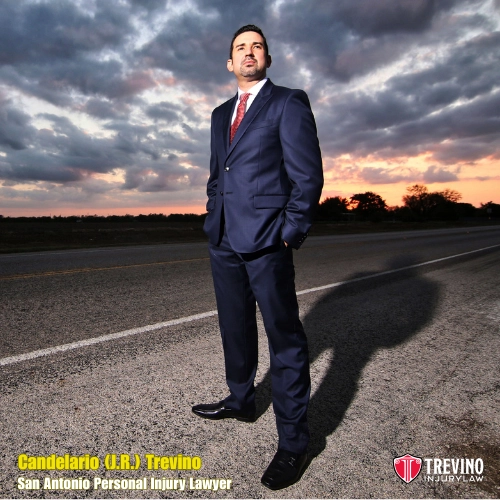
Leveraging 80+ jury trials in Bexar County, we immediately serve a Letter of Spoliation. Hiring a San Antonio personal injury lawyer who secures black box data is how we won a $17 Million Settlement in an 18-wheeler wrongful death case.
Call 210-TREVINO for a free case review. Se Habla Español. No win, no fee.