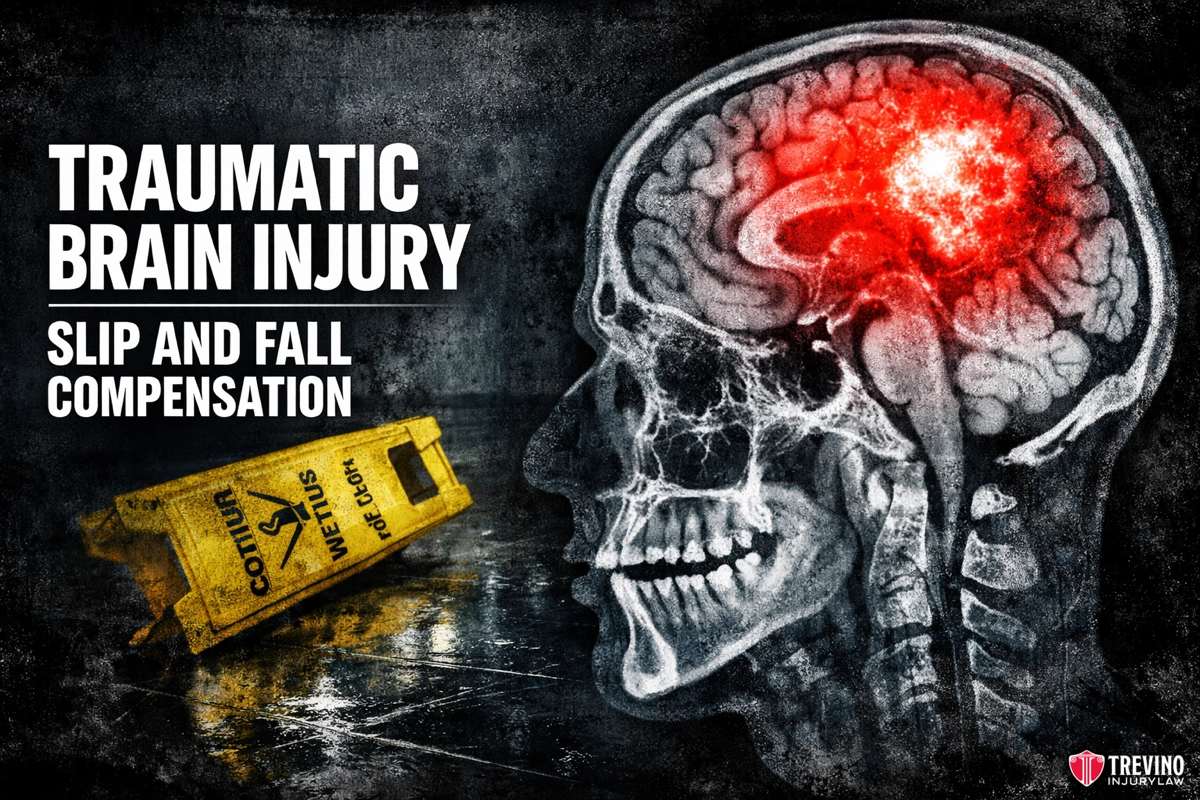
A Texas traumatic brain injury slip and fall claim is valued by calculating your lost earning capacity, future life care costs, and permanent loss of cognitive function. You face a lifetime of neurological deficits while the property owner responsible for the hazard denies liability.
The insurance adjuster is already trying to frame your brain trauma like one of the common slip and fall injuries in Texas, instead of the life-altering condition it really is.
They actively exploit the microscopic nature of your brain damage, using standard emergency room scans that appear normal to deny the severity of your cognitive decline. According to the Centers for Disease Control and Prevention, facilities reported approximately 214,110 TBI-related hospitalizations in 2020. Behind those admissions are victims fighting aggressive defense tactics designed to avoid paying for future life care plans.
What Could Your Slip and Fall Accident Case Be Worth?
Answer a few quick questions about your accident. Takes about 60 seconds.
See What My Case Might Be WorthThe insurance company offered less than $20,000. I ended up with over $1 million. — Jackie Galindo
Critical surveillance footage and maintenance logs vanish within days of a head impact. A Spoliation Letter, a legal demand that stops the property owner from destroying evidence, must go out immediately to protect your claim before Texas’s two-year filing deadline expires.
Trevino Injury Law slip-and-fall attorneys will secure objective neuropsychological testing on day one and lock down the evidence. Call 210-TREVINO now for a free case review. You pay nothing unless we win. Se Habla Español.
How Compensation is Calculated for Traumatic Brain Injuries in Texas
While there is no fixed “average” settlement for a brain injury, compensation in Bexar County is calculated in a TBI case based on three primary “severity multipliers” rather than just medical expenses. High-value verdicts, such as our $7.9 Million Mendoza verdict, are driven by proving these specific long-term costs:
- Severity of Cognitive Loss: Does the injury prevent you from returning to your previous high-focus career (e.g., cyber roles at Port San Antonio)? “Mild” TBIs that destroy careers and relationships are often valued higher than visible fractures.
- Future Life Care Costs: We calculate the “lifetime value” of the claim, which includes the cost of vocational rehabilitation, neuro-rehabilitation, and medication for the remainder of your life.
- Non-Economic “Loss of Self”: This covers physical and emotional suffering, personality changes (rage, depression, memory gaps), and the loss of enjoyment of life experienced by the family.

What Are Economic Damages in a TBI Case?
Economic damages in a TBI case are calculated by totaling past medical expenses and projecting future financial losses, with particular focus on the victim’s ability to work and the cost of future care.
Under Texas law, as defined in McIver v. Gloria, 140 Tex. 566, 169 S.W.2d 710 (1943), you are not limited to recovering only lost wages; you are entitled to compensation for your diminished capacity to earn a living in the future. This determination is left largely to the jury’s discretion, given the uncertainty of future health.
Workplace data support the reality of this disruption; recent statistics show that falls, slips, and trips accounted for 479,480 nonfatal occupational injuries, resulting in a median of 13 days away from work, even in non-catastrophic injury cases (BLS, 2024).
In San Antonio, this means demonstrating that a client can no longer perform in high-cognitive roles, such as cybersecurity positions at Port San Antonio or nursing positions at the South Texas Medical Center.
For moderate-to-severe cases, we also include a Life Care Plan that details the costs of neurorehabilitation, medications, and any required 24/7 home health care for the remainder of the victim’s life.
How Are Non-Economic Damages Calculated for Brain Injuries?
Non-economic damages cover the intangible human costs of a brain injury, specifically compensation for pain and suffering, “physical impairment,” and the “loss of self” that occurs when personality changes affect the victim’s identity.
We argue for Loss of Consortium to compensate the spouse and family unit for the physical and emotional damage to their relationships, a critical argument in San Antonio’s family-centric culture.
This right was solidified in Whittlesey v. Miller, 572 S.W.2d 665 (Tex. 1978), where the Texas Supreme Court first recognized that a spouse has an independent cause of action for the loss of affection, solace, and companionship resulting from a third party’s negligence.
These damages acknowledge that the injury stole not just money, but the person the TBI victim’s family used to know. Establishing who is liable lays the foundation for understanding the reasonable compensation you’re entitled to recover from each responsible party.
How to Prove Property Owner Negligence in a Slip and Fall TBI Case?
Proving negligence in a TBI case requires establishing that the property owner, whether a retail giant like North Star Mall or a local restaurant, had “actual or constructive knowledge” of the hazard that caused the head trauma and failed to address it.
These incidents are far from rare or minor; in 2022 alone, Texas recorded 1,617 fatal falls, representing a significant rise in premises liability dangers (Texas DSHS, 2024). We must link the specific “mechanism of injury,” such as a posterior fall on slick polished concrete, directly to the brain trauma to defeat the common defense that the victim was simply clumsy.

State data highlights the prevalence of this specific danger, noting that nearly 30% of fatal falls involved slipping, tripping, or stumbling on the same level without striking an object (Texas DSHS, 2024). This legal proof transforms a medical diagnosis into a compensable personal injury claim against the property owner’s insurance policy.
What Is Diffuse Axonal Injury (DAI)?
Diffuse Axonal Injury (DAI) is a type of injury in which the brain rapidly shifts within the skull during a fall, causing microscopic shearing (tearing) of the nerve fibers that connect brain cells.
Unlike a focal injury (such as a bruise), DAI is a widespread disruption of the brain’s communication network. This damage occurs at the cellular level, disrupting the “wiring” that controls processing speed and emotion. Traumatic brain injuries often require specialized imaging to detect this damage.
Why Do Insurance Companies Deny “Invisible” Injuries?
Insurance adjusters for companies like H-E-B or Walmart deny these claims because they prioritize structural damage (like broken bones) over functional damage (like broken thinking). They exploit the limitations of standard emergency room technology to minimize the value of a claim.
The Three Main Tactics Used to Deny DAI Claims:
- The “Normal CT” Trap: Because DAI damage is microscopic, standard ER scans at hospitals like Baptist Medical Center will often come back “normal.” Adjusters use this to falsely claim you only suffered a “minor concussion” rather than a serious head injury.
- The “Delayed Symptom” Argument: Cognitive delays and emotional regulation issues often do not appear until weeks after the fall. Insurers will argue these late-appearing symptoms of traumatic brain injuries are unrelated to the accident.
- The “Subjective” Defense: Without advanced proof, they categorize your memory loss as “subjective complaints.” We rebut this using Diffusion Tensor Imaging (DTI), which makes these invisible tears visible and forces the insurer to face objective medical evidence.
That contrast is easier to understand alongside the broader range of common slip-and-fall injuries in San Antonio, including fractures and spinal injuries that can occur in the same type of fall.
How Does the “Eggshell Plaintiff” Doctrine Protect You?
The Eggshell Plaintiff doctrine states that a defendant must take the victim “as they find them,” meaning they are fully liable for aggravating a pre-existing condition even if the victim was already vulnerable.
In “Military City USA,” defense attorneys often try to blame a victim’s symptoms on prior sports injuries, service-related concussions, or age to avoid paying. We use this Texas legal doctrine to prove that the fall aggravated the condition, making the defendant responsible for the entire decline in the victim’s health.
While proving liability secures your right to sue, understanding the timeline of your case ensures you do not accept a settlement before your medical condition has fully stabilized.
How Long Do TBI Settlements Take to Resolve?
While a simple slip and fall might settle in months, personal injury cases involving TBI often require 12 to 24 months to ensure the full extent of the injury is medically documented and stabilized.
Rushing this process benefits the insurance company, as symptoms like seizures or memory loss may not manifest immediately.

High-value claims often require filing suit in Bexar County District Court to trigger the discovery phase, allowing us to access policy limits and force the insurer to take the claim seriously.
What Is Maximum Medical Improvement (MMI)?
Maximum Medical Improvement (MMI) is the clinical point where a neurologist certifies that your condition has stabilized and is unlikely to improve further. Reaching MMI is the most critical milestone for determining the value of final damages.
Why You Must Never Settle Before MMI:
- Risk of Future Complications: If you settle early, you cannot ask for much compensation later if seizures or migraines return.
- Documentation: You cannot accurately price a Life Care Plan until stability is reached.
- Trevino Strategy: We do not send the final demand letter until a neurologist confirms MMI, ensuring all future care is included in the price.
If an operation becomes part of the treatment plan, our guide to surgery months after a slip and fall explains how a delayed procedure fits into the recovery timeline before the claim is resolved.
What Is a Reasonable Settlement Offer?
A reasonable settlement offer covers all past medical bills, future projected care costs, lost earning capacity, and significant physical pain and suffering, often far exceeding the “policy limit” offers of $30,000 frequently made by insurers like Fred Loya. Insurance calculators routinely undervalue TBI claims, so we use our history of verdicts, like the $536,000 Arriaga win, as leverage to demand the compensation they deserve.
We reject offers that only cover immediate bills, fighting instead for a sum that secures your family’s long-term financial stability.
Once you understand the timeline for reaching a fair settlement, the next critical step is knowing exactly how to file your claim to preserve the evidence needed to win it.
How to File a Slip and Fall Brain Injury Claim in Texas
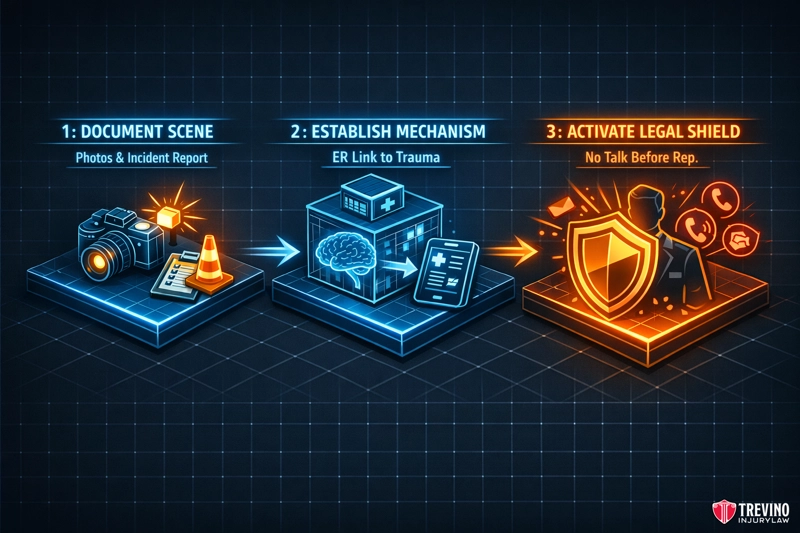
To successfully file a claim for a suffered a traumatic brain injury event in Texas, you must establish a medical chain of custody immediately after the accident. Follow these three steps to preserve your right to compensation:
- File an Incident Report at the Scene: You must officially document the date, time, and specific hazard (e.g., wet floor, uneven pavement) before leaving the property. If the head injury occurs at a major venue like North Star Mall or The Pearl, demand to file a written incident report with security. Take photos of the hazard and collect witness names immediately, as this evidence is often cleaned up within minutes.
- Establish the “Mechanism of Injury” at a Trauma Center: Seek immediate medical attention at a Level I trauma center like University Hospital or Methodist Stone Oak, even if you feel “fine.” You must explicitly tell the ER staff you hit your head so they document the mechanism of injury in your medical records. This medical entry links your brain trauma directly to the fall, preventing insurance adjusters from blaming a pre-existing condition.
- Initiate a “Legal Shield” Before Speaking to Adjusters: Contact an experienced traumatic brain injury lawyer at Trevino Injury Law at (210) 255-3088 to secure a Letter of Representation before answering any calls from the property owner’s insurance company. Adjusters for retailers (like H-E-B or Walmart) are trained to record statements that minimize your symptoms. We act as a legal shield, handling all communication to ensure your “invisible” brain injury is not devalued.
Can a Fall Cause a Traumatic Brain Injury?
Yes, posterior falls on hard surfaces create a coup-contrecoup effect where the brain slams against the skull, causing bruising even without a fracture. Even mild traumatic brain injuries can have lasting consequences.
What Is Considered a Severe Traumatic Brain Injury?
A severity of the TBI is often classified as severe if it involves extended unconsciousness or amnesia and results in permanent cognitive impairment. This level of injury often requires a comprehensive Life Care Plan to manage the impact on daily life.
Will My Health Insurance Take Part of My Settlement?
Yes, most policies and Medicare assert a Subrogation Lien under Texas law. However, an experienced personal injury attorney can often negotiate this lien down to ensure you keep more of your money.
How to Pay for Medical Care Without Health Insurance
In Texas, attorneys can use a legal instrument called a Letter of Protection (LOP) to secure top-tier neurological treatment for clients who are uninsured, ensuring that medical providers are paid directly from the final settlement rather than requiring upfront cash payments.
This mechanism is critical for victims in San Antonio who need immediate care but lack coverage. An LOP grants you access to specialists in the South Texas Medical Center who typically refuse to see “third-party liability” patients because they do not want to get involved in litigation.
By using an LOP, we ensure you receive the MRIs and rehabilitation you need to recover, while simultaneously creating the medical records necessary to prove the value of your case based on the severity of the trauma.
What Is “Malingering” and Why Will They Accuse You of It?
“Malingering” is the defense term for “faking” or exaggerating an injury for financial gain, and it is the standard defense strategy in TBI cases where the victim “looks fine” on the outside but suffers internal deficits.
Defense attorneys will aggressively dig through your social media or employment records to find any evidence that you are “living a normal life” to undermine your credibility. To counter this, we use Neuropsychological Testing, objective “lie detector” tests for the brain, to scientifically prove that your cognitive deficits are real, unrelated to malingering, and directly caused by the fall.
Why Hire a San Antonio Traumatic Brain Injury Lawyer?
A traumatic brain injury is not a “minor” accident, and you cannot afford to let an insurance company treat it like one. If you sustained a traumatic brain injury, accepting a quick check before understanding the lifetime cost of your cognitive impairment surrenders your financial future to their profit margins. This is why you need a trial attorney in San Antonio.
Want to Protect the Full Value of Your Claim?
You’ve seen how this affects your case — but this is only one piece of the puzzle. Our Slip and Fall Lawyer page breaks down what a trial-ready firm does differently.
We proved this at the Bexar County Courthouse by securing the $536,000 Arriaga verdict. To build this leverage, your personal injury accident lawyers immediately secure Neuropsychological Testing to scientifically prove your invisible cognitive deficits before the defense can deny them.
Call (210) Trevino today for a free consultation. We are ready to fight for the maximum compensation you deserve.