
You can claim compensation for a surgical procedure performed months after a slip and fall if a continuous medical record links the operation to the initial trauma. Texas law does not penalize you for trying physical therapy before agreeing to invasive reconstruction.
The adjuster at Fred Loya is already exploiting this mandatory waiting period to destroy your claim. They classify your conservative care timeline as an unjustified delay and argue that your need for surgery is just another example of common slip and fall injuries in Texas.
What Could Your Slip and Fall Accident Case Be Worth?
Answer a few quick questions about your accident. Takes about 60 seconds.
See What My Case Might Be WorthThe insurance company offered less than $20,000. I ended up with over $1 million. — Jackie Galindo
According to the Texas Department of State Health Services, the state recorded 1,957 fatal falls from slipping and tripping on the same level between 2018 and 2022. Behind most severe premises injuries is an insurer determined to avoid paying for the surgical consequences.
Accepting a quick settlement before reaching maximum medical improvement permanently closes your case. You must secure a Letter of Protection, a legal contract that defers your surgical bills until the final settlement. Texas gives you two years to file a lawsuit before the claim expires.
A Trevino Injury Law slip and fall lawyer will lock down your medical narrative and force the insurer to cover your delayed surgery. Call 210-TREVINO for a free case review. You pay nothing unless we win. Se Habla Español.
How Long After a Personal Injury Can You Get Surgery and Still Claim Fair Compensation?
In Texas, you can claim compensation for a surgical procedure performed months or even years after a slip-and-fall, provided a continuous medical record links the procedure to the initial trauma through consistent documentation.
Many injury lawyers see victims in San Antonio who worry that if they don’t get surgery immediately, they lose their right to sue. This is false. In fact, immediate surgery is rare for most serious injuries unless they are life-threatening. When you visit a Level 1 trauma center like University Hospital after a fall, the emergency room doctors typically discharge you with instructions to rest and follow up with a specialist.
Nationwide, injury-related emergency department visits reached 43.5 million in 2022 alone, illustrating that stabilization is the primary goal of the ER, not long-term orthopedic repair (CDC/NCHS, 2022). They prioritize stabilizing you rather than immediately fixing long-term orthopedic issues.
Orthopedic specialists in the South Texas Medical Center usually require a period of 6 to 12 weeks of “Conservative Treatment”, including physical therapy, chiropractic care, and steroid injections, before a health insurance provider will even approve surgery.

This waiting period is not a “delay” caused by the patient; it is a strict medical protocol enforced by insurers and doctors. However, insurance adjusters will twist this standard medical protocol into a legal defense, claiming you “waited too long” to get treatment.
Why Do You Have to Wait Months Between Injury and Surgery?
Orthopedic surgeons typically require a “failed conservative treatment” period—usually 3 to 6 months of physical therapy or steroid injections—to rule out non-surgical recovery. They need to allow acute inflammation to subside before recommending surgery to repair damage, such as spinal fusion or joint reconstruction.
The path to surgery is a ladder, not a straight line. After your initial X-rays, your doctor will likely order an MRI to visualize soft tissue damage. If a tear or herniation is found, the standard of care in Bexar County dictates a trial of physical therapy. Only if your intense pain persists after weeks of therapy and injections, proving that “conservative care” has failed, will a surgeon schedule an operation.
Skipping these steps allows the defense to argue the surgery was “elective” or “unnecessary.” Additionally, surgeons often wait for swelling to subside to ensure the procedure is safe, meaning the “gap” is a safety measure.
How to Overcome the “Gap in Treatment” Defense
To defeat the “gap in treatment” defense, your attorney must secure a medical causation narrative from your treating physician. This document must explicitly state that surgery is necessary as a direct result of the initial fall, despite any intervening time lapse or conservative treatments.
At Trevino Injury Law, we ensure our clients maintain a consistent appointment schedule to prevent unexplained gaps that adjusters attack. We use a “continuous complaint” record, documenting that you were in pain from the day you fell at The Rim or North Star Mall until the day of your surgery six months later.
If you miss appointments or stop going to the doctor, Fred Loya adjusters will argue you were “healed” during that time. Consistency is the key to linking the fall to the delayed surgery.
Once you have established the medical necessity of the surgery, the next challenge is ensuring you do not accept a potential settlement offer before the full cost of that surgery is known.
Should I Settle My Slip and Fall Case Before or After Surgery?
You should never settle a slip-and-fall claim before the recommended surgery is completed. Signing a release ends your right to claim compensation for the procedure, rehabilitation, post-operative care, and any complications that may arise during your recovery.
Adjusters from major insurers like Progressive or Allstate often try to “swoop and settle” early in the process. They may offer a lowball “quick check” of $5,000 to $10,000 immediately after the accident, specifically to close the file before an MRI reveals a surgical tear or broken bones.
This is a trap. Under Texas law, a signed release is a binding contract that extinguishes your claim forever. While the Texas Supreme Court in Williams v. Glash allowed a release to be set aside due to a ‘mutual mistake’ regarding an unknown injury, this is a rare and difficult exception to prove.
If you sign a release before discovering the need for surgery, you will likely be barred from seeking further fair compensation, regardless of the severity of your new diagnosis.
We have seen cases where clients were offered nuisance-value settlements, only to later discover they needed major surgery. In Arriaga v. Montemayor, the defense offered only $5,000. Because we fought the case through the full medical timeline, a Bexar County jury awarded a verdict of $536,007.

Waiting for the full medical picture, including surgery, is the only way to ensure the settlement amount covers the true value of your injury.
What Is the Risk of Settling Before Maximum Medical Improvement (MMI)?
Settling before Maximum Medical Improvement (MMI) forces you to estimate future medical costs rather than claiming actual incurred expenses. This gives the insurance company leverage to dispute your projections, likely resulting in compensation that falls far short of your lifelong needs.
MMI is a clinical designation, meaning you have recovered as much as you ever will. You cannot reach MMI until after surgery and rehabilitation are complete. Until a doctor declares you “medically stationary,” we do not know if you will have a permanent impairment or if you will be able to return to work in demanding San Antonio industries like construction or oil field work.
Trevino Injury Law advises clients to wait until MMI is established so we can calculate precise economic damages and “Loss of Earning Capacity” based on medical facts, not guesses.
What Is the Average Settlement for Slip and Fall Surgery Cases?
While there is no universal “average,” fall settlements with surgery typically settle for significantly higher amounts, often six to seven figures, compared to soft-tissue claims. This increase is due to the high cost of medical intervention and the extended recovery period required.
The math of a claim changes instantly when surgery is involved. A soft-tissue strain might settle for $15,000, covering basic therapy and pain. A surgical case, however, involves medical expenses that can easily exceed $50,000, months of recovery, lost wages, and a higher multiplier for pain and suffering.
Juries in San Antonio understand that “going under the knife” is a life-altering event that justifies higher non-economic damages.
We routinely see values jump from five figures to high six figures once surgical intervention is confirmed and documented. Our record includes a $7.9 Million Verdict for a crushed foot and amputated toe, proving that when injuries are catastrophic, we force them to pay.
However, a higher-value claim requires stronger evidence to withstand the scrutiny of insurance defense lawyers, who will look for any reason to deny coverage.
When the surgery is tied to spinal cord damage, valuation becomes more specific because the claim may involve permanent impairment, future care, and lost earning capacity. Our guide to slip-and-fall spinal cord injury settlement value explains the factors that can drive the value of those cases.
What Evidence Strengthens a Slip and Fall Claim Involving Surgery?
The strongest evidence in a surgical slip and fall claim is a consistent “Chain of Custody” regarding your physical symptoms. This must be documented from the accident scene through every medical appointment leading to the operation.
Winning a delayed surgery case requires more than just a surgical report; it requires a timeline that is impossible to break. This begins with an Incident Report filed with the property owner or manager and an immediate visit to an ER like Methodist Hospital or Baptist Medical Center. From there, MRI films provide the objective “picture” of the injury that X-rays miss.
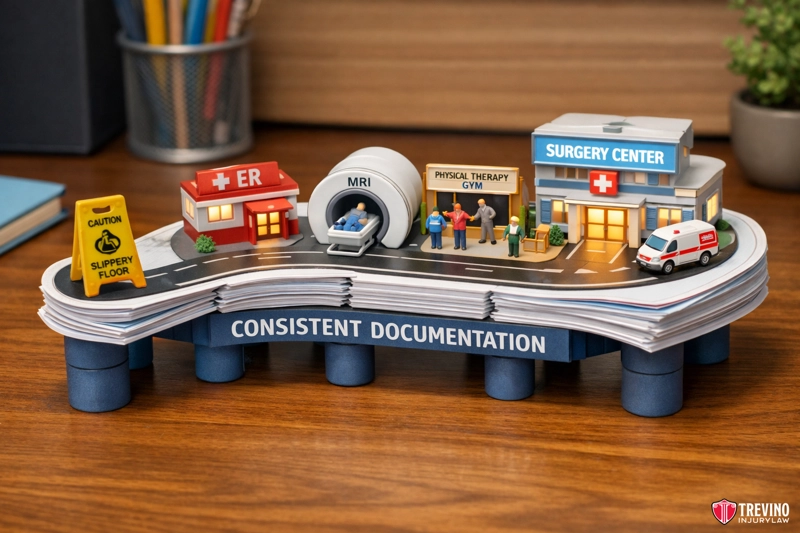
Crucially, physical therapy logs serve as proof of “failed conservative treatment,” showing that you tried to get better without surgery but couldn’t. This chain of evidence, supported by expert testimony, proves to a jury that the surgery was not a choice, but a medical necessity driven by the initial trauma.
What Are Delayed Symptoms After a Fall You Should Never Ignore?
Adrenaline often masks pain immediately after a fall, leading to delayed symptoms like radiating numbness (radiculopathy), deep bruising (hematoma), or increasing instability that may intensify days or weeks after the initial impact.
It is common for a “sore back” to evolve into something much worse. You must watch for “Late Hematoma” (deep bruising that appears days later) or signs of nerve compression like “foot drop” or incontinence (Cauda Equina Syndrome). You should also monitor for signs of internal bleeding or blood clots.
These are not just new aches; they are signs that the injury is evolving. Documenting these changes is critical. If you tell your doctor on day one that your back hurts, and on day 30 that your leg is numb, it creates a record of the injury’s progression. This prevents the defense from claiming the numbness is a “new” injury unrelated to the fall.
Documenting these symptoms early protects your claim, but many victims worry about how to pay for the expensive surgery required to fix them.
Can I Sue for Surgery Costs If I Don’t Have Health Insurance?
Yes, you can receive necessary surgery without health insurance through a legal arrangement known as a Letter of Protection (LOP). This allows you to obtain medical care immediately and pay for it later out of the proceeds from your final settlement or jury verdict.
Many slip and fall victims in San Antonio believe they cannot pursue a claim because they cannot afford the upfront medical costs of surgery. This is exactly what insurance companies hope for.
To bridge this gap, Trevino Injury Law has established relationships with orthopedic surgeons and medical facilities across Bexar County who accept Letters of Protection.
An LOP is essentially a contract between you, your attorney, and the doctor. It guarantees that the doctor will treat your injuries immediately and perform necessary surgeries, such as fusions or rotator cuff repairs, in exchange for a promise of payment once the case is resolved.
This arrangement prevents financial losses from destroying your legal case. Without an LOP, you might be forced to stop treatment, which the defense would then use to argue that you weren’t really hurt. By securing your access to care, we ensure you reach Maximum Medical Improvement (MMI), allowing us to demand full value for your damages.

Understanding how to pay for surgery is practical, but understanding the specific medical implications of different procedures is strategic for maximizing your claim value.
What Are the Most Common Surgeries After a Slip and Fall?
The most frequent surgical interventions in Texas premises liability cases involve orthopedic repairs to the spine, knees, and shoulders, necessitated by the high-impact trauma of landing on hard surfaces like concrete or tile.
Those procedures reflect several common slip-and-fall injuries in San Antonio, from fractures and spinal injuries to severe traumatic brain injuries.
To stabilize skeletal damage and restore function, victims often require specific, high-value procedures such as Lumbar or Cervical Fusion to address herniated discs or spinal cord injuries that fail conservative care.
Key Surgical Procedures and Legal Implications:
- Lumbar or Cervical Fusion: Involves joining vertebrae to halt painful motion; a critical indicator of permanent injury and high case value.
- Arthroscopic Knee Repair: Utilizes cameras to reconstruct soft tissue damage from twisting falls, such as meniscus or ACL tears; severe cases may demand total knee replacement.
- ORIF (Open Reduction Internal Fixation): The surgical implantation of metal plates and screws to stabilize severe fractures in wrists or ankles.
- Traumatic Brain Injury (TBI) Surgery: Emergency craniotomies required to relieve intracranial pressure, representing the highest tier of catastrophic injury damages.
Each of these procedures carries specific legal implications regarding recovery time and case value. The severity of these injuries require detailed legal attention, especially given that between 2018 and 2022, 1,486 adults between the ages of 16 and 64 suffered fatal falls in Texas (Texas DSHS, 2024).
Does Surgery Increase Slip and Fall Settlement?
Yes, surgery affects settlement value significantly by generating higher medical bills, extending the recovery period, and providing objective proof of a permanent alteration to your anatomy. Personal injury lawyers use this evidence to validate higher damages.
How Long Is Recovery After Common Slip and Fall Surgeries?
Recovery times vary by procedure, with arthroscopic surgeries typically requiring 6 to 8 weeks and spinal fusions often requiring 6 to 12 months of rehabilitation to reach Maximum Medical Improvement.
Missing work during this time is common. In fact, the most serious falls often require prolonged care; data from 2018–2022 shows that 1,400 fatal fall victims in Texas had a hospital stay of 10 days or longer (Texas DSHS, 2024)
Is It Too Late to Get Surgery 6 Months After a Fall?
No, it is not too late if your medical records show a continuous attempt to treat the injury through conservative methods like physical therapy before opting for surgery. Legal representation is vital to explain this timeline to the insurer.
Texas Slip and Fall Surgery Case Examples: How Does Surgery Impact Settlement Value?
Surgical intervention in Texas slip and fall cases validates pain and suffering claims, transforming “nuisance value” offers into substantial recoveries by providing Bexar County juries with objective proof of injury severity.
A clear pattern in San Antonio litigation demonstrates that cases involving back surgery or joint repair command significantly higher settlements; insurance providers frequently increase initial low-ball offers, such as $5,000 for a “sprain,” to full policy limits once the procedure confirms the trauma.
Attorneys at Trevino Injury Law specialize in “delayed onset” surgical cases, utilizing medical experts to prove the causal link between the fall and the operation, defeating defense arguments regarding unrelated medical history.
The “Degenerative Condition” Defense: Dealing with Pre-Existing Issues
Insurance adjusters frequently argue that your need for surgery months later is due to degenerative disc disease or arthritis rather than the acute trauma of the fall, attempting to dismiss your claim as the natural result of aging.
This is the standard defense tactic in delayed surgery cases, often citing comparative negligence or pre-existing conditions. However, Texas law follows the “Eggshell Plaintiff” doctrine, which holds the defendant liable if their negligence aggravated a pre-existing condition.
Even if you had a “bad back” before falling at a store in Alamo Heights, if the fall accelerated your need for surgery or made a dormant condition symptomatic, the property owner is responsible.
We specialize in using advanced imaging, such as DTI Scans, or in comparing pre-accident and post-accident MRIs to objectively prove the “aggravation” and defeat this defense.
This defense is common, but a total denial of responsibility based on the outcome of the surgery itself presents a final, critical challenge.
What If the Surgery Fails to Relieve the Pain?
If the surgery fails to resolve your symptoms, a condition known as “Failed Back Surgery Syndrome,“ the value of your slip and fall claim may increase to account for permanent disability, quality of life loss, and the need for chronic pain management or follow-up surgeries.
Under the ‘Original Tortfeasor Doctrine’, the negligent party is responsible for your accident and liable for the ultimate outcome of your injury, including the results of medical treatment.
This means that if your surgery fails or requires revision, the defendant who caused the fall is legally responsible for these compounded damages, as they are foreseeable consequences of the original accident.
You are not penalized because the medical intervention failed to restore you to 100% health; instead, the law recognizes that your “loss of enjoyment of life” is even greater. Trevino Injury Law fights to ensure these outcomes are part of your settlement.
Why Hire a San Antonio Slip and Fall Lawyer?
The insurance company knows the difference between a law firm that settles cheap and a trial lawyer who fights to the end. If you have been seriously injured and require surgery, you cannot afford to have a “settlement mill” handle your claim. You need an attorney who is ready to stand before a Bexar County jury and force them to pay what you deserve.
Want to Protect the Full Value of Your Claim?
You’ve seen how this affects your case — but this is only one piece of the puzzle. Our Slip and Fall Lawyer page breaks down what a trial-ready firm does differently.
We proved this at the Bexar County Courthouse with a $536,007 jury verdict over an insulting $5,000 defense offer. To build this exact leverage, your San Antonio personal injury attorneys immediately issue a spoliation letter to preserve vanishing Sweep Logs before the store destroys them.
Your health and your financial future are on the line. Call (210) TREVINO or contact us online today for a free consultation. Let us handle the legal battle so you can focus on your recovery.