
A slip and fall on a hard commercial floor fractures your vertebrae and permanently alters your mobility. The physical pain is immediate, but the financial devastation can last a lifetime.
The Insurance Adjuster assigned to your claim is already reclassifying your acute spinal trauma as one of the common slip and fall injuries in Texas to minimize their payout.
According to the Christopher & Dana Reeve Foundation, the estimated lifetime care cost for a young adult with high tetraplegia exceeds $5 million. They use the aging-spine defense to deny reality, shift the blame, and protect their corporate bottom line.
What Could Your Slip and Fall Accident Case Be Worth?
Answer a few quick questions about your accident. Takes about 60 seconds.
See What My Case Might Be WorthThe insurance company offered less than $20,000. I ended up with over $1 million. — Jackie Galindo
Surveillance footage proving the hazard existed can be recorded within days. A Spoliation Letter, a legal demand that prevents the property owner from destroying evidence, must be issued immediately to secure the visual evidence. You need objective diagnostic imaging to directly link your injury to their negligence before the timeline works against you.
Trevino Injury Law slip and fall lawyers will force commercial insurers to face the full cost of your lifetime care. Call 210-TREVINO now for a free case review. You pay nothing unless we win. Se Habla Español.
What Is the Average Spinal Cord Injury Case Worth?
While minor slip-and-fall settlements in Texas average $15,000 to $50,000, valid spinal cord injury cases typically settle for $500,000 to over $5 million due to lifetime care costs.
However, relying on a general average settlement for spinal cord injuries is dangerous because the settlement or verdict value is driven almost entirely by the specific functionality you have lost. According to data from the Christopher & Dana Reeve Foundation, the estimated lifetime cost for a 25-year-old with high tetraplegia (quadriplegia) exceeds $5 million.
In Bexar County, juries consider the “whole person” impairment, not just medical expenses. For example, our law firm secured a $7.9 million verdict for a client with a crushed foot and other injuries by proving the loss of future capacity, not just past expenses.
In San Antonio, what a case is worth is also heavily influenced by the defendant’s identity. A fall at a neighbor’s house with a $100,000 homeowner’s policy has a hard cap, whereas a fall at a commercial retailer like La Cantera or North Star Mall is covered by commercial liability policies that can cover the full multimillion-dollar value of a spinal injury.
The goal is not to find the average, but to determine the “full value” of your specific loss of independence.
Factors That Affect Settlement Values for Spinal Cord Injury Victims
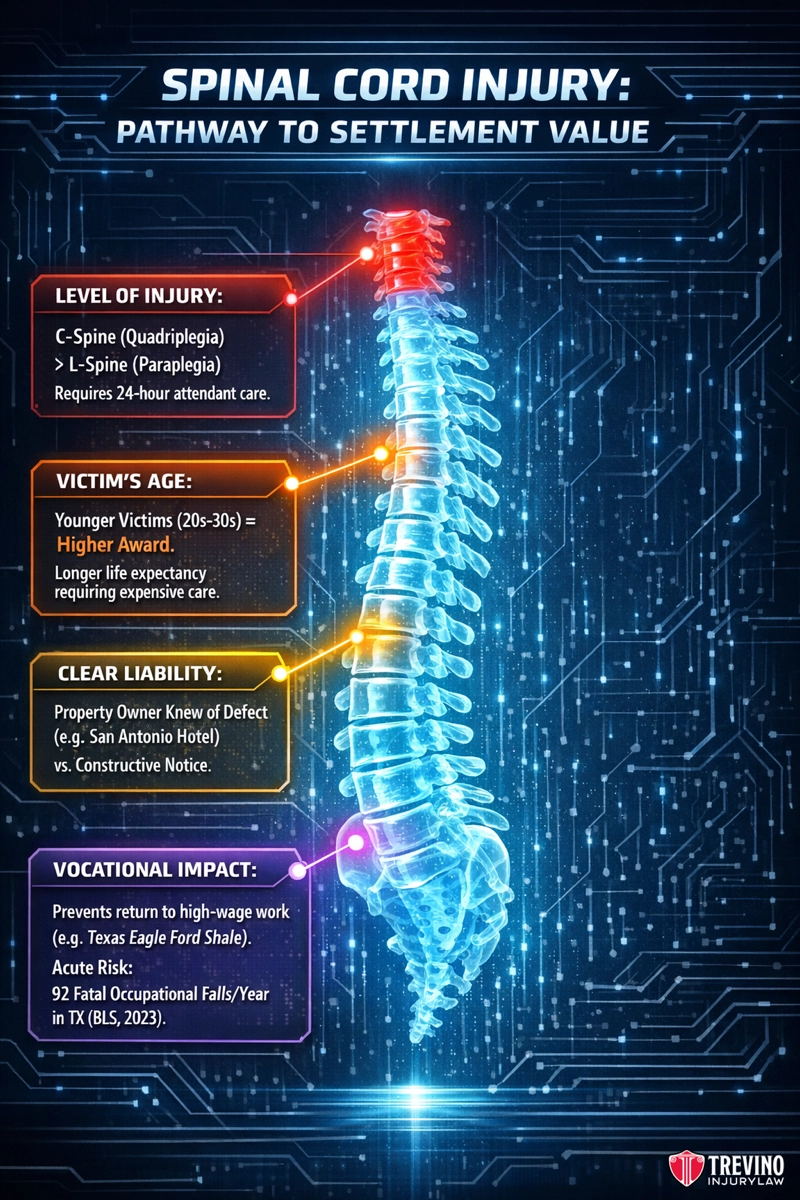
- Level of Injury: C-Spine (Quadriplegia) settlements are significantly higher than L-Spine (Paraplegia) due to the need for 24-hour attendant care and loss of upper body function.
- Victim’s Age: Younger victims (e.g., 20s-30s) receive higher awards due to longer life expectancy, requiring decades of expensive care and lost earning years, resulting in massive lost wages.
- Clear Liability: Cases in which the property owner (e.g., a San Antonio hotel or retailer) knew of the defect are valued higher than “constructive notice” cases in which the hazard was new.
- Vocational Impact: Settlements increase drastically if the injury prevents you from returning to high-wage work in industries like the Eagle Ford Shale. This risk is particularly acute in Texas industries, where official statistics recorded 92 fatal occupational injuries specifically attributed to falls, slips, and trips in a single year (BLS, 2023).
How to Calculate Damages Available for Spinal Cord Injury Settlements
Texas courts and insurers often utilize the “Multiplier Method,” calculating non-economic damages by multiplying total medical expenses by a factor of 1.5 to 5.
For a catastrophic type of injury, a “5x” multiplier is often justifiable because the pain and suffering are permanent and daily. Texas law empowers us to demand compensation for your injuries beyond just physical pain. Under the precedent set by Golden Eagle Archery, Inc. v. Jackson, 116 S.W.3d 757 (Tex. 2003), ‘Physical Impairment’ is recognized as a distinct damage category separate from pain and suffering.
This legal distinction allows a skilled spinal cord injury attorney to recover additional millions for the specific loss of life’s joys, such as the inability to hold a child or run a marathon, forcing the jury to value the loss of living with a spinal cord injury, not just the presence of pain.
At Trevino Injury Law, we use “Day-in-the-Life” videos to show adjusters exactly what this struggle looks like, moving the calculation from a spreadsheet to a human reality. This evidence forces them to apply a higher multiplier or face a jury that will likely sympathize with your permanent limitations.
Knowing the potential value range is useful, but identifying the specific elements that push a case to the top of that range establishes the foundation for understanding the evidence we must collect next.
What Proof Is Needed for a Successful Spinal Cord Injury Claim?
Maximizing a settlement for spinal cord injury requires objective medical evidence connecting the fall to acute trauma, combined with economic expert projections of future needs.
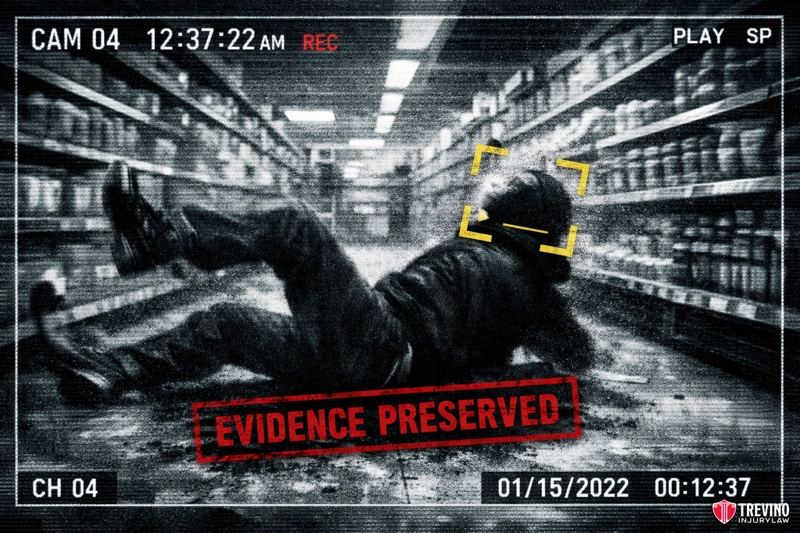
Standard “slip and fall” proof, like photos of a puddle, is not enough; you must scientifically prove the acuity of the damage to the spinal cord to defeat the “pre-existing condition” defense. Immediately after a fall, we send Spoliation Letters to preserve surveillance video that shows the mechanism of the injury, for example, a backward fall where your head or neck strikes the hard floor at H-E-B.
This visual evidence counters the common defense argument that your herniated discs or fractures were caused by “degenerative disc disease” or old age.
For a broader comparison of spinal damage with head injuries, fractures, and other consequences of a fall, see our guide to common slip-and-fall injuries in San Antonio.
In San Antonio courts, defense attorneys aggressively argue that your pain is chronic and unrelated to the fall. To defeat this, we need diagnostic imaging that shows edema (swelling) in the bone or soft tissue, which acts as a timestamp proving the injury happened today, not ten years ago.
Without this objective medical proof, your claim is reduced to your word against theirs.
Does MRI Increase Settlement?
Yes, a high-resolution MRI (Magnetic Resonance Imaging) significantly increases settlement value by visualizing disc herniations, cord compression, and hematomas that X-rays miss.
Standard X-rays only show bone, but an MRI reveals the soft tissue damage that causes paralysis or radiculopathy. We often recommend 3T MRIs, available at facilities in the South Texas Medical Center, which provide the detail needed to differentiate between an acute injury (high value) and a chronic condition.
When spinal trauma occurs alongside a head injury, our guide to traumatic brain injury compensation after a slip and fall explains the separate medical-evidence and compensation issues associated with the brain injury.
In cases involving concurrent brain trauma, advanced diffusion tensor imaging (DTI) can visualize the neural tracts themselves, providing irrefutable proof of damage that increases the settlement offer.
Why Are Life Care Plans Essential for SCI Cases?
A Life Care Plan is a comprehensive medical-economic report that itemizes every cost a spinal cord injury lawsuit victim will incur from the date of the accident through their life expectancy.
This document is the bridge between a $50,000 offer and a $2 million demand. It accounts for costs that regular medical expenses miss: home modifications (like wheelchair ramps in Alamo Heights homes), modified vans, catheter supplies, bowel management programs, and future surgeries.
Trevino Injury Law retains certified life care planners to build this roadmap before entering mediation. Without a Life Care Plan, you are asking the insurance company to guess your future needs, and they will always guess low.
While medical images and economic reports prove the extent of the injury, understanding the strategic timeline determines when you can leverage this evidence for a payout.
What Is the Average Timeline to Settle a Slip and Fall Spinal Injury Case?
Spinal cord injury cases in Texas typically take 18 to 36 months to resolve, as settling before reaching Maximum Medical Improvement (MMI) results in a loss of value.
In San Antonio, insurance adjusters often try to settle these cases within the first 60 days, hoping you will accept a quick payout before you realize the full extent of your paralysis or chronic pain.
Consider that hospitals have up to 90 calendar days just to submit traumatic injury data to the state registry, meaning a 60-day settlement offer likely precedes even the official administrative record of your injury (Texas DSHS, 2025).
You cannot settle a spinal cord injury case until your spine has stabilized, often after surgery and rehabilitation, so that a doctor can assign a permanent impairment rating. Rushing this process leads to under-compensation because you cannot reopen a claim once it is closed.

Litigation often speeds up the real offer, even if it extends the timeline. Filing a lawsuit signals that we are preparing for a trial date in Bexar County court, which forces the insurance company to move the file from a “claims adjuster” to a defense attorney who understands the risk of a high settlement or verdict.
What If I Reject the First Settlement Offer?
Rejecting the first settlement offer is standard procedure in catastrophic injury claims, as the initial offer rarely accounts for future medical expenses or non-economic damages.
The first offer is a test of your patience and financial desperation. For example, in the Arriaga case, the defense offered only $5,000 for a back injury; by rejecting that lowball offer and going to trial, we secured a jury verdict of $536,007.
Rejection sends a clear signal that you are not desperate and that you have a personal injury lawyer who knows the true value of your spinal cord injury case. It moves negotiations to a serious phase where the focus shifts from “nuisance value” to “policy limits.”
Rejecting a low offer is a strategic strength, but even the strongest negotiation strategy must account for legal technicalities regarding fault that can bar recovery entirely.
Can You Sue Even If Your Injuries Were Partially Your Fault?
Yes, under Texas’s Proportionate Responsibility scheme, confirmed in cases like Dugger v. Arredondo, 408 S.W.3d 825 (Tex. 2013), you can recover damages provided you are not more than 50% at fault. This is the critical ‘51% Bar Rule.’ If a jury finds you even 51% responsible, perhaps for failing to keep a proper lookout, you recover absolutely nothing ($0), regardless of the severity of your paralysis.
This makes our aggressive defense against liability arguments essential to preserving your recovery, regardless of how severe your spinal injury is.
If you are found 40% at fault, a $1 million award is reduced to $600,000. Defense attorneys for major retailers like H-E-B aggressively argue “failure to keep a proper lookout” to push your liability over that critical 51% line. This makes securing video evidence essential to prove the hazard was unavoidable, protecting your right to a fair settlement.

Understanding liability is one technical aspect, but strictly defining the medical severity of your injury is what ultimately sets the price tag.
What Is Considered a “Severe” Spinal Cord Injury?
A “severe” spinal cord injury is medically classified as a complete spinal cord injury (ASIA Grade A), which results in total paralysis and the complete loss of sensory and motor function below the level of trauma.
In legal terms, severity is measured by the permanent loss of independence; even incomplete injuries that allow for some movement are considered severe if they result in debilitating conditions like “Spinal Shock” or chronic neuropathic pain.
To maximize settlement value, attorneys must document the victim’s functional reality, proving the necessity for long-term inpatient recovery at specialized facilities like Warm Springs Rehabilitation Hospital.
Do Injections Increase Your Settlement?
Yes, epidural steroid injections (ESIs) increase settlement value by providing objective proof of radiculopathy and demonstrating that conservative treatment (physical therapy) failed to resolve the injury.
Does Surgery Guarantee a Higher Settlement?
Yes, surgical intervention (such as a laminectomy or fusion) typically shifts a case into a higher insurance value bracket due to the increased cost, risk, and permanent alteration of the spine.
Can I Get a Payout for a Spinal Injury Without Surgery?
Yes, you can secure a substantial settlement without surgery if medical experts can prove that your spinal injury causes permanent pain or disability that cannot be surgically corrected.
Medical treatments for these levels of severity raise specific settlement questions regarding the extent of paralysis.
Paraplegia vs. Quadriplegia: How Paralysis Level Affects Settlement Caps
Settlement values for quadriplegia (tetraplegia) consistently exceed those for paraplegia because the total loss of hand and arm function necessitates 24-hour attendant care, drastically increasing the Life Care Plan total. While paraplegic victims may retain vocational capacity for sedentary work, quadriplegic victims typically face a total loss of earning capacity, resulting in millions of dollars in additional damages.
| Injury Level | Functional Impact (ADLs) | Settlement Valuation Driver |
| Paraplegia | Retains hand and arm function; may drive modified vehicles and perform sedentary work. | Lower Life Care Plan costs; often focused on medical bills and partial lost wages. |
| Quadriplegia | Total loss of limb function; requires 24-hour attendant care for all daily tasks. | Maximum Life Care Plan costs; includes lifetime nursing and total loss of earning capacity. |
Workforce Impact:
The financial disparity is most acute for San Antonio workers in physical sectors like construction or the oil industry who can no longer perform their trade. This loss of labor is significant, with BLS (2024) data reporting 479,480 private industry cases involving days away from work due to falls, slips, and trips.
What Happens If You Delay Treatment for a Spinal Injury?
Delaying medical treatment creates a gap in care that insurance adjusters use to argue your spinal injury was not caused by the slip and fall but by an intervening event.
Defense attorneys call this the “causation defense.” If you fall at a shopping center like La Cantera but wait two weeks to visit the ER, the defense will argue that you likely hurt your back at home or work during that gap. Seeking immediate treatment at a facility like Methodist Stone Oak locks in the medical timeline, linking the acute trauma directly to the slip and fall incident and preventing the insurer from shifting blame.
Even with perfect timing, external limits can apply to your final recovery.
When Are Spinal Cord Injury Settlements Limited by Insurance Caps?
While Texas has no general cap on economic damages (medical expenses/lost wages) in slip and fall cases, your settlement is practically limited by the defendant’s insurance policy coverage.
If your injury is worth $2 million but you fell at a private residence with only $100,000 in liability coverage, collecting the full value is extremely difficult. In contrast, a fall at a major corporate chain like H-E-B typically involves commercial policies with coverage of millions of dollars.
When policy limits are the only obstacle, we often issue a “Stowers Demand,” which pressures the insurance company to pay the full policy limits or risk liability for the entire verdict amount, regardless of the cap.
Cases in which the property owner (e.g., a San Antonio hotel or retailer) has actual knowledge of the defect carry significantly higher value. However, most high-stakes litigation turns on ‘constructive notice.’ We must prove that the hazard existed long enough that the owner should have known about it and failed to act.
This legal standard transforms a simple fall into a proven breach of duty, forcing insurers to account for their client’s negligence rather than dismissing the event as an accident.
Why Hire a San Antonio Slip and Fall Lawyer?
One slip changed your life. Don’t let an insurance adjuster dictate your future. You need a San Antonio slip-and-fall lawyer who fights back. At Trevino Injury Law, we prepare every case for the courtroom, not a quick checkout line.
Want to Protect the Full Value of Your Claim?
You’ve seen how this affects your case — but this is only one piece of the puzzle. Our Slip and Fall Lawyer page breaks down what a trial-ready firm does differently.
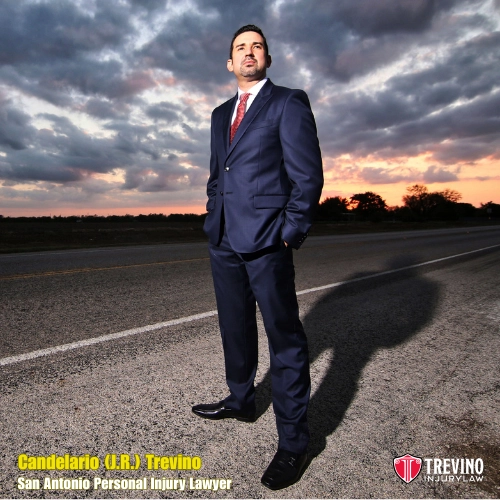
We proved this at the Bexar County Courthouse by securing a $7.9 million jury verdict. To build this leverage, your Bexar County personal injury lawyer immediately issues a spoliation letter to preserve vanishing surveillance video before the defense destroys it.
Call 210-TREVINO for a free case review. Se Habla Español. We strictly honor our “No Win, No Fee” contingency promise.