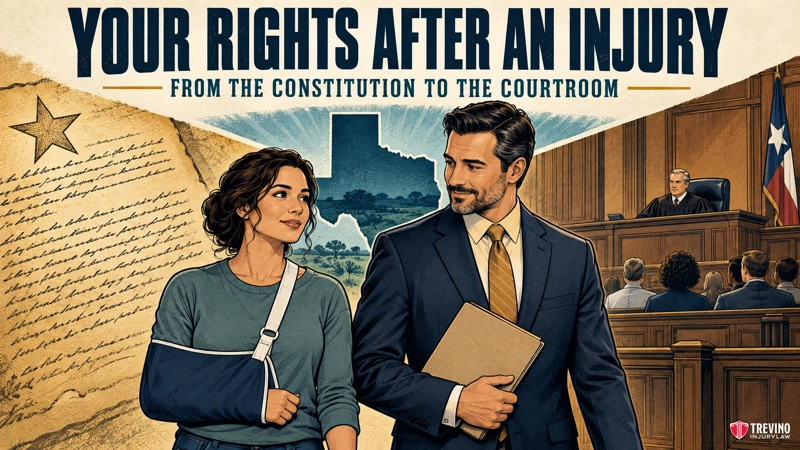
If someone else hurts you in Texas, you have the right to take them to court and have a jury decide it. Those are not courtesies the legal system extends. They are written into two constitutions, the federal one and the Texas one, and an injured person in San Antonio sits underneath both.
Almost every national constitution written since 1789 makes some version of that promise, because drafters understand that a right with no forum behind it is not a right at all. Texas went further than most and said so in unusually plain words.
No constitutional text can tell you what the promise is worth once it is operating. This page follows those guarantees from the words on the page down to what actually happens to an injury claim in Texas, and ends with the number that measures the distance between the two.
What Could Your Personal Injury Case Be Worth?
Answer a few quick questions about your accident. Takes about 60 seconds.
See What My Case Might Be WorthThe insurance company offered less than $20,000. I ended up with over $1 million. — Jackie Galindo
Trevino Injury Law, our San Antonio personal injury lawyers, build every case for a jury from day one. Call 210-TREVINO for a free case review. You pay nothing unless we win. Se Habla Español.
Key Takeaways – Your Rights After an Injury in Texas
- Texas Constitution Article I, Section 13 keeps the courts open and promises a remedy for an injury done to your person.
- Article I, Section 15 protects the right of trial by jury, and the Seventh Amendment does the same in federal court.
- A traffic ticket and an injury lawsuit are separate proceedings with different parties and different rules of proof.
- To win, you must prove duty, breach, and damages proximately caused by that breach.
- Most of the work that shapes your claim happens before a lawsuit is ever filed.
What Do the Constitutions Promise Someone Who Is Injured?
A court must hear you, and a jury must decide the outcome. Both promises appear twice, once at the national level and once in Texas. The federal guarantee is the Seventh Amendment: “In Suits at common law, where the value in controversy shall exceed twenty dollars, the right of trial by jury shall be preserved.” It is the civil counterpart to the criminal jury right and governs federal courts.
The Texas guarantee is broader on access and narrower in reach. Article I, Section 13 provides: “All courts shall be open, and every person for an injury done him, in his lands, goods, person or reputation, shall have remedy by due course of law.” The wording is unusually specific for a constitutional provision. It names the injury, the person, and the remedy. Article I, Section 15 adds: “The right of trial by jury shall remain inviolate.” The Supreme Court of Texas has enforced the open-courts guarantee, striking down a limitations rule that cut off a child’s injury claim before it could be brought, in Sax v. Votteler.
The division between them matters more than it sounds. The Seventh Amendment was never extended to state courts, so a case filed in Bexar County follows Texas law. But Texas also contains federal courts, including the United States District Court for the Western District of Texas, San Antonio Division. An injury claim against an out-of-state trucking company can be moved there, because the parties are from different states and the amount at stake is large enough. When that happens, the Seventh Amendment applies.
So a San Antonio injury case may be decided under either constitution, depending on who the defendant is and which courthouse the case ends up in. Both documents produce the same instrument: a civil lawsuit, a private dispute about money in which one person says another’s conduct caused harm and asks a court to order payment.
Why Doesn’t the Driver’s Ticket Decide Your Case?
Because a ticket and a lawsuit are separate proceedings, brought by different parties, under different rules of proof. After a serious commercial truck crash, several things may happen at once. An officer may cite the driver. The Texas Department of Public Safety may open an investigation. The driver’s commercial license may be reviewed, and the motor carrier may face a federal safety action. Each of those is the government acting against the driver or the company. None is the injured person’s case, and none awards a dollar to the person who was hurt.
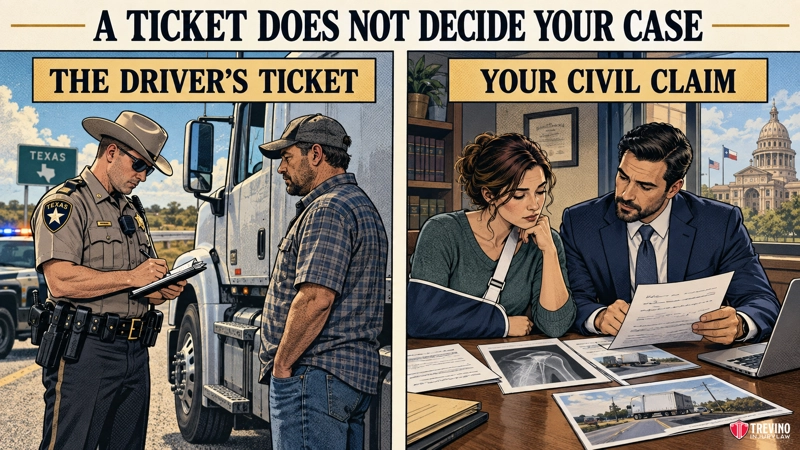
The criminal side asks whether the driver broke a law and should be punished. The civil side asks who should bear the cost of what happened. A driver can be acquitted, or never charged, and still be found responsible in civil court. The reverse is also true.
Evidence from a criminal or regulatory investigation can sometimes help in a civil case. A crash report, an officer’s diagram, or the findings of a federal safety review may point toward what went wrong and who was responsible. But those records are starting points, not verdicts, and not all of them can be shown to a civil jury. The civil case, and only the civil case, decides whether the injured person is compensated.
What Do You Have to Prove?
The Supreme Court of Texas put it plainly in Doe v. Boys Clubs of Greater Dallas, Inc.: “The elements of a negligence cause of action are a duty, a breach of that duty, and damages proximately caused by the breach of duty.” That single sentence is the framework for every negligence claim in Texas, from a low-speed collision to a fatal crash involving an 18-wheeler. Each element is a separate burden, and a claim that proves three of them but not the fourth does not succeed.
In ordinary language, four things must line up. The defendant owed a duty to act with reasonable care. The defendant failed to meet it. That failure caused the injury. And the injury produced real losses.
Causation is where most disputes are actually fought. Texas splits it into cause in fact, meaning the conduct was a substantial factor without which the harm would not have happened, and foreseeability, meaning a person of ordinary intelligence should have anticipated the danger. An insurer will usually attack one of the two. It may concede the crash happened and still argue the injuries came from somewhere else.
The standard of proof is lower than in a criminal case. A conviction requires proof beyond a reasonable doubt. A civil claim is decided by which side is more likely right, though that still must be supported by evidence rather than assertion.
Responsibility can also be shared, and Texas has a specific rule for how that is measured, set out in how Texas divides fault between the people involved.
What Happens Before a Lawsuit Is Filed?
Most of the work happens here, before you file anything. The strength of a claim is usually shaped in the first weeks and months, long before a petition reaches a courthouse. What you preserve, document, and evaluate during this stage often determines what the case is worth later. The process generally unfolds in three steps.

- First, investigation. A lawyer collects the crash report, photographs, witness accounts, and medical records. In a commercial vehicle case, this is urgent, because the most valuable evidence sits on equipment the other side controls: electronic logging data, engine control module data, dashcam footage, maintenance records. Much of it is overwritten on a routine cycle, so preservation demands usually go out early.
- Second, evaluation. Nothing sensible can be demanded until the medical picture is stable, because the full extent of an injury is rarely clear in the first weeks. The first weeks after an injury cover that stretch in more detail.
- Third, the demand. The lawyer sets out liability and losses in writing and gives the insurer a chance to resolve the claim. Many claims end here. When the response is inadequate, the case moves to filing.
What Happens After It Is Filed?
The case begins with pleadings. The plaintiff files a petition, the defendant files an answer, and the court defines the disputed issues. The petition sets out who is being sued, what they are alleged to have done, and the harm it caused. The answer is the defendant’s formal response, and it often denies responsibility or raises defenses such as shared fault. Together, these filings set the stage for everything that follows.
Then discovery, the longest phase in most cases. Both sides exchange documents, answer written questions under oath, and produce records. In a trucking case, this is where driver qualification files, hours-of-service data, and company safety policies come to light. We also take sworn testimony outside court in a deposition, which we cover in What Actually Happens in a Deposition.
Experts are typically retained during this period, including accident reconstruction and medical experts. Discovery in a serious case runs for months, and in a complex commercial case considerably longer.
How Often Does a Case Reach a Jury?
Almost never. This number measures the gap between a constitutional promise and its delivery, and it is the most revealing figure in Texas civil litigation.
According to the Texas Office of Court Administration’s Annual Statistical Report for the Texas Judiciary, of roughly 193,000 civil cases disposed of in Texas district courts in fiscal year 2023, jury or directed verdict accounted for about half of one percent. Two constitutions guarantee that right. About one case in two hundred exercises it.

The rest resolve by agreement, dismissal, or default. Most courts require mediation first, a session with a neutral third party who carries offers between rooms and tests each side’s view of its own case. Many claims settle there. When a case does not settle, it is tried, a jury answers the questions the court puts to it, judgment is entered, and either side may appeal.
That gap explains something about leverage. A right that is never exercised exerts no pressure. An insurance company evaluating a claim is also evaluating the lawyer bringing it, and whether that lawyer is prepared to put the case in front of a jury if the offer is inadequate. A file that will never see a courtroom is valued accordingly.
Does This Change Depending on the Type of Claim?
Yes. The sequence above is the general shape, and particular claims add their own requirements.
- A fatal-injury claim has its own rules about who may bring it and what may be recovered.
- A commercial truck case carries heavier evidence obligations and a longer discovery phase:
- A workplace injury may run through a different system entirely depending on whether the employer carries workers’ compensation.
Where to Go From Here
Two constitutions promise an injured person an open court and a jury. Everything between the crash and the verdict is the work of making those sentences mean something in a particular case. That work includes preserving evidence, proving each element of negligence, and building a claim strong enough that an insurer has to take the possibility of a jury seriously. The guarantees are written down; putting them to work depends on the injured person and the lawyer they choose.
We offer a free consultation and work on a contingency fee, which means no fee unless we recover for you. You can read more about the kinds of injury claims handled in Texas civil court.
One note that applies from day one: you are not required to give the other driver’s insurance company a recorded statement, and you should speak with a lawyer before you do. Adjusters often request these statements early, when injuries are still developing, and the facts are not fully known. Anything said in that conversation can later be used to dispute fault or minimize the injury.
Understand the Process. Find Out Your Next Step.
Want to Protect the Full Value of Your Claim?
Every injury claim starts with questions. Trevino Injury Law can walk through what happened and what pursuing a claim could involve. Start with a free consultation.
You don’t have to figure out the legal process alone. At Trevino Injury Law, we can review your case and walk you through the next steps, from preserving evidence to pursuing your claim. Call 210-TREVINO for a free case review. Se habla español. No attorney’s fee unless we recover for you.