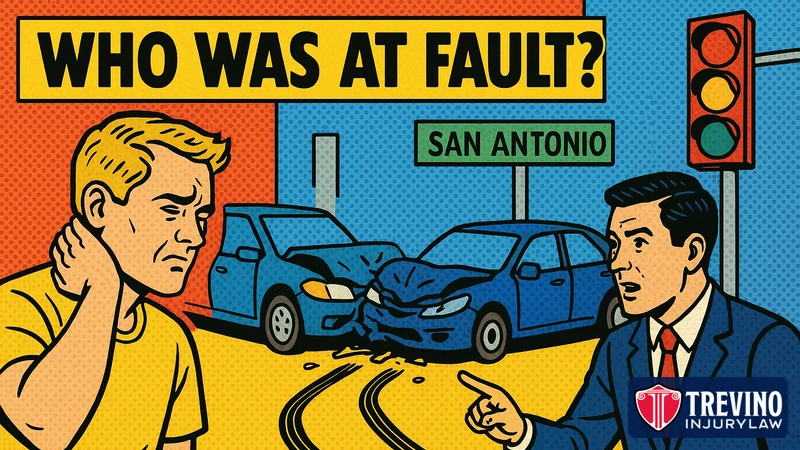
Fault in a San Antonio car accident is determined by negligence, meaning which driver failed to use reasonable care and caused the crash. Insurance adjusters make the first call, but if a claim goes to court, a Bexar County jury decides fault and assigns each party a percentage of responsibility.
Adjusters work for the other driver’s insurer, and their fault decision is a negotiating position, not a final ruling. They look for any reason to shift blame to you, from a late turn signal to a statement you made at the scene, because every percentage point of fault assigned to you lowers what they pay.
Texas follows proportionate responsibility. Your compensation is reduced by your share of fault, and you recover nothing if you are found more than 50 percent responsible. Evidence gathered in the first days after a crash often decides those percentages.
At Trevino Injury Law, our San Antonio car accident lawyers collect crash reports, video, and witness accounts, work with reconstruction experts, and prepare every case for a Bexar County jury. Call 210-TREVINO for a free case review. You pay nothing unless we win. Se Habla Español.
What Could Your Car Accident Case Be Worth?
Answer a few quick questions about your accident. Takes about 60 seconds.
See What My Case Might Be WorthThe insurance company offered less than $20,000. I ended up with over $1 million. — Jackie Galindo
Trevino Injury Law, San Antonio car accident lawyers, preserves the evidence that proves who caused your crash. Call 210-TREVINO now for a free case review. You pay nothing unless we win. Se Habla Español.
How Is Fault Determined in a Texas Car Accident?
Fault in a Texas car accident is determined by negligence. A driver is negligent when they fail to act as a reasonably careful driver would, and that failure causes the crash and your injuries. Texas is an at-fault state, so the negligent driver and their insurance company pay for the harm they cause.
To prove negligence, you must show four things: the other driver owed you a duty of care, breached that duty, the breach caused the crash, and you suffered damages as a result.
| Who decides fault | When | What it means |
|---|---|---|
| Police officer | At the scene, in the CR-3 crash report | An opinion based on the scene and statements, not a legal ruling |
| Insurance adjuster | During the claim | A negotiating position that sets the insurer’s first offer |
| Jury or judge | At trial | The final, binding decision on each party’s percentage of fault |
All three rely on the same thing: evidence.
What Evidence Proves Who Caused a Car Accident?
The evidence that proves fault shows how the crash happened and what each driver was doing in the moments before impact. The most useful evidence includes:
- The CR-3 crash report, including the officer’s diagram, contributing factors, and any citations. Our guide explains how to get your CR-3 crash report.
- Photos and video from phones, dash cams, traffic cameras, and nearby businesses.
- Witness statements from people with no stake in the outcome.
- Vehicle damage and final rest positions, which show the angle and force of impact.
- Event data recorder data showing speed, braking, and steering in the seconds before the crash.
- Phone records when distracted driving is suspected (see how to prove the other driver was texting).
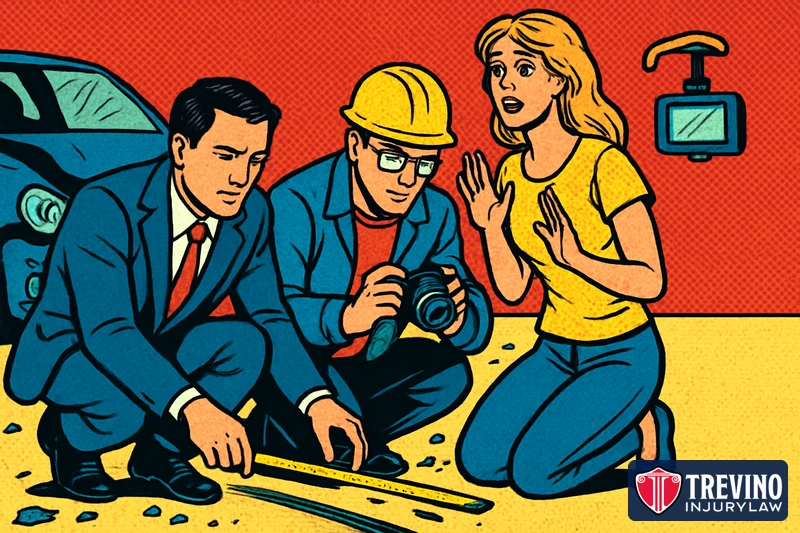
Some of this evidence disappears fast. Businesses often overwrite surveillance video within days, and damaged vehicles may be repaired or salvaged. When the evidence shows a driver broke a traffic law, fault becomes much easier to prove.
How Do Texas Traffic Laws Help Prove Fault?
Texas traffic laws set the standard of care every driver must follow, so proof that a driver broke one is strong evidence of negligence. Common violations include:
- Following too closely under Texas Transportation Code Section 545.062, the most common basis for rear-end liability.
- Failing to yield the right of way when turning left under Section 545.152.
- Unsafe lane changes under Section 545.060, which cause most sideswipe crashes.
- Running a red light or stop sign under Sections 544.007 and 544.010.
- Speeding or driving too fast for conditions under Section 545.351.
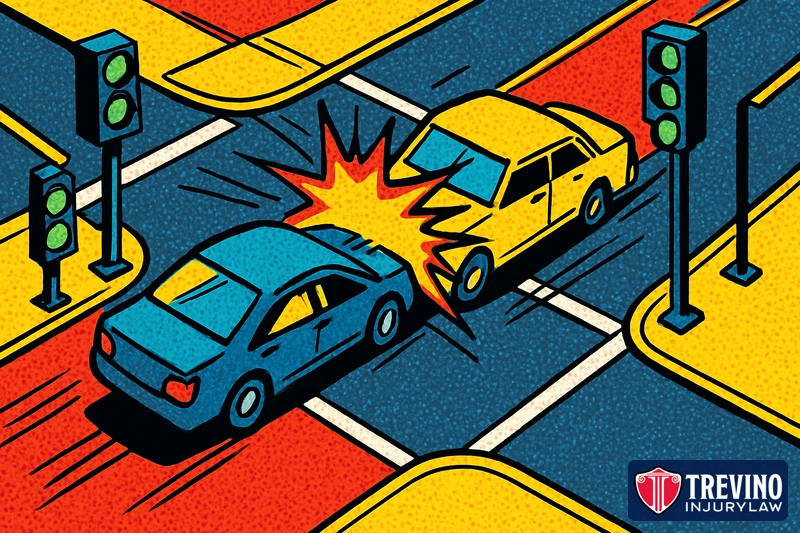
A traffic ticket helps, but it does not settle fault on its own, and insurers can still argue that you also contributed. Most crashes fall into familiar patterns, and each pattern points toward a likely at-fault driver.
Who Is Usually at Fault in Common Types of Crashes?
- Rear-end collisions: usually the rear driver, who must keep a safe distance. The lead driver may share fault for a sudden, unnecessary stop or broken brake lights.
- Left-turn collisions: usually the turning driver. The oncoming driver may share fault for speeding or running a red light.
- Intersection crashes: usually the driver who ran the light or stop sign, which makes witnesses and video especially important.
- Parking lot crashes: often shared, because drivers backing out and drivers in the lane both must watch for others.
Who Is at Fault in a Sideswipe Accident?
The driver who left their lane when it was unsafe is usually at fault in a sideswipe accident. Section 545.060 requires drivers to stay within a single lane and not move from it until that movement can be made safely. The driver who stayed in their lane can share fault if they sped up to block a merge or drifted toward the line, and when two drivers move into the same middle lane at once, fault is often split.
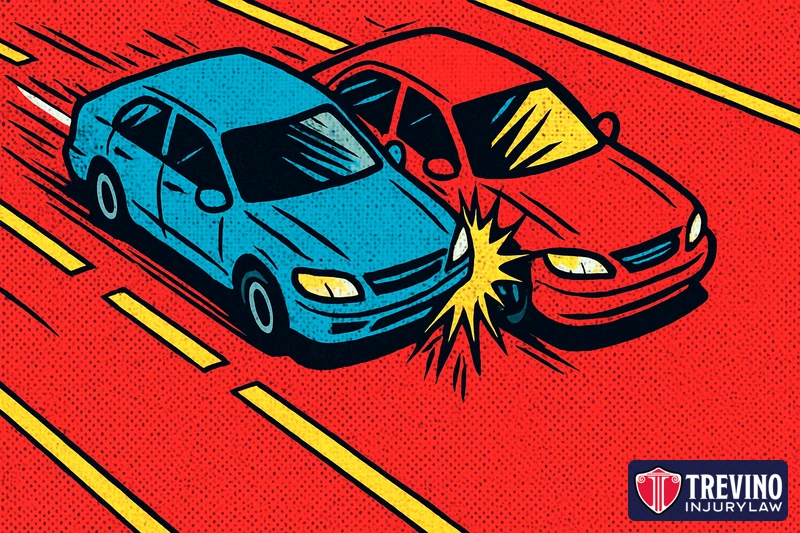
Because both cars are damaged along the side, scrape direction, paint transfer, and video usually decide who sideswiped whom. When both drivers made mistakes, Texas divides responsibility between them.
When both drivers share fault, Texas reduces your compensation by your percentage of responsibility under Chapter 33 of the Texas Civil Practice and Remedies Code. If a jury finds your damages are $100,000 and assigns you 20 percent of the fault, you recover $80,000.
You cannot recover anything if you are more than 50 percent at fault. This is known as the 51 percent bar rule, and it is why insurers work so hard to push your share of fault above that line.
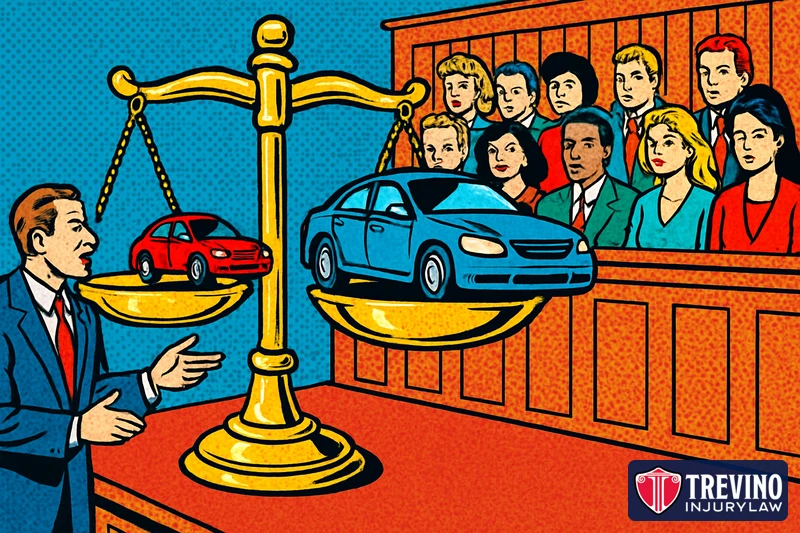
Fault percentages are not fixed when an adjuster names them. Evidence, expert analysis, and the prospect of a jury trial can move those numbers. The police report is usually the first document insurers point to, but it is not the final word.
Does the Police Report Decide Who Is at Fault?
No. The police report does not legally decide fault. The officer usually arrives after the crash and bases the report on the scene, the vehicles, and what drivers and witnesses said. Insurers give the report significant weight, but a jury decides fault based on all of the evidence.
If the report contains a factual error, such as the wrong direction of travel or a missing witness, it can be challenged with photos, video, and statements. When no officer responds, fault is proven with the evidence you and your lawyer collect. Insurance companies use the same evidence to make their own decision.
How Do Insurance Companies Determine Fault?
Insurance adjusters determine fault by reviewing the crash report, photos, vehicle damage, medical records, and recorded statements from the drivers. The other driver’s insurer has a financial interest in finding you partly responsible, because every percentage point of fault it assigns to you reduces its payment.
Be careful with early calls from the other driver’s adjuster. You are generally not required to give them a recorded statement, and an apology or a guess about your speed can later be used against you. Your own personal injury protection coverage pays regardless of fault, which helps with medical bills while the fault dispute is resolved. Our guide to what to do after a car accident in San Antonio covers how to protect your claim at the scene.
Quick Answers About Car Accident Fault in Texas
Does Getting a Ticket Mean I Was at Fault?
Not necessarily. A citation is evidence the insurer will use, but it is not a finding of civil fault. How you resolve the ticket can matter, so talk to a lawyer before you pay it or plead guilty.
Can Both Drivers Be at Fault in a Car Accident?
Yes. Texas juries often assign fault to more than one driver. You can still recover compensation as long as your share is 50 percent or less, reduced by your percentage.
How Long Does It Take to Determine Fault?
An insurer may reach an initial decision within a few weeks, but disputed fault can take months and may only be resolved by settlement or trial. Texas generally gives you two years from the crash to file a lawsuit.
Why Hire a San Antonio Car Accident Lawyer to Prove Fault?
Every percentage point of fault an insurer assigns to you comes out of your recovery. At Trevino Injury Law, we prepare every case for a Bexar County jury, and we secured a $17 million settlement in a head-on collision case involving three fatalities. Prior results do not guarantee a similar outcome.
Want to Protect the Full Value of Your Claim?
You’ve seen how this affects your case — but this is only one piece of the puzzle. Our San Antonio Car Accident Lawyer page breaks down what a trial-ready firm does differently.
We preserve video and crash data before it disappears, work with accident reconstruction experts, and challenge unfair fault findings. The sooner we start, the more evidence we can protect.
Call 210-TREVINO for a free case review. We operate on a strict no-win, no-fee basis. Se Habla Español.
