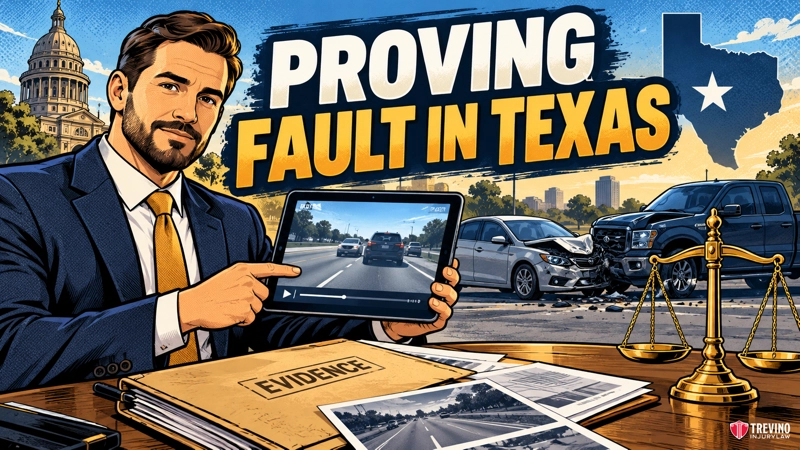
You prove fault with evidence, measured against a four-part legal test: duty, breach, causation, and damages. Whoever secures that evidence first controls the crash story.
The insurance adjuster is already writing that story. Before you hold a copy of your crash report, the adjuster takes the other driver’s version, leans on the officer’s opinion, and hunts for any fact that shifts a slice of blame onto you. Every point of fault assigned to you comes straight off what the insurer pays.
Some of the strongest proof sits inside a phone. The Texas Department of Transportation counted 91,442 crashes involving distracted drivers across Texas in 2024.
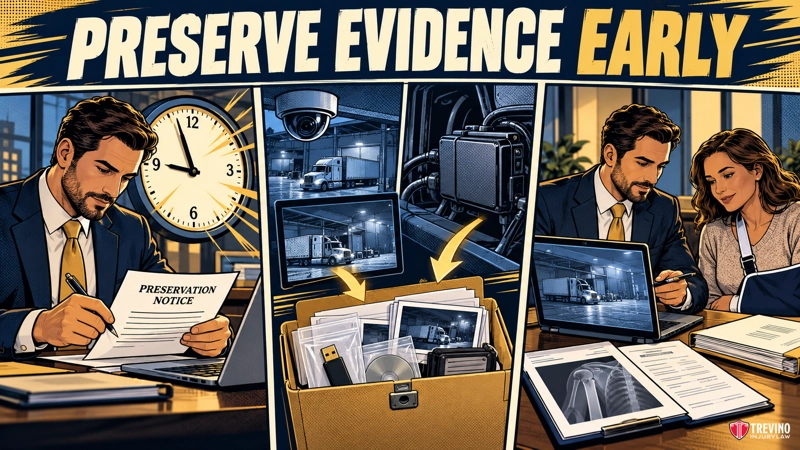
Send a spoliation letter now. It is a formal legal demand that the other side preserve video, phone records, and black box data. Wait, and recordings get overwritten, trucks get repaired, and the proof of fault disappears with them.
What Could Your Personal Injury Accident Case Be Worth?
Answer a few quick questions about your accident. Takes about 60 seconds.
See What My Case Might Be WorthThe insurance company offered less than $20,000. I ended up with over $1 million. — Jackie Galindo
Trevino Injury Law’s personal injury lawyers demand evidence in the first week and build every case to prove fault before a jury. Call 210-TREVINO. You pay nothing unless we win. Se Habla Español.
Key Takeaways – How Is Fault Proven in a Texas Personal Injury Case
- In Texas, you prove fault through negligence: duty, breach, proximate cause, and damages. If any one element is missing, the claim fails.
- You only need a preponderance of the evidence, meaning your version of events is more likely true than not.
- Video, black box data, phone records, witnesses, and expert analysis prove fault. The police report is the officer’s opinion, not a final ruling.
- A traffic violation can establish breach under negligence per se, but you still must prove causation and damages.
- Insurers shift blame because every percentage point of fault lowers what they pay. In Texas, recovery is barred if your share is greater than 50 percent.
- Employers and trucking companies can share responsibility, and evidence against them can disappear quickly, so preservation starts in the first week.
What Do You Have to Prove to Hold Someone at Fault in Texas?
You must prove negligence: the other party owed you a duty of care, breached that duty, and the breach caused injuries and losses you actually suffered. All four elements are required:
- Duty: the other party owed you a legal obligation to act with reasonable care.
- Breach: they failed to act as a careful person would.
- Proximate cause: that failure was a substantial, foreseeable cause of your injury.
- Damages: you suffered real, documented losses.
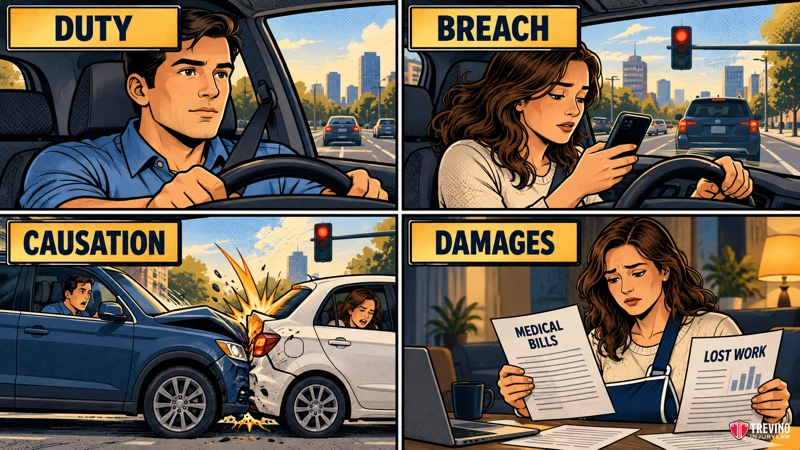
If the evidence fails on any one of them, the claim fails, no matter how badly you were hurt. Every other page in our Texas legal library builds on this test.
Duty and Breach: Measure How a Reasonable Person Would Have Acted
Duty is the legal obligation to act with reasonable care toward others, like a driver’s duty to watch the road. Breach is failing to meet that standard: speeding, running a light, or ignoring a spill in a store aisle. The question is never whether the defendant meant to hurt you. It is whether a careful person in the same position would have acted differently.
Proximate Cause Ties the Breach to Your Injury
Texas law calls the causal link proximate cause, and it has two parts. In Doe v. Boys Clubs of Greater Dallas, Inc., the Texas Supreme Court said that “the components of proximate cause are cause in fact and foreseeability.” Cause in fact asks whether the negligence was a substantial factor in bringing about the injury, without which the harm would not have occurred. Foreseeability asks whether a reasonable person would have anticipated the danger.
Damages Must Be Real and Documented
The final element is loss you can prove: medical bills, lost income, pain, physical impairment. What those losses are worth is a separate question with its own rules.
Who Actually Decides Fault: The Insurer, the Police, or a Jury?
Only a jury, or a judge in a bench trial, makes a binding finding of fault. The insurance adjuster‘s liability decision is a negotiating position. The officer’s crash report is an opinion. Both matter, because insurers price settlements around them, but neither one is the final word if the case goes to court.
Knowing what must be proven raises the next question: how much proof is enough to win.
How Much Proof Do You Need to Win a Texas Injury Case?
You need a preponderance of the evidence: proof that your version is more likely true than not. Picture a scale. You do not have to erase every doubt, as a prosecutor must in a criminal case. You only have to tip the scale past the midpoint. Cornell Law School’s Legal Information Institute describes the standard as convincing the fact finder “that there is a greater than 50% chance that the claim is true.”
You carry that burden, not the defendant. A higher bar, clear and convincing evidence, applies only to punitive (exemplary) damages. Insurers know the standard too. When proof is thin on even one element, they discount the whole claim.
Meeting that standard comes down to evidence, and some kinds of evidence carry far more weight than others.
What Evidence Proves Fault After an Accident?
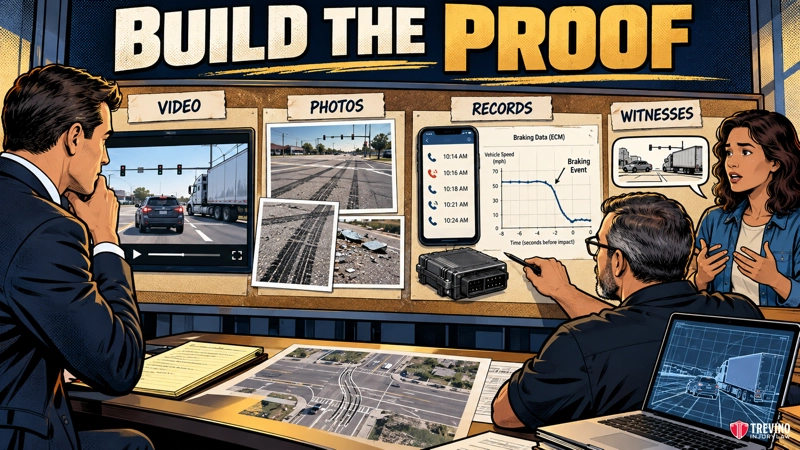
You prove fault with a combination of physical and digital evidence, witness testimony, documents, and, in serious or disputed cases, expert analysis. No single item wins a case. The strength comes from pieces that corroborate each other.
Physical and Digital Evidence Rarely Forgets
Video is the most persuasive evidence a jury sees. The physical and digital record usually includes:
- Dash cam footage and police body cam footage
- Business or traffic surveillance video
- Scene photos and vehicle damage, which show angles and force
- Phone records, when distraction is in question
Commercial trucks carry an Electronic Control Module (ECM), often called a black box, which records speed, braking, and throttle data in the seconds before a crash. A spoliation letter, a legal demand that the company preserve that evidence, is how the data is protected. See how a spoliation letter protects 18-wheeler black box data.
Do Eyewitnesses and the Other Driver’s Statements Matter?
Yes. Independent witnesses with no stake in the outcome carry real weight with juries. What the other driver said at the scene (“I didn’t see you,” “I was looking at my GPS”) can be used as evidence against them. The sooner you identify and interview witnesses, the more accurate and useful their accounts will be.
Do You Need an Accident Reconstruction Expert?
Not in every case. In a serious or disputed crash, an accident reconstructionist turns skid marks, crush damage, and electronic data into speed, timing, and sightline conclusions a jury can follow. Trevino Injury Law fronts all case expenses, experts included, so the cost of proving fault never falls on an injured client upfront.
Proving how the crash happened is half the case. The other half is proving the crash caused your injuries.
How Do You Prove the Accident Caused Your Injuries?
You prove it with three kinds of evidence:
- Medical records that connect the diagnosis to the event
- The timing of your treatment, starting as soon after the crash as possible
- A qualified expert’s causation opinion, when the injury is medically complex
In Guevara v. Ferrer, the Texas Supreme Court drew the line. Lay evidence can prove causation for basic conditions within common experience, like a broken bone right after a collision, when the sequence of events provides “a strong, logically traceable connection between the event and the condition.” Conditions outside jurors’ common knowledge require expert testimony.
Defense lawyers attack causation with two arguments: gaps in treatment and pre-existing conditions. Prompt, consistent treatment protects the causal link.
Some cases do not require building breach from scratch, because the law treats certain violations as proof on their own.
Can a Traffic Violation Prove the Other Driver Was at Fault?
Often, yes. Under negligence per se, violating a safety statute can establish breach without arguing what a reasonable driver would have done. In Perry v. S.N., the Texas Supreme Court described the doctrine as “the unexcused violation of a legislative enactment or an administrative regulation which is adopted by the court as defining the standard of conduct of the reasonable man.” Courts decide which statutes qualify. Rules of the road written to prevent collisions, like red-light and failure-to-yield rules, are the classic examples. You still must prove causation and damages.
Distracted Driving as Evidence of Breach
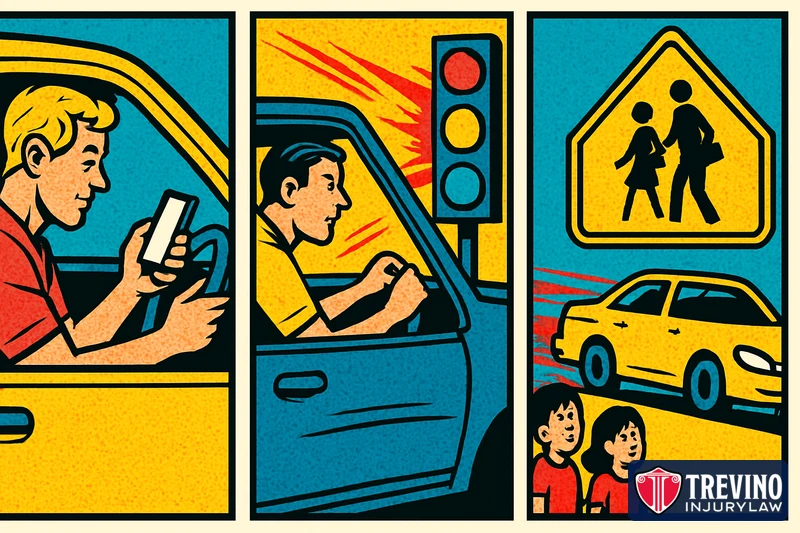
Texting or other phone use behind the wheel is a frequent way drivers breach their duty of care. In Bexar County, the Texas Department of Transportation counted 17,761 crashes involving distracted drivers in 2024, with 58 deaths. Here is how to prove the driver who hit you was texting.
A citation is one piece of official paperwork. Most people assume the police report settles the question.
Does the Police Report Decide Who Was at Fault?
No. The crash report reflects the investigating officer’s opinion, formed after the fact from what the officer saw and was told. Insurers lean on it heavily, but it does not bind a jury. Texas Rule of Evidence 803(8) allows certain public records, including factual findings from a legally authorized investigation, to be admitted in civil cases, unless the opposing side shows the information is untrustworthy. How much of a given report comes in, and whether an officer’s conclusions about fault are admissible, is argued case by case.
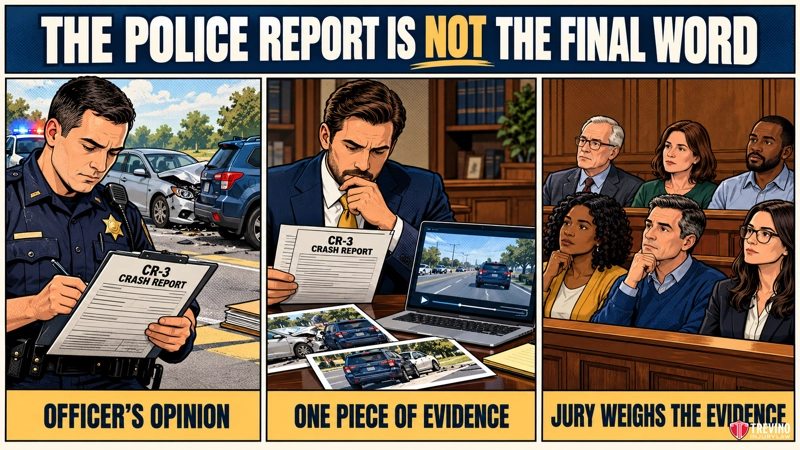
In Texas, that document is the CR-3 crash report. Start by getting your CR-3 crash report in San Antonio from the San Antonio Police Department or the agency that worked the crash.
If your CR-3 contains a factual error, like the wrong name, plate, or insurance carrier, you can often correct or supplement it. An officer’s opinion about who caused the crash rarely changes; see whether a police officer can change a police report.
Even if the report is clear, expect the insurance company to build its own version of fault.
What Happens When the Insurance Company Says the Crash Was Your Fault?
Blame-shifting is a negotiation tactic, not a finding. Every percentage point of fault an adjuster assigns to you cuts what the insurer has to pay, so the insurer has a financial reason to find it. Under Tex. Civ. Prac. & Rem. Code § 33.001, “a claimant may not recover damages if his percentage of responsibility is greater than 50 percent,” and any recovery at or below that line shrinks by your share. Learn how the Texas 51% rule reduces or bars recovery.
We see this play every week. One client put it plainly: “The 18-wheeler driver tried to say I was speeding, and the crash was all my fault… The case settled about one year after the crash for close to the maximum amount available.” (Roland Cardenas). The answer to blame is evidence, gathered before the insurer’s version hardens into the official one.
Blame isn’t only pushed onto you. It also gets pushed away from the companies that should share it.
Can Someone Other Than the Driver Be Legally Responsible?
Yes. Employers can be vicariously liable for an employee’s negligence on the job, and companies can be directly liable for their own negligence in hiring, training, entrusting vehicles, or maintaining equipment.
Employers Answer for Employees Acting Within the Scope of the Job
The doctrine is called respondeat superior, meaning “let the master answer.” In Painter v. Amerimex Drilling I, Ltd., the Texas Supreme Court held that the plaintiff must show that, at the time of the negligent conduct, the worker “(1) was an employee and (2) was acting in the course and scope of his employment.” A related doctrine, negligent entrustment, reaches owners who hand their vehicle to a driver they knew or should have known was unsafe. Here is how vicarious liability works in Texas.
Why Do Trucking Cases Usually Involve More Than One Defendant?
A commercial crash can implicate several parties, each with separate evidence and separate insurance:
- The driver
- The motor carrier
- A broker or shipper
- A maintenance vendor
San Antonio’s heavy commercial truck traffic from Mexico trade along I-35 makes these multi-defendant cases common here.
Every defendant on that list has one thing in common: the evidence against them sits in their own hands, and it will not stay there forever.
Why Does Proving Fault Get Harder the Longer You Wait?
Video gets overwritten, vehicles get repaired or scrapped, electronic data is lost, and witnesses forget. The companies holding that evidence have no incentive to volunteer it. That is why Trevino Injury Law acts in the first week. Our first-week process:
- An attorney, not just staff, reviews the case from day one.
- We analyze the police report.
- We identify potential dash cam and body cam footage.
- We send public records requests immediately.
- We secure video, witness statements, and medical records in court-admissible formats.
Speed matters because government agencies move slowly. In our experience, responses to FOIA and Texas Public Information Act requests can take 6 to 9 months. Settlement mills often settle before that footage ever arrives. We make sure it is requested, preserved, and in hand before trial.
A few questions about fault come up in nearly every consultation, and each has a short answer.
What Are the Different Types of Negligence in Texas?
Texas recognizes several types of negligence, and the type you can prove affects both liability and the damages available:
- Ordinary negligence: failing to use the care a reasonable person would use in the same situation, such as a driver who looks at a phone and rear-ends traffic.
- Negligence per se: breaking a safety statute, such as running a red light, when the law was meant to protect people like you from the harm that occurred. The violation itself can establish the breach of duty.
- Gross negligence: knowing about an extreme risk and consciously ignoring it. Under Chapter 41 of the Texas Civil Practice and Remedies Code, proof of gross negligence by clear and convincing evidence can support exemplary damages.
- Vicarious liability: holding an employer or vehicle owner responsible for someone else’s negligence, covered in the section on parties other than the driver above.
Texas does not use the old contributory negligence rule that bars any recovery for a partly at-fault plaintiff. Instead, it applies proportionate responsibility: your damages are reduced by your percentage of fault, and you recover nothing only if you are more than 50 percent responsible.
Quick Answers About Proving Fault in Texas
Is Texas an At-Fault State?
Yes. Texas uses an at-fault system, so you file injury claims against the responsible party and their liability insurance.
Yes. When several parties contributed to a crash, a Texas jury assigns each one a percentage of responsibility.
Is Fault Proven the Same Way in a Slip and Fall?
The same four elements apply, but premises cases usually turn on whether the owner knew, or should have known, about the hazard.
Do You Need a Lawyer to Prove Fault?
Not legally. But the other side will have one, plus an adjuster whose job is to assign you blame. Learn the difference between trial lawyers and settlement mills.
Why Hire a San Antonio Personal Injury Lawyer?
Because fault is won or lost on evidence, and evidence does not wait. A San Antonio personal injury lawyer at Trevino Injury Law sends the spoliation letter, requests body cam and dash cam footage through public records requests, and retains an accident reconstructionist when the insurer disputes how the crash happened. Settlement mills accept the adjuster’s version of fault to close files fast. We build the proof to beat it in front of a South Texas jury.
Prove What Really Happened
Trevino Injury Law sends spoliation letters, requests dash cam and body cam footage, and brings in reconstruction experts before the evidence disappears. Every case is built to prove fault before a jury, not accept the adjuster’s version.
Trevino Injury Law has tried more than 80 cases across South Texas courts, including a $536,007 jury verdict after an insurer offered $5,000 and a $291,550 jury verdict after a $25,000 offer, both secured at trial. Work with a personal injury team that prepares every case for a jury.
Call 210-TREVINO for a free case review. Se Habla Español. No Win, No Fee.