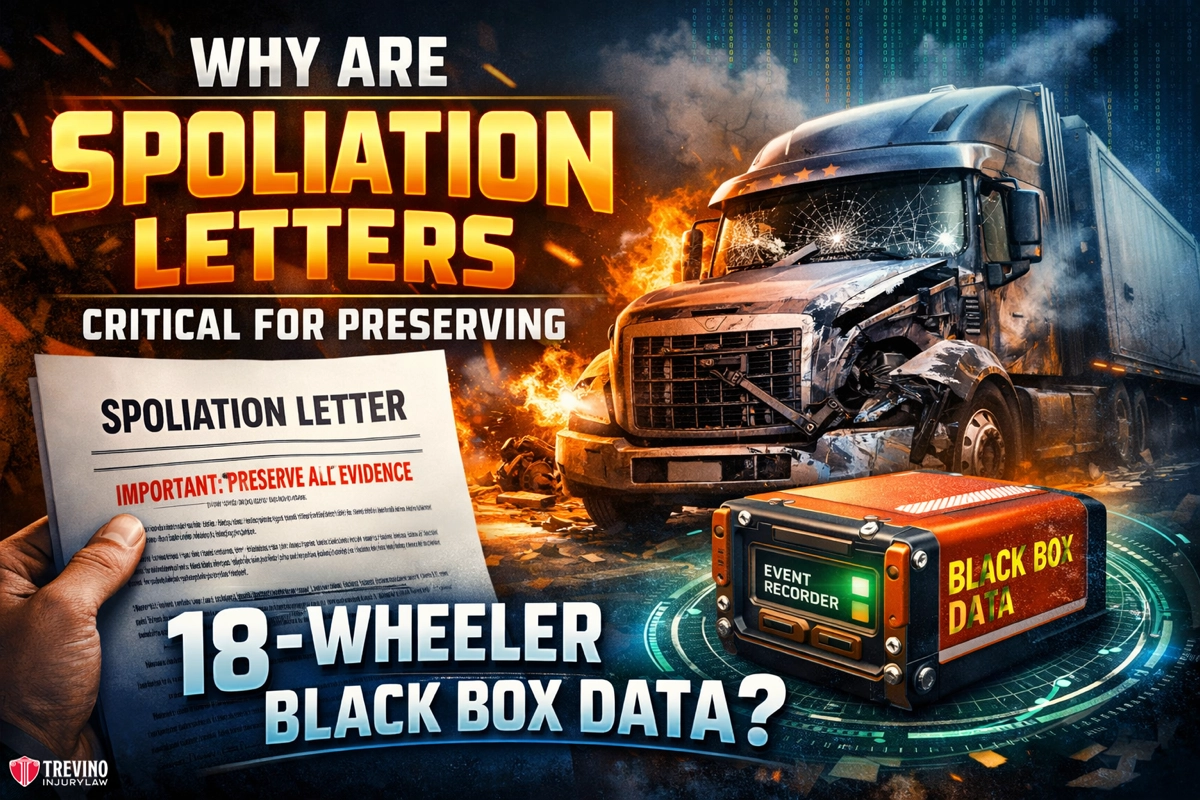
A spoliation letter, a legal demand that stops a corporate defendant from destroying evidence, locks down the 18-wheeler’s black box data before the trucking company can overwrite it. The electronic control module records the truck’s exact speed, hard braking, steering inputs, and Hours of Service data from the seconds before impact.
The carrier’s rapid-response team is already moving to return the truck to service. Once it resumes normal operations, the continuous recording loop erases the critical-event data, and the case becomes a he-said-she-said built on memory. According to the National Safety Council, 70 percent of injuries in large-truck crashes in 2023 were sustained by occupants of other vehicles, not the driver of the truck. The defense knows you are the one in the hospital, and they will shift the blame onto you the moment that data is gone.
What Could Your 18-Wheeler Accident Case Be Worth?
Answer a few quick questions about your accident. Takes about 60 seconds.
See What My Case Might Be WorthThe insurance company offered less than $20,000. I ended up with over $1 million. — Jackie Galindo
Texas law lets carriers overwrite this evidence within days if you haven’t served a preservation demand. Send a formal spoliation letter immediately, naming the tractor’s VIN, the ECM, and any connected dash-cam footage.
At Trevino Injury Law, our semi truck accident lawyers serve the demand the same week and force a Bexar County jury to weigh the data, not the trucking company’s story. Call 210-TREVINO for a free case review. You pay nothing unless we win. Se Habla Español.
What Exact Digital Evidence Does a Commercial Truck’s Black Box Record?
A commercial truck’s black box, also called the Electronic Control Module (ECM), objectively records the vehicle’s speed, braking patterns, steering inputs, and exact hours-of-service data in the critical seconds before an impact on busy corridors like Loop 410.
When a catastrophic crash occurs on major freight routes in San Antonio, the electronic control module serves as an unbiased digital witness. These systems run on continuous recording loops, capturing technical metrics that show when a commercial driver violates federal safety regulations. As a plaintiff trial law firm, we aggressively analyze these data points to reconstruct the exact sequence of events, proving whether the driver was:
- Fatigued behind the wheel
- Speeding recklessly
- Ignoring critical safety warnings
The data extracted from this hardware provides undeniable proof that insurance adjusters cannot simply talk their way out of it during litigation. Texas courts vigorously protect the right to discover and extract this highly technical electronic data, guided by landmark frameworks such as In re Weekley Homes, L.P., 295 S.W.3d 309 (Tex. 2009), which governs the proper preservation and forensic recovery of electronic storage devices.
How Does Dash Cam and Body Camera Footage Supplement ECM Data?
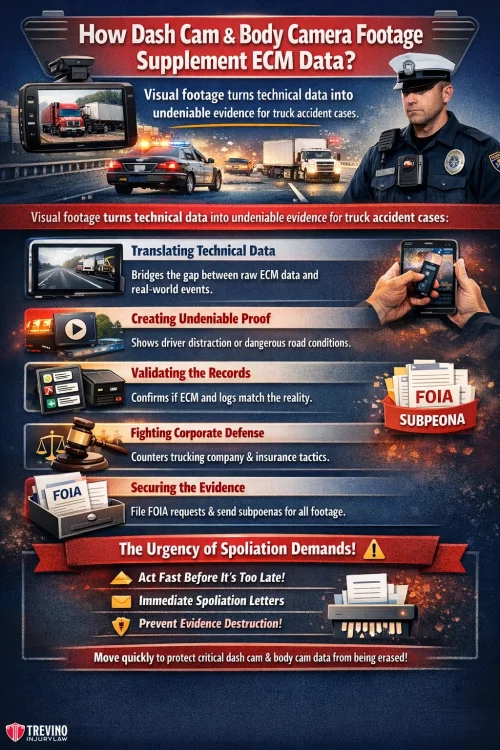
Dash cam and police body camera videos provide undeniable visual proof of driver distraction and road conditions, and they must be secured through FOIA requests and aggressive subpoenas immediately after the collision to corroborate the digital metrics. For victims of a serious truck accident, this footage serves as crucial evidence that complements digital metrics.
Here is how visual footage supplements ECM data to build a stronger case:
- Translating Technical Data: While the truck’s computer records the mechanical inputs, visual evidence transforms those abstract numbers into a compelling reality for Bexar County juries. It bridges the gap between raw technical data and the visible events leading up to the accident.
- Creating Undeniable Proof: Video acts as physical evidence and data that can prove exactly what happened. It provides visual evidence that could prove a truck driver’s negligence, such as showing the driver texting right before the crash.
- Validating the Records: By comparing visual footage with the truck’s black box and driver logs, attorneys can verify whether the electronic logs tell the whole truth or contain discrepancies.
- Fighting Corporate Defense: Trucking companies may try to shift the blame or quickly return vehicles to service. Using camera footage alongside the term “black box” metrics helps level the playing field against massive insurance companies.
- Securing the Evidence: Securing this footage requires filing Freedom of Information Act requests for body-camera footage from the San Antonio Police Department or the Bexar County Sheriff’s Office, and subpoenaing the carrier’s internal cab surveillance systems. We have a dedicated page on securing 18-wheeler dash cam evidence in Texas that walks you through the exact authentication and FOIA process.
The Urgency of Spoliation Demands: To secure any of this data, we must act quickly, as the window is rapidly closing and it could be lost forever. The spoliation letter is one component of the full 18-wheeler accident evidence-preservation protocol that locks down every category of perishable evidence.
Your lawyer must immediately send spoliation letters (formal letters to the trucking company); without them, trucking companies often overwrite this data. Sending a spoliation letter to the trucking company guarantees consequences if they destroy evidence after receiving it.
How Quickly Can a Trucking Company Legally Destroy ECM Data Without a Preservation Demand?
Commercial trucking companies can legally allow critical black box memory to be overwritten by normal driving operations within just a few weeks, or even days, if a plaintiff’s trial lawyer does not immediately serve a formal spoliation letter. Under Texas law, a corporate defendant’s legal duty to preserve evidence is triggered only when it knows or reasonably should know that there is a substantial chance a claim will be filed against it, a strict standard established by the Texas Supreme Court in Wal-Mart Stores, Inc. v. Johnson.
Standard operating protocols are designed to protect corporate interests, which means a semi-truck is often returned to service shortly after an accident. Once the vehicle resumes driving, the continuous data loop naturally erases the preceding critical-event data, effectively destroying evidence of negligence. This creates urgent pressure in the first week after a crash.
While the victim is fighting for their life in a facility like University Hospital in the Medical Center, the trucking company’s rapid response team is already working to mitigate their liability. Our immediate attorney involvement ensures this evidence is locked down before the carrier can execute these routine overwrites.
The threat of litigation forces them to halt these destructive operational procedures immediately. This intentional destruction of evidence to protect corporate interests raises the question of what happens when a company ignores these legal demands.
What Are the Legal Penalties in Texas If a Trucking Company Deletes Black Box Data?
Under Texas law, if a commercial carrier destroys ECM data after receiving a spoliation letter, trial courts may impose severe sanctions, including an adverse inference instruction that allows the jury to assume the destroyed evidence would have proved the trucking company’s guilt.
The Texas legal system provides powerful tools to punish defendants who intentionally destroy evidence. The landmark Texas Supreme Court decision in Brookshire Bros., Ltd. v. Aldridge established strict spoliation guidelines, empowering Bexar County trial courts to impose heavy penalties on commercial carriers.
If a trucking company allows data to be overwritten on vehicles operating along corridors such as Culebra Road after receiving a preservation demand, we aggressively seek sanctions. An adverse inference instruction essentially tells the jury that the missing black box data would have confirmed the driver’s negligence, crippling the defense’s case.
By acting as the trial authority, we use these legal precedents to compel massive insurers like State Farm or Progressive to preserve the data, or face devastating consequences before a jury. Once the threat of these severe courtroom penalties protects the data, we must examine how your legal team weaponizes it.
How Does Your Attorney Use a Spoliation Letter to Prove Driver Negligence?
Your San Antonio plaintiff trial lawyer uses the digital data preserved by a formal spoliation letter to definitively prove that a commercial truck driver was speeding, fatigued, or driving aggressively in the critical moments before crashing into your family’s vehicle.
Once we force the negligent trucking company to hand over its electronic control module records, we use those irrefutable metrics to completely dismantle the insurance adjuster’s defense.
Moving from the technical rules of preservation to the practical application of litigation, this data becomes our primary weapon for defeating lowball settlement offers from massive insurers like State Farm, GEICO, and Allstate. According to 2023 National Safety Council data, 70% of injuries in large-truck crashes are sustained by occupants of other vehicles, not by truck drivers. Knowing the statistical reality of these lopsided impacts, these corporate defenders routinely attempt to shift the blame onto the injured victim, claiming you swerved or stopped short.
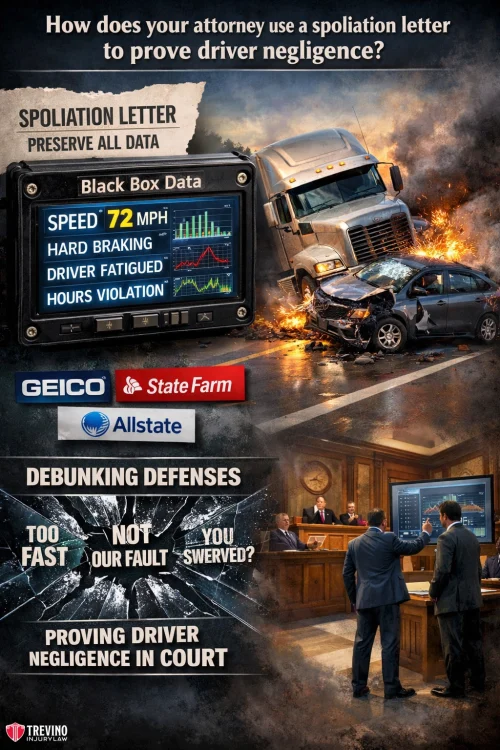
However, when we present objective, black-box evidence showing their driver’s hard braking, excessive speed, or hours-of-service violations, those delay tactics instantly collapse. As a trial-ready law firm, we take this preserved evidence directly into the courtroom to force these corporate defendants to pay full compensation for the catastrophic injuries they caused.
Understanding how this preserved evidence compels insurance companies to pay full value is crucial to knowing exactly which legal elements render these preservation demands enforceable in Texas.
What Specific Legal Elements Must a Valid Texas Spoliation Letter Contain?
A valid spoliation letter in Texas must clearly identify the anticipated litigation, explicitly demand preservation of specific electronic control modules, and cite the carrier’s legal duty to halt routine data-destruction protocols. Without these elements, the document lacks the enforcement power needed in Bexar County courts.
When litigating commercial crashes on dangerous corridors like the “Mixing Bowl” interchange, a generic letter is insufficient. The demand must be technically exhaustive to prevent insurance defense teams from claiming ambiguity. At Trevino Injury Law, our preservation demands specify the exact vehicle identifiers, data points, and hardware references needed to lock down the evidence. To ensure compliance, the letter must demand the preservation of:
- The tractor-trailer’s specific DOT number, license plate, and VIN.
- All ECM data points, including hard braking, steering inputs, and precise speed metrics.
- The physical hardware components and any secondary event data recorders.
- Any connected dash cam or inward-facing cab surveillance footage.
By outlining these exact elements, we leave negligent trucking companies no room to conveniently “lose” the data. Addressing common misconceptions about who can execute this demand is critical for protecting your case.
Can You Send a Spoliation Letter Without Hiring a Truck Accident Attorney?
No, while physically possible, sending a spoliation letter without a trial-tested attorney is highly ineffective because massive trucking corporations routinely ignore demands that are not backed by the imminent threat of formal litigation.
Insurance adjusters and corporate defense teams know that unrepresented victims lack the legal leverage to enforce court sanctions, so they will simply allow the standard operational overwriting of the black box to proceed.
Do Spoliation Letters Apply to Truck Driver Logbooks and Dispatcher Records?
Yes, a comprehensive spoliation letter specifically mandates the preservation of driver logbooks, dispatcher communications, and maintenance records to prove hours-of-service violations.
In 2023 alone, the National Safety Council reported a staggering 153,452 injuries resulting from large-truck crashes nationwide. Given this massive scale, a commercial truck crash is rarely just about an isolated impact; it is often the result of systemic corporate negligence, making these supplemental records just as vital as the ECM data for securing maximum compensation.
Federal FMCSA Data Retention Rules vs. Texas State Preservation Laws
Commercial evidence preservation requires navigating both federal FMCSA baseline data-retention regulations and stringent Texas state laws governing the intentional destruction of evidence in anticipation of litigation. These two legal frameworks operate differently, but a plaintiff trial lawyer uses both to construct an impenetrable wall of evidence protection.
The Federal Motor Carrier Safety Administration (FMCSA) sets the minimum retention period for certain records that a trucking company must keep before legally discarding them. However, Texas common law spoliation duties supersede those baseline timelines the moment a carrier reasonably anticipates a lawsuit.
| Evidence Type | FMCSA Minimum Retention Period | Texas Common Law Spoliation Duty |
| Driver Logbooks (HOS) | 6 months | Indefinite preservation upon notice |
| Vehicle Maintenance Records | 1 year (or 6 months after sale) | Indefinite preservation upon notice |
| ECM / Black Box Data | No specific federal minimum for ECM | Immediate preservation required upon legal demand |
| Dispatcher Communications | Varies (often 6 months) | Indefinite preservation upon notice |
When a trucking company tries to hide behind federal minimums after destroying evidence, we use Texas precedent to hold them accountable in court. Understanding what is lost when these systems fail is essential.
What Happens to Your Personal Injury Claim Without Black Box Evidence?
Without black box evidence to objectively prove the truck’s speed and braking, your personal injury claim becomes a vulnerable “he-said, she-said” battle where corporate insurance adjusters will actively twist the narrative to blame you for the crash. This absence of irrefutable digital proof is exactly what settlement mills and corporate defendants hope for.
When critical ECM data is lost because a preservation letter was not sent in time, the defense will immediately attempt to minimize catastrophic injuries and deny wrongful death claims. They will argue that you merged improperly on I-35 or stopped too suddenly, forcing you to rely solely on human memory and witness testimony, which they will aggressively attack.
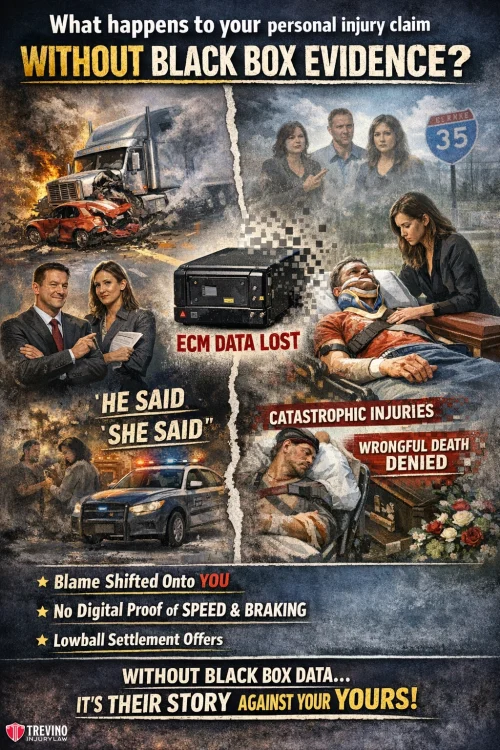
This lack of objective data significantly reduces your leverage in settlement, making it incredibly difficult to secure a maximum payout. Defining the extreme limits of this preservation tool helps set realistic expectations for recovery.
When Does a Spoliation Letter Not Guarantee the Recovery of Crash Data?
A spoliation letter cannot guarantee data recovery if the commercial vehicle’s ECM was completely physically annihilated in an explosive, catastrophic crash, or if the letter is sent after the legal statute of limitations has already expired. While the letter is a powerful legal shield, it cannot resurrect data from hardware burned or crushed beyond the limits of digital forensic recovery.
In these rare edge cases, a skilled San Antonio personal injury lawyer must pivot strategies. If the electronic control module is unreadable, we rely heavily on expert accident reconstruction, tire skid mark analysis, and secondary evidence to prove negligence. Furthermore, if you wait months to hire an attorney, the letter cannot retrieve data that standard operating procedures already erased weeks prior.
Why Hire a San Antonio Truck Accident Lawyer?
You hire an 18-wheeler accident lawyer at Trevino Injury Law to lock down the black box data before the carrier overwrites it, force the trucking company into a Bexar County courtroom on the ECM evidence, and reject the predatory offer that closes your file before your future surgeries surface.
We serve the spoliation letter, a legal demand that stops the trucking company from destroying evidence, in the first week. We subpoena cab surveillance footage and file FOIA requests for body-cam footage. Settlement mills wait until the data is gone. We do not.
Want to Protect the Full Value of Your Claim?
You’ve seen how this affects your case—but it is only one piece of the puzzle. Our 18 Wheeler Accident Lawyer page breaks down what a trial-ready firm does differently.
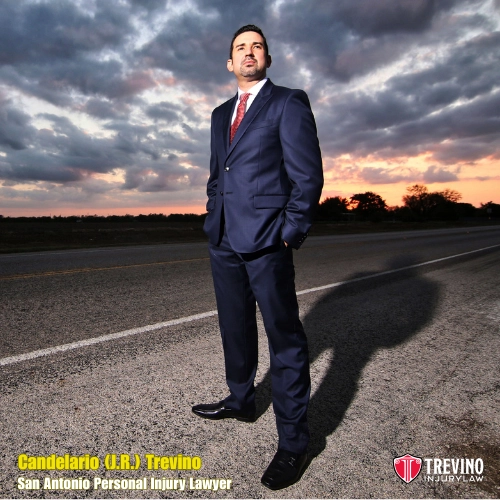
The $17 million wrongful death settlement and the $2.2 million 18-wheeler settlement prove what happens when Trevino Injury Law’s personal injury trial lawyers in Bexar County force carriers to settle on the ECM evidence rather than let the adjuster price catastrophic injuries into a lowball offer near the Bexar County Courthouse.
Call 210-TREVINO for a free case review. Se Habla Español. No Win, No Fee.