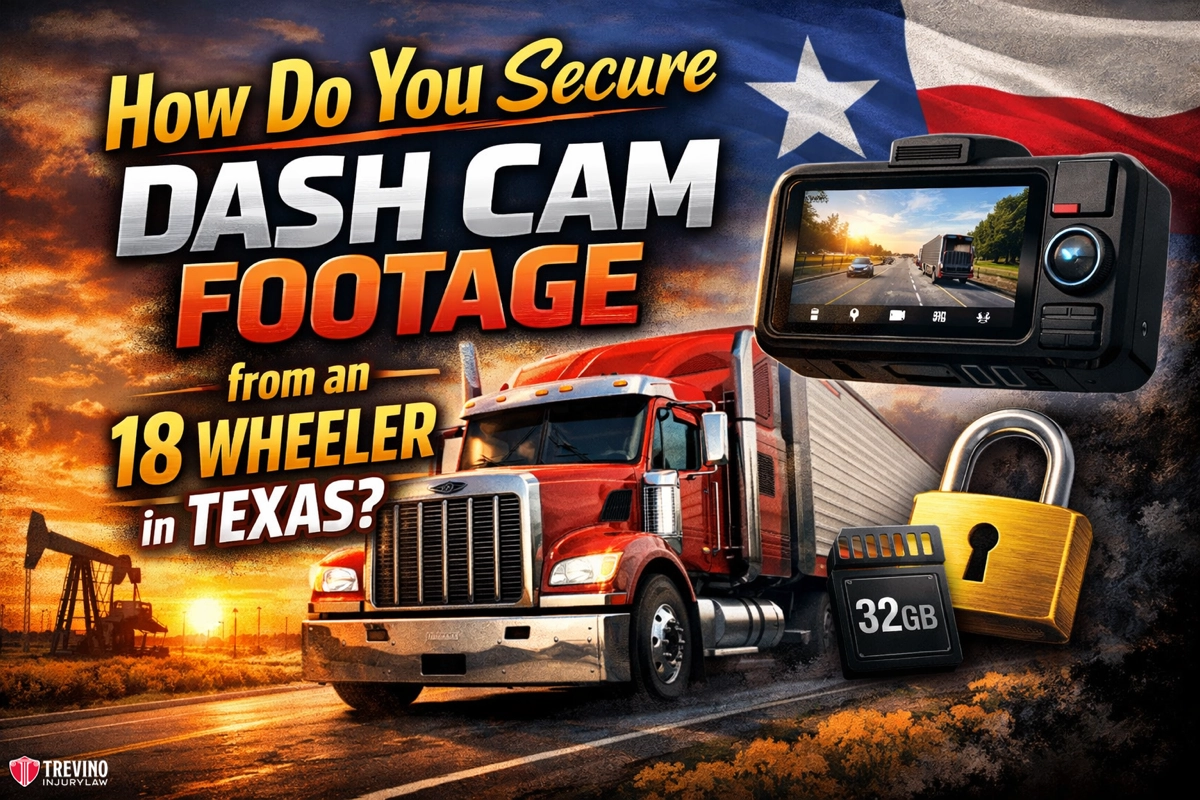
You secure commercial dash cam footage by filing an immediate legal demand before the corporate defense team erases the data. The recording inside that cab proves the driver was texting, falling asleep, or violating federal regulations in the seconds before impact.
Major insurers and rapid-response units are already securing the crash scene to retrieve the interior video before you leave the hospital. According to the National Safety Council Injury Facts 2023 data, fatal crashes involving large trucks surged by 43% over the previous decade. Because corporate liability is a massive financial threat, standard company policy allows these camera systems to overwrite digital evidence in a continuous loop within days.
What Could Your 18-Wheeler Accident Case Be Worth?
Answer a few quick questions about your accident. Takes about 60 seconds.
See What My Case Might Be WorthThe insurance company offered less than $20,000. I ended up with over $1 million. — Jackie Galindo
That visual proof vanishes without aggressive intervention. You must immediately send a spoliation letter, a legal demand that requires the negligent trucking company to stop destroying evidence. Texas law punishes intentional destruction of digital files, but only if you are legally required to preserve them before the deletion cycle completes.
At Trevino Injury Law, a big rig wreck lawyer will subpoena these corporate systems to secure your digital evidence. Call 210-TREVINO for a free case review. You pay nothing unless we win. Se Habla Español.
How Do You Legally Demand Dash Cam Footage From a Negligent Trucking Company?
To legally demand dash cam footage from a negligent trucking company, a plaintiff trial lawyer must immediately send a formalized Spoliation Letter that prohibits the destruction of the electronic control module and crucial video data before the corporate defense team can erase the evidence.
Fatal crashes involving large trucks have surged by 43% over the last ten years, making corporate liability a massive financial threat to the transportation industry. Because the stakes are so high, major insurers like State Farm and corporate trucking fleets use rapid-response teams to secure crash scenes on I-35 and Loop 410, often pulling dash-cam video before the victim even leaves the hospital. (National Safety Council (NSC) Injury Facts, 2023 Data.)
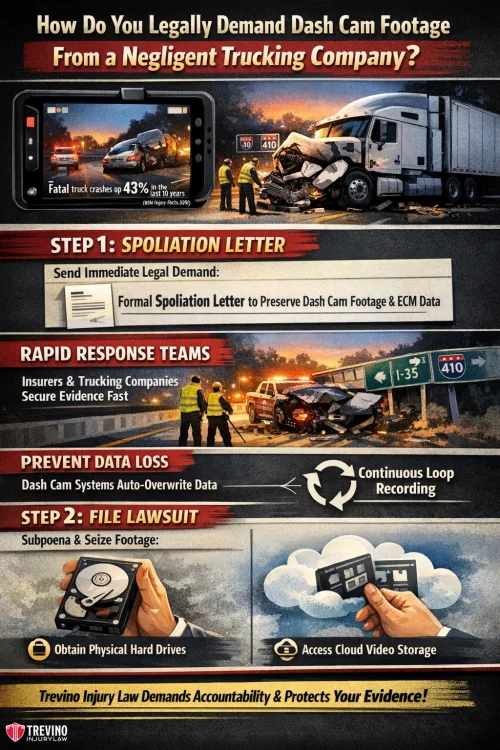
Without immediate legal intervention, standard company policy allows these camera systems to overwrite data in a continuous loop. Trevino Injury Law stops this by filing an aggressive, legally binding preservation demand as part of our full process to preserve 18-wheeler accident evidence in San Antonio. We then file a lawsuit to formally subpoena the physical hard drives and cloud-stored video logs directly from the carrier’s safety department.
How Quickly Does Dash Cam Memory Overwrite After a South Texas Crash?
Commercial dash cam memory systems typically overwrite their stored footage every 48 to 72 hours in a continuous loop unless a critical event triggers an automatic save or a trial-ready lawyer intervenes immediately to demand the preservation of this vital digital evidence.
Modern commercial fleets utilize continuous-loop recording systems that require rapid action. To understand the timeline, consider these retention periods:
- Standard SD cards generally overwrite data within 48 to 72 hours, depending on capacity.
- Cloud-uploaded telematics data may be retained longer, but may be restricted by internal corporate policies.
- Critical event triggers (such as hard braking) may capture a short clip, but the surrounding context is quickly lost.
What Happens If the Trucking Company Deletes the Video After Receiving a Spoliation Letter?
If a negligent Trucking Company intentionally deletes video evidence after receiving a formalized Spoliation Letter, a Bexar County judge can issue a spoliation instruction. This severe judicial penalty tells the jury to presume the destroyed video definitively proved the company’s gross negligence and liability for the crash.
This mechanism is strictly governed by the landmark Texas Supreme Court case Brookshire Bros., Ltd. v. Aldridge, 438 S.W.3d 9 (Tex. 2014), which establishes that trial courts have broad discretion to impose severe sanctions when a party intentionally destroys crucial electronic evidence.
The landmark Texas Supreme Court decision in Brookshire Bros., Ltd. v. Aldridge strictly governs the destruction of evidence and the severe consequences that follow. Trevino Injury Law uses this severe judicial penalty to secure higher settlements when corporate entities attempt to hide dash-cam footage.
Because our firm has successfully taken over 80 cases to trial, defense teams know we will aggressively pursue these sanctions in court. Securing the video from destruction is critical, but securing the evidence means we must next ensure the court will allow the jury to see it.
Is Commercial Dash Cam Footage Admissible in a Texas Court?
Yes, commercial dash cam footage is highly admissible in Texas civil courts, provided your San Antonio personal injury lawyer can properly authenticate the video and establish a clear chain of custody. We must definitely prove to the judge that the digital file has not been digitally altered by the defense.
The admissibility and probative value of video evidence in Texas is reinforced by cases like Diamond Offshore Services Ltd. v. Williams, 542 S.W.3d 539 (Tex. 2018), which highlights how properly authenticated video recordings provide critical, objective evidence that a Bexar County jury can use to independently evaluate the severity of the incident.
Securing the video is only the first battle; getting it before a Bexar County jury requires overcoming the defense’s aggressive objections. Insurance defense lawyers will routinely argue that the footage lacks context, is corrupted, or violates privacy.
A trial-tested lawyer anticipates these tactics and uses the Texas Rules of Evidence to firmly establish the chain of custody for the footage. We use this unblinking electronic witness to expose the exact speed, lane position, and braking response of the 18-wheeler in the moments before impact.
What Legal Foundation is Required to Authenticate Truck Crash Video?
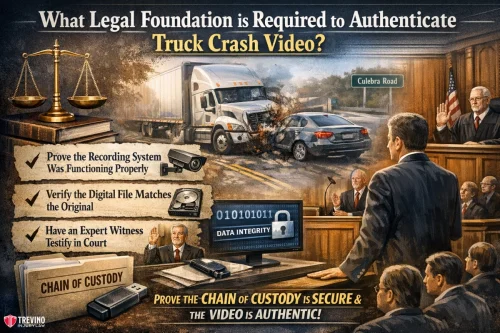
To successfully authenticate a truck crash video, your trial lawyer must clearly demonstrate that the commercial recording device was operating correctly, the footage accurately depicts the catastrophic crash on routes like Culebra Road, and absolutely no digital tampering or deceptive editing occurred after the fact.
The Texas Rules of Evidence require a strict chain of custody from the trucking company’s IT department to the courtroom. This process requires:
- Proving the video system was well-maintained and functioning accurately on the day of the crash.
- Demonstrating that the extracted digital file exactly matches the original recording.
- Having a qualified witness testify that the video fairly and accurately represents the events as they occurred.
Will San Antonio Police Investigate and Seize the Truck’s Dash Cam Footage?
San Antonio Police may view dash cam footage to determine criminal citations at the scene, but they rarely seize or preserve the physical video for your future civil personal injury lawsuit against the negligent trucking company.
There is a vast difference between a criminal traffic investigation and a civil liability investigation. Victims cannot rely on SAPD to subpoena an 18-wheeler’s telematics or secure corporate video data. While you do not have to explicitly tell cops you have a personal dash cam, voluntarily providing it can help ensure the crash report accurately reflects the truck driver’s fault.
Our firm assumes responsibility for securing this critical evidence immediately. Recognizing that police do not secure private corporate video makes it critical to secure the video that law enforcement generates.
How Do San Antonio Truck Accident Attorneys Use Cab-Facing Cameras to Prove Liability?
We use internal cab-facing cameras to definitively prove a commercial truck driver was illegally texting, falling asleep at the wheel, or violating strict FMCSA distracted driving regulations in the exact seconds before causing a catastrophic collision that devastates a family.
Many modern 18-wheelers are equipped with sophisticated dual-facing camera systems. Here is exactly how we use this internal corporate technology against the defense:
- Unbiased, Real-Time Evidence: When a semi-truck causes a crash, fleet managers often rely on conflicting stories or hazy eyewitness accounts to shift blame. Modern dash cam technology cuts through the lies to provide an unbiased, real-time record of the driver’s actions.
- Enforcing Driver Accountability: Corporate fleet management claims their dash cam solutions are installed for driver safety, to ensure fleet safety, and to protect your drivers from false claims. We aggressively subpoena these systems to enforce strict driver accountability and expose fraudulent defenses.
- Capturing Driving Behaviors: The best dash cam systems on commercial vehicles use wide-angle, high-quality lenses. This provides unblinking daytime and nighttime visibility from inside the cab, exposing the root cause of the negligence.
- Preventing Evidence Deletion: Truck dash cams can also use smart features to send an alert in the event of a crash. These units use wireless connections to upload dashboard footage to secure cloud storage, preventing a panicked trucker from intentionally deleting evidence at the scene.
Trucking companies fight fiercely to hide this internal footage because it completely destroys their defense. Trevino Injury Law aggressively pursues these specific interior files to prove gross negligence, thereby dramatically increasing the value of a settlement and opening the door to punitive damages.
How Does a FOIA Request Secure Police Body Camera Video After a Bexar County Crash?
We aggressively file a Freedom of Information Act (FOIA) request directly with the local police department or the Texas Department of Public Safety to compel the immediate release of the investigating officers’ body-camera recordings and cruiser dash-cam footage following a devastating Bexar County commercial-vehicle collision.
Securing private corporate video from the trucking company is only half the battle; public law enforcement video is equally critical. Police body cams often capture the truck driver making contradictory statements, admitting extreme fatigue, or even apologizing to victims immediately after the wreck at the scene.
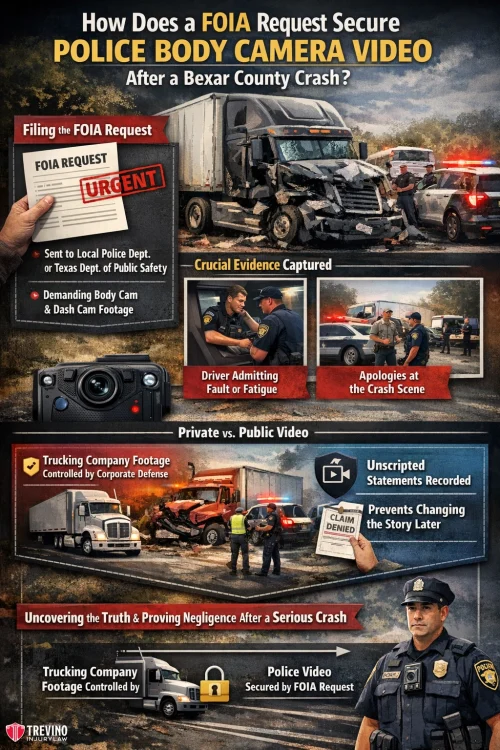
This raw audio-visual evidence is absolutely crucial when our trial lawyers are fighting insurance adjusters who inevitably try to change the truck driver’s story weeks later to blame you for the crash. By capturing the immediate aftermath and unscripted statements on digital video, Trevino Injury Law locks in the truck driver’s initial admissions before their corporate defense team can coach them.
Securing this objective through FOIA requests for police video is highly effective, but understanding the strict federal regulations governing the trucking industry’s own camera systems reveals additional avenues for proving corporate negligence.
What Are the FMCSA Regulations Regarding Dash Cams in Commercial Trucks?
The Federal Motor Carrier Safety Administration (FMCSA) does not currently mandate dash cams in all 18-wheelers, but it heavily regulates their windshield placement to ensure the physical recording devices do not obstruct the commercial truck driver’s field of view while operating on Texas highways.
While the federal government does not require trucking companies to install these cameras, many large corporate fleets use them to monitor their drivers and reduce insurance premiums. However, trucking companies often try to weaponize their own technology.
Trevino Injury Law aggressively uses a company’s internal safety manuals against the corporate defendant. If their own internal policy required an active camera that was mysteriously “turned off” or “malfunctioning” on the day of your devastating crash near the South Texas Medical Center, our trial lawyers use that violation to establish a clear pattern of negligence. Understanding federal regulations naturally leads to specific legal boundaries regarding these devices.
Are Dashcams Legally Required in 18-Wheelers in Texas?
No, neither Texas state law nor federal FMCSA regulations legally require 18-wheelers to have dash cams installed, though most major carriers use them voluntarily.
Can a Trucking Company Legally Withhold Dash Cam Footage?
No, a trucking company cannot legally withhold dash cam footage if it has been properly subpoenaed during the discovery phase of a personal injury lawsuit.
How Does Dash Cam Evidence Compare to Black Box (ECM) Data?
While a dash cam provides essential visual evidence of the crash scene and the commercial driver’s behavior, the truck’s black box (ECM) provides hard, mathematical data on the 18-wheeler’s exact speed, braking force, and engine RPMs immediately before the devastating collision.
To build an undeniable, trial-ready narrative that forces high-value settlements, our firm utilizes both forms of electronic evidence. The comparison is clear:
Visual Evidence (Dash Cam): Qualitatively shows aggressive lane swerving, obvious driver fatigue, illegal cell phone use, and the immediate physical impact of the wreck.
Mathematical Data (ECM): Quantitatively records hard braking events, exact vehicle speeds leading up to the crash, cruise control status, and throttle positioning.
Understanding why a spoliation letter for 18-wheeler black box data is critical to preserving this evidence is essential, as both the video and the mathematical data can be permanently erased.
What Happens If the 18-Wheeler Did Not Have a Dash Cam?
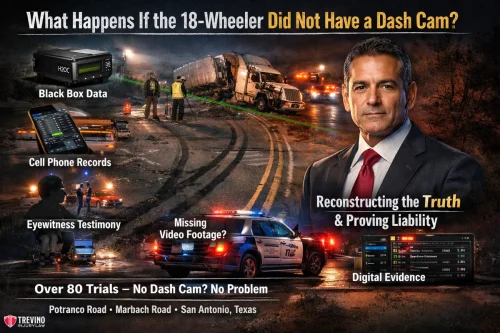
If the 18-wheeler did not have a dash cam, an experienced plaintiff trial lawyer will reconstruct the crash using black box data, tire skid marks, cell phone records, and eyewitness testimony to definitively prove the corporate trucking company’s liability.
Do not let an insurance adjuster convince you that a lack of video ruins your family’s case. As a dedicated San Antonio personal injury lawyer, Trevino Injury Law has taken over 80 cases to trial, proving negligence through alternative forensic accident reconstruction.
Even on chaotic corridors like Potranco Road or Marbach Road, the physical evidence left behind on the asphalt and the digital footprint on the driver’s phone tell the true story. Overcoming a lack of corporate evidence leads directly to an examination of the strict limitations and exceptions governing the law-enforcement video we can secure.
Can Cops Delete Dash Cam Footage or Turn Off Body Cams During an Investigation?
Police officers are strictly prohibited by departmental policy from intentionally deleting cruiser dash cam footage or turning off their body cameras during an active commercial crash investigation, as doing so destroys the absolute integrity of the accident evidence necessary for your family’s civil case.
While San Antonio Police Department protocols protect this footage, technical failures or policy violations occasionally happen. If a police body cam suddenly cuts out during a truck driver’s statement at the scene, an aggressive trial lawyer can subpoena the investigating officer to testify under oath about the missing conversation. We hold the department accountable through the public records act to ensure the jury hears exactly what the negligent driver admitted before their insurance company told them to stay silent.
Why Hire a San Antonio Truck Accident Lawyer?
When an 18-wheeler crashes on I-35, corporate teams rush to erase dash cam footage. Securing a trial-ready advocate is your only defense against this destruction.
Negligent trucking companies destroy evidence to escape liability, while high-volume settlement mills easily fold under their pressure. Trevino Injury Law fights for families, forcing corporations to pay by leveraging our record of over 80 trial cases.
Want to Protect the Full Value of Your Claim?
You’ve seen how this affects your case — but this is only one piece of the puzzle. Our 18- Wheeler Accident Lawyer page breaks down what a trial-ready firm does differently.
Our aggressive litigation in Bexar County yields undeniable results, including a $1.8 Million truck accident settlement. By immediately sending a spoliation letter to secure video evidence, your San Antonio personal injury lawyer builds an unstoppable case.
Call 210-TREVINO for a free case review. Se Habla Español. No Win, No Fee.