Move your drivable vehicle out of traffic, check for injuries, and lock down visual evidence before the road clears. Texas law requires clearing the highway, but doing so without capturing wide-angle photos on Bandera Road destroys your proof of liability.
The Insurance Adjuster is already preparing to exploit the evidence gap. Because police dispatchers routinely ignore collisions lacking severe injuries, the adjuster uses the missing crash report to dismiss your incident as a fabricated debate. Trevino Injury Law recently defeated this tactic, turning a cheap settlement offer into a $1.29 million verdict in Bexar County.
What Could Your Car Accident Case Be Worth?
Answer a few quick questions about your accident. Takes about 60 seconds.
See What My Case Might Be WorthThe insurance company offered less than $20,000. I ended up with over $1 million. — Jackie Galindo
Physical evidence vanishes within minutes. You must record statements from neutral witnesses and issue a Spoliation Letter, a legal demand that stops the opposing party from destroying proof. Delays can ensure the official record permanently contradicts your claim.
Trevino Injury Law’s car accident lawyer launches immediate investigations to preserve the scene. Call 210-TREVINO now for a free case review. You pay nothing unless we win. Se Habla Español.
What Are Your Immediate Legal Obligations at the Crash Scene in Texas?
You must stop your vehicle immediately, check for injuries, and, if the vehicle is drivable and no one is seriously injured, move it out of traffic. While general advice often says to “preserve the scene,” San Antonio traffic laws specifically require clearing the roadway to prevent secondary collisions on high-speed corridors.
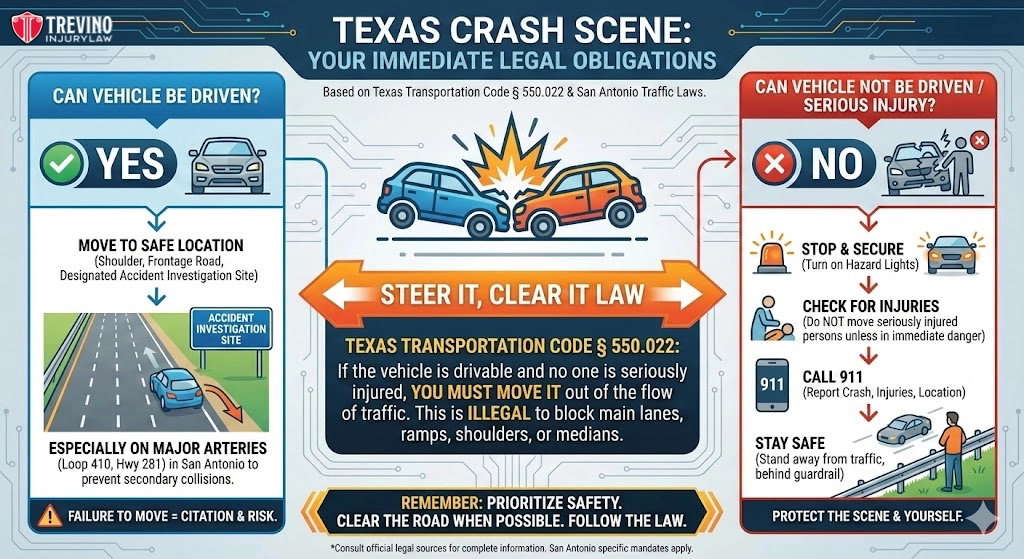
Under Texas Transportation Code § 550.022, commonly known as the ‘Steer It, Clear It’ law, it is illegal to block traffic on a main lane, ramp, shoulder, or median of a highway if the vehicle can be safely driven. Failing to adhere to such statutory safety standards doesn’t just result in a traffic ticket; under the landmark Texas Supreme Court ruling in Carter v. William Sommerville and Son, Inc., 584 S.W.2d 274 (Tex. 1979), the unexcused violation of a legislative safety enactment constitutes negligence per se, effectively establishing a breach of your legal duty of care and complicating your liability standing.
If your accident occurs on a major artery like Loop 410 or Hwy 281 and there are no serious injuries, you must move your vehicle to a designated accident investigation site or the nearest frontage road.
Failure to do so puts other drivers at risk and can result in a citation. If the vehicle is disabled or someone is injured, you must leave it in place, turn on the hazard lights, and stand safely behind a guardrail, away from traffic.
When Should You Call 911 Vs. the SAPD Non-Emergency Line?
Call 911 immediately if there are injuries, the road is blocked, or the other driver is intoxicated; for minor fender benders without injuries, call the SAPD Non-Emergency Line.
911 is reserved for true emergencies where life or public safety is at risk, such as crashes involving fire, fluid leaks, or aggressive behavior from a drunk driver. If your collision results in only minor property damage (typically under $1,000) and no one is hurt, San Antonio police dispatch often prioritizes more severe calls and may not send an officer.
For these non-emergency situations, call 210-207-SAPD (7273) to report the incident. If an officer does respond, they will file a CR-3 (Texas Peace Officer’s Crash Report).
If the police did arrive, you will need to obtain your official CR-3 police crash report to verify the officer’s findings. However, if police do not arrive, you are responsible for gathering the information needed to file a driver’s crash report later.
If the police did arrive, you will need to obtain your police crash report to verify the officer’s findings. However, if police do not arrive, you are responsible for gathering the information needed to file a driver’s crash report later.
Since police may not write a report for minor crashes, gathering evidence yourself is critical to establishing liability.
How Do You Preserve Liability Evidence Before Leaving the Scene?
You must proactively gather evidence by photographing the entire crash site from multiple angles and recording witness statements, as physical evidence can disappear within minutes after the road is cleared. While the main hub mentions the need for evidence, this section outlines the specific “360-degree method” required to establish fault at complex San Antonio intersections.
Visual evidence is your primary defense against insurance disputes. Use your phone to capture wide shots showing vehicle positions relative to lanes and traffic lights, such as at the busy intersection of Culebra Road & Loop 1604. Capture close-ups of all vehicle damage, license plates, and the VIN on the dashboard.
Do not overlook contextual clues such as skid marks, shattered glass, debris fields, or temporary construction signage, which are common during ongoing expansion projects on the North Side.
What Specific Details Should You Record from Witnesses?
Secure the full name, phone number, and a brief audio or written account of what they saw from every neutral witness before they leave the area.
Neutral witnesses, bystanders, or other drivers not involved in the crash are the gold standard for insurance adjusters because they have no bias, unlike passengers in your own vehicle. Approach them immediately and simply ask, “Did you see who had the red light?” or “Did you see the truck change lanes?”
Once they confirm they saw the event, get their direct cell phone number immediately. Police reports frequently omit witness contact details or contain transcription errors that make them impossible to find later. A quick audio recording on your phone of their account can be the deciding factor in a liability dispute months from now.
Collecting this evidence builds your case, but you must also strictly follow state laws regarding what data you share with the other party.
What Information Must You Exchange with the Other Driver?
Texas law requires you to exchange names, addresses, registration numbers, and liability insurance information, but you should avoid discussing the cause of the accident during this interaction. While the main hub advises exchanging information, strictly following Texas Transportation Code § 550.023 helps ensure you fulfill your duty without inadvertently jeopardizing your claim.
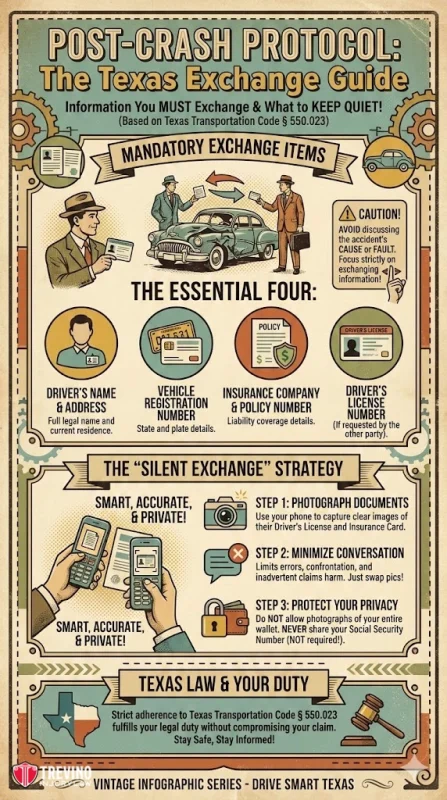
You must provide the following items to the other driver:
- Driver’s Name and Address.
- Vehicle Registration Number.
- Insurance Company Name and Policy Number.
- Driver’s License Number (if requested).
To avoid confrontation or transcription errors, use the “Silent Exchange” strategy. Yes, you can take a clear photo of their driver’s license and insurance card on your phone instead of writing down the information by hand.
This ensures accuracy and limits conversation. However, protect your privacy: don’t let them photograph your entire wallet or ask for your Social Security Number, which isn’t required.
What If the Other Driver Refuses to Exchange Information?
A driver who refuses to exchange information after a crash is violating Section 550.023 of the Texas Transportation Code, and a driver who leaves the scene can face criminal charges that become a felony when someone is injured. Do not argue or try to stop them. Instead:
- Call 911 or SAPD so an officer can collect the driver’s identity and insurance details for the crash report.
- Photograph the license plate, the vehicle, any company markings, and the driver if it is safe to do so.
- Get witness contact information before they leave the scene.
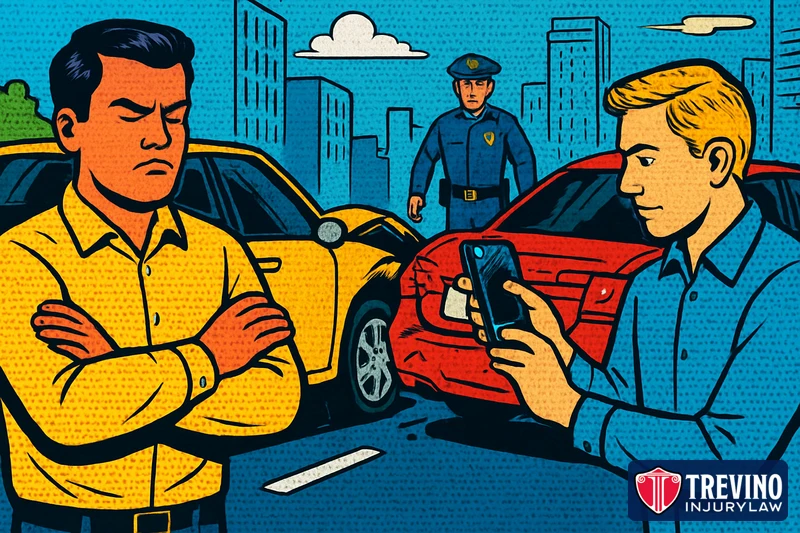
A plate number is often enough for police and your lawyer to identify the owner and insurer. If the driver cannot be found or turns out to be uninsured, your own uninsured motorist and personal injury protection coverage may still pay for your injuries, but those policies have notice requirements, so report the crash to your insurer promptly.
Should You Discuss Who Was at Fault with the Other Driver?
No, limit the conversation to exchanging required information, and never apologize or admit fault, as these statements can be used against you.
The “sorry” trap is a common mistake; saying “I’m sorry” out of politeness is often interpreted by insurance adjusters as a legal admission of guilt (liability). Even if you believe you might be partially responsible, you likely do not have all the facts, such as whether the other driver was texting or speeding.
If the other driver becomes aggressive or demanding, do not engage. Retreat to your vehicle, lock the doors, and wait for law enforcement to arrive.
Even if you execute these steps perfectly at the scene, the decisions you make in the hours that follow determine whether that evidence holds up.
How Do Immediate Mistakes at the Scene Impact Your Injury Claim?
Faltering at the scene, such as admitting fault, failing to call police, or delaying medical care, gives insurance adjusters the ammunition they need to devalue or deny your claim entirely. While the crash happens in an instant, the legal consequences of your actions afterward can last for years.
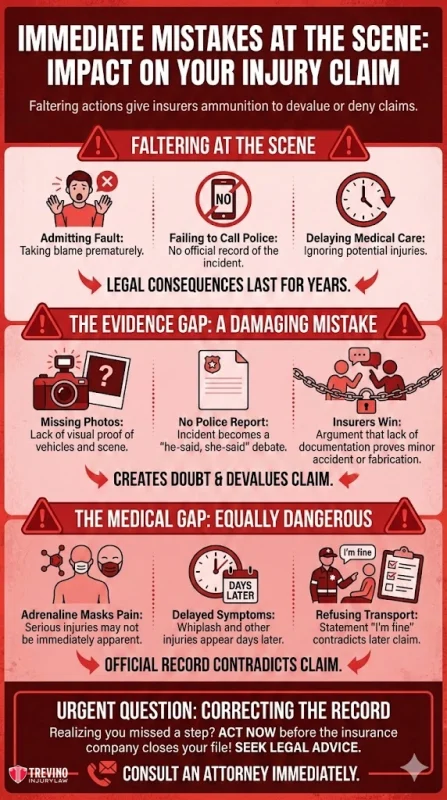
The most damaging mistake is creating a “gap in evidence.” Without photos of the vehicles or a police report from a crash on Bandera Road, the incident becomes a “he-said, she-said” debate that insurance companies are skilled at winning. They will argue that the lack of documentation proves the accident was minor or that your version of events is fabricated.
Equally dangerous is the “medical gap.” Adrenaline often masks serious injuries immediately after a collision. Even if you feel fine, delayed whiplash symptoms often appear days later. If you tell a responding officer, “I’m fine,” or refuse transport to University Hospital, that statement becomes part of the official record and contradicts your later claim.
Realizing you may have missed a step raises the urgent question of how to correct the record before the insurance company closes your file.
How to Report an Accident If the Police Do Not Respond?
If the San Antonio Police do not dispatch an officer to the scene, you must file a claim directly with your insurance provider using your own documentation, as the state no longer requires the CR-2 “Blue Form” for civilian reporting.
Since the CR-2 form was discontinued, there is no longer a mechanism for drivers to file a crash report directly with the Texas Department of Transportation (TxDOT). This makes your internal reporting to the insurance company the primary record of the event. Call your insurance agent immediately to initiate this process, and provide them with the photos, witness contact information, and the other driver’s details you collected.
Creating a written timeline of events while your memory is fresh, noting exactly what happened near landmarks like the Pearl District or Broadway Street, ensures consistency when you speak to adjusters.
What Is the Difference Between Reporting a Crash and Giving a Recorded Statement?
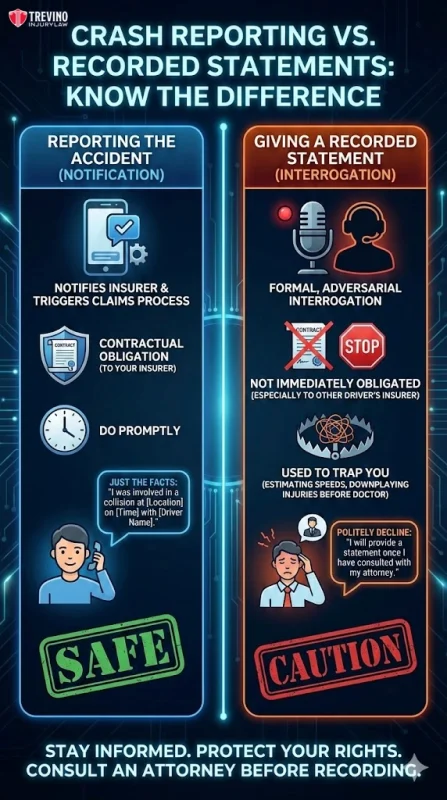
Reporting the accident notifies the insurer that a crash occurred and triggers the claims process, whereas a recorded statement is a formal, often adversarial interrogation that should be conducted only with an attorney present.
You are contractually obligated to “report” the accident to your own insurance company promptly, which simply means stating, “I was involved in a collision at [Location] on [Time] with [Driver Name].” However, you are not obligated to give a recorded statement immediately, especially to the other driver’s insurance company.
Adjusters often use these recorded calls to trap you into estimating speeds or downplaying injuries before you’ve seen a doctor. Politely decline the statement by saying, “I will provide a statement once I have consulted with my attorney.
What Happens If You Leave the Scene of an Accident in Texas?
Leaving the scene without exchanging information or rendering aid is a serious criminal offense in Texas, ranging from a Class C misdemeanor for minor property damage to a felony if serious injuries or death are involved.
Under Texas Transportation Code § 550.021, fleeing the scene, commonly known as a “hit-and-run“, can result in heavy fines, license suspension, and potential jail time. Panic is not a valid legal defense. If you drove away from a crash site on a busy road like Military Drive on the South Side out of fear or confusion, the law allows you to return immediately to rectify the mistake.
Doing so can sometimes mitigate the severity of the charges, but you should contact a lawyer immediately to handle the surrender and protect your rights.
When Is It Too Late to Report a Car Accident in San Antonio?
While Texas has a two-year statute of limitations for filing personal injury lawsuits, most insurance policies require you to report the accident within 24 to 72 hours, and failing to do so can legally void your coverage.
There is a critical distinction between the state law (which gives you time to sue) and your insurance contract (which demands immediate notice). Waiting weeks to report a crash allows evidence to decay, skid marks to fade, surveillance video at intersections like Huebner & Vance Jackson to get overwritten, and witnesses to move away.
Even if you are technically within the two-year legal window, an insurance company may deny your claim simply because your delay prevented them from investigating the crash while the evidence was fresh.
Do I Have to Move My Car off the Highway in Texas?
Yes, under the “Steer It, Clear It” law, you must move drivable vehicles with no serious injuries to the shoulder or frontage road to prevent traffic obstruction. Because car accidents happen frequently on high-speed corridors, remaining in the lanes after a minor accident endangers every passing motorist.
If your motor vehicle is disabled, however, you must stay at the scene of the accident until help arrives.
Can I Handle a Car Accident Claim Without a Lawyer?
Yes, you can handle simple property-damage-only claims yourself, but injury claims handled without legal representation typically result in significantly lower settlements than those led by an attorney. For injury claims, our guide to trial-ready car accident representation explains how litigation readiness changes the strategy used against the insurer.
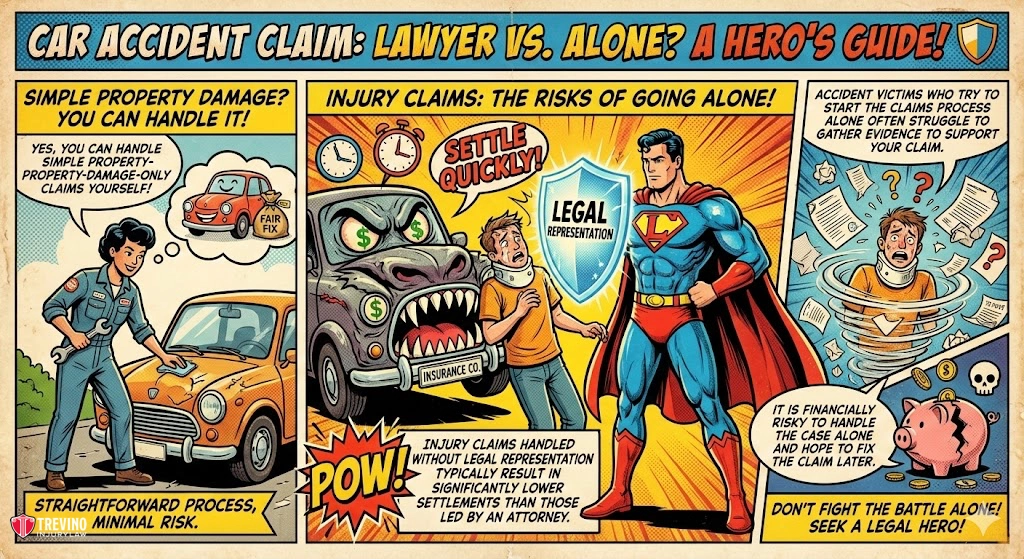
If you are involved in a car accident and get injured, the car insurance company will often pressure you to settle quickly. Accident victims who try to start the claims process on their own often struggle to gather evidence to support their claim. Handling the case alone and hoping to fix the claim later is financially risky.
Is a Police Report Mandatory for a Claim in San Antonio?
No, while a police report (CR-3) is the strongest evidence, you can still file a valid insurance claim using your photos, witness statements, and exchange-of-information forms. Even if you don’t report the accident to the police immediately, you still need to file a claim using the accident details you preserved.
Make sure you have the other driver’s insurance information and license plate numbers to help prove fault. While filing a police report is preferred, your own documentation can serve as a substitute.
Why Hire a San Antonio Car Accident Lawyer?
Missing visual proof on Loop 1604 creates a damaging evidence gap, but hiring a trial lawyer helps protect your financial recovery. Insurance giants delay payouts and pressure you into cheap settlements. Settlement mills help them avoid court. We don’t. Trevino Injury Law treats every crash as a future trial to force maximum compensation.
Want to Protect the Full Value of Your Claim?
You’ve seen how this affects your case — but this is only one piece of the puzzle. Our Car Accident Lawyer page breaks down what a trial-ready firm does differently.
Our aggressive litigation turned a $12,000 offer into a **$1.29 million** verdict right here in Bexar County. As your San Antonio car accident lawyer, we launch immediate investigations and issue spoliation letters to preserve critical evidence before it disappears. Call 210-TREVINO for a free case review. Se Habla Español. No Win, No Fee.