
A trial-ready lawyer maximizes your car accident payout by introducing real financial risk into the insurance company’s settlement algorithms.
The adjuster assigned to your case is intentionally capping your compensation at nuisance value, betting that you hired a high-volume settlement mill that will abandon the claim rather than spend the money to fight in court.
According to the Texas Department of Transportation, 112 innocent victims died in 2024 while sitting in non-speeding vehicles struck by aggressive drivers. The insurer continuously attempts to shift the blame to you for the crash, making a lawsuit the only legal mechanism powerful enough to subpoena the forensic vehicle data required to prove your innocence.
What Could Your Car Accident Case Be Worth?
Answer a few quick questions about your accident. Takes about 60 seconds.
See What My Case Might Be WorthThe insurance company offered less than $20,000. I ended up with over $1 million. — Jackie Galindo
Evidence vanishes within days. A Spoliation Letter, a legal demand to stop the opposing party from destroying critical black box data, must be sent immediately. Texas gives you two strict years to formally file your petition, and missing that deadline permanently destroys your right to financial recovery.
Trevino Injury Law’s San Antonio car accident law firm files the lawsuits that force adjusters to pay full value. Call 210-TREVINO for a free case review. You pay nothing unless we win. Se Habla Español.
The Economics of Insurance: Why “Trial Readiness” Increases Value
Insurance companies determine settlement values based on risk algorithms, but that risk is only real when they face the ‘Stowers‘ threat. Under the landmark Texas doctrine established in G.A. Stowers Furniture Co. v. American Indemnity Co., an insurer has a legal duty to accept a reasonable settlement offer within policy limits.
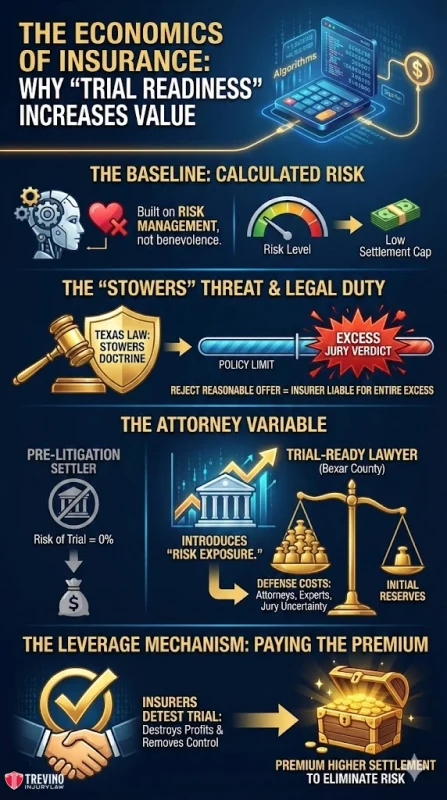
If they reject it and a jury later awards a verdict higher than your policy limit, the insurer, not the driver, is liable for the entire excess amount. This legal pressure forces them to increase their offers to avoid the financial exposure of a Bexar County verdict.
The entire insurance business model is built on risk management, not benevolence. When you hire an attorney known for settling every case pre-litigation, the insurer’s “risk of trial” variable is set to zero, capping your settlement offer at a significantly lower value.
However, when a trial-ready San Antonio accident lawyer files a lawsuit, we introduce “Risk Exposure” into their calculation. Suddenly, the insurance company must budget for its own defense attorneys, pay for expert witnesses, and face the uncertainty of a jury that may award damages far exceeding its initial reserves.
This leverage mechanism forces them to pay a premium, the higher settlement, to eliminate the risk of a courtroom loss. The question “Do insurance companies like to go to trial?” has a simple answer: No, they detest it because it destroys their profit margins and removes their control over the outcome.
What Is the “80% Rule” in Injury Settlements?
The “80% Rule” refers to the insurance industry practice of paying a significant percentage of a projected jury verdict to settle a case before trial, but this premium is offered only when a trial-ready attorney creates genuine risk for the insurer.
Adjusters are authorized to pay more when they believe a lawyer will actually drag them to the Bexar County Courthouse. If the predicted verdict is $100,000, a mill might get an offer of $15,000, whereas a litigator might secure $80,000 simply because the threat of the full verdict is real.
Understanding this financial leverage is critical, but it requires distinguishing a lawyer who creates this risk from one who merely processes paperwork.
Settlement Mills vs. Litigators: How to Spot the Difference
You can distinguish a dedicated litigator from a high-volume settlement mill by checking if you meet the actual attorney instead of just case managers, reviewing their recent court records in San Antonio, and noting if they pressure you to accept the first offer. Settlement mills operate on a volume business model, similar to a fast-food franchise, where the goal is to process as many claims as possible with minimal effort.
This model often leads to the most common complaint against lawyers: a complete lack of communication and pressure to sign low settlements quickly.
In contrast, a trial-ready car accident lawyer operates under a quality-representation model. If you see high volumes of billboard advertising but few actual lawsuit filings in the public record, you are likely dealing with a mill.
These firms often assign your case to a “pre-litigation manager” rather than an attorney, leaving you without a legal strategy until it is too late. Watch for these red flags:
- You never meet the attorney handling your case; you only meet paralegals or intake staff.
- The firm pressures you to sign a settlement release before you have finished medical treatment.
- They discourage you from filing a lawsuit, claiming it is too time-consuming or too risky.
Do Settlement Mills Drop Cases That Need Lawsuits?
Yes, settlement mills frequently drop clients or refer them to other firms when a case requires filing a lawsuit, because their high-volume business model relies on quick turnover and lacks the financial resources to cover litigation costs.
These firms often hit a “pre-litigation ceiling” beyond which they cannot extract more value from the insurer because the insurer won’t incur filing fees, deposition costs, or expert fees. If your case involves disputed liability or complex injuries, a mill may abandon you exactly when you need a fighter most.
Once you have secured true representation, the focus shifts to understanding the specific legal steps we take to maximize your claim’s value in court.
The Litigation Lifecycle in Bexar County: What “Going to Trial” Actually Means
Going to trial in San Antonio involves a structured four-step process: filing a petition in district court, aggressive discovery to uncover evidence, mandatory mediation to attempt resolution, and, if necessary, presenting your case to a jury.
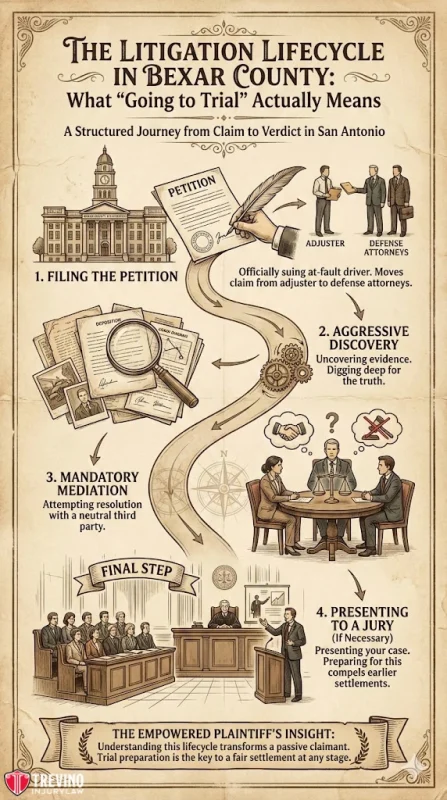
When clients ask, “Is it better to take a settlement or go to trial?”, the answer depends on where you are in this lifecycle. Often, preparing for the final step prompts the insurance company to offer a fair settlement earlier.
The process begins formally when we file a Petition with the Bexar County District Clerk, officially suing the at-fault driver. This moves your claim out of the adjuster’s hands and into the realm of defense attorneys.
While the Main Hub outlines these phases in general terms, understanding what happens to the client during each phase is what separates a passive claimant from an empowered plaintiff.
What Happens During the Discovery Phase?
Discovery is the aggressive investigation phase in which we compel the at-fault driver to answer written questions under oath and to sit for a deposition to admit the truth about the crash.
While settlement mills often skip this detailed work to save money, a trial-ready accident attorney uses discovery to uncover cell phone records and vehicle ‘black box’ data to prove negligence.
This forensic evidence is the only way to protect the innocent; in 2024, the Texas Department of Transportation reported that 112 people were killed in vehicles that were not speeding, yet were struck by drivers who were. We use discovery to scientifically prove you were following the law, preventing the defense from confusing the jury about who was actually speeding.
In Bexar County, this is often where the “truth” comes out, forcing adjusters to re-evaluate their lowball offers.
Is Mediation Mandatory in San Antonio?
Yes, mediation is almost always a mandatory step ordered by Bexar County judges before a case can proceed to a jury trial, serving as the final opportunity for negotiation, where a neutral third party seeks to resolve the dispute.
Most high-value litigation cases settle here. Because we have already built a “trial-ready” case during discovery, the insurance company enters mediation knowing that if they don’t offer fair compensation now, the next date on the calendar is the courtroom.
What Occurs During the Jury Trial?
If mediation fails, the case proceeds to a jury trial where we present evidence, cross-examine witnesses, and ask a panel of twelve San Antonio residents to determine the fair value of your injuries.
This is the “final battle” that insurance companies fear most. Paradoxically, the more prepared we are for this step, having medical experts ready and exhibits finalized, the less likely it is that the trial will actually take place, as the insurer will often pay the policy limits to avoid a verdict.
While the litigation timeline creates leverage, understanding the costs involved ensures you know exactly how your final compensation is calculated.
Is It Worth Hiring an Attorney After a Car Accident?
Yes, hiring a trial-ready attorney is worth the investment because industry data consistently shows that injury victims with legal representation recover three to four times more money than those who handle claims alone, even after paying legal fees.
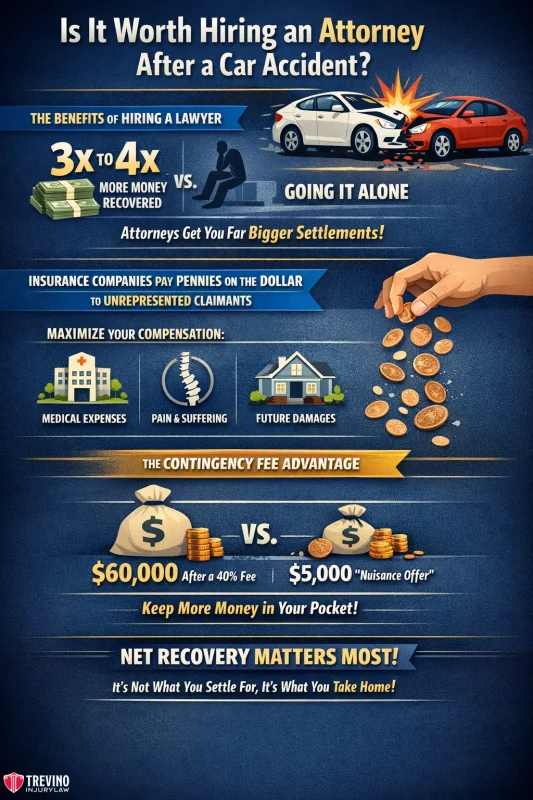
The financial reality is that insurance adjusters are trained to pay unrepresented claimants pennies on the dollar. By bringing in a San Antonio litigation firm, you shift the power dynamic and ensure your settlement covers not only immediate bills but also future medical needs and non-economic damages, such as pain and suffering.
Many victims hesitate because of the cost of hiring a lawyer, especially under the contingency fee model. However, the math of litigation is straightforward: receiving 60% of a $100,000 settlement (after a 40% litigation fee) is significantly better than keeping 100% of a $5,000 “nuisance value” offer.
We focus on your “net recovery“, the actual amount you put in your pocket, rather than just the gross settlement number.
How Do Contingency Fees Change in Litigation?
Standard injury contingency fees often increase from 33% to 40% once a lawsuit is formally filed to account for the additional hundreds of hours of work and increased risk required to litigate a case in the Bexar County District Court.
This fee structure is standard across Texas and ensures that your trial-ready car accident lawyer is fully invested in the outcome. We only earn this higher fee if we secure a recovery, meaning our financial interests are perfectly aligned with maximizing your compensation.
Who Pays for Litigation Costs and Experts?
Your attorney advances all litigation costs upfront, including filing fees, court reporter charges for depositions, and expensive expert witness retainers, so you never have to pay out of pocket to keep your case moving.
A complex crash on Bandera Road or Culebra Road might require accident reconstructionists or orthopedic experts, which could cost thousands of dollars. We carry this financial burden as an interest-free loan to your case, which is reimbursed from the final settlement only if we win.
Understanding the financial mechanics of your claim is essential, but recognizing the specific legal scenarios that make a trial absolutely necessary is what ultimately protects your rights.
When Is a Car Accident Trial Necessary?
A trial becomes necessary when an insurance company fundamentally denies liability for the crash, disputes the medical validity of your injuries, or operates in bad faith by refusing to make a settlement offer that covers your documented future needs.
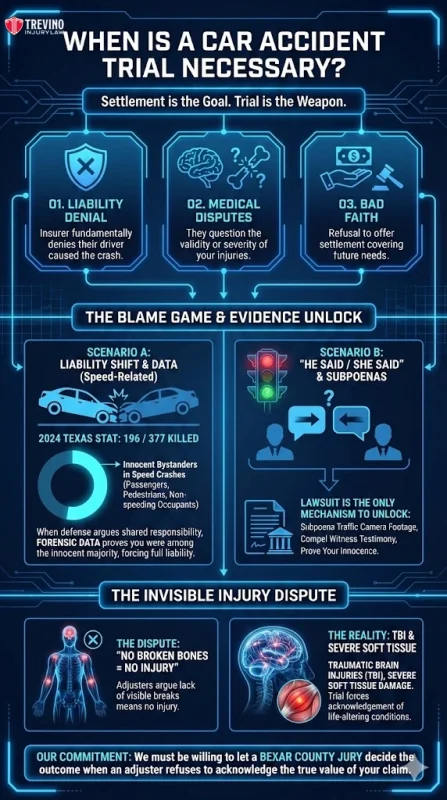
While our goal is always to secure a full settlement before going to court, we must be willing to let a Bexar County jury decide the outcome when an adjuster refuses to acknowledge your claim’s true value.
One common scenario that requires a trial is a liability dispute, particularly when the at-fault driver attempts to shift blame. This is critical in speed-related crashes where the victims are often innocent bystanders; in 2024, the Texas Department of Transportation reported that 196 of the 377 people killed in speed-related crashes were actually passengers, pedestrians, or occupants of the non-speeding vehicle.
When the defense argues you share responsibility, we use forensic data to show you were part of the innocent majority, compelling the insurer to accept full liability.
If the other driver claims you ran the red light, and the insurance company backs their story, a lawsuit is the only mechanism to subpoena traffic camera footage or witness testimony to prove your innocence.
Similarly, cases involving “invisible” injuries, like traumatic brain injuries (TBI) or severe soft tissue damage, often require a trial because adjusters argue that a lack of broken bones equals a lack of injury.
What Is the Hardest Case to Win in Court?
In these scenarios, a trial-ready San Antonio lawyer must utilize medical specialists to connect the crash to your injuries. In Texas, you cannot simply tell a jury you are hurt and expect a verdict; the Texas Supreme Court ruled in Guevara v. Ferrer that lay testimony is insufficient to prove causation for complex conditions like soft tissue injuries.
We must provide expert medical evidence to legally establish that the accident caused your specific medical needs and to overcome the skepticism insurance defense teams rely on. Our guide to medical causation for delayed car accident injuries examines that proof problem in more detail, including objective medical records and expert evidence.
How Does Bad Faith Trigger a Lawsuit?
Bad faith occurs when an insurance company denies a valid claim or delays payment without a reasonable basis, forcing us to file a lawsuit not only for the accident damages but also for the insurer’s unethical conduct. If an adjuster ignores clear evidence of their policyholder’s negligence or misrepresents policy limits, filing suit exposes their internal claim files to scrutiny.
In Texas, proving bad faith can sometimes lead to additional damages, turning a standard claim into high-stakes litigation that insurers are desperate to settle once exposed.
Recognizing the specific scenarios that call for a courtroom battle is vital, but understanding the severe risks you face when navigating this complex legal system without an advocate is equally important.
Does Filing a Lawsuit Guarantee a Higher Settlement?
No, filing a lawsuit does not technically guarantee a higher number, but it is often the specific lever required to strengthen your case. Insurance adjusters operate on a model designed to minimize payouts, frequently undervaluing your future medical expenses and pain and suffering.
When we file a lawsuit, it signals that we are not afraid of litigation. This forces the insurance company to re-evaluate its risk exposure. By elevating a standard personal injury claim into formal litigation, we remove the adjuster’s ability to dictate terms and bring the rules of personal injury law to your defense.
This pressure often leads to increased settlement offers as the trial date approaches to avoid the uncertainty of a jury verdict.
Will I Have to Testify in Court?
It is possible, but statistically unlikely. While very few cases go to trial (most settle during discovery or mediation), we build every strategy as if we are prepared to take the case to trial. If your personal injury trial moves forward in a San Antonio courtroom, you will likely have to testify to explain the impact of the injury on your life.
However, you will never be alone in this process. Having a seasoned trial lawyer and a legal team prepared to go to trial ensures you are coached, practiced, and protected. With a skilled lawyer by your side, the prospect of testifying changes from a source of fear to an opportunity to speak your truth.
How Long Does a Lawsuit Take vs. a Settlement?
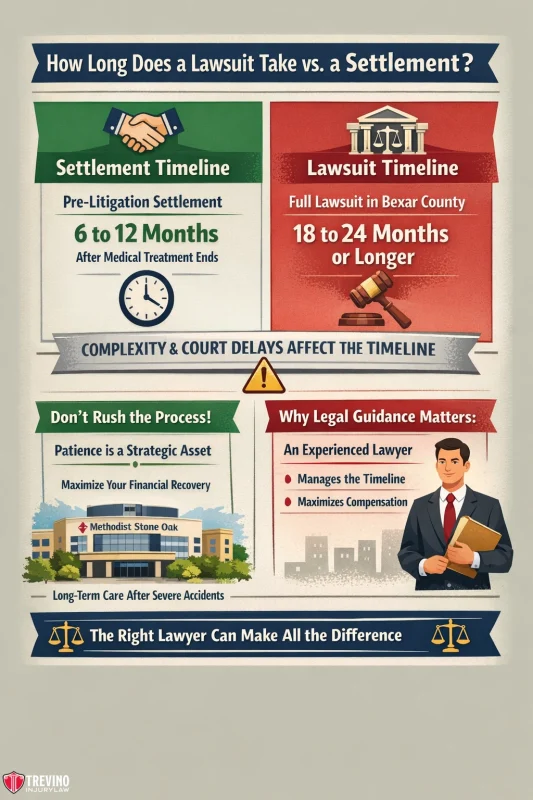
The timeline depends heavily on the complexity of the accident case and the court’s docket. A pre-litigation settlement typically resolves within 6 to 12 months after medical treatment concludes. In contrast, if you were involved in a car crash that requires a full lawsuit in Bexar County, the process can take 18 to 24 months or longer.
While the litigation path is slower, seeking early legal advice is crucial because patience is a strategic asset. Rushing the process usually means leaving substantial money on the table, especially in a severe vehicle accident involving long-term care at facilities like Methodist Stone Oak.
An experienced lawyer can help manage this timeline, ensuring the delay yields greater value. Ultimately, having the right lawyer manage the litigation timeline can make all the difference in your financial recovery.
Can I Handle My Claim Without a Trial Lawyer?
Attempting to handle a serious injury claim without a trial-ready lawyer exposes you to aggressive insurance tactics designed to strip away your rights before you even understand them. Without an attorney who can threaten a lawsuit, you are effectively negotiating with zero leverage; the adjuster knows you cannot take them to court, so they have no incentive to offer more than a nuisance value.
Victims who go it alone often inadvertently admit fault in recorded statements or sign broad medical releases that allow the insurer to dig through decades of private history to find a “pre-existing condition.
What If I Miss the Filing Deadline?
If you miss the two-year statute of limitations for filing a personal injury lawsuit in Texas, your claim will expire completely, and you will be permanently barred from recovering any compensation, regardless of how severe your injuries are or how clear the liability is.
This strict deadline applies to filing the actual petition in court, not just filing an insurance claim. Waiting too long to hire an attorney can be fatal to your case, as evidence disappears and procedural clocks run out, leaving you with no legal recourse to pay for your recovery.
Why Hire a San Antonio Car Accident Lawyer?
Insurance adjusters intentionally drag their feet, hoping your collision evidence from Loop 410 disappears before you find a fighter. While high-volume settlement mills drop cases that require real work, Trevino Injury Law exposes their bad faith. We force them to pay a premium to avoid a Bexar County jury verdict.
Want to Protect the Full Value of Your Claim?
You’ve seen how this affects your case — but this is only one piece of the puzzle. Our Car Accident Lawyer page breaks down what a trial-ready firm does differently.
Victims recover three to four times more money when San Antonio accident attorneys preserve traffic camera footage and file suit in the Bexar County District Court. After turning a $20,000 lowball into over $1 milliondollars, we fight for families to maximize their financial leverage.
Call 210-TREVINO for a free case review. Se Habla Español. We work on a contingency-fee basis: No Win, No Fee.