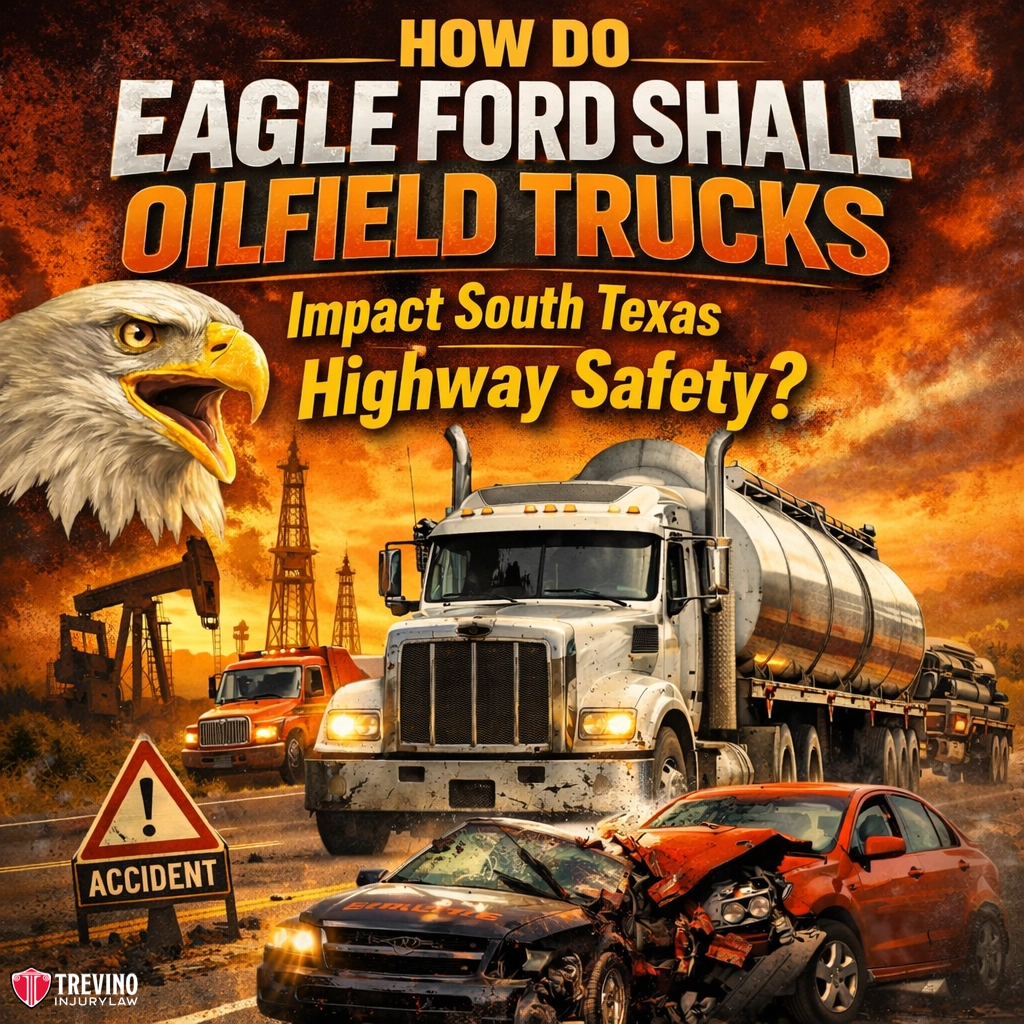
Overloaded frac sand and water hauler trucks systematically destroy rural highway infrastructure and strip passenger cars of their steering control on undivided roads. Heavy industrial transporters dominate narrow corridors originally engineered for light agricultural use, turning driving errors into catastrophic commercial disasters.
The corporate well operator behind the collision is already hiding behind an independent contractor shield, arguing they have no direct control over the exhausted driver who hit you. Dispatchers exploit federal hours-of-service loopholes to keep fleets moving without real rest. Trevino Injury Law pierces this deliberate corporate shield to expose systemic negligence, securing outcomes like a $1.8 million settlement for a commercial crash spinal injury.
Corporate response teams arrive quickly to lock down the scene. Evidence disappears fast. You must immediately issue a Spoliation Letter, a legal demand that stops the company from destroying critical black-box data and internal dispatch communications.
What Could Your Oilfield Truck Accident Case Be Worth?
Answer a few quick questions about your accident. Takes about 60 seconds.
See What My Case Might Be WorthThe insurance company offered less than $20,000. I ended up with over $1 million. — Jackie Galindo
Trevino Injury Law’s oilfield truck accident lawyers subpoena Master Service Agreements to shatter the corporate veil and force the true operators to pay full compensation. Call 210-TREVINO for a free case review. You pay nothing unless we win. Se Habla Español.
Why Are Eagle Ford Shale Oilfield Trucks So Dangerous on South Texas Roads?
Eagle Ford Shale oilfield trucks are disproportionately dangerous because these 80,000-pound vehicles must navigate narrow, two-lane rural highways that were never engineered to support continuous, high-speed industrial traffic. This severe mismatch between heavy industrial commerce and the rural infrastructure surrounding San Antonio creates devastating risks for local families.

The danger intensifies when heavy machinery transporters and water haulers carry specialized cargo. What is frac sand? It is a specialized material utilized in hydraulic fracturing, adding immense weight to commercial trailers. The sheer volume of these vehicles creates massive blind spots and dangerous passing scenarios on routes originally designed for local passenger and agricultural use.
How Do Overloaded Frac Sand Trucks Impact Rural Highway Infrastructure?
Overloaded frac sand trucks systematically destroy rural highway infrastructure by creating deep ruts, destroying shoulders, and causing severe pavement blowouts that strip passenger vehicles of their steering control. This relentless industrial weight creates sudden lane departures and rollover risks for standard passenger cars sharing the road.
The physical hazards created by these trucks include:
- Creating deep pavement ruts that force a standard vehicle’s trajectory to change.
- Destroying emergency road shoulders needed for safe stops.
- Causing severe pavement blowouts that instantly destroy tires and steering control.
Understanding the road’s physical hazards is crucial, but the greatest danger comes from exhausted drivers operating these heavy loads.
How Do Oilfield Exemptions Affect Truck Driver Hours of Service?
Oilfield exemptions legally allow commercial truck drivers servicing the Eagle Ford Shale to work longer consecutive hours than standard 18-wheeler drivers, drastically increasing the risk of fatigue-related collisions. The oil and gas industry successfully lobbied for dangerous exceptions to standard federal safety rules designed to protect the public.
While interstate commercial drivers must follow strict rest periods, oilfield drivers can manipulate waiting times at the wellhead to legally extend their shifts. This legalized fatigue leads to exhausted drivers piloting deadly equipment on critical corridors such as Interstate 37 and US Highway 83, heading back toward San Antonio.
What Are the Specific FMCSA Hours of Service Loopholes for the Oil Industry?
The primary FMCSA loopholes the oil industry uses include the 24-hour restart rule and the exemption that lets drivers log waiting time at a natural gas well site as “off-duty” rest. Dispatchers routinely manipulate these technical regulations to force exhausted drivers back onto South Texas highways without actual restorative sleep.
Under 49 CFR § 395.1(d), companies actively exploit:
- The 24-hour restart rule to minimize required downtime between massive shifts.
- Logging active waiting time at wellheads as off-duty rest, hiding true fatigue levels.
- Scheduling loopholes to maximize driving hours over physical safety.
Knowing how companies manipulate federal laws dictates how we target the corporate entities funding the operation.
Who Is Liable When a Contracted Oilfield Water Hauler Causes a Crash?
The shale boom brought immense economic growth to the Eagle Ford region, but it also caused an unprecedented surge in heavy truck traffic. As trucking in the Eagle Ford rapidly expanded, rural county roads that were originally engineered for light agricultural use were suddenly overwhelmed.
The Texas Department of Transportation has repeatedly noted how this increased traffic directly correlates with rapidly deteriorating road conditions and a sharp spike in commercial crashes, echoing the staggering fatalities in 2013 when the drilling frenzy peaked. When a massive, fully loaded rig is forced to navigate these narrow, rutted corridors, it creates a deadly hazard for standard passenger cars and smaller vehicles sharing the road.
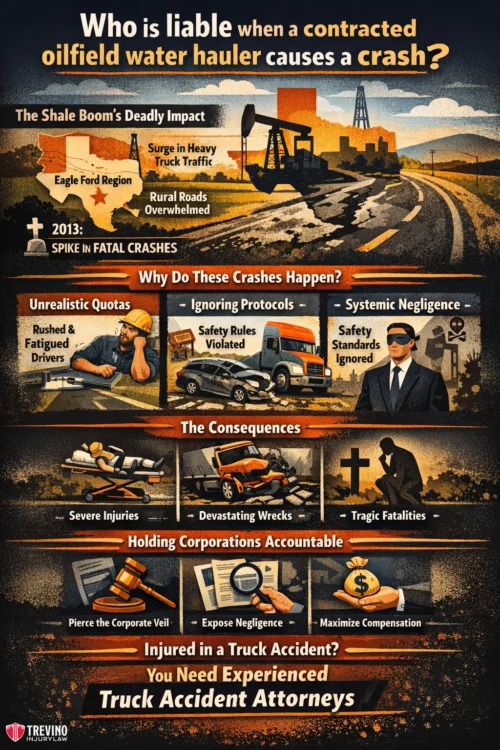
Because of the extreme weight disparity in truck accidents, a single driving error rarely results in a minor fender-bender. If you or a loved one was injured, the injuries sustained are almost always life-altering, frequently resulting in severe injuries, serious injuries, or fatalities. The common causes of these devastating wrecks often trace back to systemic corporate negligence within the trucking industry, including:
- Unrealistic Quotas: Dispatchers frequently pressure exhausted drivers to travel at high speeds to meet delivery deadlines at the wellhead, even in poor weather or blinding dust.
- Ignoring Protocols: When basic health and safety protocols are ignored for profit, it often leads to catastrophic rear-end collisions and violent rollovers.
- Systemic Negligence: Corporate operators routinely turn a blind eye to blatant safety violations and a failure to uphold federal safety standards.
These deliberate safety concerns endanger families across a massive geographic footprint. The danger stretches from well sites in Dimmit and Cotulla down major South Texas transport corridors toward Corpus Christi, McAllen, and Brownsville.
Overcoming this deliberate corporate shield and proving that the multi-billion-dollar exploration company dictated the negligent operation requires a highly skilled personal injury attorney. If you are injured in a truck accident, you cannot rely on standard car wreck lawyers who push for quick settlements; you need battle-tested truck accident attorneys equipped to handle complex personal injury litigation.
We know how to pierce the corporate veil, expose the root cause of the fatality or injury, and secure maximum financial compensation for your family.
How Do Operators Use Independent Contractor Shields to Avoid Liability?
Major operators use independent contractor shields by structuring their legal agreements to distance themselves from the water haulers’ day-to-day operations, attempting to avoid vicarious liability for crashes.
However, under Texas law, a large exploration company cannot hide behind a contract if it actually directs the work. This ‘retained control’ doctrine was firmly established in the landmark case Redinger v. Living, Inc., 689 S.W.2d 415 (Tex. 1985), which dictates that an employer who entrusts work to an independent contractor, but retains control of any part of the operation, is subject to direct liability for physical harm caused by their failure to exercise that control with reasonable care.
While corporate legal teams aggressively argue they had no direct control over the negligent driver, intentionally leaving the injured victim fighting a bankrupt subcontractor, citing Redinger provides the precise legal framework we use to pierce this corporate shield.
Overcoming this deliberate corporate shield requires aggressive legal discovery to prove actual control over the trucking fleet.
What Evidence Proves That an Oil and Gas Company Controlled the Negligent Driver?
To shatter the independent contractor shield, your trial attorney must subpoena Master Service Agreements, gate logs, and internal dispatch communications to definitively prove the operator dictated the driver’s routes and deadlines. Under Texas law, securing this complex liability evidence is mandatory.
Proving retained control over a driver requires:
- Acquiring GPS tracking data and wellhead delivery schedules to show the operator’s operational control.
- Subpoenaing Master Service Agreements to expose the true legal relationship.
- Demanding internal dispatch communications and gate logs to prove schedule manipulation.
Securing this complex liability evidence is critical when evaluating exactly where these crashes occur in our region.
Which South Texas Rural Highways Have the Highest Oilfield Truck Crash Rates?
The highest oilfield truck crash rates consistently occur on the primary arteries connecting the Eagle Ford Shale to San Antonio, specifically targeting State Highway 97, US Highway 83, and the heavily congested, undivided rural stretches of Interstate 37 heading south.
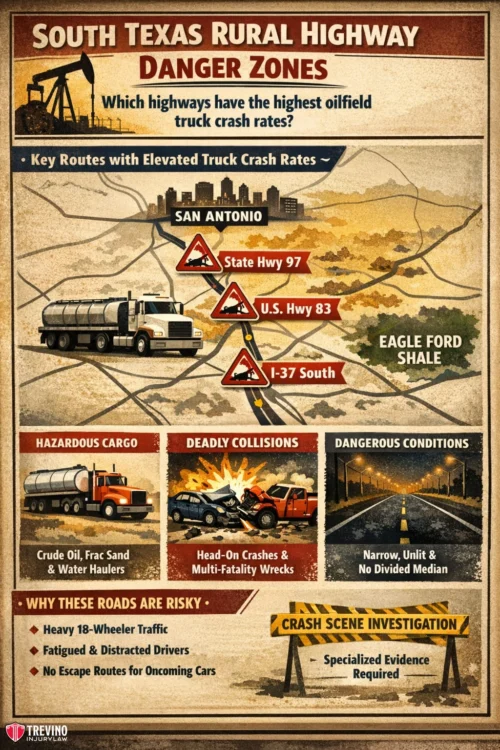
These specific corridors serve as the central veins for transporting volatile crude oil, fresh water, and heavy frac sand. As daily commuter traffic from Bexar County violently intersects with fatigued commercial operators on these two-lane stretches, minor driving errors can quickly escalate into multi-fatality commercial disasters. For families traveling south from San Antonio toward rural towns like Somerset or Elmendorf, sharing the road with a relentless stream of 18-wheelers is a daily hazard.
Because these rural highways frequently lack divided medians, concrete barriers, and adequate lighting, a single-lane departure by an exhausted water-hauler driver leaves oncoming passenger vehicles with no escape route. Understanding these local danger zones underscores the need to gather highly specialized crash-scene evidence.
What Specialized Evidence Is Needed to Win an Oilfield Truck Accident Claim?
Winning an oilfield truck accident claim requires aggressively preserving specialized evidence, such as wellhead gate logs, daily drilling reports, and the specific Master Service Agreement governing the relationship between the operator and the trucking fleet. Securing this distinct evidence differs significantly from what is required in standard commercial crashes along Interstate 10.
To secure this documentation, a San Antonio personal injury lawyer must immediately send a spoliation letter. This is a formal legal demand that prevents the corporate defendant from deleting critical black-box data from the commercial vehicle or destroying site-specific logs. The legal duty to preserve such critical crash evidence is heavily governed by the Texas Supreme Court’s landmark ruling in Brookshire Brothers, Ltd. v. Aldridge, 438 S.W.3d 9 (Tex. 2014).
Under Brookshire Brothers, trial courts can severely penalize corporate defendants, including instructing a jury to assume the missing evidence would have proven the company’s negligence, if they intentionally or negligently destroy data after a catastrophic collision.
These logs are often the only way to prove a commercial driver was kept awake for 24 hours at a fracking site in the Eagle Ford Shale before causing a catastrophic collision. This aggressive evidence preservation lays the groundwork for holding massive energy producers accountable for the devastation they cause.
Can You Sue the Oil Company If an Independent Contractor Truck Causes Your Crash?
Yes, you can sue the massive oil company if your attorney can prove they exerted direct operational control over the independent contractor’s routing and delivery schedules.
Are Oilfield Water Haulers Exempt from All FMCSA Safety Regulations?
No, even when they use specific hours-of-service exceptions, water haulers must still strictly comply with federal weight limits, maintenance standards, and commercial driver’s license requirements.
How Does an Oilfield Truck Crash Differ from a Standard 18-Wheeler Accident?
An oilfield truck crash differs from a standard 18-wheeler accident by introducing complex layers of corporate subcontracting, specialized industry fatigue rules, and highly volatile cargo that significantly alter the litigation strategy needed to secure maximum compensation for your family. A standard collision on Loop 1604 might involve a single trucking entity and a standard auto insurer, but an Eagle Ford Shale crash is far more legally complex.
This strategic litigation approach produces real results: Our firm secured a $1.8 Million Settlement for a spinal injury following a commercial crash, demonstrating how uncovering every layer of liability maximizes your financial recovery.
| Crash Element | Standard 18-Wheeler Accident | Oilfield Truck Accident |
| Liability Targets | A driver and a single trucking company | Driver, fleet owner, well operator, and landowner |
| Fatigue Regulations | Strict standard FMCSA hours of service | Complex exemptions and the 24-hour restart loophole |
| Insurance Coverage | Single commercial policy (e.g., GEICO) | Multiple specialized corporate insurance policies |
| Cargo Risks | Standard consumer goods or dry freight | Volatile crude oil, heavy machinery, and frac sand |
What Happens If an Oilfield Truck Crash Involves a Non-Commercial Company Vehicle?
If an oilfield crash involves a non-commercial vehicle, such as a “company man” driving a standard heavy-duty pickup, federal FMCSA trucking regulations do not apply, but the massive oil company remains fully vicariously liable for their employee’s negligence on Texas roads.

Often, site supervisors or landmen cause catastrophic wrecks in F-250s or F-350s while rushing between drilling sites and corporate offices in the Medical Center district. Without the commercial element, your trial attorney will pursue the corporate auto policy under standard Texas negligence laws rather than federal commercial trucking statutes.
While federal trucking laws cannot be leveraged, holding the corporation accountable for its supervisors’ reckless driving helps ensure your family receives the compensation needed for your recovery.
When Does Oilfield Exemption Status Not Apply to Commercial Truck Drivers?
Oilfield exemption status does not legally apply to commercial truck drivers who are engaged in general transport operations, such as moving standard supplies down Interstate 35, rather than directly servicing the physical operations of the natural gas wellhead site.
Corporate defense lawyers frequently attempt to illegally invoke the 24-hour restart loophole for drivers who fail to meet the strict legal requirements. If the driver was not hauling material specifically for the natural gas well’s operation, their special protections do not apply, and the stricter FMCSA hours-of-service standard applies. Exposing this failure to comply with federal limits makes it significantly easier to prove negligence, defeat the insurance company, and secure justice for your catastrophic injuries.
Why Hire a San Antonio Oilfield Truck Accident Lawyer?
When an exhausted water hauler causes a wreck on Interstate 37, corporate response teams arrive quickly. Avoid settlement mills that fear the court. At Trevino Injury Law, we fight for families and force negligent trucking companies and insurance adjusters to pay maximum compensation.
Want to Protect the Full Value of Your Claim?
You’ve seen how this affects your case — but this is only one piece of the puzzle. Our 18 Wheeler Injury Lawyer page breaks down what a trial-ready firm does differently.
We litigate aggressively in Bexar County courts, securing results such as a $1.8 million settlement in commercial crash cases. By sending a spoliation letter to lock down black-box data, your personal injury crash lawyer in San Antonio immediately protects your claim.
Call 210-TREVINO for a free case review. Se Habla Español. We work on a contingency fee: no win, no fee.