Texas dram shop compensation requires a strict formula: (Economic Damages + Non-Economic Multiplier) +/- Comparative Fault = Total Case Value. The calculation targets the bar’s commercial liability policy rather than the drunk driver’s inadequate personal coverage.
The insurance adjuster uses algorithmic software to classify your catastrophic injury as a standard data point and generates a baseline offer that intentionally excludes your future medical requirements. Trevino Injury Law rejects these spreadsheet valuations by taking cases to trial, recently securing a $536,007 jury verdict against lowball tactics.
What Could Your Dram Shop Accident Case Be Worth?
Answer a few quick questions about your accident. Takes about 60 seconds.
See What My Case Might Be WorthThe insurance company offered less than $20,000. I ended up with over $1 million. — Jackie Galindo
The bar immediately deletes receipt logs and overwrites surveillance footage to protect its liquor license. A Spoliation Letter, a legal demand that prevents the property owner from destroying evidence, must be issued today to preserve the transaction data proving the driver was visibly intoxicated. Texas gives you two years to file suit, but the proof vanishes in days.
A Trevino Injury Law dram shop accident lawyer subpoenas the commercial policy data and locks the evidence down before it disappears. Call 210-TREVINO for a free case review. You pay nothing unless we win. Se Habla Español.
Calculating Compensatory Damages: Future Medical and Lost Earnings
The high-stakes nature of dram shop lawsuits in San Antonio requires a rigorous actuarial approach. Generally, damages aim to restore you to the financial position you were in before the crash. Damages cover strictly defined economic losses, including past medical bills and replacement costs for household services you can no longer perform. Crucially, we must also calculate how your injuries affect your ability to work to secure the compensation you deserve, and we must overcome aggressive defense tactics that aim to minimize your payout.
One of the most critical concepts for victims to understand is the “Paid vs. Incurred” rule under Texas Civil Practice & Remedies Code § 41.0105. In Texas, economic damages that include medical expenses are strictly limited to the amounts actually paid or owed, not the higher ‘billed’ amount charged by the hospital.
The Texas Supreme Court cemented this standard in Haygood v. De Escabedo. Under Haygood, evidence of the full list price of medical care is inadmissible if your insurance has already negotiated a lower rate. For a spinal injury victim treated at University Hospital or Methodist Hospital, this legal distinction can drastically reduce the ‘paper value’ of a claim, making it imperative that we focus on future medical needs where these limitations do not yet apply. This is why we focus heavily on proving future needs where these discounts don’t yet apply.
To counter this, we hire a Life Care Planner to estimate the costs of wheelchair replacements, home modifications, and daily nursing care over the next 40 years. For example, a crash on I-35 resulting in a TBI might require lifelong therapy; our forensic economists adjust these costs for inflation to ensure the settlement money doesn’t run out in ten years.
While we calculate these future costs, the defense will often argue that your injuries aren’t “new” but are actually old problems, which will lead to our next battleground.
Does a Pre-Existing Injury Lower My Settlement Amount?
Insurance adjusters will attempt to lower your compensation calculation by claiming your injury existed before the drunk driving accident, but Texas’s “Eggshell Skull Rule” protects your right to recover damages for the aggravation of prior conditions. The defense will often pull medical records from 10 years ago to find a “bad back” or old sports injury.
We use MRI comparisons and expert testimony to prove the drunk driving crash was the proximate cause of your current suffering, separating ‘degenerative’ issues from the ‘acute’ trauma. Under the law, the defendant must take the victim “as they find them,” meaning that if the crash left the victim in a condition that would otherwise be manageable but is now disabling, the defendant is liable for that disability.
How Are Non-Economic Types of Compensation Calculated for Pain and Suffering?
Insurance adjusters typically use the “Multiplier Method,” multiplying your economic damages by a number between 1.5 and 5.0 to estimate the amount of non-economic damages. This calculation covers physical pain and suffering damages, emotional distress, and the loss of enjoyment of life, such as the inability to pick up your children or return to your hobbies. Insurers almost always argue for a low 1.5x multiplier, but Trevino Injury Law fights for fair compensation using a 5x multiplier or higher.
We do this by presenting ‘day-in-the-life’ photos and videos to the jury. Alternatively, we may use the “Per Diem” method, asking a Bexar County jury to award a set amount (e.g., $500) for each day the victim suffers pain for the remainder of their life expectancy.

Once we establish the medical and human baseline for your damages, the next critical calculation involves punishing the bar for their gross negligence.
Can Punitive Damages Be Awarded for Dram Shop Liability in the Lone Star State?
Yes, Texas law allows for punitive (exemplary) damages in dram shop cases if we prove gross negligence. This focuses entirely on the defendant’s actions. We must prove the establishment breached its legal duty of care and acted negligently by serving alcohol to a visibly intoxicated patron.
These awards are typically subject to statutory caps unless specific criminal acts, like Intoxication Assault, occurred. While recovering your losses is the priority, seeking punitive damages serves to punish the establishment that prioritized profits over safety.
The standard calculation for punitive damages is limited by Texas Civil Practice & Remedies Code § 41.008. The cap is generally the greater of $200,000 OR (2 times Economic Damages + Non-Economic Damages up to $750k). However, a critical exemption exists: if the drunk driver’s actions constituted a felony such as Intoxication Assault or Intoxication Manslaughter, the punitive damage caps are WAIVED.
This opens the door to unlimited punitive liability for the defendant, drastically increasing the case’s potential value if we can prove the bar’s gross negligence contributed to that felony.
Establishing Liability and Negligence: The 51% Rule Formula
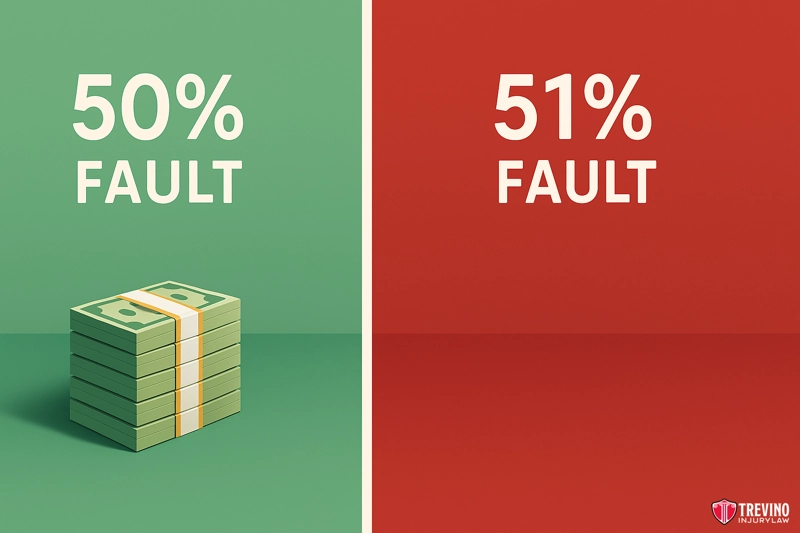
The formula for your final recovery is your Total Damages minus the Percentage of Fault assigned to you by the jury; however, if your fault is found to be 51% or more, your recovery drops to zero. For example, if a jury awards $1,000,000 but finds you 10% at fault (perhaps for not wearing a seatbelt on Loop 1604), you would receive $900,000.
For the broader framework around liability, proof, defenses, and fault, see our guide to Texas dram shop liability.
But if the defense successfully argues you were 51% at fault, you get $0, which is why we aggressively fight any attempt to shift blame onto the victim.
How Insurance Companies Devalue a Drunk Driver Claim?
Insurance companies use industry-standard algorithmic software (often Colossus) to calculate a “base value” for your life. This software analyzes diagnosis codes and zip codes to generate a rigid payout number. It intentionally excludes future medical needs or pain and suffering to generate a lowball offer.
They treat your claim as a data point in a “settlement mill,” offering a quick check hoping you don’t know the real value. Our response is to refuse to negotiate with their software; instead, we present a demand package backed by expert reports and trial readiness, forcing them to pay more when they realize the cost of going to trial against Trevino Injury Law exceeds their algorithm’s offer.

Punitive damages and correct calculations add value, but the final payout is often dictated by the hard ceiling of insurance policy limits.
How Policy Limits Affect Compensation in a Dram Shop Case?
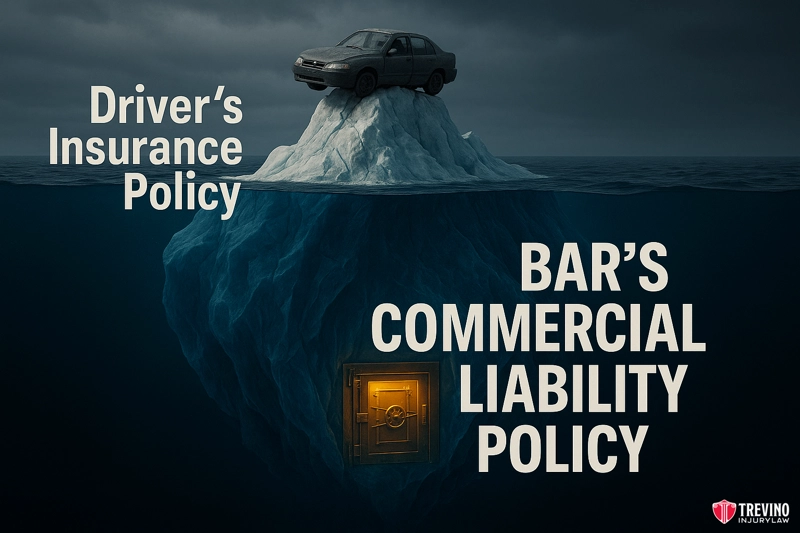
The practical limit on your compensation is often dictated by the defendant’s insurance policy limits, which is why dram shop claims are essential—they tap into commercial liability policies that are typically 20 to 50 times larger than personal auto policies. While knowing the total damage value is crucial, understanding where that money comes from determines if the judgment is collectible.
A drunk driver might only have the state minimum of $30,000 in coverage, which is insufficient for a catastrophic injury. However, a bar on the River Walk or The Pearl typically carries a $1 million/$2 million commercial liquor liability policy.
Commercial liquor liability policies in San Antonio typically carry limits of $1 million to $2 million. When damages exceed this, as seen in the 2025 Mendez v. Koozies Icehouse verdict of $831 million, we leverage the Stowers Doctrine. By formally demanding the policy limits when liability is clear, we corner the insurer: if they refuse to pay and a jury awards a massive verdict like Mendez, the insurer may be liable for the entire judgment, far exceeding their original policy cap. This fear of unlimited exposure is what drives maximum settlements.
Seeking Justice: What Is an Acceptable Settlement Offer?
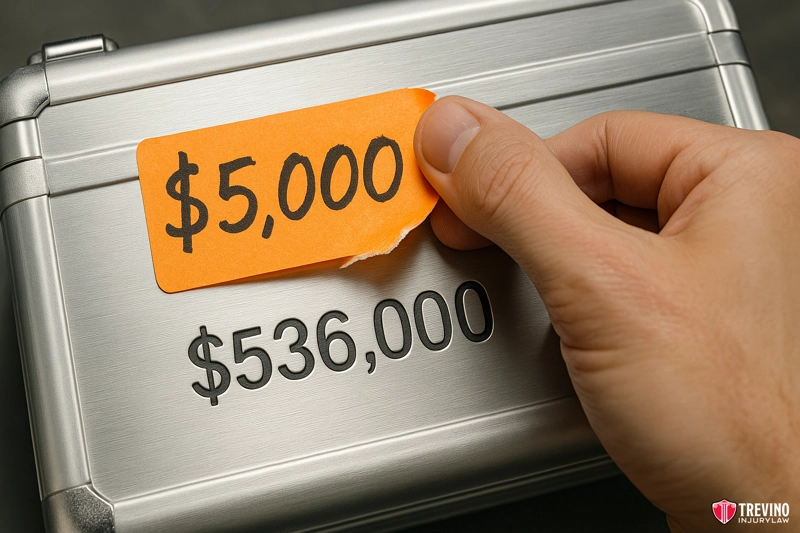
An acceptable settlement offer is one that covers all past medical bills (reimbursing subrogation liens), provides fully for future medical needs, and adequately compensates you for pain and suffering, without leaving you financially vulnerable later. We teach clients to look at the “net” number—what goes in your pocket after fees and bills—rather than the “gross” offer. A “good” offer rarely comes on Day 1; it comes after we have filed suit and exposed the bar’s negligence, as seen in the Arriaga v. Montemayor case, where we turned a $5,000 offer into a $536,000 jury verdict.
Understanding these limits helps answer the “how much” question for injuries, but the calculation changes entirely when a life is lost.
How Texas Rules Change the Calculation for Wrongful Death Damages
In wrongful death dram shop cases, the calculation shifts fundamentally from physical pain to the surviving family’s loss of financial support and loss of companionship. We use specific statutory formulas to quantify these profound absences.
For example, in a case involving 18-wheeler negligence resulting in wrongful death, our firm secured a $17 Million settlement. This result was achieved not just by calculating lost wages, but by quantifying the immense intangible loss to the surviving family members.
We calculate Pecuniary Loss by projecting the decedent’s lost future income—for instance, the wages a 35-year-old father would have earned until retirement age. Beyond money, we value Intangible Loss, which includes the “loss of counsel, guidance, and society” that children and spouses will no longer receive. Additionally, we calculate Lost Inheritance, determining what the family would have accumulated if the victim had lived a normal lifespan.
It is important to distinguish this from the Survival Claim, which compensates for the victim’s own pain before death; we pursue both claims simultaneously to maximize the recovery for the estate and the family members.
While calculating these losses establishes the total claim value, specific legal rules determine how much of that money you actually get to keep.
How Does the Collateral Source Rule Impact My Settlement?
This rule strictly prohibits the defense from telling the jury that Blue Cross, Aetna, or Medicare paid your bills, preventing the negligent driver or bar from receiving a “credit” for your prudence in carrying insurance. For example, if a hospital bill is $50,000 but your insurance paid a negotiated rate of $15,000, we present the full $50,000 figure to the jury as your economic damages, maximizing the potential verdict.
The Hidden Cost: Subrogation and Hospital Liens While the jury sees the full amount, your health insurer retains a right of subrogation, meaning they can demand repayment from your settlement funds for the bills they covered. In San Antonio, this often manifests as a hospital lien filed by major trauma providers like University Hospital or Methodist Healthcare specifically to secure payment before you see a dime.
How We Protect Your Payout Trevino Injury Law adds critical value by aggressively negotiating these “backend” costs. We challenge the validity of hospital liens and negotiate subrogation reductions, often by 30% to 50%, to ensure that the difference between the billed amount (what the jury awards) and the paid amount (what the insurer accepts) stays in your pocket, not an insurance conglomerate’s ledger.
Do I have to pay taxes on a dram shop lawsuit settlement?
Generally, no compensation for physical sickness or injury is tax-free under IRS rules, but any portion of the award designated as punitive damages or interest is considered taxable income, which we factor into the final settlement structure.
What is the formula for calculating compensation?
There is no single statutory formula, but the practical calculation used by attorneys is: (Economic Damages + [1.5 to 5x Non-Economic Multiplier]) +/- (Comparative Fault %) = Case Value.
What is the average compensation for a car accident?
There is no meaningful “average” because a minor fender-bender is worth a few thousand dollars, while a dram shop spinal injury case can result in verdicts or settlements ranging from $1 Million to $17 Million depending on liability and limits.
Why Experienced Attorneys Warn Against Accepting Early Offers?
If you accept a settlement offer too early, before your medical treatment is complete, you will be forced to sign a Release of Liability that permanently bars you from asking for more money, even if you discover new injuries or need surgery later. Insurance adjusters often pressure victims to settle “for cheap” within days of the crash, knowing that serious conditions like Traumatic Brain Injuries (TBI) or spinal disc herniations may not show symptoms for weeks.
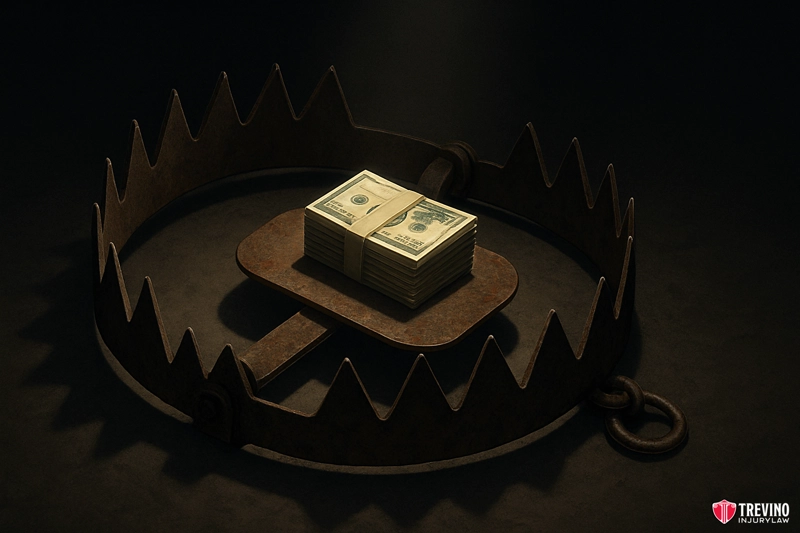
Once you sign that release, the case is closed forever; you only get one shot at compensation. If you settle for $20,000 now and find out next year that you need a $100,000 back surgery, you cannot reopen the claim. We protect you by delaying the demand until you have reached Maximum Medical Improvement (MMI), ensuring every dollar of your future care is included in the calculation.
How Our Law Firm Finds Assets When Insurance Isn’t Enough
If the bar’s insurance policy limits are insufficient to cover your damages, we can investigate excess coverage policies, pursue assets from the business entity directly, or identify other liable parties (like a second bar that also served the driver) to find additional layers of compensation. Larger chains often carry “umbrella” policies that provide coverage well above the standard $1 million limit, but they rarely disclose these voluntarily.
In cases where a driver was “bar hopping,” we may file suit against multiple establishments, triggering multiple insurance policies to cover your damages. In rare instances of extreme negligence, we may look to “pierce the corporate veil” to reach the personal assets of the business owners, though identifying all available insurance layers remains the primary strategy for securing the maximum compensation your family deserves.
Why Hire a San Antonio Dram Shop Lawyer?
Refusing to let an insurance algorithm dictate your future requires the threat of a courtroom battle. Insurance adjusters and high-volume settlement mills bank on your fear of litigation to push lowball offers that ignore your lifetime medical needs. We force them to pay by preparing every case for a Bexar County jury, ensuring they negotiate against a potential verdict rather than a spreadsheet.
You need personal injury attorneys to send spoliation letters and preserve commercial policy data before the defense hides its assets.
Want to Protect the Full Value of Your Claim?
You’ve seen how this affects your case — but this is only one piece of the puzzle. Our Dram Shop Lawyer page breaks down what a trial-ready firm does differently.
Our aggressive trial-first approach forces maximum value. In one major victory, the defense offered $1.3 million, but we took them to trial and secured a $7.9 Million jury verdict. We apply this same pressure to bar owners, issuing immediate spoliation letters to preserve video evidence and arming your San Antonio dram shop lawyer with the proof needed to break commercial policy limits.
Call 210-TREVINO for a free case review. Se Habla Español. Our No Win, No Fee promise means you pay nothing unless we win.