Commercial liquor liability insurance matters because it provides the essential financial resources required to cover catastrophic injuries when a drunk driver’s standard auto policy falls short. While a driver’s personal coverage rarely funds lifelong medical care, a negligent establishment’s commercial policy acts as the deep pocket necessary to secure your family’s future.
The commercial insurance adjuster is already building a Safe Harbor Defense, gathering employee certifications to legally void their liability and leave you paying for their dangerous service. But dram shop lawsuit compensation depends on proving the establishment’s negligence before the insurer can shift the blame. According to TxDOT, San Antonio recorded 1,394 DUI (alcohol) crashes in 2024. Behind these collisions sits a negligent bar owner who encouraged over-serving to maximize corporate profits.
What Could Your Dram Shop Accident Case Be Worth?
Answer a few quick questions about your accident. Takes about 60 seconds.
See What My Case Might Be WorthThe insurance company offered less than $20,000. I ended up with over $1 million. — Jackie Galindo
Surveillance video and receipt logs that prove visible intoxication vanish in the first week. You must immediately send a Spoliation Letter, a legal demand that stops the property owner from destroying evidence, before the establishment erases the proof of their negligence. Delaying this step allows the defense to shift the blame and destroy the claim.
A Trevino Injury Law dram shop attorney will subpoena the commercial declarations page and lock the evidence down before it disappears. Call 210-TREVINO now for a free case review. You pay nothing unless we win. Se Habla Español.
San Antonio Bar Insurance: Key Takeaways
- As your San Antonio dram shop lawyer, we uncover Liquor Liability policies of $1 million or more to secure maximum compensation for victims.
- The firm aggressively investigates establishments on corridors like Culebra Road in Bexar County to preserve video evidence before insurance companies hide it.
- Our legal team is dismantling the Safe Harbor Defense triggers insurance coverage by proving managers encouraged over-serving to protect their profits.
- Trevino Injury Law secured a $17 million settlement in a wrongful death case by proving the establishment’s negligence caused catastrophic harm.
Do Texas Bars Need Liquor Liability Insurance to Operate?
While Texas law does not strictly mandate liquor liability insurance for all alcohol permit holders, the Texas Alcoholic Beverage Commission (TABC) often requires it for specific permits or following violations, and most commercial landlords demand it from any bar or restaurant owner as a condition of the lease.
Unlike auto insurance, which is mandatory for all drivers, “going bare”, or operating without insurance, is a risky but legal option for some smaller venues in Bexar County.
This creates a dangerous “judgment proof” scenario where suing a bar with no insurance results in an empty verdict because the LLC has no assets to seize. Responsible, high-traffic venues like those at The Pearl or along the River Walk almost always implement robust policies to protect their substantial assets.
However, smaller “ice houses” or cantinas on corridors like Culebra Road or Bandera Road may attempt to operate without this safety net, leaving bar owners exposed and victims vulnerable unless their attorney acts quickly to identify other assets.
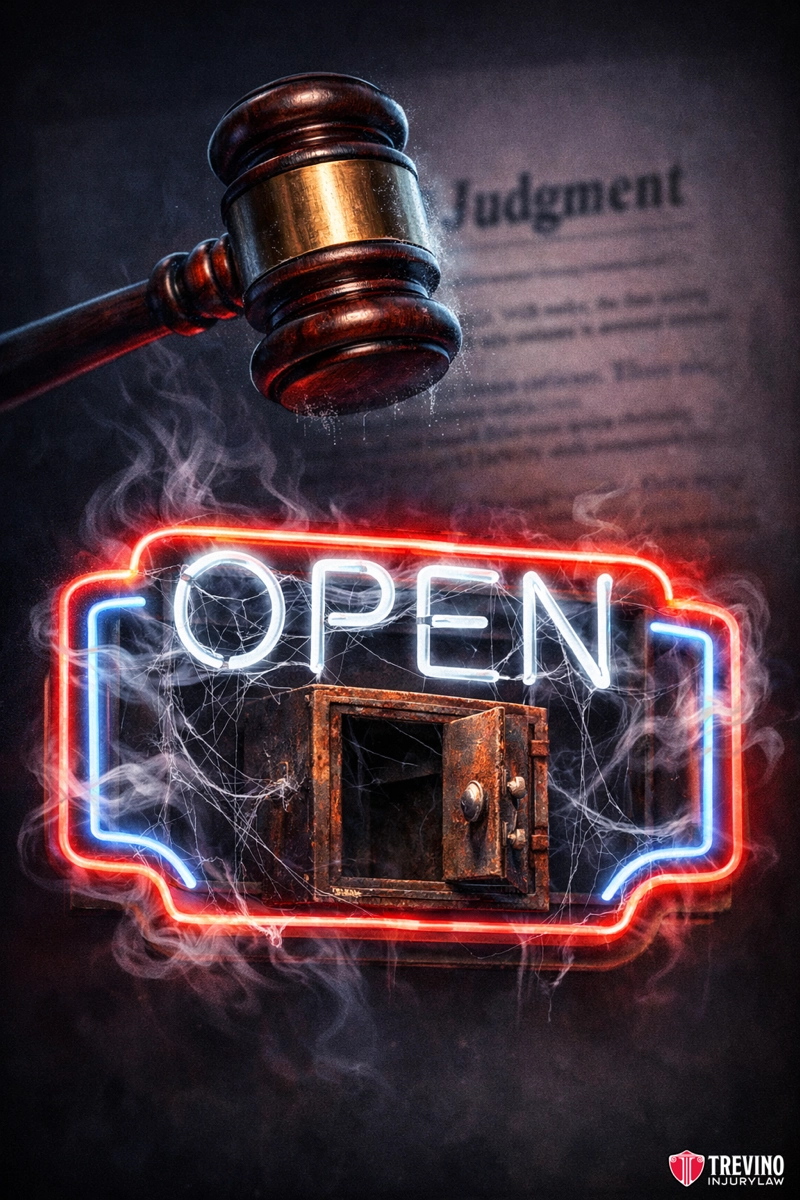
Even if a liquor store or bar carries insurance, it might be the wrong kind of policy that excludes the very accidents they cause.
What Is the Difference Between General Liability and Liquor Liability?
General Liability Insurance covers slip-and-falls or accidental property damage, but contains a specific “Liquor Liability Exclusion” that completely denies coverage for any bodily injury or property damage arising from the business of selling or serving alcohol.
A bar relying solely on a General Liability policy has zero coverage for a drunk driving crash caused by a negligent act of serving an intoxicated patron, meaning the insurance company will deny the claim immediately.
At Trevino Injury Law, we specifically investigate the “declarations page” of every policy to ensure the liquor liability insurance endorsement protecting the venue is actually present and valid. Once valid coverage is confirmed, we must identify exactly what incidents trigger a payout and which ones the insurer will try to reject.
What Does Dram Shop Liability Insurance Actually Cover?
A comprehensive liquor liability policy covers third-party bodily injury, such as a victim hit by a drunk driver, property damage caused by the intoxicated patron, and the establishment’s legal defense costs during the course of a lawsuit.
This coverage is essential because it protects the bar’s assets from being seized, which is why insurance adjusters fight so aggressively to deny liability at the start of a claim.
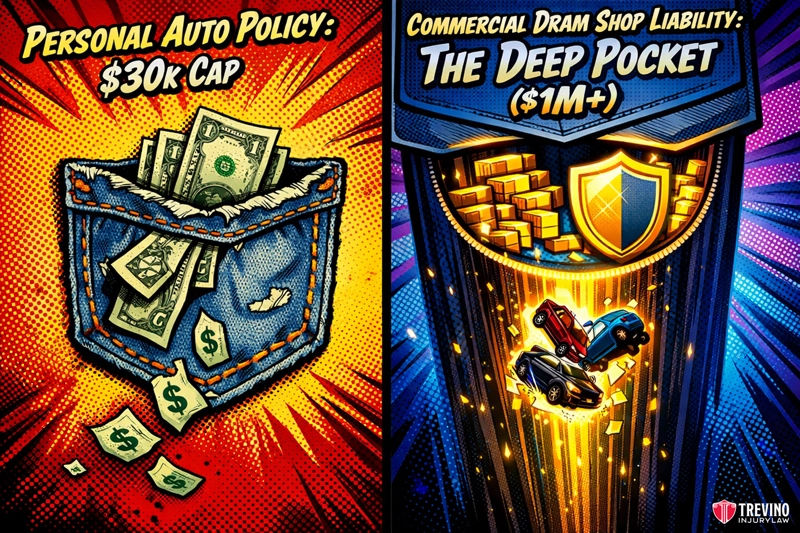
While a driver’s personal auto policy in Texas often caps bodily injury liability at $30,000, a commercial liquor liability policy acts as a “deep pocket,” often providing $1 million or more per occurrence for injuries. This level of funding is critical for cases involving catastrophic damages, such as the $17 million settlement we secured in a wrongful death case or the $1.8 million settlement for a spinal injury.
However, these policies often contain “fine print” exclusions designed to help insurance professionals avoid paying even valid claims.
Does Dram Shop Insurance Cover Bar Fights and Assaults?
Standard liquor liability policies often exclude coverage for assault and battery unless the establishment specifically purchased an “Assault & Battery Endorsement,” meaning injuries from a bar fight or bouncer misconduct may be denied coverage. From January to December 2025, there were 29,438 assault offenses in San Antonio (San Antonio Police Department, 2025).
Insurance companies frequently use the ‘intentional act’ exclusion to argue that a punch thrown by an intoxicated person is a crime rather than a covered accident. To defeat this, the Texas Supreme Court held that a bar has a duty to intervene when it has ‘reason to know’ that a fight is imminent on the premises.
By proving the establishment ignored obvious signs of aggression, we can trigger liability coverage despite the assault exclusion. We fight to prove that the establishment’s negligence in over-serving alcohol was the root cause of the aggression, triggering the liquor liability coverage rather than allowing them to hide behind the assault exclusion.
Beyond exclusions, the insurer’s favorite weapon is a specific Texas statute that can completely immunize the bar from paying damages.
How Does the Texas Safe Harbor Defense Work for Establishments?
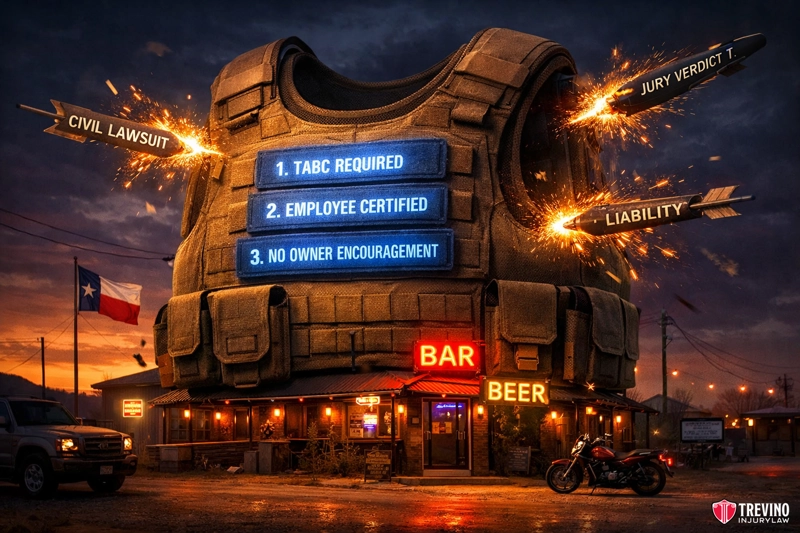
The Safe Harbor Defense is a provision in the Texas Alcoholic Beverage Code (often central to the Texas Dram Shop Act) that shields a bar from civil liability—and voids insurance payouts, if the establishment proves it required TABC certification for employees, the serving employee was certified, and the owner did not encourage the violation.
This defense acts like a “bulletproof vest” for bars; if they can prove these three elements of responsible alcohol service, the insurance company does not have to pay a dime, even if the driver was obviously intoxicated and caused a fatality. Defense attorneys will raise this in a Motion for Summary Judgment to try to dismiss the case before it ever reaches a jury.
It is the single biggest hurdle in Texas dram shop litigation, often used by defense teams representing bars in areas like Alamo Heights or Stone Oak to protect their clients. Because this defense is so powerful, we must aggressively prove tthat he bar chose to violate the law or encouraged the behavior to keep the case alive.
How Do You Prove a Bar Violated Safe Harbor Rules?
To defeat the Safe Harbor defense, we must prove the employer directly or indirectly encouraged the violation, such as by setting sales quotas or knowingly allowing employees to consume alcohol while on duty.
This specific form of negligence was highlighted in D. Houston, Inc. v. Love, 92 S.W.3d 450 (Tex. 2002), where the Texas Supreme Court recognized that an alcohol provider could be liable when it turned a blind eye to an employee getting drunk on the job, effectively encouraging the very negligence the statute seeks to prevent.
We immediately send “Spoliation Letters” to preserve video evidence and internal memos that might reveal management pressuring staff to ignore slurred speech, a patron who has begun to stumble, or other signs of overservice to boost profits. If we can prove even one server wasn’t certified, that they sold alcohol to minors, or that a manager looked the other way during a rush at a busy Southtown venue, the “Safe Harbor” protection collapses.
Securing the insurance money often requires proving that they continued to serve alcohol to someone who was a danger to themselves and others.
How Do We Confirm if a San Antonio Bar Has Insurance Coverage?
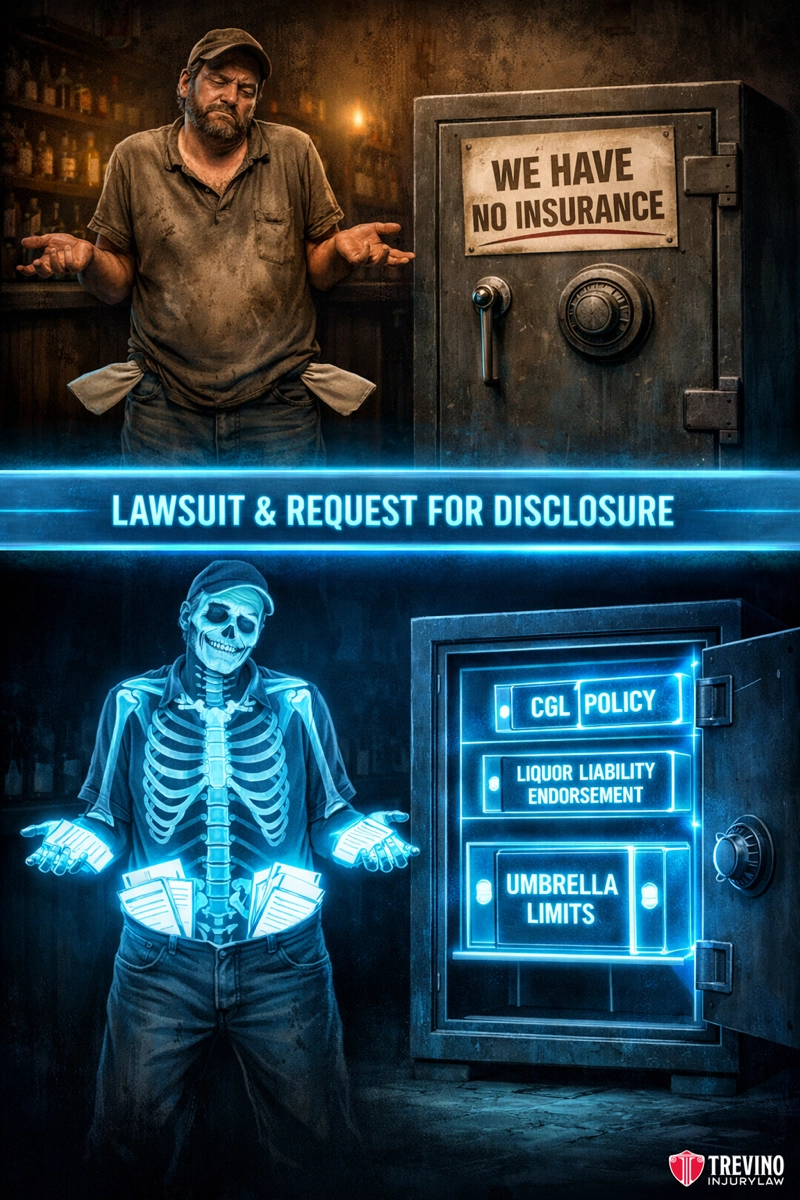
We confirm coverage by filing a lawsuit and serving a Request for Disclosure, which legally compels the defendant to produce the “Declarations Page” of all applicable insurance policies within 30 days. Before a lawsuit is filed, negligent bars often hide their coverage or claim they are uninsured to discourage you from pursuing a claim.
We aggressively search for Commercial General Liability (CGL), specific Liquor Liability endorsements, and Umbrella or Excess policies that sit above the primary limits. Our investigation also identifies whether the bar holds a “wasting policy,” where their legal defense costs reduce the money available for your recovery, or if defense costs are paid outside the policy limits.
This forensic review often reveals multiple layers of hidden coverage, especially at high-volume venues near UTSA or at upscale bars at The Rim, which often carry higher limits to protect their corporate assets.
Once coverage is identified and confirmed, we must determine how compensation is calculated in a Texas dram shop lawsuit and whether the available policy limits can cover the full extent of your damages.
How Do You Prove Visible Intoxication in a Dram Shop Case?
Proving visible intoxication in a Dram Shop case mandates establishing that a server furnished alcohol to a patron exhibiting unmistakable physical signs of impairment, such as slurred speech, stumbling, or fumbling for money. To satisfy the burden of proof, legal teams utilize forensic toxicologists to extrapolate the driver’s Blood Alcohol Content (BAC) back to the time of service, validating security footage and witness testimony.
This evidence serves as the critical trigger for liquor liability coverage; failing to prove the intoxication was apparent to the server allows insurers to deny claims under the exclusion for non-negligent service.
Can insurance deny a claim for alcohol?
Yes, insurance can deny a claim if the policy contains a specific Liquor Liability Exclusion or if the bar successfully invokes the Safe Harbor Defense in court.
Does general liability cover drunk driving crashes?
No, standard General Liability policies specifically exclude bodily injury or property damage arising from the business of selling or serving alcohol.
Can a bar lose its liquor license for no insurance?
Generally, no, Texas does not automatically revoke a liquor license for lack of insurance, but a lack of coverage can lead to bankruptcy if a major judgment is entered against the bar.
Comparison: Commercial Policy vs. Driver’s Auto Policy
The definitive difference lies in the financial limits: a commercial liquor liability policy typically secures $1 million or more per occurrence for catastrophic injury, whereas a standard Texas personal auto policy is frequently capped at the $30,000 state minimum. To adhere to the “made whole” doctrine, attorneys employ stacking remedies, exhausting the driver’s limited policy before accessing the commercial limits to fund long-term care.
Coverage Tier Breakdown:
– Driver’s Auto Policy: Often restricted to $30,000 per person; typically insufficient, as it barely covers a single ER visit.
– Commercial Liquor Policy: Generally starts at $1,000,000; essential for covering long-term rehabilitation and lost wages.
– Umbrella/Excess Policy: Can add $5 million to $10 million+ for corporate chains; vital for fully funding wrongful death cases.
What Happens If the Bar Has No Liquor Liability Insurance?
If a bar has no liquor liability insurance (“going bare”), the victims must seek compensation directly from the bar’s assets, which often leads the bar to declare bankruptcy to avoid paying the judgment. In these “judgment proof” scenarios, the negligent establishment closes its doors to escape liability, leaving victims with limited options.
When this occurs, Trevino Injury Law aggressively investigates the personal assets of the owners to determine if we can “Pierce the Corporate Veil,” a legal mechanism that allows us to hold owners personally responsible if they used the business to perpetrate a fraud or injustice.
If the driver was served at more than one establishment, the investigation should also examine how liability may be divided among multiple bars in a Texas dram shop case, because the uninsured venue may not be the only establishment whose conduct needs to be investigated.
However, insurance remains the primary target because liquidating physical assets like barstools and inventory rarely yields sufficient compensation. Even when a bar has a valid insurance policy, certain staff actions can still cause coverage to be voided entirely.
When Does Insurance Not Pay Even With a Policy?
Insurance will not pay if the bar’s actions were criminal or intentional, or if the policy lapsed due to non-payment of premiums prior to the date of the accident. Insurance adjusters constantly look for reasons to cite these exclusions to save their company millions.
For example, if a bouncer intentionally assaults a patron, the carrier may cite an “intentional act” exclusion to deny coverage for the injuries. Similarly, if a struggling bar owner missed a premium payment by even a single day before the crash occurred, the carrier will declare the policy “lapsed” and refuse to defend the case.
This creates a complete picture of the risks: we must prove negligence, defeat the Safe Harbor defense, and ensure the policy was active and applicable to the specific conduct that caused your injury.
Why Hire a San Antonio Dram Shop Lawyer?
The insurance company wants you to believe their “Safe Harbor” defense is unbeatable, but an experienced San Antonio dram shop lawyer knows how to dismantle it.
You need a team of personal injury lawyers to send immediate spoliation letters and subpoena the Declarations Page before coverage vanishes.
Want to Protect the Full Value of Your Claim?
You’ve seen how this affects your case — but this is only one piece of the puzzle. Our Dram Shop Lawyer page breaks down what a trial-ready firm does differently.
You only have a limited time to preserve the surveillance footage and witness testimony needed to secure your compensation before they disappear.
Call 210-TREVINO now for a free consultation; we fight for families throughout Texas, we litigate to verdict, and you pay nothing unless we win.