Proving a Texas bar served an intoxicated patron requires securing the physical surveillance footage and the point-of-sale financial data before the establishment deletes them. The timeline of obvious intoxication lives in the receipts showing exactly when the bartender poured the final drink.
The insurance company is already invoking the statutory Safe Harbor defense, claiming its staff received state certification to shield the establishment from liability while simultaneously allowing the security cameras to tape over the night in question.
According to Bexar County crash data, the community suffered 1,844 DUI-alcohol crashes in 2023. Behind these collisions is a commercial provider that prioritized profits over public safety by ignoring slurred speech and a loss of coordination. A Spoliation Letter, a legal demand that prevents the property owner from destroying evidence, must be issued immediately before the system overwrites the footage within 30 days.
At Trevino Injury Law, we will assign the best dram shop attorney to subpoena the financial records and lock down the evidence before it vanishes. Call 210-TREVINO now for a free case review. You pay nothing unless we win. Se Habla Español.
What is the “Obvious Intoxication” Standard in Texas Dram Shop Law?
“Obvious intoxication” is the high legal standard in Texas that serves as the central target of all evidence in a dram shop case. The statute, Texas Alcoholic Beverage Code § 2.02(b), requires you to validate two things:
- Obvious Intoxication: At the time the liquor was sold, it was “apparent to the provider” that the individual was “visibly intoxicated” to the extent that he presented a clear danger to himself and others.
- Proximate Cause: That intoxication was a “proximate cause of the damages suffered“.
It is not enough to show the person was drunk after the fact; we must verify they displayed visible signs of impairment that a trained provider should have recognized before pouring the next drink. This involves proving the Texas bar failed to serve alcohol responsibly.
As the Texas Supreme Court established in 2008 in 20801, Inc. v. Parker, 249 S.W.3d 392 (Tex. 2008), a high blood alcohol content (BAC) alone is insufficient to prove liability. This is a behavioral standard, not just a chemical one.
We focus on proving specific, visible manifestations of intoxication that align with the Texas Alcoholic Beverage Commission (TABC) criteria:
- Slurring speech: Inability to articulate words clearly when ordering.
- Stumbling or swaying: Difficulty maintaining balance while standing at the establishment or walking to the restroom.
- Spilling drinks: Lack of fine motor control, including fumbling with a wallet or credit card.
- Belligerent behavior: Aggressive or unusually loud conduct toward staff or other customers.
- Bloodshot eyes: Visible physical indicators often captured on high-definition security cameras.
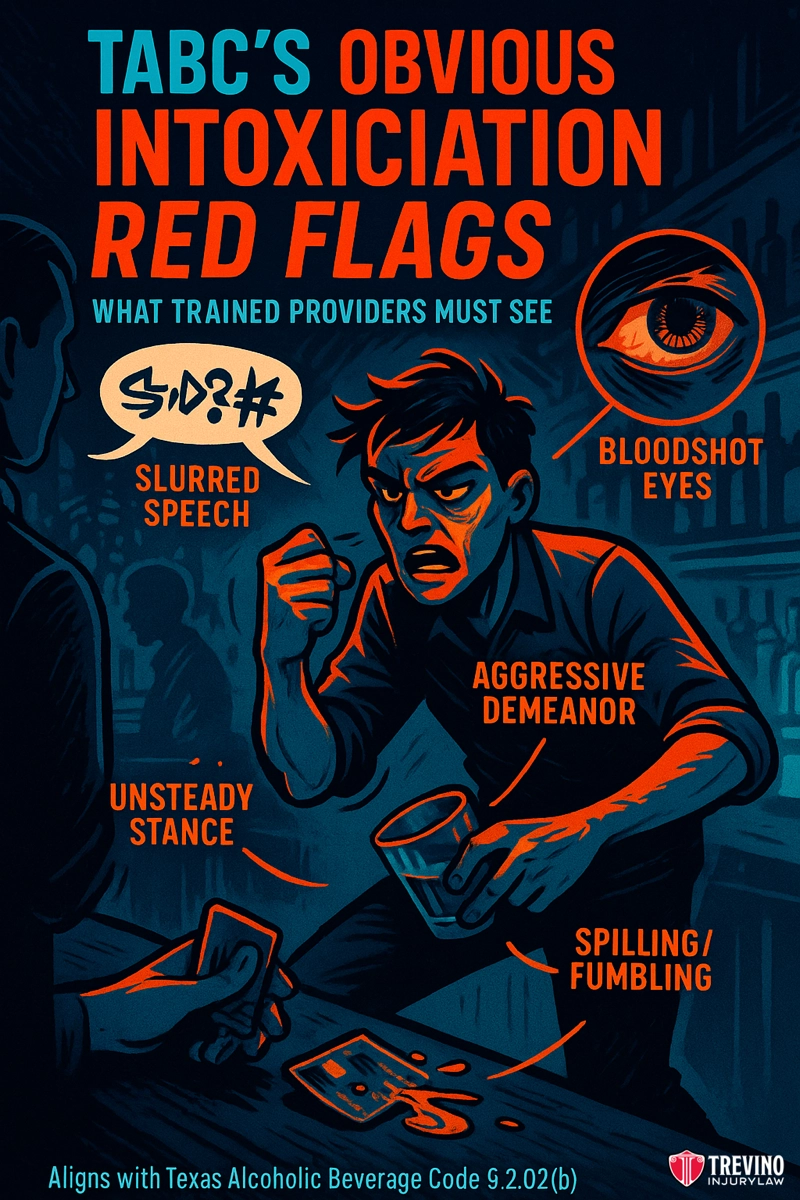
These behaviors mirror the specific red flags TABC seller-server training teaches bartenders to look for: slurred speech, loss of coordination, red or watery eyes, and delayed reactions, meaning a reasonable person could reasonably claim they “didn’t notice” these clear signs.
What Role Do Bar Receipts and Credit Card Records Play as Evidence?
Receipts and credit card records serve as powerful objective evidence that allows us to create a time-stamped financial timeline of the patron’s alcohol consumption, which can be used to confirm that the establishment served a dangerous volume of alcohol in a short period.
By analyzing the exact time each drink was purchased, we can mathematically demonstrate that holding a bar legally responsible is appropriate because they continued to serve alcohol to someone who had already consumed enough to be visibly impaired.
We immediately subpoena the bar’s Point of Sale (POS) data and the patron’s credit card statements to build this timeline. While a server might refuse to serve a drunk person, the data often tells a different story.
For example, in a past wrongful death case involving dram shop liability, we secured a $1 million settlement by proving the establishment ignored the sheer volume of alcohol served.
Suppose we can show a receipt for “8 shots and 4 beers” charged to a single card within 90 minutes, combined with a high BAC result. In that case, we can argue that no human being could consume that much alcohol without showing obvious signs of intoxication. The pattern of a certain number of drinks in a short period suggests the patron was obviously intoxicated.
This objective data corroborates subjective accounts and makes it difficult for the defense to claim ignorance.
What Evidence Is in a Police Report for a DWI Crash?
The DWI accident police report contains critical evidence, including the driver’s confirmed Blood Alcohol Content (BAC), the arresting officer’s sworn observations of intoxication, and witness contact information. We use this to connect the driver’s impairment at the scene back to the bar’s over-served status.
The report provides critical “end result” data points. For example, if a crash occurs on I-35 (San Antonio’s highest-collision corridor) or Culebra Road, the officer’s notes on the driver’s “stumbling” or “slurring” are vital. Based on a 2024 analysis, Culebra Road has been identified as San Antonio’s most dangerous road, and a TxDOT I-35 Statewide Corridor Plan found the Bexar County I-35 segment’s wreck rate was higher than the Texas interstate average (based on 2009–2013 data).
We use these observations to argue that if a driver was that impaired at the accident scene, they were likely displaying visible signs at the bar just minutes earlier.
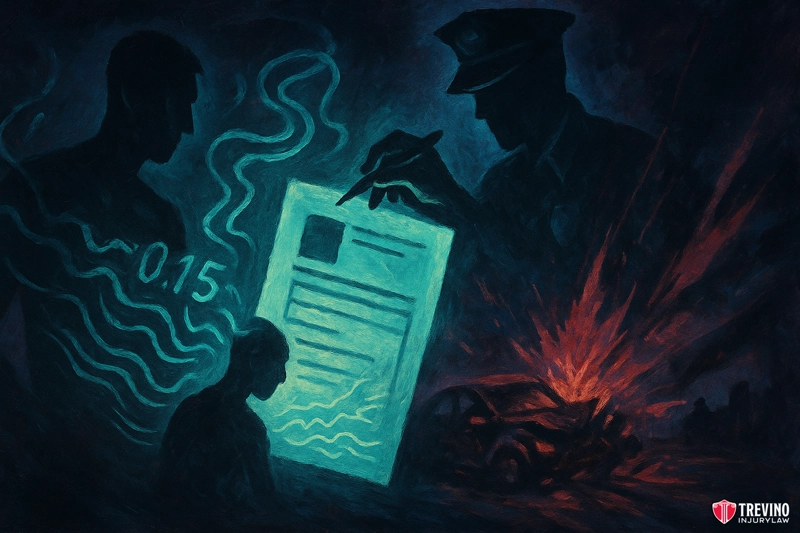
The report confirms it. With the financial timeline and police records secured to establish the facts, we must next add the human element to explain what those facts mean to a jury.
How is Witness Testimony Used to Prove “Obvious Intoxication” and Bar Liability?
Testimony is used to translate the cold, hard data from receipts and police reports into a compelling human story for a jury, using eyewitnesses to describe the patron’s actual behavior and experts to explain the science behind their impairment levels. While documents corroborate what happened, testimony explains how it looked and why it matters, bridging the gap between a receipt for twelve drinks and the legal standard of “obvious intoxication.”
We clearly differentiate the roles of these witnesses. Eyewitnesses provide subjective observations of what they saw, heard, and felt, while experts provide objective calculations that confirm those observations were consistent with the alcohol consumed.
Both are essential to defeat a defense attorney who will claim the patron “held their liquor well.” We use testimony to substantiate that the signs of intoxication were there, they were obvious, and they were ignored for the sake of a sale.
What Specific Witness Statements Strengthen a Dram Shop Injury Claim?
The strongest witness statements are those that describe the specific, visible signs of “obvious intoxication,” such as a witness confirming they saw the patron “slurring their speech,” “stumbling into tables,” or “being belligerent with staff” before they were served their last drink.
General statements like “he seemed drunk” are often challenged by the defense as opinions, so we interview other patrons, door staff, and even the driver’s companions to obtain detailed descriptions of the behavior.
We depose bar staff to lock in their stories, often finding contradictions between what they claim they saw and what the video or other witnesses reveal.
How is Expert Witness Testimony About Impairment Used in Court?
A toxicologist expert is used in court to synthesize all the evidence, receipts, BAC levels, and timelines, to provide scientific testimony on the driver’s likely BAC and visible impairment level at the exact time the bar served them. Through a process called “retrograde extrapolation,” the expert works backward from the time of the collision to determine how drunk the person was at the bar.
This testimony effectively translates the “obvious intoxication” standard from a behavioral guess into a scientifically backed fact, showing the jury that, based on the biology of alcohol, the patron must show they were displaying visible signs of impairment.
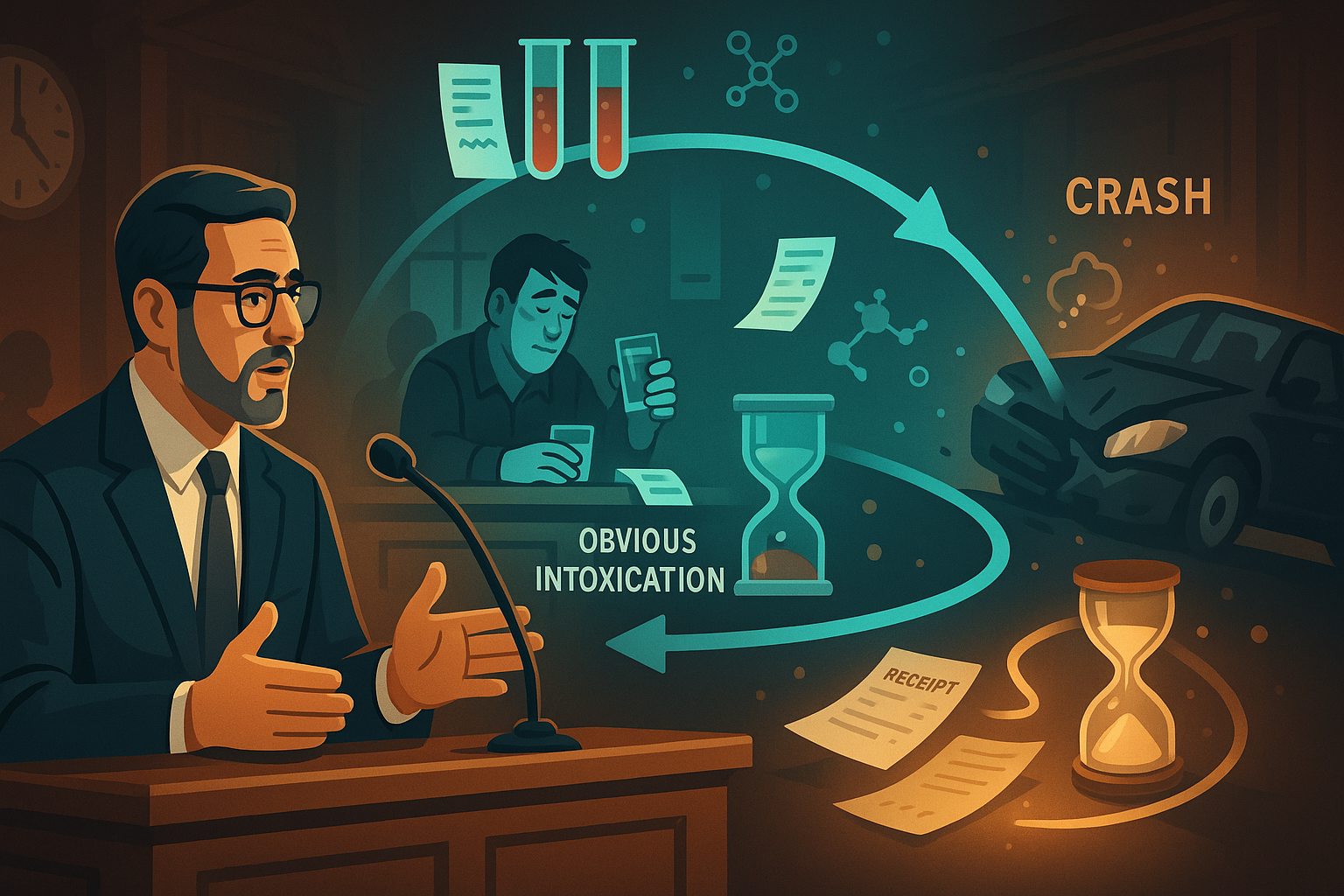
You now understand what we need to prove and the testimony required to support it, but the single most powerful piece of evidence is also the most fragile and time-sensitive.
How Do You Obtain Surveillance Footage to Prove the Bar Served the Drunk Driver?
The only effective way to obtain surveillance footage is to have a trial-ready attorney immediately send a legal spoliation letter to the bar, formally demanding that they preserve all video recordings, receipts, and electronic data before they are routinely erased. This legal demand freezes the evidence in place, stopping the clock on auto-deletion systems and effectively forcing the establishment to secure the “smoking gun” proof of their negligence.
This action is the single most urgent step in any dram shop case because of the “Dual Clock” problem. While Texas personal injury law gives you two years to file a lawsuit, the practical deadline to secure video evidence is often just 7 to 30 days after the wreck.
Whether the alcohol-related incident occurred at a high-end venue at The Pearl or a crowded nightspot on the St. Mary’s Strip, most security systems automatically tape over old footage to save storage space. Once that loop completes, the visual proof of the bartender serving a stumbling patron is gone forever. A spoliation letter is the only legal tool that halts this process.
The preservation process also extends beyond the camera feed. Preserving bar surveillance and POS evidence in a Texas dram shop case means identifying the video systems, transaction records, and other digital sources that need to be secured before the underlying data disappears.
This legal demand is our primary weapon to lock down the truth, but, naturally, bars and their insurance companies have a well-developed playbook to try to defeat it or explain away what the evidence shows.
Real-world cases are rarely simple; they often involve “bar hopping” down the St. Mary’s Strip or social media trails that complicate the timeline. We address these complex scenarios by applying specific provisions of Texas law to hold every negligent party accountable, regardless of how many stops the driver made.
What If the Driver Drank at Multiple Bars or Restaurants Before the Crash?
If a drunk driver visited multiple establishments, for example, starting at a restaurant at The Rim and ending at a club downtown, Texas Civil Practice & Remedies Code – Chapter 33 (Proportionate Responsibility) allows us to sue a bar and every establishment that continued to serve the patron while someone’s loved one was injured.
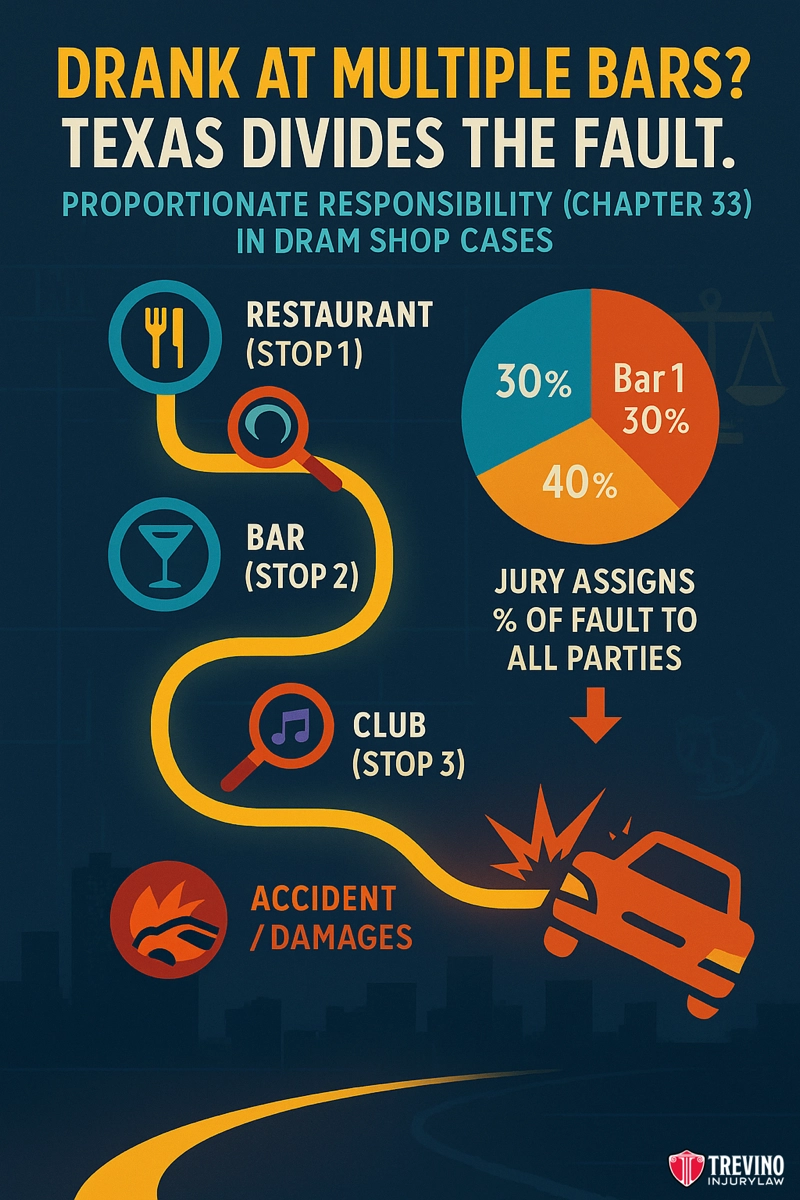
The Texas Supreme Court has confirmed that Chapter 33 applies to Dram Shop actions, meaning a jury assigns a percentage of fault to each bar and the drunk driver based on their contribution to the driver’s intoxication. We map the driver’s route to show that the later bars also had a duty to stop service because the patron had already arrived impaired.
Yes, social media content is admissible court evidence that frequently serves as the “digital smoking gun” to prove a patron’s location, drink volume, and physical state of impairment in real-time.
While the bar’s security camera might be “conveniently missing,” the driver’s own Instagram Stories, TikTok videos, or Facebook check-ins often remain online. We immediately preserve these digital footprints to show the jury what the server saw: a patron slurring words in a selfie video or posting photos of multiple rounds of shots mere minutes before getting behind the wheel.
Can a Bartender Be Held Personally Liable for Overserving?
Yes, under the Texas Dram Shop Act, individual bartenders and servers can be held personally liable for serving an intoxicated person. However, we primarily focus on litigation to establish access to their commercial insurance policy. Naming the bartender as a defendant is a strategic move; it often forces a wedge between the server and the bar owner.
During depositions, the server may be able to sue and admit they were understaffed or pressured by management to “upsell” drinks to intoxicated patrons to protect themselves, effectively destroying the bar’s “Safe Harbor” defense.
Does the Car’s “Black Box” Help Prove the Bar’s Liability?
Yes, the vehicle’s Event Data Recorder (black box) provides objective crash data, such as a lack of braking or reaction time, that expert toxicologists use to scientifically corroborate that the driver was legally and visibly impaired hours earlier. If the black box shows the driver did not brake before impact on I-35, it confirms a total lack of cognitive function.
Our toxicologist then uses retrograde extrapolation to work backward from that moment scientifically. They testify that a person with such severe cognitive failure at the collision site must have displayed obvious physical signs (stumbling, glassiness) when they were served their last drink. Even with scientific proof from the black box, the bar will not simply accept liability; they will deploy specific legal defenses to protect their license.
What Are Common Bar Defenses Against Claims of Overserving?
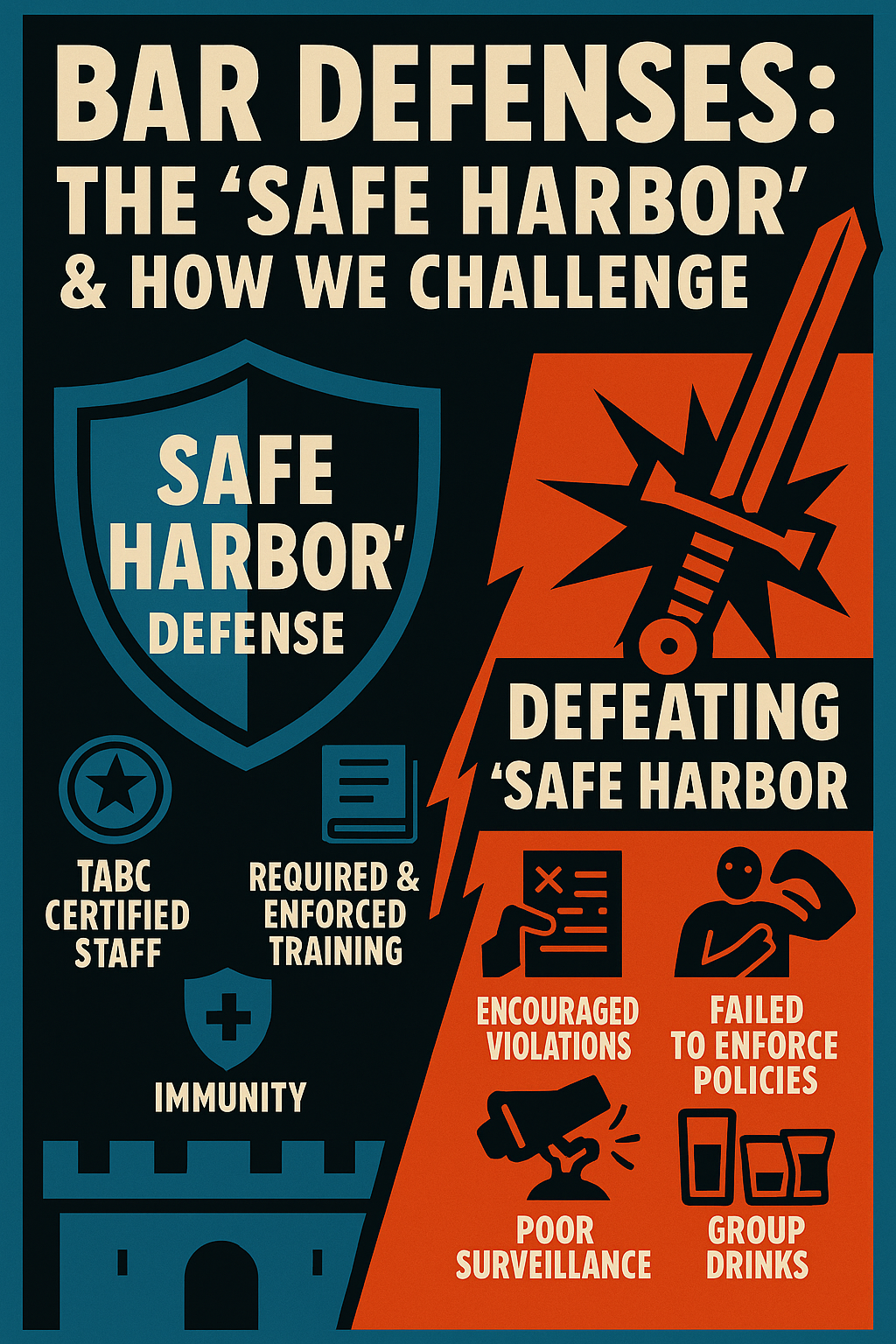
The most common defense is the “Safe Harbor Defense,” in which the bar claims immunity because its staff is TABC-certified. The statute, Texas Alcoholic Beverage Code – § 106.14(a), says a bar is not vicariously liable for an employee’s overserving if it requires and enforces TABC training and has not encouraged violations.
For a closer examination of this defense and the evidence involved in challenging it, see our guide to the TABC Safe Harbor Defense.
No, TABC certification is not an automatic shield. We defeat the “Safe Harbor” defense by proving that although the staff was certified, they knew or should have known the bar knowingly encouraged them to violate the law or failed to actually enforce those policies.
Beyond this statutory defense, defense attorneys in Bexar County will attack the evidence itself. They may argue the patron “held their liquor well” and showed no visible signs, claim the surveillance video is too dark or grainy to be conclusive, or insist that receipts showing multiple drinks were for a group rather than a single person.
Is TABC certification an automatic “Safe Harbor” that dismisses a lawsuit?
No, certification is not an automatic shield; we can defeat this defense by proving the bar was negligent, encouraged overserving, or that the specific server was not actually certified at the time.
Can a bar avoid liability simply by claiming a patron “held their liquor well” and didn’t appear drunk?
No, the legal standard is “obvious intoxication,” and we use expert toxicologists to verify that, based on the amount of alcohol served, the patron must have displayed visible signs of impairment regardless of their tolerance.
Does a grainy video or a confusing bar tab mean the bar is not responsible for overserving?
No, imperfect evidence does not absolve the bar; we use witness testimony and forensic receipt analysis to corroborate the timeline and substantiate liability, even if a single piece of evidence is unclear. The most common and complex defense is when the bar claims the primary evidence, the video, is gone.
What Happens if the Bar Erased the Surveillance Video?
Suppose a bar erased the video after receiving our spoliation letter. In that case, this is considered spoliation of evidence, and we can ask the judge to instruct the Bexar County jury to assume the missing video would have proven our case. This “spoliation instruction” is a powerful legal sanction that turns the bar’s attempt to hide the truth into an admission of guilt.
However, the situation is different if the video was erased before we were hired. If the footage was deleted in the normal course of business (usually 7-30 days) because no one requested it, we cannot claim spoliation. In these scenarios, we must pivot to building a “circumstantial case” using credit card receipts, witness statements, and TABC reports to reconstruct the night without the visual “smoking gun“.
Can a bar be legally penalized if it intentionally erases video evidence after being told to save it?
Yes, if a bar destroys video after receiving a spoliation letter, the court can sanction them and instruct the jury to assume the destroyed footage would have proven the bar’s negligence.
Is the case automatically lost if the bar’s surveillance video was erased before you hired an attorney?
No, while the case is more difficult without video, it is not impossible; we immediately pivot to securing credit card receipts, TABC reports, and eyewitness statements to reconstruct the event.
Can we still win a case even if the “smoking gun” video proof is gone forever?
Yes, trial-ready lawyers frequently win these cases by using expert toxicology testimony to scientifically verify the patron was intoxicated based on the timeline of drinks purchased. If the “smoking gun” video is gone, we must build a case without direct visual proof.
What Happens If You Have No Direct Evidence of Overserving?
If you have no direct evidence, like video or witnesses, a skilled trial attorney can still build a powerful circumstantial case by combining expert toxicology testimony with the driver’s high BAC and receipts showing a high volume of sales. Do not assume your case is lost simply because there is no video of the servers handing the drink to the driver.
Under the ‘Proportionate Responsibility’ statute, a jury can assign a percentage of fault to each bar based on its contribution to the driver’s intoxication. This principle was solidified in F.F.P. Operating Partners, L.P. v. Duenez, 237 S.W.3d 680 (Tex. 2007), where the Texas Supreme Court held that a dram shop provider’s liability is determined by comparing its negligence to that of the intoxicated driver.
We leverage this legal standard to hold every establishment in the chain of events accountable. The math creates the proof when the video cannot. While a case can be built later, the best evidence is fragile and must be captured immediately.
When Is It “Too Late” to Get Evidence from a San Antonio Bar?
In many cases, it is “too late” to get the best evidence just 7 to 30 days after the accident, as this is when most San Antonio bars’ surveillance video systems automatically tape over and erase the “smoking gun” proof forever. This reality creates a “Dual Clock” for victims: the legal statute of limitations gives you 2 years to file a lawsuit, but the evidence deadline is weeks away.
Once that footage is overwritten, it is gone permanently. Waiting to see if the insurance company will “do the right thing” is the biggest mistake victims make. The deadline to build a winning case is not two years from now; it is today.
Why Hire a San Antonio Dram Shop Lawyer?
Negligent bars hide behind “Safe Harbor” defenses, and high-volume settlement mills are often too afraid of trial to challenge them effectively. We are not. We expose their profits-over-safety culture and force them to pay full value for the lives they endangered.
You need a San Antonio accident attorney to immediately send spoliation letters and subpoena POS data before the evidence is destroyed.
Want to Protect the Full Value of Your Claim?
You’ve seen how this affects your case — but this is only one piece of the puzzle. Our Dram Shop Lawyer page breaks down what a trial-ready firm does differently.
We secured a $1 million settlement in a dram shop wrongful death case by strictly validating the establishment’s negligence. We immediately issue spoliation letters to lock down “smoking gun” evidence before facing the insurance defense at the Bexar County Courthouse.
Call 210-TREVINO for a free case review. Se Habla Español. You pay nothing unless we win.