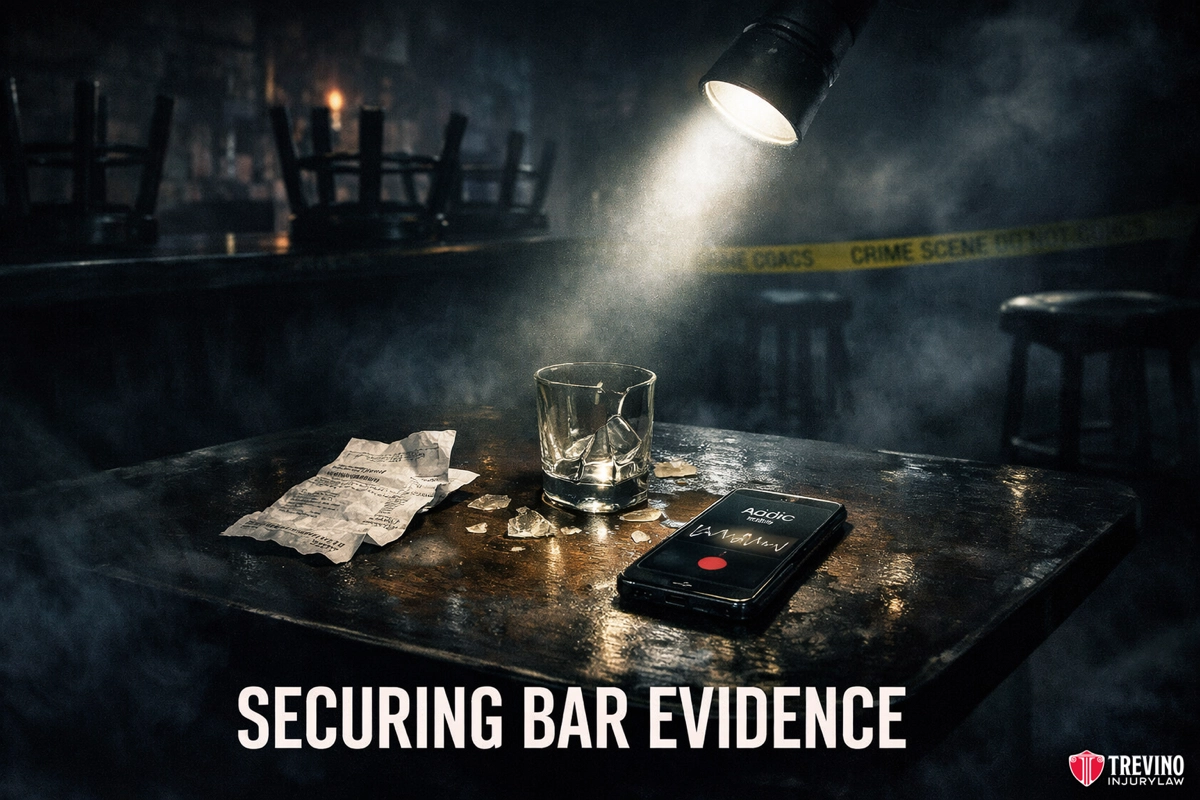
A drunk driver caused the collision, but the bar that overserved them controls the evidence. The critical surveillance footage showing the bartender pushing the final drinks to an obviously intoxicated patron sits on a local hard drive right now. Point-of-sale data detailing the exact timeline of consumption remains hidden in their system.
The venue relies on rolling digital video recorders that automatically overwrite camera feeds in mere days. Defense attorneys use this routine looping mechanism to wipe the record clean and argue that the footage simply disappeared. That is why dram shop attorneys in San Antonio focus early on securing surveillance footage and sales records before they are erased.
What Could Your Dram Shop Accident Case Be Worth?
Answer a few quick questions about your accident. Takes about 60 seconds.
See What My Case Might Be WorthThe insurance company offered less than $20,000. I ended up with over $1 million. — Jackie Galindo
The Texas Department of Transportation recorded 64 DUI-related fatalities across Bexar County in 2024. Behind these wrecks is a negligent commercial establishment prioritizing profit over public safety. You must interrupt this deletion cycle immediately with a Spoliation Letter, a legal demand that stops the property owner from destroying proof. Once a week passes, the hardware loops over the files, and the claim evaporates.
Trevino Injury Law’s dram shop lawyers subpoena these cloud providers and lock the digital footprint down before the manager hits delete. Call 210-TREVINO for a free case review. You pay nothing unless we win. Se Habla Español.
How Long Do San Antonio Bars Keep Surveillance Video Evidence?
Most bars and nightclubs in Bexar County use rolling DVR systems that automatically overwrite surveillance footage after a short cycle, typically 7 to 30 days, unless specific legal action is taken to stop it.
This “looping” mechanism is designed to save storage space, meaning that once the hardware and software reach capacity, the system immediately begins writing over the oldest files with new camera feeds. Federal guidance confirms that if the earliest recorded date on a system is seven days prior, investigators may have no more than seven days before relevant data is overwritten (FBI/TSWG, 2006).
In high-traffic venues along Loop 1604 or dense entertainment districts, the sheer volume of high-definition video data can shorten this retention window to as little as a week. We frequently encounter establishment owners who claim the footage “just disappeared” or was “routinely scrubbed” before we could request it.
This is why relying on the bar’s goodwill is a failed strategy; they have no incentive to save evidence that proves their own negligence. Our approach assumes the evidence is in danger of destruction from the moment the crash occurs.
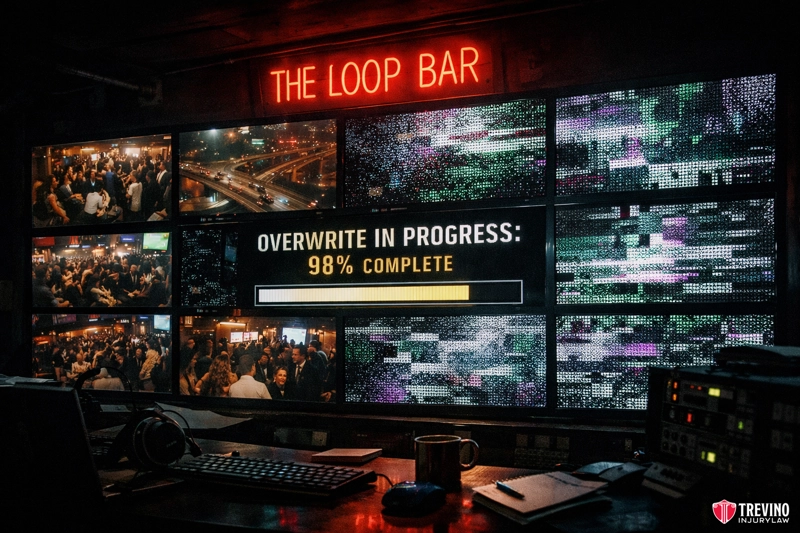
By recognizing that the default operation of these systems is deletion, we can act quickly to interrupt that cycle before the critical hours leading up to the crash are lost forever.
Does TABC Require Bars to Retain Video Footage?
No, the Texas Alcoholic Beverage Commission (TABC) does not universally require bars to retain surveillance video for extended periods, so it is a purely business decision for the venue unless a legal hold is in place. While the TABC enforces liquor licensing laws, the specific duty to preserve video evidence for civil litigation usually only triggers once the bar receives formal notice of a claim.
This regulatory gap means that, without immediate attorney intervention, a bar can legally allow footage to be overwritten without facing automatic penalties from the state. However, for tax purposes, the Texas Comptroller requires businesses to retain records for at least 4 years to support potential audits (Texas Comptroller, n.d.).
Similarly, the IRS advises keeping records for 3 to 7 years, depending on the filing situation (IRS, 2025). Knowing that the video will disappear quickly leads to the urgent question of how to stop it legally. This is a common issue in the hospitality industry, where documentation standards vary wildly.
What Is a Spoliation Letter and When Must It Be Sent?
A spoliation letter is a formal legal demand sent by a trial attorney to a bar, its insurance carrier, and its registered agent, explicitly notifying them of an impending claim and their legal duty to preserve all digital and physical evidence immediately. Unlike a simple request or phone call, this document carries significant legal weight because it triggers the formal duty to preserve evidence before litigation.
Under the strict standards set by the Texas Supreme Court in Brookshire Bros., Ltd. v. Aldridge, if a bar intentionally destroys footage after this duty has been triggered, the court may impose a spoliation instruction, instructing the jury to presume the missing evidence would have been harmful to the bar’s defense.
To be effective, this letter must be sent immediately following the accident, often days or even weeks before a formal lawsuit is filed in the Bexar County Courthouse. Across the broader Bexar County area, total DUI-related fatalities reached 64 in 2024, emphasizing the frequency with which these legal interventions are necessary (TxDOT, 2024). We dispatch these letters via certified mail, fax, and email to ensure there is an undeniable paper trail of receipt.
For establishments in high-liability areas like Culebra Road, where traffic volume and incident rates are high, locking down this evidence is often the difference between a dismissed case and a successful recovery.
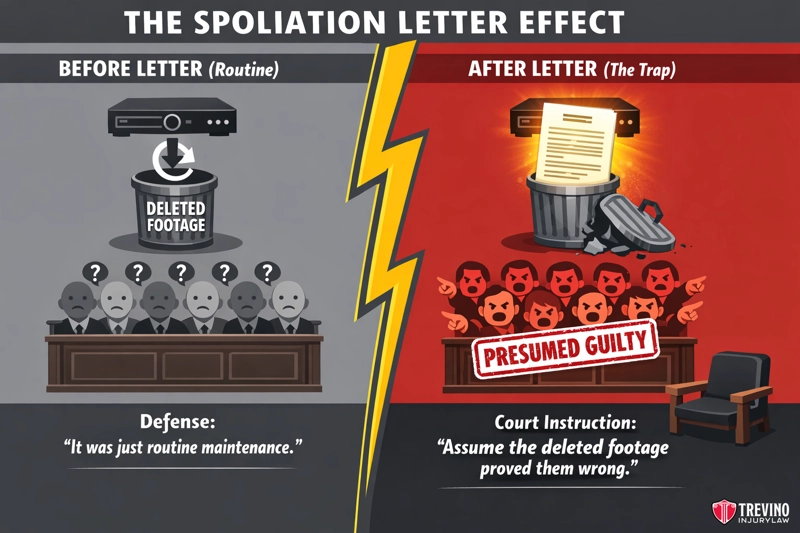
The letter acts as a legal “freeze” on their systems, warning them that the “routine maintenance” defense will no longer protect them from sanctions if they allow the DVR to loop over the night in question.
What Specific Digital Data Must Be Requested in a Spoliation Letter?
A comprehensive spoliation letter must demand more than just “video”; it must specifically list Point of Sale (POS) electronic logs, credit card batch reports, shift schedules, and manager logs to prevent partial deletion of evidence. We specifically request the native electronic files with metadata intact, rather than just printed summaries or cell phone screen recordings.
Securing these documents quickly allows them to be admitted as self-authenticating business records accompanied by an affidavit under Texas Rule of Evidence 902(10) (Texas Courts, 2025). This ensures we receive the raw data needed to authenticate the timeline and prevents the defense from providing low-quality or altered versions of the content that obscure critical details.
A spoliation letter preserves the video, but we also need the data that proves what was served.
How Does POS Data Prove a Driver Was Overserved?
Point of Sale (POS) data provides an irrefutable, timestamped digital footprint of every drink ordered, allowing forensic experts to calculate the exact volume of alcohol served to a patron within a specific timeframe. Modern systems used in San Antonio venues, such as Toast, Aloha, or Micros, track far more than just the final dollar amount; they record the precise minute a “Double Vodka” or “Draft Beer” was entered into the platform.
This allows us to construct a “drink-by-drink” timeline that often contradicts the employee testimony that they “only served him two beers.” In cases involving venues in the busy Medical Center area or along I-10, this data is often the smoking gun that proves the bar prioritized profit over safety.
By analyzing the frequency of orders, we can mathematically demonstrate that a server continued to push alcohol to a patron who had already consumed a dangerous amount in a short period. This objective data qualifies as a “record of a regularly conducted activity” under Texas Rule of Evidence 803(6), making it admissible in court (Texas Courts, 2025).
Texas courts have long recognized the value of such data; obvious intoxication can be proven by circumstantial evidence, specifically, the amount of alcohol served, even without direct testimony regarding the patron’s speech or balance.

POS data is one part of the larger proof picture. Our guide to proving a bar served an obviously intoxicated patron in Texas explains how transaction records can be evaluated alongside surveillance, witness testimony, police records, and expert analysis.
This objective data strips away the subjectivity of witness memory and replaces it with hard numbers that are difficult for insurance defense teams to dispute.
Can You Match POS Timestamps to Surveillance Video?
Yes, trial attorneys synchronize the POS system’s internal clock with the timestamp on the surveillance video to show the jury exactly what the patron’s behavior looked like at the precise moment the 10th drink was sold.
Forensic guidance indicates that digital CCTV systems often contain embedded transactional data that links specific sales to video frames (FBI/TSWG, 2006). This “overlay” technique creates a powerful visual in the courtroom: on one side of the screen, they see the receipt for a fresh round of shots, and on the other, they see the driver stumble into a table at that exact moment.
Once those timestamps are aligned, the records can be organized into a last drink timeline in a Texas dram shop case that reconstructs the sequence from the final service events to the crash.
This synchronization undermines the defense argument that the bartender “couldn’t see” signs of intoxication, because the video display shows exactly what was visible at the moment of sale. We have the bar’s data, but what about the patron’s financial records?
How Do We Obtain Credit Card Receipts Without the Bar’s Cooperation?
If a bar attempts to hide its records, we can bypass them by issuing subpoenas directly to major credit card processors like Visa, Amex, or Mastercard, or to the driver’s issuing bank, to obtain the complete transaction history that proves exactly when and where the purchases occurred.
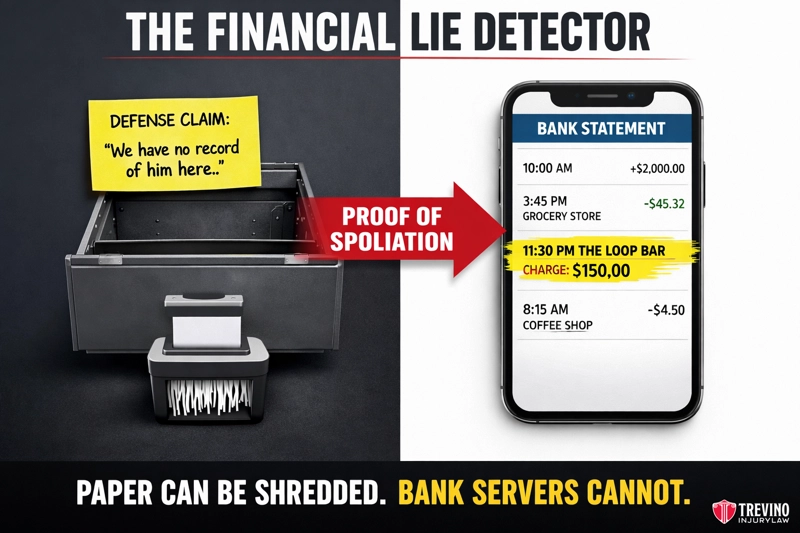
This is increasingly relevant as the Federal Reserve reports that the share of payments made with cash declined to 14% in 2024 (Federal Reserve, 2025). This “follow the money” strategy is critical because, while a bar manager can easily shred a paper merchant copy or delete a local file, they cannot erase the digital record held by the bank. In many Bexar County dram shop cases, this external financial data becomes the anchor for our investigation, establishing the driver’s presence at the location and the total amount spent on alcohol.
If the bar claims no record exists, but the bank statement shows a $150 charge at 11:30 PM, we not only prove the sale occurred but also build a strong argument for intentional spoliation of evidence against the venue. Securing these records allows us to look deeper into the hidden data they contain.
While defense attorneys may raise data privacy concerns to block this access, appropriate court orders allow us to secure the necessary evidence.
Electronic POS records contain hidden metadata beyond pricing, specifically identifying the server identity, voided transactions, and “comped” drinks that constitute “shadow inventory”, alcohol consumed but never billed.
Forensic analysis of this data frequently exposes negligent service patterns, such as “spills” or “voids” entered at closing time to conceal free drinks served earlier. By correlating these inventory log adjustments with video footage, legal counsel can prove an establishment actively fueled a patron’s intoxication off the books, providing the objective evidence needed to refute claims of responsible service and win complex litigation.
Can a bar legally delete just one segment of surveillance video?
No, selectively deleting specific segments of video while preserving others is considered intentional spoliation of evidence, and Texas courts can heavily sanction a bar for attempting to sanitize the record.
Do cash transactions leave a digital trail in POS systems?
Yes, even cash payments must be entered into the POS system to balance the drawer and track inventory, creating a timestamped log of the sale even without a credit card name attached.
Cloud Storage vs. On-Site DVR: How Preservation Differs
Preservation strategy is strictly dictated by the venue’s technology: cloud-based systems require demanding administrative login logs and third-party subpoenas, while on-site DVRs necessitate immediate physical seizure to prevent manual tampering.
For legacy systems found in older bars, the hardware is vulnerable to overwritten sectors or theft, forcing counsel to physically secure the device. Conversely, modern venues using subscription-based cloud storage cannot claim hardware failure; instead, attorneys must bypass local managers and subpoena the cloud provider directly to retrieve untampered footage and access logs, ensuring data validity even if the establishment attempts to delete files remotely.
What If Cash Was Used and No Credit Card Record Exists?
If the patron paid cash and no credit card record exists, we reconstruct the timeline using the bar’s “Z-tapes” or daily sales summaries, along with witness testimony, to identify the specific transaction time and server. A Z-tape is the end-of-shift report that summarizes every transaction, including cash drops, for a specific register.
By analyzing these tapes, we can pinpoint a cash transaction for “4 Bud Lights” at 10:42 PM and correlate it with witness statements confirming the driver bought a round at that time. This forensic accounting method allows us to build a case even when there is no paper receipt in the driver’s pocket.
We do not need a name printed on a slip of paper if we can link a specific sale instance in the system to a specific moment in the video or a witness’s timeline. This eliminates the “cash loophole” defense, where bars assume that because there is no credit card trail, there is no proof of service.
However, possessing the receipt is not always proof of personal consumption.
When Does POS Data Fail to Prove Consumption?
POS data may be insufficient proof of individual intoxication if the receipts show large “rounds” of drinks purchased at once, as the defense will argue the patron was buying for a group rather than consuming all the alcohol themselves. This is known as the “Round Buyer Defense,” in which bar attorneys argue that a receipt for 10 drinks proves generosity, not drunkenness.
To overcome this, we must go beyond the receipt and examine the context of consumption. We counter this defense by correlating purchase times with video evidence showing who actually lifted the glasses, or by comparing the total group size to the total alcohol sold. If a group of three people purchased 30 drinks in 2 hours, the math shows that everyone, including the driver, was likely overserved, regardless of who paid the bill.
We use the bar’s own sales volume against them to show that safe service was mathematically impossible given the timeframe.
Why Hire a San Antonio Dram Shop Lawyer?
The surveillance footage holding the bar accountable is on a strict countdown, and their defense team is counting on you to wait until it is gone. Every moment of delay allows the DVR loop to overwrite critical proof of intoxication, turning a winning case into a “he-said, she-said” argument that favors the negligent establishment.
You need an accident compensation lawyer to send immediate spoliation letters and subpoena cloud providers before the evidence vanishes permanently.
Want to Protect the Full Value of Your Claim?
You’ve seen how this affects your case — but this is only one piece of the puzzle. Our Dram Shop Lawyer page breaks down what a trial-ready firm does differently.
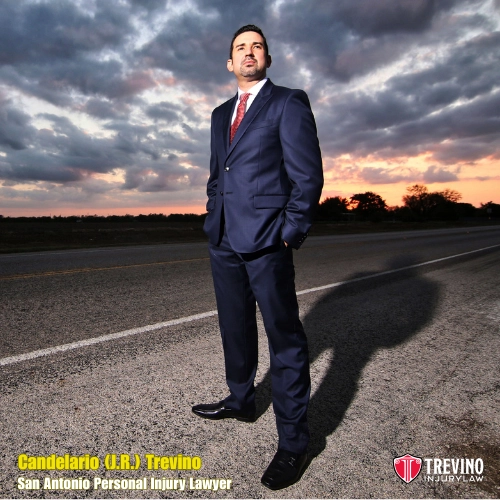
We aggressively intervene to stop this destruction, issuing immediate spoliation demands that legally bind the commercial venue to preserve every digital log, receipt, and video frame.
Do not let a rolling hard drive erase the justice your family deserves. Call 210-TREVINO. Se Habla Español.