You defeat the TABC Safe Harbor Defense by proving the establishment’s training policy is a sham and exposing how management actively encouraged staff to overserve intoxicated patrons. When a venue prioritizes high liquor sales over patron safety, its legal immunity collapses.
The bar’s corporate defense team is already using this statutory loophole to shield its commercial liability policy by claiming its staff was fully certified. According to the 2025 Texas Impaired Driving Plan, alcohol-impaired fatalities accounted for 40% of all motor vehicle deaths in Texas in 2023. Behind these fatal collisions is a profitable business hiding behind a meaningless certificate to avoid accountability.
What Could Your Dram Shop Accident Case Be Worth?
Answer a few quick questions about your accident. Takes about 60 seconds.
See What My Case Might Be WorthThe insurance company offered less than $20,000. I ended up with over $1 million. — Jackie Galindo
The proof needed to invalidate their immunity disappears within days as surveillance video is overwritten and shift logs go missing. A Spoliation Letter, a legal demand that stops the property owner from destroying evidence, must be sent immediately. Texas gives you two years to file your claim. After that, the legal window closes forever.
A Trevino Injury Law dram shop accident attorney will subpoena the necessary records on day one and dismantle the corporate defense. Call 210-TREVINO for a free case review. You pay nothing unless we win. Se Habla Español.
How Does the Texas Dram Shop Act Defeat the Safe Harbor Defense?
To qualify for Safe Harbor, a business owner must prove that it had strict policies in place and enforced them. We prove the bar was negligent by showing they failed one of the following:
- Not all employees were TABC-certified.
- The employer failed to diligently enforce the TABC policy.
- Management actively encouraged over-service of patrons for financial gain.
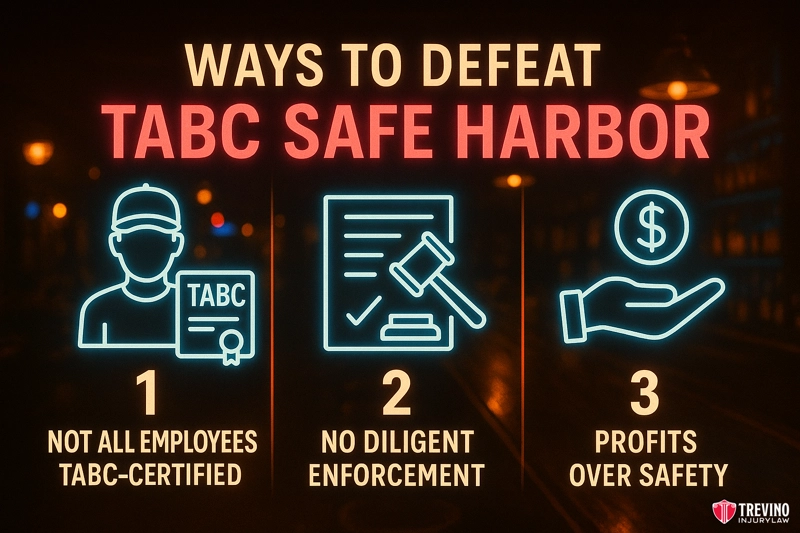
While the main considerations for dram shop cases focus on the injury itself, the specific legal mechanism to defeat the Safe Harbor defense in court requires a deep dive into the bar’s internal conduct and policy, which is the layer of protection they hide behind.
Our battle-tested team drills down on management encouragement as a legal act of negligence, the TABC Training Log Subpoena Process, and the deposition strategy for servers and managers to uncover the truth.
This legal fight focuses on establishing a corporate culture that prioritizes profit over patron safety in establishments like those on the River Walk. This comprehensive approach is essential because once the TABC shield is gone, the path to recovering maximum compensation from the bar’s higher-limit commercial insurance policy is clear.
Proving an Establishment Failed Supervision Under the Dram Shop Law
The legal standard requires proving the bar’s failure was an active decision or a pattern of gross negligence, such as ignoring repeated internal complaints about over-service or systematically allowing a bartender to serve alcohol to patrons who were already overserved just to boost sales.
We use a multifaceted approach to challenge the bar’s claims of diligent enforcement, arguing that the bar’s certified policy was a pretext for failing to enforce. Testimony from former employees often reveals a company culture that actively prioritized profit over safe alcohol service. We build our case by proving a three-pronged failure:
- Proving a lack of training
- Proving a lack of supervision
- Proving active encouragement of over-service
Gathering Evidence That Bars and Restaurants Encouraged Overserving
We gather evidence to show that the alcohol provider encouraged irresponsible alcohol service. For businesses that sell alcohol, this proof often hides in internal shift reports, text messages from managers, bonus structures tied to alcohol service volume, and proof of “power hours” that explicitly or indirectly rewarded staff for pushing high-volume drinks.
To invalidate the TABC Safe Harbor Defense, we subpoena the bar’s Point-of-Sale (POS) data to look for metrics that track individual server sales, linking high liquor sales to performance rewards or explicit manager directives. Depositions of managers also focus heavily on whether there were specific policies against “cutting off” patrons, or if managers simply turned a blind eye to obvious intoxication.
This forensic level of discovery is essential to proving the gross negligence necessary to pursue a claim for punitive damages, intended to punish the establishment for its reckless conduct.
Establishing that a bar’s policies were a sham and that management actively encouraged overserving dismantles their first line of defense; however, without the actual TABC training records, their entire claim of compliance cannot be fully invalidated.
The Texas Alcoholic Beverage Code § 106.14 (current through 2025) codifies the Safe Harbor Affirmative Defense, which the Texas Supreme Court has confirmed as an affirmative defense, meaning the bar has to prove its initial compliance.
To see how those records fit together in practice, review what evidence defeats the TABC Safe Harbor Defense in Texas for a focused look at internal records, sales incentives, POS data, and management communications.
Using Training Records to Verify if Staff Were Properly TABC Certified
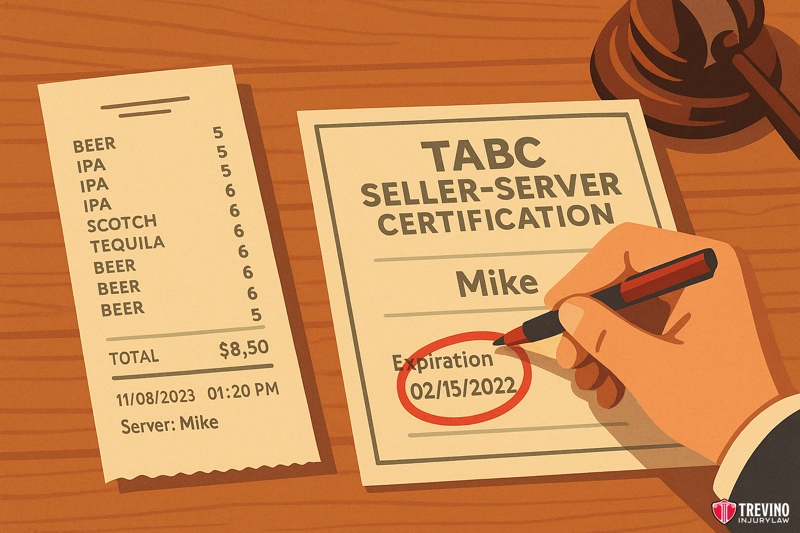
We obtain TABC training records by issuing subpoenas to both the Texas Alcoholic Beverage Commission and the bar’s corporate office so we can match the server on the receipt to a specific certification number, training date, and expiration date.
These records are critical because the Safe Harbor Defense under Texas Alcoholic Beverage Code § 106.14(a) only applies if every employee on duty was properly trained and the employer did not encourage violations. TABC’s own FAQs confirm that seller-server certification is valid for 2 years from the date of issuance (as of 2025) and requires renewal every 2 years.
In Perseus, Inc. d/b/a Hippodrome v. Canody, 995 S.W.2d 202 (Tex. App.—San Antonio 1999, no pet.), the court explained that Safe Harbor requires proof of all three statutory elements and that failure to show all servers were certified allows a jury to reject the defense. We use the TABC training logs the same way, linking each sale to a specific server and certification record, to show gaps, expired certifications, or missing documentation that can completely knock out the bar’s Safe Harbor claim.
Our trial attorneys have the procedural knowledge of the TABC Records Request Process, know how to cross-reference the server ID and date of service, and can prove the record is incomplete or that the server’s certification has lapsed.
Securing these records immediately is essential because the two-year statute of limitations is meaningless if the critical evidence disappears in the first few weeks after the collision. This level of due diligence in discovery has proven critical in cases across Bexar County, ensuring that the bar’s defense is met with irrefutable documentation.
How to check TABC training records for a specific server
Checking TABC training records for a specific server involves our legal team issuing a Subpoena Duces Tecum, a legal demand, to the TABC or the bar’s corporate office to demand the specific certification ID, training date, and expiration date associated with the employee on the date of the drunk driving injury.
This is not a process that can be rushed; it requires immediate legal action, especially when dealing with establishments that serve alcohol in areas like Helotes. We must prove the injury was a direct result of their negligence.
We work backward from the scene of the dram shop injury to the source of the alcohol, and we execute a clear three-step process to confirm compliance:
- We identify the specific server who made the last sale from the bar’s shift log and payment receipts.
- We issue the formal legal subpoena (demand) to the bar and the TABC to compel production of the records.
- We cross-reference the certification date with the date and time of the over-service to confirm if the Safe Harbor defense is legally invalid under state law.
What If the TABC Certification is Expired?
If a server’s TABC certification had expired at the time of the over-service, the bar automatically loses its Safe Harbor Defense shield. This happens because the server was not currently certified by the Texas Alcoholic Beverage Commission. Texas alcohol regulations are strict: if they fail to meet the certification requirement, the defense fails; the defense applies only if all requirements are met.
We diligently check the server’s certification expiration date—a detail often missed by less experienced firms.
We diligently check the server’s certification expiration date, a detail often missed by less experienced firms, which, if expired, makes the bar strictly liable for its employee’s negligence in serving the visibly intoxicated patron.
This is consistent with TABC’s current guidance (as of 2025) that Safe Harbor conditions must be met, including that the seller holds a current TABC certificate. This is a powerful legal principle that often unlocks the door to full compensation.
Once we strip the bar of its procedural shield by proving policy failure and expired certifications, the insurance company’s only remaining strategy is to shift the blame to the victim through the doctrine of modified comparative fault.
How the 51% Rule Affects Liability in a Texas Dram Shop Case
The “51% Rule” is officially called Modified Comparative Responsibility (or “Modified Comparative Fault”) under Texas Civil Practice & Remedies Code § 33.001. This Texas law states that an injured person is completely barred from recovering any compensation if a jury assigns 51% or more of the fault for the accident to the victim, forcing the bar’s lawyers to try to shift blame away from their client. This rule is codified at Texas Civil Practice & Remedies Code § 33.001 (current through 2024).
After we successfully dismantle the Safe Harbor defense, the bar’s legal team will try to blame you, claiming you were speeding, distracted, or otherwise negligent, to push your fault percentage over the 50% mark. If their insurance lawyers convince a jury that you were 51% at fault for the accident caused by the driver, the legal hurdles become insurmountable. You could be left with nothing for your injuries or property damage.
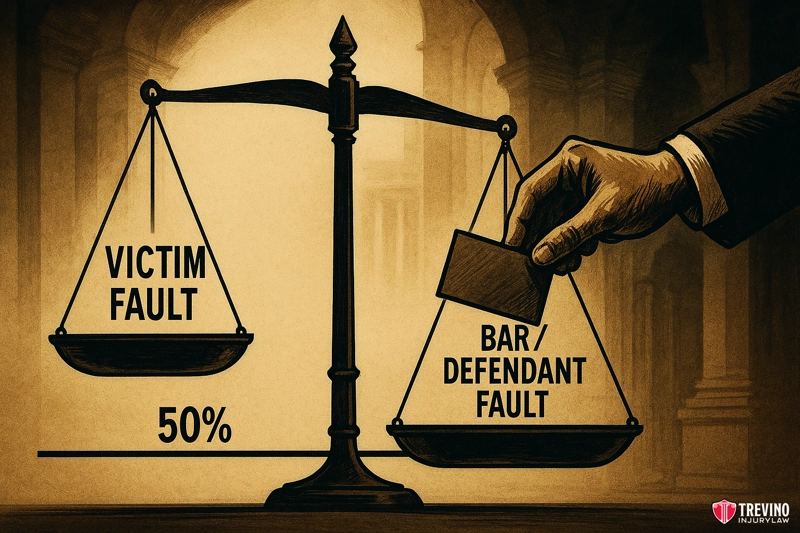
Our firm’s reputation for trial experience and major jury verdicts, such as the $536,007 verdict secured after the defense offered only $5,000, ensures their attempts to shift blame are met with trial-ready defense.
How does the bar’s commercial insurance policy differ from the driver’s?
The bar’s commercial liability insurance policy is significantly different from the drunk driver’s personal auto policy because the commercial policy typically carries much higher limits, often $1,000,000 or more, providing the necessary financial recovery for catastrophic spinal or internal injuries.
The drunk driver’s personal policy may only be the Texas minimum of $30,000, which is rarely enough to cover even a basic hospital stay after a serious drunk driving collision. This financial difference is the real reason we fight so hard to overcome the TABC loophole. By defeating the Safe Harbor defense and successfully suing the bar, we unlock access to the commercial policy, which is often the only path to full compensation for lifetime medical care, lost wages, and pain and suffering for you and your family.
Understanding the critical legal standard of the 51% rule and the financial importance of the bar’s policy is crucial for setting expectations, but the next logical step is to confirm the full damages and compensation you are now legally entitled to claim in the lawsuit.
For a more detailed breakdown of the factors that affect claim value, see how compensation is calculated in a Texas dram shop lawsuit.
What Damages Can Be Claimed in a Dram Shop Lawsuit After Defeating Safe Harbor?
If you’ve been injured by a drunk driver, you have a valid cause of action for dram shop liability. Once the Safe Harbor Defense is defeated, victims can pursue actual damages (medical bills, rehabilitation costs, and lost wages) and non-economic harms (pain, suffering, and mental anguish) under the Texas Dram Shop Act and general Texas personal-injury law. Our goal is to document every category of your loss so the jury sees the full impact of the crash—not just the emergency-room bill.
In Borneman v. Steak & Ale of Texas, Inc., 22 S.W.3d 411 (Tex. 2000), the Texas Supreme Court treated the Dram Shop Act as a detailed statutory scheme and emphasized that its own enforcement tools, like license suspension or revocation, serve the same deterrent function as punitive damages. Later courts have read Borneman to sharply limit separate punitive-damages claims in dram shop suits. That is why we focus on maximizing your actual damages and using the bar’s commercial policy limits to secure the highest lawful recovery for your family.
To understand how we secure these maximum damage awards, we must first look inside the courtroom and examine the critical legal strategy used to expose the bar’s internal failures: the deposition process.
How Our Law Firm Uses Depositions to Invalidate Safe Harbor Training
Trevino Injury Law use depositions to dismantle the Safe Harbor Defense by extracting sworn testimony that proves a venue’s TABC training was merely a formality and not diligently enforced.
By questioning servers, managers, and corporate representatives, counsel exposes fatal contradictions between written policy and actual practice to strip the bar of its statutory immunity.
Strategic inquiry targets three specific failures that invalidate the defense: admission that managers never intervened to stop service to intoxicated patrons, proof of monetary bonuses or rewards based on high alcohol sales volume, and the staff’s inability to articulate mandatory signs of “obvious intoxication.”
Establishing these facts proves the employer effectively encouraged over-service, rendering the Safe Harbor protection legally void.
Can a bar claim Safe Harbor immunity if the drunk driver had an out-of-state ID?
No, the bar’s liability under the Dram Shop Act is governed by Texas law, and an out-of-state ID does not grant them immunity if they served an obviously intoxicated patron in San Antonio.
Is a bar automatically liable if a TABC investigator cited them for a violation?
No, a TABC citation is strong evidence in a civil case, but it does not automatically make the bar liable; you must still prove the violation was a direct cause of your injury.
Is TABC certification an automatic “Safe Harbor” that dismisses a lawsuit?
No, certification is not an automatic shield; we can defeat this defense by proving the bar was negligent, encouraged overserving, or that the specific server was not actually certified at the time of the over-service.
What’s the Difference Between Defeating Safe Harbor and Proving Overserving?
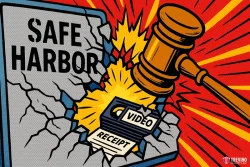
Defeating Safe Harbor is a legal/procedural step that removes the bar’s shield, while proving overserving is an evidentiary step that uses proof (video, receipts, testimony) to win the case once the shield is gone.
Defeating Safe Harbor is the legal fight where we dismantle the bar’s corporate policy defense, which gives us the leverage we need to force a fair settlement.
Smash the Safe Harbor and drag the real evidence into the light.
Proving overserving is the trial fight where we present the evidence to the jury that the bar failed its duty by serving alcohol to a visibly intoxicated customer. Insurance companies often concede the second point once we prove we can beat the first because they want to avoid facing a trial lawyer with 80+ cases to trial experience in court.
What Happens If You Fail to Prove the Bar Encouraged Overserving?
If you fail to prove the bar encouraged overserving, they may successfully claim the Safe Harbor Defense, and the court could dismiss your claim against the bar, leaving you with only the drunk driver’s often low-limit auto insurance policy.
The bar that profited from the illegal over-service faces zero financial consequences and is free to do it again, while your family suffers the financial burden. The failure to prove encouragement is a major risk when hiring a “settlement mill” firm that won’t commit the resources to the necessary deep discovery.
The Texas Supreme Court’s 2025 decision in Raoger Corp. v. Myers emphasized that plaintiffs must present specific evidence of obvious intoxication and overservice tied to the crash to defeat Safe Harbor at the summary-judgment stage. This is an exploration of the negative space of ABSENCE (the absence of proof needed to win).
Why You Need an Immediate Case Evaluation to Protect Your Claim
In many cases, it is ‘too late’ to get the best evidence just 7 to 30 days after the accident, as this is when most San Antonio bars’ surveillance video systems automatically tape over and erase the ‘smoking gun’ proof forever.
This timing issue is the “Dual Clock” concept:
- The legal deadline (Statute of Limitations) is two years.
- The deadline to secure winning evidence (the video and digital receipts) is measured in days.
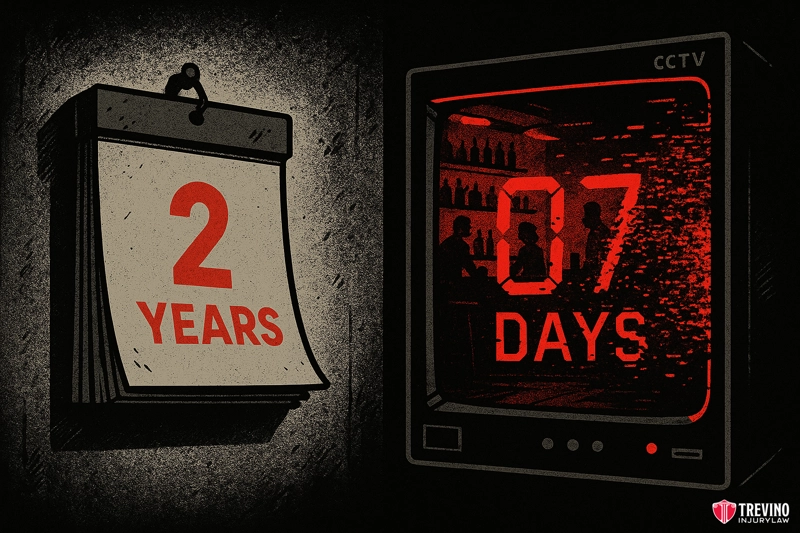
Your case dies from lack of evidence long before the statute of limitations runs out, highlighting a key failure of timely action. This is an exploration of the negative space of FAILURE (the failure of a time-sensitive legal right).
Why Hire a San Antonio TABC Violation Lawyer?
Insurance adjusters use the “Safe Harbor” defense to protect their profits, knowing that high-volume “settlement mills” will never take them to court to prove otherwise. We force them to pay by exposing these sham policies.
You need a personal injury accident lawyer to send spoliation letters and subpoena TABC training logs before the truth is erased.
Want to Protect the Full Value of Your Claim?
You’ve seen how this affects your case — but this is only one piece of the puzzle. Our Dram Shop Lawyer page breaks down what a trial-ready firm does differently.
Our trial-first strategy drives superior results, like the $7.9 Million jury verdict we secured for a client after the defense tried to limit their payout to a fraction of that amount. You need a dram shop law firm that will immediately subpoena the TABC training logs and POS data to destroy their defense.
Call 210-TREVINO for a free case review. We fight on a contingency fee—No Win, No Fee. Se Habla Español.