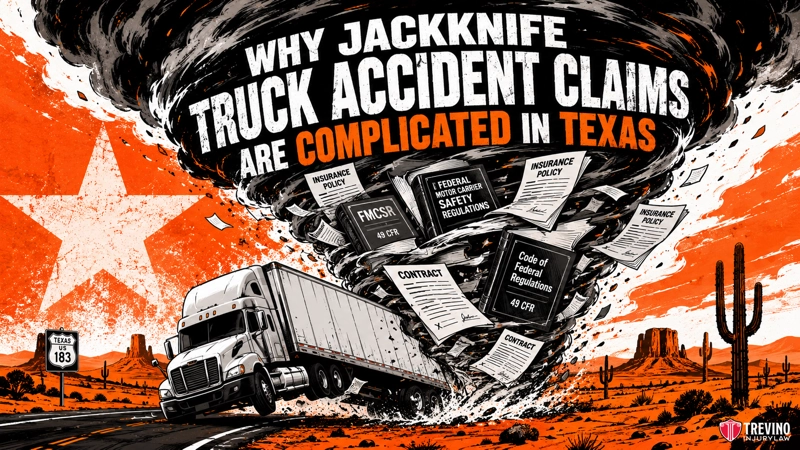
Jackknife truck collisions require navigating multi-layered corporate insurance policies, federal trucking regulations, and complex crash physics that differ from those in standard passenger vehicle crashes. Liability is deliberately divided among the motor carrier, third-party freight brokers, and external cargo loading facilities.
Corporate defense teams from entities like Great West Casualty immediately deploy to obscure fault behind shell companies and independent contractor agreements to protect their profit margins. According to federal safety data, large trucks are involved in approximately 1,000 jackknife injury crashes and 169 fatal jackknife crashes annually across the United States. The defense points fingers between the cab owner and the trailer operator to bury the truth in the wreckage.
What Could Your Jackknife Accident Case Be Worth?
Answer a few quick questions about your accident. Takes about 60 seconds.
See What My Case Might Be WorthThe insurance company offered less than $20,000. I ended up with over $1 million. — Jackie Galindo
The trucking company has legal authority to destroy critical maintenance logs and safety audits after six months. A Spoliation Letter, a legal demand that prevents the property owner from destroying evidence, must be issued immediately to preserve the electronic logging device data and physical evidence. Waiting guarantees the legal erasure of corporate negligence.
Trevino Injury Law jackknife accident lawyers subpoena this federal evidence before it vanishes and force multi-layered insurance towers to pay full value. Call 210-TREVINO now for a free case review. You pay nothing unless we win. Se Habla Español.
How Do Multiple Corporate Defendants Complicate Jackknife Liability in Texas?
Identifying liability in a jackknife crash is highly complicated because negligent actions are often divided among the truck driver, the motor carrier operating in South Texas, third-party freight brokers, and external cargo loading facilities.
Unlike a standard car crash with a single at-fault driver, a jackknifed semi-truck triggers a massive corporate defense effort to shift blame among multiple parties to protect their profit margins.
This division of blame is a major hurdle in a state with massive commercial traffic, where 26,281 truck-tractors or semi-trailers were involved in crashes in a single year.
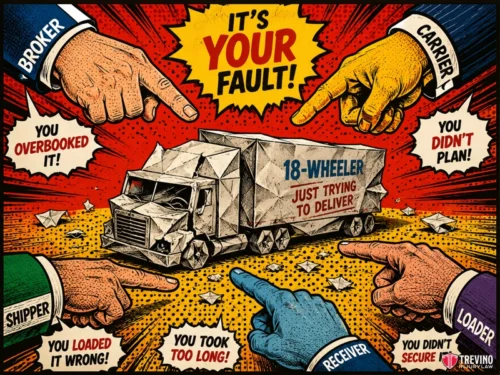
A deep exploration of how trucking conglomerates like J.B. Hunt or Swift Transportation use independent contractor agreements to shield themselves from liability when a driver causes a jackknife on I-10 is required. We expose the challenge of identifying the true owner of the cab versus the trailer, particularly for routes originating in the Eagle Ford Shale or passing through the San Antonio “Mixing Bowl”.
How does negligent hiring and retention increase commercial carrier liability?
A commercial carrier becomes directly liable for a jackknife crash when investigations reveal they intentionally hired unqualified drivers or ignored previous safety violations to keep freight moving. The consequences of these systemic carrier failures are devastating, contributing to a statewide toll of 546 fatal commercial motor vehicle crashes and 608 fatalities annually.
Detail the process of auditing the driver’s qualification file and background checks. Explain how finding a history of safety infractions increases the case value and forces the carrier’s primary insurance to pay.
- Ignoring prior FMCSA safety violations.
- Failing to conduct mandatory drug and alcohol screenings.
- Employing drivers without the proper CDL endorsements for articulated loads.
Proving these hiring failures requires reviewing specific federal records, but uncovering how the company manipulated those regulations reveals the true extent of its negligence.
Why Is Federal FMCSA Regulation Compliance Crucial in Texas Truck Crashes?
Personal injury cases involving commercial vehicles are complex at the federal level because interstate carriers must strictly adhere to federal and state regulations set by the FMCSA. Proving a violation of these safety statutes instantly establishes a foundation for corporate negligence.
Under the doctrine of negligence per se, as defined by the landmark Texas Supreme Court decision in Parrott v. Garcia, 436 S.W.2d 897 (Tex. 1969), an unexcused violation of a safety statute designed to prevent the specific type of harm that occurred serves as proof of negligence as a matter of law, giving a truck accident lawyer a powerful tool to hold trucking companies accountable.
A trial lawyer uses these federal mandates as a weapon, exposing when a trucking company prioritized delivery speed over mandatory safety protocols.
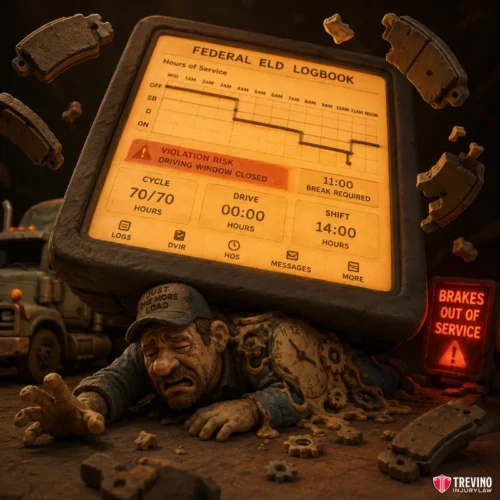
We leverage deep knowledge of federal trucking laws to find hidden liability. By investigating electronic logging device records, we expose systemic issues, such as forcing exhausted drivers to stay behind the wheel, particularly on long-haul commercial corridors crossing Bexar County or on heavy freight routes like Laredo to San Antonio via I-35. This aggressive tracking is vital along these corridors, where commercial vehicle wrecks resulted in 18 fatal crashes and 18 fatalities within Bexar County in a single year.
How do federal commercial truck maintenance logs uncover mechanical failures?
Auditing federal maintenance logs reveals when maintenance contractors or trucking companies deliberately deferred necessary repairs on brakes or tires, directly causing the mechanical failure that led to the trailer jackknifing. Mechanical negligence remains a widespread threat on Texas roads, where defective or slick tires alone contributed to 3,975 total crashes and 62 fatal crashes statewide. Explain the federal requirement for pre-trip and post-trip inspections. Describe how a trial attorney proves gross negligence by matching fraudulent inspection reports against actual physical wear on the wrecked 18-wheeler.
- Subpoena historical maintenance records and pre-trip inspection reports.
- Cross-reference mechanic invoices with claimed repair dates.
- Conduct an independent mechanical inspection of the wrecked cab and trailer.
Connecting these mechanical failures to the physical crash requires expert analysis, and knowing how to interpret that raw data is what ultimately defeats the insurance company’s defense.
How Does Commercial Accident Reconstruction Differ for Articulated Truck Crashes?
Reconstructing a jackknife crash requires specialized commercial engineering experts, as the violent articulation between the heavy cab and the fully loaded trailer involves complex weight-shifting physics related to the size and weight of commercial vehicles that do not occur in passenger vehicle crashes. Engineers must calculate the exact moment traction was lost to determine the causes of truck accidents, whether driver error or equipment failure caused the acute fold.

Accident reconstructionists need to be brought in immediately for complex intersections like the San Antonio “Mixing Bowl” or the Loop 410 corridors. This exact calculation is essential, given that Texas saw 42,146 trailer-involved crashes, showing how often these complex configurations lose stability on the highway. Experts calculate the angle of articulation, measure skid versus yaw marks, and correlate physical debris with the vehicle’s Electronic Control Module (ECM) data to defeat the defense’s argument that the crash was “unavoidable”.
Why is matching ECM black box data to physical highway evidence critical?
Matching the digital electronic logging device and black box data on steering input and hard braking to the physical skid marks on the Texas highway irrefutably proves whether the commercial driver was speeding or reacted too late. Synergy between digital forensics and on-scene physical evidence prevents adjusters from companies like Great West Casualty from fabricating alternative narratives about the crash.
- Speed at impact: Shows whether the driver exceeded safe limits for the load.
- Braking application: Indicates whether the driver improperly locked the trailer brakes.
- Steering inputs: Reveals sudden, over-corrected movements that induce a jackknife.
This complex evidence gathering directly affects your financial recovery timeline, showing how soon you can secure the settlement you need.
Do Complex Commercial Truck Claims Take Longer to Settle in Texas?
Yes, complex commercial jackknife claims generally take longer to settle than standard passenger-car accidents because they require extensive federal evidence gathering, specialized expert witness analysis, and aggressive, sustained litigation to overcome the massive multi-million-dollar corporate insurance towers deployed by trucking companies and their insurers. The severe human cost of these delays is reflected in the 34 suspected serious injury crashes and 46 suspected serious injuries recorded within Bexar County commercial crashes over a single year.
Transitioning from the technical mechanics of crash physics to your actual litigation timeline reveals a stark contrast in legal strategies. While high-volume settlement mills push for fast, low payouts that leave families severely undercompensated, truck accident attorneys with a trial-first approach prepare for court from Day 1 to force maximum compensation. By meticulously auditing FMCSA records and employing top accident reconstructionists, we build an ironclad case the defense cannot easily dismiss.

We litigate to verdict, refusing to accept inadequate initial offers from commercial insurers like Progressive Commercial or Great West Casualty Company. This trial-first approach is proven by our track record, such as when Trial Attorney Candelario (J.R.) Trevino took a minimal $5,000 initial offer and secured a $536,007 jury verdict by thoroughly dismantling the insurance company’s defense.
Maximizing that settlement value requires uncovering every available insurance policy to ensure all catastrophic damages are fully covered.
How do attorneys untangle multi-layered commercial insurance policies?
Trial attorneys untangle complex commercial policies by sequentially demanding declarations of coverage for the primary liability policy, identifying excess or umbrella policies, and locating secondary coverage held by cargo brokers or trailer owners.
Navigating the commercial insurance hierarchy is essential to ensure victims of catastrophic injuries are fully compensated. Unlike a standard auto accident where one driver’s personal policy dictates the maximum settlement, an 18-wheeler crash involves a web of corporate coverage. At Trevino Injury Law, we meticulously dismantle these corporate shields. If the motor carrier operates out of San Antonio, we do not simply stop at the first policy presented by their defense team. We systematically locate every dollar of available coverage.
To untangle these multi-layered policies, we systematically:
- Exhaust Primary Limits: Target the motor carrier’s mandatory FMCSA minimum liability policy, which is often $750,000 to $1,000,000.
- Trigger Umbrella Policies: Identify corporate excess coverage that activates once primary limits are depleted.
- Pursue Third-Party Coverage: Go after the cargo loader’s or freight broker’s separate liability insurance.
This multi-layered structure creates specific legal liabilities.
Does a commercial umbrella policy cover jackknife truck accidents?
Yes, commercial umbrella policies provide crucial secondary coverage for jackknife accidents, offering millions in additional compensation once the trucking company’s primary liability limits are exhausted by catastrophic injury claims.
Is the third-party cargo broker legally liable for the crash?
Yes, a third-party cargo broker can be held legally liable if evidence proves they negligently hired an unqualified motor carrier with a history of safety violations to transport their freight.
Can an independent owner-operator shield the parent trucking company from liability?
No, federal regulations prevent parent trucking companies from using independent owner-operator contracts to shield their commercial insurance policies from jackknife accident liability.
Commercial Jackknife Litigation vs. Standard Commercial Crash Claims
While all 18-wheeler accidents are severe, jackknife crashes present unique litigation challenges compared to standard commercial rear-end collisions due to the distinct physics and specific maintenance failures involved.
Treating a jackknife crash like a standard commercial collision is a critical error made by many settlement mills. Because the articulated trailer swings violently out of alignment with the cab, the destruction spans multiple lanes, often wiping out several vehicles across major highways like I-10. This requires a completely different approach to establishing negligence, relying heavily on commercial engineering experts rather than basic police reports.
| Factor | Standard Truck Collision | Jackknife Truck Collision |
| Primary Crash Physics | Linear force and forward momentum | Acute articulation and lateral trailer swing |
| Typical Negligence | Distracted driving, following too closely | Improper braking, unbalanced cargo, tire failure |
| Expert Analysis Required | Standard speed and impact calculations | Complex yaw mark analysis and mechanical articulation physics |
Failing to recognize these distinct complexities will destroy your claim.
What happens to your compensation if you fail to identify all liable corporate entities?
If you fail to identify all liable corporate entities, you will likely only recover from the driver’s primary, limited insurance policy, leaving you severely undercompensated for catastrophic medical expenses, lifelong care, lost wages, and diminished earning capacity. Furthermore, you will lack adequate compensation for your enduring pain and suffering.
This represents the severe risk of treating a complex jackknife collision like a simple car wreck. When a trucking conglomerate’s defense team successfully hides behind independent contractor agreements or obscure freight broker contracts, you leave millions of dollars on the table. Without an aggressive trial lawyer to pierce the corporate veil, negligent cargo loaders and umbrella policy providers escape accountability entirely, forcing your family to bear the financial burden of the trucking company’s negligence.
Furthermore, time is actively working against your ability to find these entities.
When is it too late to request corporate safety audit records?
It becomes effectively too late to request corporate safety audit records if you wait beyond the six-month federal retention period, allowing the trucking company to legally destroy the exact logs needed to prove their negligence. This directly affects the limitations for personal injury claims regarding evidence spoliation.
The strict temporal barriers dictated by FMCSA document retention policies mean that waiting to hire legal representation is one of the most destructive mistakes you can make. If a trial lawyer does not immediately send a spoliation letter to preserve these specific federal safety audits, the corporation will erase the evidence of their skipped maintenance and hours-of-service violations. Delaying the hiring of a Trial Authority guarantees that critical evidence of corporate negligence is legally erased, which is why complex articulated truck cases require immediate, specialized legal intervention.
Why Hire a Jackknife Accident Lawyer?
You must hire a compensation lawyer immediately because defeating corporate trucking defense teams requires aggressive federal evidence preservation, multi-layered insurance policy auditing, and seasoned courtroom trial readiness to ensure your catastrophic injuries are fully compensated before critical evidence is legally destroyed.
Want to Protect the Full Value of Your Claim?
You’ve seen how this affects your case — but this is only one piece of the puzzle. Our Jackknife Accident Lawyer page breaks down what a trial-ready firm does differently.
At Trevino Injury Law, we do not operate a settlement mill; we have taken over 80 cases to trial and litigate to verdict, forcing multi-million-dollar corporate insurance towers to pay exactly what you deserve. Never give a recorded statement to the trucking company’s adjusters.
Contact us right now at 210-TREVINO for your 100% free legal consultation. Se Habla Español.
