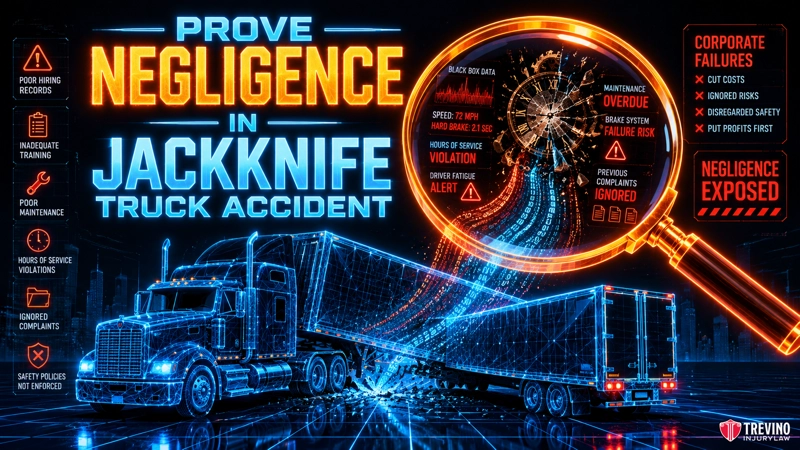
Proving negligence after a jackknife truck crash requires securing the vehicle’s electronic black box data and the driver’s service logs before the corporate carrier intentionally deletes them.
Commercial adjusters from powerful insurers like Progressive Commercial are already deploying rapid-response teams to the crash scene to scrub fatigue records and reclassify the driver’s catastrophic loss of control as an unavoidable weather-related emergency.
What Could Your Jackknife Accident Case Be Worth?
Answer a few quick questions about your accident. Takes about 60 seconds.
See What My Case Might Be WorthThe insurance company offered less than $20,000. I ended up with over $1 million. — Jackie Galindo
This aggressive defense strategy conceals a massive and deadly highway threat; according to the National Highway Traffic Safety Administration, commercial truck tractors were involved in 137 fatal jackknife crashes nationwide in 2023.
Critical physical evidence and digital records vanish in the first week. A Spoliation Letter, a legal demand that prevents the trucking company from destroying evidence, must be issued immediately. Texas enforces a strict two-year filing deadline, but federal retention guidelines allow carriers to legally purge crucial electronic logs well before that deadline.
A Trevino Injury Law jackknife accident attorney subpoenas this hidden data on day one and forces the negligent carrier to pay full value. Call 210-TREVINO now for a free case review. You pay nothing unless we win. Se Habla Español.
What are the four legal elements to prove negligence in a Texas jackknife accident?
To successfully win a personal injury claim in Texas, your personal injury attorney must prove four legal elements: that the trucking company owed you a duty of care, that they breached that duty, that their breach directly caused the jackknife crash, and that you suffered verifiable pain and suffering and financial damages as a result.
While the main hub explains why commercial truck jackknife claims are far more complex than standard car accidents involving smaller vehicles, understanding these four pillars of the plaintiff’s burden of proof shows how we hold corporations accountable in South Texas.
Beyond the standard analysis, victims in Bexar County must navigate how courts define these responsibilities, how juries evaluate specific breaches, and the complex chain of causation that links corporate decisions to catastrophic injuries. In Bexar County courts, proving negligence in a truck accident demands a forensic, deep exploration of personal injury law.

When a commercial vehicle barrels down major local arterials like Culebra Road or Bandera Road, the standard of care is elevated far beyond that of a typical commuter. This localized risk is substantial, with Bexar County recently recording 2,684 total crashes involving commercial motor vehicles, underscoring the persistent danger on our roads (TxDOT, 2024).
We must educate the jury on exactly how duty is defined in the context of an 80,000-pound machine and how specific actions—or inactions—by the driver and the corporate carrier constitute a catastrophic breach of that duty. It is not enough to simply claim the truck lost control; we must establish the exact mechanism of failure and directly tie it to the damages you sustained.
How do you establish the truck driver’s duty of care on Texas highways?
Establishing a truck driver’s duty of care requires demonstrating their legal obligation to operate their 80,000-pound vehicle safely in accordance with both Texas transportation codes and federal safety regulations. Detail the specific duties using:
- Maintaining safe following distances to prevent sudden braking during sudden traffic shifts, which avoids harm to others. This specific duty is paramount, given that statewide data identified 22,532 crashes in which a unit followed too closely (TxDOT, 2024).
- Adjusting speed and maintaining control for inclement weather on South Texas roads. Speed management is critical, as “failed to control speed” was cited as a contributing factor for 135,053 units involved in Texas crashes (TxDOT, 2024).
- Strictly adhering to Federal Motor Carrier Safety Administration (FMCSA) hours-of-service mandates to prevent critical driver fatigue that might impair reaction times.
What specific evidence proves the driver or company breached their duty?
A breach of duty is proven by immediately securing critical physical and electronic evidence to build a strong foundation before the trucking company’s corporate salvage teams can destroy it. We protect this evidence by:
- Issuing immediate Spoliation Letters to halt the deletion of ECM black box data.
- Filing FOIA requests for local intersection or dash cam footage to lock in the timeline.
- Subpoenaing the driver’s electronic logging devices (ELDs) to expose fatigue and operational violations.
Gathering this initial evidence is only the first step in proving systemic corporate failures.
What evidence proves a trucking company’s systemic negligence caused the jackknife?
Proving systemic corporate negligence requires an attorney to analyze corporate hiring records, audit federal safety logs, and utilize accident reconstruction experts to demonstrate that the trucking company prioritized profits over public safety, directly causing the jackknife crash.
While we previously explored how a trial lawyer uncovers hidden evidence to prove that negligence actually occurred, the specific mechanics of a jackknife crash demand a highly specialized corporate audit.
Exposing systemic negligence requires us to navigate complex federal mandates, audit internal safety compliance histories, and reconstruct the precise physics of the trailer’s loss of control. To expose true liability, a plaintiff trial lawyer must master federal trucking regulations and apply them aggressively against major carriers operating out of the Eagle Ford Shale and across South Texas jurisdictions.

These corporate defendants often attempt to hide behind layers of commercial policies, hoping to starve out unrepresented victims. At Trevino Injury Law, our trial-first mindset means we fully fund top-tier litigation experts at no upfront cost to the client, ensuring we can meticulously audit the carrier’s hiring practices to prove that their systemic failures, such as hiring unqualified drivers, made the crash inevitable.
How do FMCSA violations establish “negligence per se”?
When a trucking company violates specific safety statutes outlined by the FMCSA—such as forcing exhausted drivers to falsify logs or pressuring drivers to meet unreasonable delivery deadlines—the court can consider this “negligence per se,” meaning the act is inherently negligent without requiring further proof of a breach of duty. This legal doctrine dramatically shifts the battlefield.
Instead of arguing over subjective standards of care, we point directly to the broken federal law. This prevents commercial insurers from downplaying the crash as a “simple mistake,” effectively stripping away their primary defenses and holding the corporation strictly accountable.
How do accident reconstruction experts prove causation in Bexar County courts?
Accident reconstruction experts establish causation by analyzing skid marks, yaw marks, and electronic vehicle data to mathematically recreate the physics of the jackknife, showing a jury exactly how the negligence caused the collision.
Proving exactly why an 80,000-pound trailer swung out of control requires advanced scientific analysis. Unlike settlement mills, Trevino Injury Law leverages its financial strength to hire these expensive, highly specialized experts.
By presenting this mathematically sound evidence, we lay the groundwork for a jury verdict on Day 1. This rigorous level of analysis is vital, as Texas recorded 42,146 total crashes involving a trailer unit in a single year, demanding precise scientific investigation to establish exact liability (TxDOT, 2024).
Despite overwhelming evidence, the defense will immediately deploy counter-tactics.
How do Texas trial lawyers defeat the trucking company’s defense tactics?
Trial lawyers defeat trucking company defense tactics by anticipating their arguments—such as blaming the victim or claiming unavoidable weather conditions—and systematically dismantling them with hard data, expert testimony, and a willingness to take the case to a jury.
Refining our understanding of how the 51% bar rule affects trucking accidents, defeating a commercial carrier requires neutralizing defense strategies that go far beyond standard comparative fault.
To truly protect an injured family, we must systematically anticipate and destroy the sudden emergency defense, expose the biases injected by defense counsel, and challenge the adjuster’s attempts to minimize your injuries. The primary villains in these cases are the commercial adjusters and their high-volume defense counsel, who are trained to deny liability at all costs. Overcoming the inherent biases sometimes found in South Texas courts requires undeniable evidence.
Whether they are attempting to use sudden rain on Loop 410 to excuse a catastrophic jackknife or trying to blame the victim for failing to evade the sliding trailer, we shut their playbook down. By leveraging Trevino’s record of 80+ trials, we force high-volume defense firms to realize they cannot use delay tactics to escape accountability.
How do lawyers counter the “sudden emergency” or weather defense?
When trucking companies claim a jackknife was an unavoidable “sudden emergency” due to a stalled car or rain, a trial lawyer counters this by proving the driver was speeding or distracted, meaning their own prior negligence actually created the emergency. Failing to maintain a proper lookout or driving recklessly shatters this defense.
The Texas Supreme Court affirmed in Dillard v. Texas Elec. Co-op., 157 S.W.3d 429 (Tex. 2005), that the sudden emergency defense is only valid if the condition arose suddenly, unexpectedly, and was not proximately caused by the negligent act of the truck driver claiming the emergency. Commercial drivers operate under a vastly higher standard of care than everyday commuters.
They are legally required to anticipate road hazards, especially on high-traffic, congested corridors such as Potranco Road and San Pedro Ave. We use ECM data to prove they failed to adjust their speed, invalidating the defense. Speeding is a pervasive issue rather than a sudden anomaly; in Bexar County alone, speed was involved in 7,516 total crashes and 178 suspected serious injuries, proving that many ’emergencies’ are actually preventable driver errors (TxDOT, 2024).
Defeating these defenses opens the door to maximizing the financial recovery.
How does proving gross negligence increase compensation in San Antonio truck crashes?
Proving gross negligence, which demonstrates that a trucking company acted with extreme, conscious disregard for human safety, allows a Bexar County jury to award punitive damages, significantly increasing the total financial compensation secured for the injured victim far beyond standard medical bills and lost wages.
While our main hub discusses who pays for your medical treatment and lost income after a jackknife truck crash, securing true economic justice often requires going beyond basic fault. When we uncover egregious corporate failures, such as forcing drivers to falsify logs or ignoring critical brake maintenance, we move from simply proving negligence to establishing gross negligence. This higher legal standard exposes the carrier to punitive damages, intended to punish the corporation and deter future misconduct on our highways.

Trevino Injury Law has a documented history of leveraging this standard to secure multi-million dollar recoveries for South Texas families, including a $17 Million settlement in an 18-wheeler wrongful death case. By exposing these severe corporate failures and making sure the right parties are held accountable and pay for the full scope of the devastation they caused, recovering millions becomes a reality for victims.
Direct vs. Vicarious Liability: What is the difference when proving fault?
Direct liability holds the trucking company responsible for its own corporate failures, such as negligent hiring or failure to properly train its workforce to safely secure cargo. When a commercial vehicle is improperly loaded, the company responsible for loading may be held accountable.
Conversely, vicarious liability holds the company financially responsible for the careless actions of its employee driver while they are operating on the clock. Determining liability frequently involves dangerous driving maneuvers; for instance, unsafe lane changes—which contributed to 52,691 crashes statewide—can easily trigger a catastrophic jackknife event when a commercial driver makes an erratic shift (TxDOT, 2024).
| Liability Type | Direct Liability | Vicarious Liability |
| Focus | Corporate actions | Driver actions |
| Examples | Negligent maintenance, forced HOS violations | Speeding, running a red light, distracted driving |
Establishing these distinct liability models often brings up critical questions about evidence preservation and identifying all liable parties.
Do I need a police report to prove the truck driver was at fault?
Yes, you need a certified Texas Peace Officer crash report to formally document the scene, establish timelines, and prevent immediate corporate denials.
Can I prove negligence if the trucking company deleted the dashcam footage?
Yes, if a carrier intentionally destroys dashcam footage after receiving a Spoliation Letter, a judge can instruct the jury to assume it proves the carrier’s negligence.
Can I hold the trucking company liable if the driver is an independent contractor?
Yes, you can hold the trucking company liable by proving they exercised strict operational control over the driver under federal statutory regulations governing employees.
What is the process for proving negligent maintenance in a jackknife crash?
Proving negligent maintenance requires an experienced trial attorney to subpoena specific mechanical records and definitively demonstrate that a commercial carrier knowingly ignored critical safety repairs. In many cases, someone failed to address faulty brakes or defective tires, directly leading to the mechanical failure that caused the massive trailer to jackknife.
The process involves meticulously subpoenaing internal maintenance records, auditing daily pre-trip inspection reports, and comparing these findings against strict FMCSA mechanical standards. Negligent carriers often attempt to conceal deferred maintenance on their fleets. Our trial lawyers aggressively pursue these hidden records, partnering with top-tier mechanical experts to inspect the wrecked 18-wheeler. We look for out-of-adjustment air brakes, worn tire treads, or compromised steering columns that made the jackknife inevitable when the driver faced a sudden stop, increasing the risk of a deadly crash. This can easily lead to brake failures or steering malfunctions, making it impossible for the truck’s driver to brake safely on a crowded roadway.
The danger of deferred maintenance is evident in state records, which show that 180 crashes were directly attributed to defective or missing trailer brakes (TxDOT, 2024). By establishing a timeline of ignored warnings and skipped maintenance cycles, we transform a simple crash into a clear case of corporate negligence.
What happens if you do not document trucking negligence at the crash scene?
If you fail to document the crash scene or hire an attorney immediately, critical physical evidence like skid marks, debris fields, and dashcam data will vanish, allowing commercial insurers to aggressively dispute injuries and intentionally shift the blame onto you.
The vulnerability of an unrepresented victim is exactly what major carriers rely on to escape accountability. Facing corporate giants like J.B. Hunt or Swift Transportation without a trial lawyer’s protection leaves you exposed to their predatory tactics. While you focus on recovering from catastrophic injuries in a local hospital, their rapid response teams are already working to minimize your claim. Without immediate attorney intervention to secure the evidence, your ability to obtain fair financial compensation for medical bills and lost wages becomes extremely difficult.
When is it too late to prove the trucking company was negligent?
It becomes legally impossible to prove a trucking company was negligent once the strict two-year statute of limitations fully expires in Texas civil courts, forever barring you from filing a lawsuit or securing any financial compensation for your catastrophic injuries.
Waiting even a few months can be disastrous because federal retention guidelines legally allow commercial carriers to purge critical electronic and paper logs long before the statute expires. Even if you file before the two-year deadline, the case is severely crippled if the black box data and dispatch records have already been legally destroyed. Time is the insurance adjuster’s greatest weapon. To protect your family’s financial future and prevent the loss of critical evidence, you must mandate immediate intervention by a San Antonio plaintiff trial lawyer who will aggressively preserve your rights.
Why Hire a Jackknife Accident Lawyer?
Hiring a jackknife accident lawyer levels the playing field against powerful commercial carriers by immediately preserving critical crash evidence before it is legally destroyed, exposing systemic corporate negligence in court, and forcing insurance companies to pay maximum financial compensation for your catastrophic injuries.
Want to Protect the Full Value of Your Claim?
You’ve seen how this affects your case — but this is only one piece of the puzzle. Our Jackknife Accident Lawyer page breaks down what a trial-ready firm does differently.
Insurance companies rely on your vulnerability to protect their corporate profits. Do not let their rapid response teams scrub the scene or pressure your family into accepting a fast, lowball settlement. You need a personal injury attorney 24/7 who knows their playbook and has a documented history of shutting it down. We operate on a contingency basis, meaning our attorney-client relationship is built on securing your success without upfront costs.
Do not give a recorded statement to the commercial adjuster. Protect your case and demand economic justice. Call 210-TREVINO for a free consultation today. Se Habla Español.