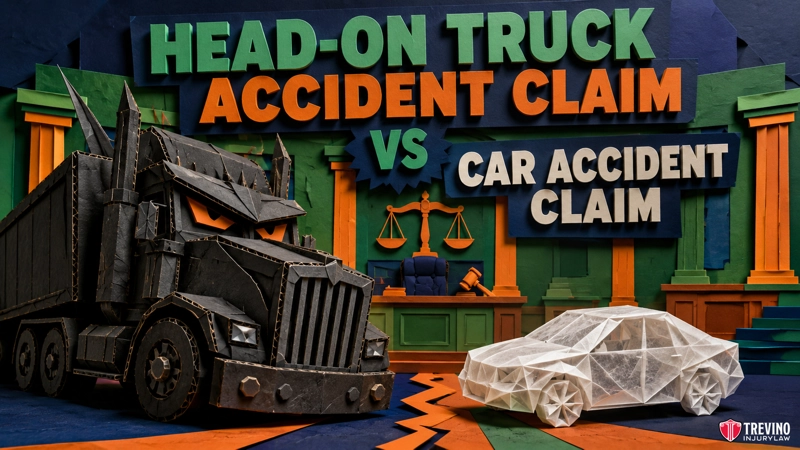
A head-on commercial truck claim requires independent accident reconstruction and federal data extraction, which sets it apart from a standard car collision. Unlike a typical wreck, this level of devastation involves out-of-state freight brokers and massive insurance policies designed to protect cargo operators.
The corporate defense team is already mobilizing to repair the damage, scrub the electronic logging device telemetry, and blame your catastrophic impact on a lane departure. According to TxDOT, commercial motor vehicles were involved in 2,684 crashes in Bexar County in 2024. This volume of destruction occurs because negligent logistics providers intentionally push underqualified drivers to bypass hours-of-service mandates to meet tight delivery windows.
What Could Your Head-On Truck Accident Case Be Worth?
Answer a few quick questions about your accident. Takes about 60 seconds.
See What My Case Might Be WorthThe insurance company offered less than $20,000. I ended up with over $1 million. — Jackie Galindo
Crucial digital telemetry disappears within the first week. A Spoliation Letter, a legal demand that stops the property owner from destroying evidence, must be issued immediately. Texas gives you two years to file a lawsuit, but black box engine control module data and mandatory dash cam footage can vanish in days.
A Trevino Injury Law head-on truck collision attorney subpoenas this highly regulated federal proof and forces commercial insurers to pay maximum compensation. Call 210-TREVINO now for a free case review because you pay nothing unless we win. Se Habla Español.
Who Else Can Be Sued in a Commercial Truck Crash Besides the Driver?
Unlike a normal car accident, where only the opposing driver is liable, a head-on 18-wheeler accident often involves multiple corporate defendants, including the truck owner, freight brokers, cargo loaders, and third-party maintenance companies, all sharing the financial blame.
While our main hub covers how we hold negligent trucking companies accountable for FMCSA violations, uncovering the full liability web requires examining the mechanical and driver failures that cause an 80,000-pound truck to cross a highway median. When a head-on accident occurs on SH-151 or Culebra Road, the physical cause might be a driver drifting over the center line, but the financial liability extends far beyond that.

We routinely pierce the corporate veil to expose parent companies, in Dallas or out-of-state, that pull the strings. Because we litigate to verdict, we know how to trace the supply chain prior to the crash and find every available insurance policy meant to cover your catastrophic injuries.
How Do Shifting Cargo Loads Cause Head-On Collisions?
Cargo loaders share fault in head-on collisions when improperly secured freight shifts mid-transit, altering the trailer’s center of gravity and forcing the truck into oncoming traffic lanes, sometimes resulting in a deadly jackknife. The sheer volume of these incidents is alarming; to put this in perspective, trailer-involved accidents accounted for 42,146 total crashes and 486 fatal crashes across Texas in 2024 (TxDOT, 2024).
Unbalanced loads create deadly hazards on high-speed curves along I-10. When third-party logistics companies prioritize cheap freight over safety, they cannot escape liability for the resulting devastation. The liable parties often include:
- Third-party logistics providers are coordinating the shipment.
- Warehouse loading teams who fail to secure the freight.
- The commercial driver for failing to perform required cargo inspections.
Why Is the Trucking Company Liable for Negligent Hiring?
Trucking companies commit negligent hiring when they employ commercial drivers with a history of DWI convictions or severe safety violations who subsequently cause head-on wrecks. Corporate defendants frequently rush to put underqualified drivers on the road to meet intense supply chain demands.
This avenue for direct corporate liability was heavily reinforced by landmark Texas cases like Werner Enterprises, Inc. v. Blake, 679 S.W.3d 296 (Tex. App.—Houston [14th Dist.] 2023, pet. filed), which affirms that motor carriers can be held directly liable for their own systemic negligence—such as reckless hiring, inadequate training, and ignoring safety protocols—independently of the driver’s individual negligence.
Our firm has a proven history of holding these entities accountable when they intentionally ignore mandatory background checks, violate the Code of Federal Regulations, and directly cause wrong-way driving incidents. These reckless hiring practices directly lead to the regulatory violations that cause serious truck accidents.
Understanding exactly who is legally responsible for the crash establishes the foundation for securing the highly regulated data necessary to prove their negligence.
How Do Federal FMCSA Regulations Change the Evidence Needed?
Federal FMCSA regulations require commercial trucking companies to maintain highly specific digital and physical evidence, such as electronic logbooks and maintenance histories, that do not exist in standard passenger-car accidents. The need for these strict evidence requirements becomes clear when comparing vehicle lethality.
While there were 465,631 passenger cars involved in Texas crashes in 2024 compared to just 26,281 truck-tractors/semi-trailers, these commercial trucks were still involved in a disproportionately high 430 fatal injury crashes (TxDOT, 2024).
While the main hub outlines general trucking company accountability, specific evidence-preservation protocols for truck accident cases involve electronic logging devices (ELDs) and mandatory drug testing unique to commercial drivers. Relying solely on a San Antonio Police Department report for a standard car crash is vastly different from subpoenaing hours of service logs for a commercial collision.

With 80+ cases taken to trial, our attorneys know exactly which federal documents defense lawyers try to hide to obscure their driver’s fatigue and negligence. We act immediately to secure this data because the driver’s digital footprint often reveals the true story of why the truck veered out of its lane.
What Federal Evidence Proves the Truck Crossed the Center Line?
To mathematically prove that a commercial truck drifted into oncoming traffic, our attorneys secure electronic logging device (ELD) data, black-box engine control module (ECM) telemetry, and mandatory dash-cam footage.
Fatigued drivers on Loop 410 often try to falsify paper logs, but they cannot hide the irrefutable ELD telemetry. We extract critical data points to reconstruct the moments before impact:
- Steering angle and trajectory at the point of impact.
- Hard braking events or a lack of evasive maneuvers.
- Cruise control status seconds before the head-on collision.
How Do Steer Tire Blowouts Lead to Head-On Wrecks?
When a commercial trucking company ignores federal daily inspection mandates, worn steer tires can suffer catastrophic blowouts, instantly pulling the 80,000-pound vehicle across the median into oncoming traffic.
Unlike standard passenger vehicles, 18-wheelers must have federally mandated daily inspection reports. When our investigation uncovers missing or falsified maintenance reports, it proves the Negligent Trucking Company chose profit over safety. This mechanical failure directly resulted from corporate negligence.
Uncovering these federal violations provides the necessary leverage to access the massive insurance policies required for commercial freight carriers.
Why Are Commercial Truck Insurance Limits So Much Higher Than Personal Auto Policies?
Because the combined closing speed of a head-on collision with an 80,000-pound 18-wheeler causes unparalleled catastrophic destruction—often resulting in traumatic brain injuries, spinal cord damage, and amputation—federal law requires commercial trucking companies to carry insurance policies often exceeding one million dollars.
This section refines our main hub’s discussion on why catastrophic injuries require a Bexar County trial authority by connecting the extreme physics of head-on closing speeds to these million-dollar commercial policies. A standard $30,000 Texas minimum auto policy pales in comparison to a $1,000,000+ commercial policy.

Under current legal frameworks, the minimum liability coverage for Texas passenger vehicles is $ 30,000/$60,000/$25,000, whereas the federal minimum financial responsibility for certain for-hire nonhazardous property carriers is legally mandated at least $750,000 (Texas Legislature; FMCSA/eCFR, Current law). Adversaries like Great West Casualty Company and Progressive Commercial fight viciously to protect these massive financial exposures.
Our proven ability to break through these high-limit defenses is demonstrated by our $17 Million Settlement in a wrongful death 18-wheeler crash involving multiple fatalities.
The Difference Between Texas Minimum Auto Insurance and Commercial Policies
The structural differences between personal and commercial insurance dictate the trajectory of your financial recovery and require distinct litigation strategies to secure the medical care and future medical funds you need.
| Policy Type | Minimum Liability Limits | Typical Adjuster Tactics |
| Texas Minimum Personal Auto | $30,000 | Rapid lowball offers |
| Interstate Commercial Freight | $750,000 – $5,000,000+ | Aggressive evidence destruction and accident reconstruction denial |
While understanding the sheer size of these commercial policies is critical, knowing how to force the insurance company to actually pay those limits determines your family’s financial survival.
Do Head-On Truck Accidents Always Result in Higher Settlements Than Car Crashes?
While commercial truck accidents have access to much higher insurance policy limits, they do not automatically result in higher settlements without an aggressive San Antonio truck accident lawyer actively forcing the insurance carrier to pay full value through relentless litigation and courtroom pressure. The tragic reality is that commercial truck accidents disproportionately harm standard passenger drivers. Nationally, 70% of the 5,340 people killed in large-truck crashes in 2024 were occupants of other vehicles (NHTSA, 2024).
Victims often falsely assume that a large commercial policy guarantees a massive payout. However, high-volume settlement mills will routinely accept lowball offers from corporate insurers even on massive policies because these volume-driven law firms lack the financial resources and courtroom experience to litigate complex claims.
At Trevino Injury Law, we approach every 18-wheeler crash with a trial-first mindset, knowing that a $7.9 Million Verdict is achieved through exhaustive evidence preservation, independent accident reconstruction, and an unwavering willingness to face Bexar County juries—not simply because the commercial truck carried a million-dollar policy. Insurance adjusters use their deep pockets to delay and deny liability, counting on victims to hire a firm that will fold under pressure. We flip that leverage by preparing every case for the courtroom from day one.
Securing these massive financial recoveries requires a completely different, highly specialized investigative process starting immediately after the crash.
How Does the Investigation Process Differ for 18-Wheeler Wrecks?
Investigating a commercial crash requires rapid preservation of federal data and independent accident reconstruction, whereas standard car accident cases rely primarily on local police reports and witness statements.
Our trial-first methodology dictates a highly aggressive first week after a head-on truck accident to secure evidence that settlement mills frequently miss. When a head-on collision occurs, we immediately execute the following steps to protect your injury claim:
- Deploying Accident Reconstruction Experts to the scene at the “Mixing Bowl” interchange to measure yaw marks and gouge marks left by the head-on impact.
- Issuing immediate Spoliation Letters to prevent the corporate defendant from deleting or destroying critical telematics.
- Downloading Black Box (ECM) data to prove exact closing speeds and braking patterns.
- Auditing driver qualification files for background check failures and hidden FMCSA safety violations.
This complex investigation completely transforms the standard process and raises critical questions about legal costs and law enforcement reliance.
Do I Need a Federal DOT Inspector for My Truck Crash Claim?
Yes, while state police handle the immediate scene, our firm often uses former federal DOT inspectors as expert witnesses to show the trucking company violated federal safety mandates before the crash.
Can I Rely on the San Antonio Police Report for a Commercial Collision?
No, you cannot rely solely on the local police report, because standard patrol officers often lack the specialized training in commercial vehicle physics required to accurately reconstruct complex 18-wheeler collisions.
Will the Trucking Company Voluntarily Hand Over Their Dash Cam Footage?
No, negligent trucking companies will not voluntarily surrender dash cam video or electronic logbooks; our attorneys must force them to turn over this critical evidence using legally binding spoliation letters and subpoenas.
Settlement Mill vs. Trial Lawyer: Handling Truck vs. Car Claims
Settlement mills treat catastrophic truck crashes exactly like minor car accidents to secure quick fees, whereas a plaintiff trial lawyer approaches head-on 18-wheeler wrecks as complex federal litigation.
Volume-driven billboard law firms operate by checking settlement boxes, eagerly accepting the first lowball offer an insurance adjuster throws their way. They refuse to spend the necessary resources to litigate against massive corporate entities. Conversely, Trevino Injury Law utilizes a trial-first methodology, aggressively preparing every case for Texas state courts from day one. We know that rapid settlements in truck cases always leave millions of dollars on the table for families dealing with massive medical bills and disabilities requiring lifelong care.
Trusting the wrong type of law firm leads directly to destroyed evidence and ruined claims.
What Happens If You Treat a Truck Accident Like a Standard Car Wreck?
If you treat a commercial collision like a standard car wreck, you will fail to issue spoliation letters, allowing the trucking company to legally erase the digital evidence proving their driver’s negligence.
Missing the critical first-week window for evidence preservation is a fatal error in commercial claims. Inaction creates a void that can permanently cut off access to mandatory dash cam footage, ELD telemetry, and the legal foundation needed to establish liability against third-party freight brokers or negligent cargo loaders. Unlike a basic fender bender, corporate defendants immediately mobilize response teams to obscure liability and limit financial exposure.
This leads directly to the strict deadlines governing the preservation of commercial evidence.
When Is It Too Late to Inspect the Commercial Truck for Mechanical Failure?
It is permanently too late to inspect the 18-wheeler once the trucking company repairs the damage or sells the vehicle for salvage, destroying the physical proof of the collision, long before the statute of limitations expires.
Victims face severe temporal barriers when dealing with commercial vehicles. Without an immediate temporary restraining order (TRO) filed in the Bexar County Courthouse, the physical proof of bald steer tires, faulty air brakes, or compromised cargo securement will disappear forever. Trevino Injury Law aggressively halts these repairs, ensuring the physical evidence of their negligence remains intact for a Bexar County jury.
Why Hire a Head-On Truck Collision Lawyer?
You must hire a personal injury trial lawyer immediately to preserve critical federal evidence, stop negligent trucking companies from destroying black box data, and force massive commercial insurance carriers to pay maximum compensation for your catastrophic injuries instead of accepting lowball settlement offers.
Want to Protect the Full Value of Your Claim?
You’ve seen how this affects your case — but this is only one piece of the puzzle. Our Head-On Truck Collision Lawyer page breaks down what a trial-ready firm does differently.
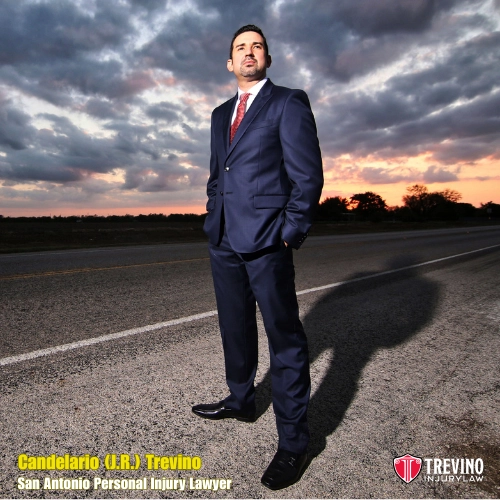
Insurance adjusters will use the chaos of the crash against you. Do not give a recorded statement to the commercial insurance company. At Trevino Injury Law, we utilize our Bexar County trial experience to shut down their delay tactics, expose hidden supply chain defendants, and prepare your case for the courtroom from day one. We fight for families and litigate to a verdict, ensuring you owe no upfront costs because we operate strictly on a no-win, no-fee model.