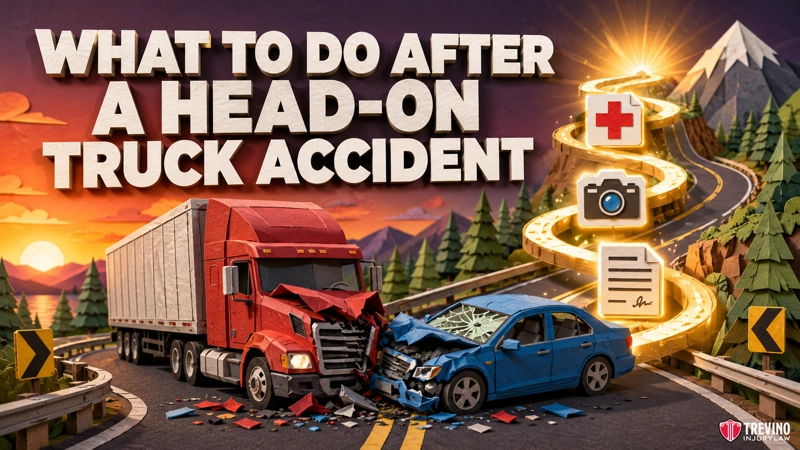
You must immediately document the commercial truck’s final resting position, secure independent witness information, and seek an emergency medical evaluation before the transportation company rewrites the narrative. Head-on collisions transfer devastating physical force, requiring immediate trauma documentation to connect your severe injuries directly to the crash.
The commercial adjuster is already deploying a rapid response team to erase yaw marks on Culebra Road and blame you for crossing the center line. According to the National Highway Traffic Safety Administration, head-on impacts accounted for 30.7% of all two-vehicle fatal large-truck crashes in 2024. Behind most of these collisions is a fatigued corporate driver who drifted into oncoming traffic and a dispatcher working to hide the telematics data.
You must issue a Spoliation Letter, a legal demand that stops the trucking company from destroying evidence, to freeze the steering components and electronic control module. Texas gives you two years to file a lawsuit, but the physical proof on the asphalt vanishes in hours.
Trevino Injury Law head-on truck accident lawyers deploy accident reconstruction experts to the scene and lock the evidence down before it disappears. Call 210-TREVINO for a free case review. You pay nothing unless we win. Se Habla Español.
What Immediate Steps Must You Take at the Scene of a Head-On 18-Wheeler Crash?
You must immediately secure your physical safety, call 911 for law enforcement and emergency medical services, and document the final resting position of the vehicles before they are moved.
While our primary hub addresses what to do in the first week after a San Antonio commercial truck crash, surviving a head-on accident requires immediate physical scene management, handling centerline debris, and interacting with emergency medical personnel. A car crash with a fully loaded, 80,000-pound commercial truck is a catastrophic event. The local risk is substantial; in 2024, Bexar County recorded 2,684 total crashes involving commercial motor vehicles, resulting in 18 fatal crashes (TxDOT, 2024).
Your first priority is safety and initiating an official law enforcement response. Never assume a crash is too minor to report; the massive weight disparity guarantees structural damage and hidden physical trauma. While waiting for the San Antonio Police Department or Bexar County Sheriff’s Office, document the scene if you are physically able.

If you can, take photos of the point of impact, the truck’s license plate, and the USDOT number on the cab door. Do not engage in arguments with the commercial driver, and absolutely never apologize or minimize your injuries. These initial minutes are when the insurer’s defense begins, as the driver will immediately contact their dispatcher. Whether the crash occurs on Culebra Road or Bandera Road, these initial steps establish the foundation of your claim.
Why Are Gouge Marks and Debris Fields Critical Evidence?
Gouge marks and debris fields provide undeniable mathematical proof of exactly where the two vehicles collided. In a head-on crash, the massive force transfer leaves permanent scars on the roadway. When metal structures collapse, they strike the asphalt, creating gouge marks that pinpoint the exact point of impact. Accident reconstruction experts map these marks, along with the spread of glass and fluid trails, to reconstruct the moments before the frontal crash.
This physical evidence overrides the truck driver’s verbal testimony, mathematically demonstrating that the 18-wheeler breached the center line and caused serious injuries. While physical evidence proves the point of impact, insurance adjusters will still attempt to shift the blame.
How Do You Prove the Commercial Driver Crossed the Center Line?
We prove the commercial driver crossed the center line by deploying independent accident reconstruction experts to analyze tire friction marks, vehicle crush profiles, and electronic control module (ECM) data.
Building beyond the standard methods of investigating brokers and corporate executives, holding a negligent trucking company accountable in a head-on scenario requires distinct accident reconstruction to definitively prove wrong-way driving factors and overcome comparative negligence arguments. Since a head-on crash is officially defined as a crash involving two vehicles traveling in opposite directions before impact (TxDOT, 2026), proving which vehicle deviated from its lane is paramount.
Commercial adjusters from companies like Progressive Commercial or Great West Casualty Company will routinely argue that you drifted out of your lane, attempting to apply Texas comparative negligence laws to reduce your payout. Overcoming this requires scientific proof. Trevino Injury Law immediately secures the 18-wheeler’s black box data, which records the truck’s steering angle, braking patterns, and speed in the exact seconds before the head-on impact.
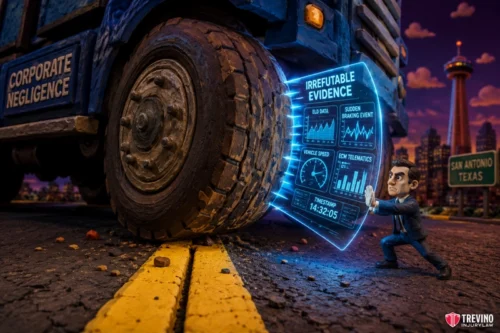
By combining this telematics data with scene forensics—such as yaw marks indicating abrupt, uncontrolled steering corrections by fatigued or distracted drivers—we construct an airtight liability argument. We do not rely solely on the initial crash report, which is often incomplete. Whether the crash occurred in the Eagle Ford Shale or at the “Mixing Bowl” Interchange, our trial-first approach mathematically destroys the defense’s attempt to shift the blame onto the victim.
Can Witness Statements Override a Truck Driver’s Story?
Yes, independent eyewitness statements are highly persuasive and can completely dismantle a truck driver’s false narrative when combined with physical scene evidence. Commercial drivers are trained to protect their CDL and their employer’s liability. They will often lie to investigating officers, claiming you swerved first. Independent witnesses—other drivers or pedestrians who saw the 18-wheeler drifting across the double-yellow line—provide objective testimony that juries trust.
Securing their names and contact information before they leave the scene is vital. Trevino Injury Law contacts these witnesses immediately to secure their recorded statements before the trucking company’s defense lawyers can manipulate their memories of the event in a potential lawsuit. Establishing fault allows us to focus entirely on the medical and financial recovery process.
What Medical Documentation is Essential for Head-On Collision Trauma?
Essential medical documentation requires immediate emergency room imaging—such as MRI and CT scans, to definitively link the traumatic forces of the head-on crash to your specific physical injuries.
While coordinating immediate medical benefits is standard in any personal injury claim, head-on collisions present a unique necessity for immediate trauma documentation to identify masked injuries and defeat insidious gap-in-treatment arguments designed to derail your Life Care Plan. Head-on collisions cause extreme rapid-deceleration trauma, violently throwing occupants forward against the steering column or dashboard. The devastating nature of these specific impacts is clear, as 617 people were killed in head-on crashes across Texas in a single year (TxDOT, 2024).
This causes spinal cord damage, traumatic brain injuries, neck injuries, whiplash, broken bones, and internal organ rupture. However, the massive spike of adrenaline following a crash can temporarily mask severe pain. If you refuse an ambulance or delay going to a facility like University Health System or Methodist Hospital, the insurance adjuster will immediately claim your injuries are unrelated to the crash.
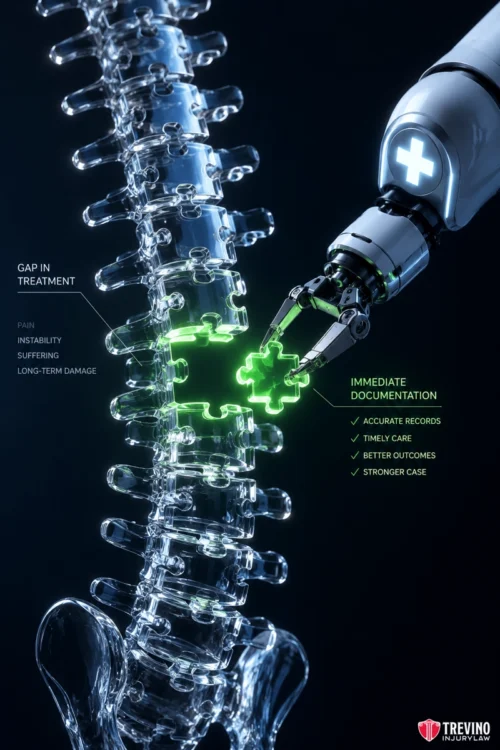
You must get checked and seek emergency medical evaluation right away—ideally within 24 hours. A complete set of emergency room records, radiological scans, and strict adherence to your doctor’s follow-up treatment plan forms the foundation of your financial claim.
Trevino Injury Law builds this documentation to support comprehensive Life Care Plans, ensuring you are compensated for every medical bill, future surgeries, rehabilitation, and lost wages, rather than accepting a lowball settlement from a high-volume settlement mill. This rigorous trial-first preparation yields undeniable results—as demonstrated when we turned a $5,000 settlement offer into a $536,007 jury verdict by fully preparing for the courtroom.
Why Do Adjusters Use “Gaps in Treatment” Against You?
Adjusters exploit any delay or gap in your medical treatment to argue that your injuries were either pre-existing or not severe enough to warrant the compensation you are demanding. A “gap in treatment” occurs if you wait a week to see a doctor or miss scheduled physical therapy appointments.
Commercial insurance companies train their adjusters to highlight these gaps during negotiations with juries, arguing that if you were truly injured in a head-on crash, you would have prioritized your medical care. Consistency is the greatest shield for injured parties.
Our firm ensures you are connected with specialized medical providers who understand how to properly document traumatic injuries, neutralizing the insurer’s attempt to devalue your claim. Understanding how to document your injuries leads directly to understanding the official investigative process.
How Does the Police Investigation Work for Major San Antonio Highway Crashes?
The police investigation of a major highway crash involves responding officers immediately securing the chaotic scene, interviewing the involved drivers, examining physical debris, and ultimately generating a formal Texas Peace Officer’s Crash Report (CR-3) to officially document the incident. By state regulation, this official documentation must be processed quickly, as the law-enforcement crash report submission deadline is no later than the 10th day after the crash (TxDOT, 2026).
When a head-on commercial truck accident occurs on major San Antonio arteries like Loop 410, law enforcement treats it as a major incident. Officers will close lanes, dispatch emergency medical services, and deploy their traffic investigation unit if fatalities or catastrophic injuries are involved. They will test the commercial driver for intoxication and review their initial logbook entries to check for obvious FMCSA violations. This immediate scene and medical response serve as the foundation for your injury claim, initiating the formal legal timeline discussed in our main hub.

However, the resulting CR-3 crash report is only a preliminary finding; it is not the final word on liability in a Bexar County civil court. Trevino Injury Law routinely overrides inaccurate police reports by launching a parallel, independent investigation using forensic experts to uncover the truth that the police may have missed. The police report is just one piece of evidence, leading to specific legal questions about preserving your claim.
What Are the Steps to Preserve Head-On Crash Evidence?
Preserving head-on crash evidence requires a rapid, multi-step legal intervention to freeze data before the trucking company can destroy it.
- Immediate Retention: Hiring a trial attorney immediately triggers legal protections.
- Spoliation Letter Issuance: We send a legally binding demand to the trucking company, forbidding the destruction of the 18-wheeler’s black box data, dash cam footage, and maintenance logs.
- Scene Inspection: Our accident reconstructionists deploy to the crash site to map gouge marks, fluid spills, and skid marks before weather or traffic erases them.
- Vehicle Preservation: We legally block the trucking company from repairing or salvaging the commercial truck until our experts inspect the steering columns, brakes, and tires.
This aggressive preservation process directly impacts your ability to overcome unfavorable initial reports.
For a deeper breakdown of the specific proof that should be secured, review the head-on truck accident evidence that should be preserved.
Do I Need a Police Report for a Truck Crash Claim?
Yes, you absolutely need an official police report because it provides the foundational, third-party documentation of the crash date, time, parties involved, and initial observations required by commercial insurance carriers when you submit your claim.
Can I Still File a Claim if I Was Partially in the Other Lane?
Yes, you can still file a claim because Texas is a modified comparative fault state, allowing you to recover compensation as long as you are found to be 50 percent or less responsible for the crash.
Am I Required to Give a Recorded Statement to the Trucking Company’s Adjuster?
No, you are not legally required to give a recorded statement to the commercial insurance adjuster, and doing so will only give them ammunition to shift blame for the head-on collision.
Emergency Room Treatment vs. Delayed Medical Care
Immediate emergency room treatment provides an undeniable medical link to the crash, whereas delayed medical care provides the insurance company with grounds to deny your claim entirely. Going straight to the emergency room at a local San Antonio hospital guarantees that medical professionals record your initial complaints of pain on the exact date of the collision, establishing an immediate chain of causation.
Conversely, waiting days or weeks to visit a doctor breaks this causal link. In the landmark case Guevara v. Ferrer, 247 S.W.3d 662 (Tex. 2007), the Texas Supreme Court underscored that establishing legal causation for complex medical conditions usually requires expert medical testimony directly connecting the specific crash event to the injury. Immediate and continuous clinical documentation is essential to neutralizing adjusters who attempt to devalue your traumatic injuries.
Conversely, waiting days or weeks to visit an urgent care center or primary care physician breaks the chain of causation. The defense will weaponize this delay, arguing that your injuries occurred at work or at home in the days following the crash, not due to the 18-wheeler. Fast action protects both your physical health and your financial recovery. Failing to take immediate action creates specific, often irreversible consequences for your legal case.
What Happens If You Do Not Photograph the Impact Point?
If you do not photograph the impact point, you lose critical visual evidence of the exact resting positions and debris fields, making it significantly harder to dispute the truck driver’s fabricated story. Without immediate photographs of the scene on roads like I-35, the physical evidence quickly disappears.
Tow trucks move the vehicles, street sweepers clear the shattered glass, and rain washes away fluid trails. By the next day, the scene is sterile. This absence of photographic proof allows the commercial insurance adjuster to rely solely on their driver’s version of events, often falsely claiming you swerved into their lane.
While accident reconstructionists can still use black box data, losing the visual context of the immediate aftermath severely weakens your initial negotiating position. This urgency extends to the commercial vehicle’s physical condition.
When Is It Too Late to Inspect the Truck’s Steering Components?
It becomes permanently too late to inspect the truck’s steering components once the trucking company repairs the damage or sells the cab for salvage, which can happen within weeks if a spoliation letter is not issued.
In head-on collisions, mechanical failure—such as a blown steer tire or a snapped tie rod—is frequently the root cause of the truck swerving into oncoming traffic. However, negligent trucking companies are eager to hide poor maintenance. If a trial lawyer does not immediately secure a temporary restraining order or send a preservation demand, the company will quickly replace the broken parts and put the truck back on the road.
Once the original components are destroyed or altered, your ability to prove a catastrophic maintenance failure is permanently lost, crippling your claim against the carrier.
Why Hire a Head-On Truck Collision Lawyer?
Hiring a head-on truck collision lawyer provides you with a trial-ready champion who immediately secures black box data, deploys accident reconstructionists to prove center-line violations, and stops Negligent Trucking Companies from destroying critical evidence before they can shift the blame onto you. After a catastrophic crash, corporate adjusters move instantly to protect their assets. Without a personal injury accident attorney, your opportunity to prove liability can disappear before you even leave the hospital.
Want to Protect the Full Value of Your Claim?
You’ve seen how this affects your case — but this is only one piece of the puzzle. Our Head-On Truck Collision Lawyer page breaks down what a trial-ready firm does differently.
Trevino Injury Law brings over 20 years of litigation experience to force insurance companies to pay maximum compensation for your traumatic injuries. We litigate to verdict, using undeniable forensic evidence to fully fund your future medical needs and Life Care Plans. Do not let a settlement mill devalue your family’s future. Call us today at 210-TREVINO for a free, no-obligation consultation on a contingency-fee basis. Se Habla Español.