The reader’s core problem is determining who bears financial responsibility after a commercial vehicle crash. The adversary-blocking resolution is the corporate defense team’s use of independent-contractor loopholes and shared-fault tactics to deny liability. The intro must move the reader to immediately preserve data and target the corporate policy.
The corporation pays when its driver hits you on the job. Liability shifts from the individual behind the wheel directly to the employer the moment that the worker acts within the scope of their employment.
What Could Your Commercial Vehicle Accident Case Be Worth?
Answer a few quick questions about your accident. Takes about 60 seconds.
See What My Case Might Be WorthThe insurance company offered less than $20,000. I ended up with over $1 million. — Jackie Galindo
The corporate defense team is already working to shield its commercial policy. They classify their driver as an independent contractor to escape responsibility and deploy blame-shifting tactics to pin the fault on you, ensuring you recover nothing. According to Bexar County records, the region recorded 2,684 commercial motor vehicle crashes in 2024. Behind most of those collisions is a logistics company or dealership that prioritized delivery schedules over public safety. That is not bad luck. That is corporate negligence.
Trucking companies purge dashcam footage and maintenance logs fast. A Spoliation Letter, a legal demand to stop the corporation from destroying evidence, must be sent immediately. Texas gives you two years. After that, the claim is gone.
Trevino Injury Law, commercial vehicle crash attorneys secures the black box data on day one and dismantles corporate shields. Call 210-TREVINO for a free case review. You pay nothing unless we win. Se Habla Español.
Who Is Liable for a Commercial Vehicle Accident in Texas?
In Texas, liability shifts from the individual driver to the corporation under the Doctrine of Respondeat Superior when the driver acts within the scope of their employment. This shift is a financial necessity in Bexar County, which recorded a staggering 2,684 total CMV-involved crashes in 2024, the highest in the region.
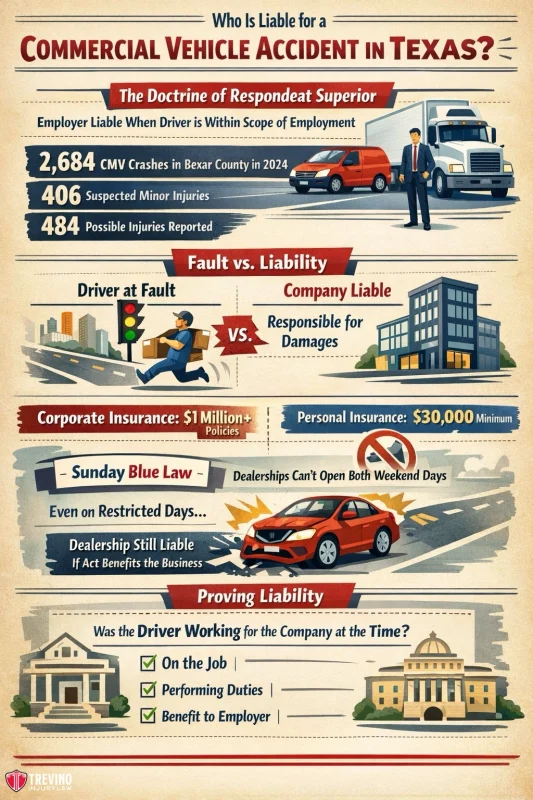
With 406 suspected minor injuries and 484 possible injuries reported in these San Antonio-area wrecks alone, a driver’s $30,000 policy is quickly exhausted, making access to a multi-million-dollar corporate policy vital for full recovery.
While the main hub introduced the concept of multiple defendants, establishing actual liability requires distinguishing between fault (the action) and liability (the responsibility). For example, if a delivery driver runs a red light in Alamo Heights, the driver is at fault for the collision, but the logistics company is liable for the resulting injuries.
This distinction matters because commercial policies often have limits exceeding $1 million, while a personal driver might carry only the state minimum of $30,000.
This principle applies even when specific local regulations complicate the scenario. For instance, under the Texas “Sunday Blue Law,” car dealerships cannot operate on consecutive weekend days, affecting when and how fleet vehicles are legally on the road for sales purposes;
However, if a dealership porter crashes a loaner vehicle while moving it on a restricted day, the dealership remains liable because the act benefits the business. To hold the company liable, you must prove the driver was working for it at that exact moment, which leads to the specific legal test Texas courts use.
When Is a Company Liable for an Employee’s Crash? (Vicarious Liability)
A company is liable for an employee’s crash under the doctrine of Respondeat Superior if the injured party proves the employee was acting within the “course and scope” of their employment at the time of the negligent act.
The Texas Supreme Court case Painter v. Amerimex Drilling I, Ltd. clarified that liability exists even if the employer did not authorize the specific negligent conduct, provided the act furthered the employer’s business. This means that even if a company policy strictly forbids texting while driving, the company is still liable if its driver causes a wreck while texting a client about a delivery.
Independent Contractors vs. Employees: The ‘Right to Control’ Test
The “Right to Control” test determines liability by asking whether the company had the authority to direct the details of the driver’s work, regardless of whether the contract labels them an “independent contractor”. Courts look at specific factors to pierce this common defense:
- Did the company provide the tools, such as the truck or scanner?
- Did the company dictate the specific route and delivery schedule?
- Did the company pay by the hour rather than by the job?
- Did the company have the right to fire the driver at will?
Once you establish that the company controlled the driver, the next critical question becomes whether the driver was actually performing work duties during the specific trip that caused your injury.
What Happens If I Get in an Accident in a Company Vehicle Off the Clock?
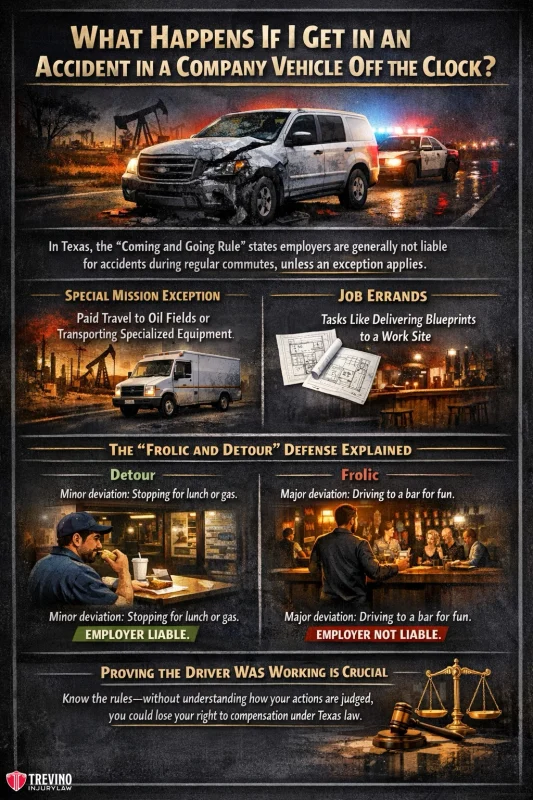
Generally, Texas employers are not liable for accidents that occur while an employee is commuting to or from work, known as the “Coming and Going Rule,” unless a specific exception applies that links the travel to the employer’s benefit.
This rule protects companies from liability when their workers are effectively part of the general public, but skilled trial lawyers can use exceptions to secure coverage for victims.
While the general rule excludes commutes, the unique industrial landscape of South Texas often triggers the “Special Mission” exception. For example, oil field workers traveling from San Antonio to the Eagle Ford Shale are often paid for their travel time or transport specialized equipment essential to the job.
If an employee is sent on a specific errand by their boss, such as dropping off blueprints at a job site in Leon Valley before heading home, that deviation falls within the course and scope of employment, making the company liable for any crash that occurs during that errand.
The ‘Frolic and Detour’ Defense Explained
The “Frolic and Detour” defense distinguishes between minor deviations from a work route, for which the employer remains liable, and major abandonments of duty, which absolve the employer of responsibility.
- Detour: A minor deviation for personal comfort that is reasonably foreseeable, such as a delivery driver stopping for lunch or gas on Bandera Road. The employer remains liable because this is incidental to the work.
- Frolic: A significant deviation where the employee abandons work duties for personal reasons, like driving a company van to a bar at The Pearl for a night out. The employer is generally not liable because the employee has ceased serving the business.
Proving the driver was working is critical, but without understanding how your own actions are evaluated, you could still lose your right to compensation under Texas’s shared fault laws.
What Is the 51% Rule in Texas Commercial Accident Cases?
Texas follows the Modified Comparative Negligence rule, meaning you can only recover damages if a jury finds you are 50% or less responsible for the accident, and your compensation is reduced by your percentage of fault.
This “51% Bar” is a favorite weapon of defense attorneys; if they can convince a jury that you were even 51% at fault, perhaps for speeding slightly or changing lanes abruptly, you recover zero dollars, regardless of how severe your injuries are.
In the high-stakes environment of commercial litigation, this rule drives the defense’s strategy to shift blame onto the victim. For instance, if a semi-truck merges into you on Loop 1604, the company’s lawyers might argue that you were distracted or in the truck’s blind spot.
If the jury awards you $100,000 but finds you 20% at fault, your actual recovery is reduced to $80,000; however, if that fault finding ticks up to 51%, the award vanishes completely.
Because the specific percentage of fault is so financially determinative, these figures are often the subject of intense negotiation and formalized in “Rule 11 Agreements”. Under Texas Rule of Civil Procedure 11, any agreement between lawyers regarding the lawsuit, including stipulations about fault percentages or settlement terms, must be in writing, signed, and filed with the court to be enforceable.
We use these agreements to secure favorable terms and prevent insurance companies from reneging on liability admissions once the evidence is presented.
Can You Recover Damages If You Were Partially at Fault?
Yes, you can recover damages if you were partially at fault, provided your responsibility does not exceed the 50% threshold established by Chapter 33 of the Texas Civil Practice and Remedies Code.
This system of “Proportionate Responsibility” ensures that a victim is not barred from justice for a minor error, but it also means that every percentage point of blame shifted to you results in a corresponding reduction in compensation. This makes preserving evidence like dashcam footage and “black box” data vital to refute the defense’s attempts to inflate your share of the blame.
Once you understand how shared fault can reduce your claim against the company, the next critical question becomes whether it is strategic to include the individual driver as a defendant in your lawsuit.
Can You Sue the Driver of a Company Vehicle Personally?
Yes, you can sue the driver personally for their negligence, but their personal insurance policy is often insufficient to cover the catastrophic damages typical of a commercial crash, making it strategically necessary to also target the employer’s much larger commercial liability policy.
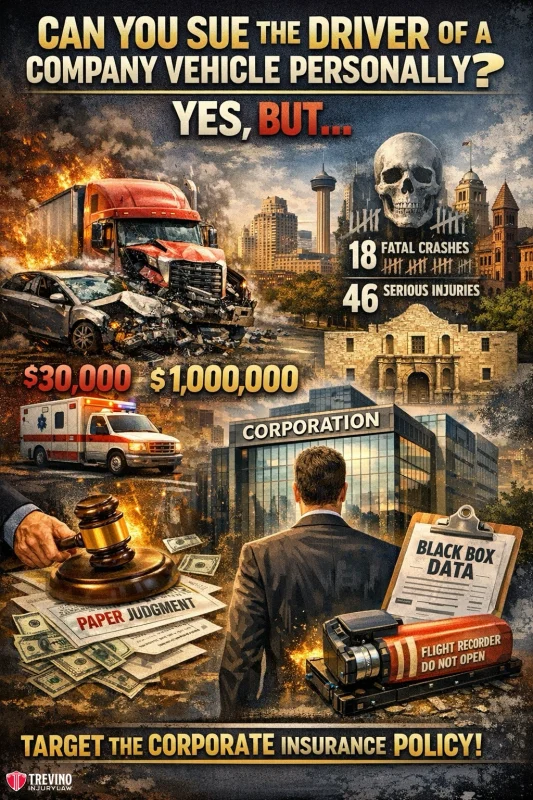
In Texas, a personal auto policy may cover only the state minimum of $30,000 for bodily injury, which barely covers an ambulance ride and initial ER visit after a major wreck, whereas commercial policies often start at $1 million.
Litigation in San Antonio often involves catastrophic stakes. In 2024, Bexar County saw 18 fatal CMV crashes and 34 suspected serious crashes. Identifying the corporation as a defendant is essential because these specific incidents resulted in 18 fatalities and 46 suspected serious injuries.
At Trevino Injury Law, we secure “black box” data immediately to link these high-stakes outcomes to corporate negligence before evidence is purged.
If you only sue the driver, you risk obtaining a “paper judgment” against an individual who cannot pay, leaving you with no funds for your long-term recovery. Identifying the defendants is only half the battle; ensuring there is an actual insurance policy that covers the specific type of accident is where many unrepresented victims hit a wall.
Does Commercial General Liability Cover Auto Accidents?
Generally, no. Commercial General Liability (CGL) policies typically exclude auto accidents, which are covered under a separate Commercial Auto Policy designed for fleet risks.
While CGL covers injuries that occur on business premises, such as a customer slipping on a wet floor at a grocery store on Culebra Road, it almost never applies to crashes involving vehicles on public roadways.
This distinction is vital during the “discovery phase” of a lawsuit, as inexperienced lawyers may waste time targeting the wrong policy limits while the actual coverage lies elsewhere.
Is Texas a No-Fault State for Commercial Accidents?
Because Texas is not a no-fault state, the burden is on the victim to establish negligence after a truck crash. This means you must identify all liable parties, which could include the driver, the company, or even cargo loaders, before you can recover compensation.
Under Texas’s modified comparative negligence rules, it is also possible to share liability and still win your case, as long as you were not more than 50% responsible for causing the accident. However, if the insurance company argues that you caused the accident entirely, you may be barred from recovery, which is why establishing fault early is critical.
Does My Car Insurance Cover Me When I Drive a Company Vehicle?
Since your personal vehicle policy likely excludes coverage for a regular-use company car, you must rely on your employer’s commercial insurance. It is vital to report the accident to your employer immediately so they can notify their carrier.
If the employer’s insurance denies responsibility, or if the coverage limits are insufficient for your medical bills, you may be left vulnerable. Navigating these coverage disputes is a common part of complex personal injury cases, and you may need to file a claim against multiple policies to ensure you are fully protected.
What Happens When a CDL Driver Has an Accident?
When a Commercial Driver’s License (CDL) holder causes a crash, they are subject to mandatory post-accident drug testing and may face license suspension under strict Federal Motor Carrier Safety Administration (FMCSA) regulations.
The timeline for this testing is strict: alcohol testing must occur within 8 hours and controlled substance testing within 32 hours; failure to comply can result in the driver being placed “Out of Service.” We immediately request these toxicity reports because a positive result creates a presumption of negligence that is difficult for the trucking company to overcome in court.
Ultimately, while the thief is criminally responsible, they rarely have the financial means to cover the damages. In these situations, accident victims often look to the employer. Although the company is generally not liable for a criminal’s actions, exceptions apply if its negligence facilitated the theft.
For instance, if a company’s policy of leaving keys in a large truck’s ignition directly contributed to the accident, the trucking company may still be held liable for the resulting collisions.
How Do Insurance Companies Determine Who Is at Fault?
Insurance companies determine who is at fault by analyzing initial police reports, immediately deploying their own aggressive, rapid-response investigators to the scene, and actively searching for any twisted narrative or technicality to shift legal blame onto the injured victim and protect their profits.
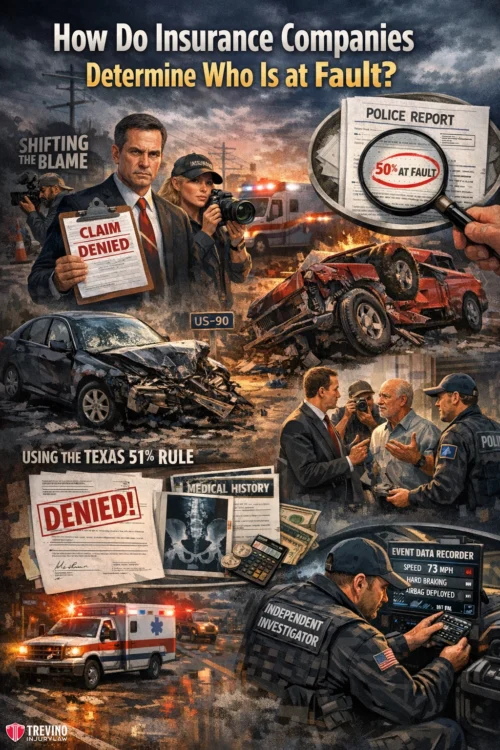
Corporate Insurance Adjusters do not seek the truth. They seek to protect their profit margins. Within hours of a crash on US-90, they review property damage, interview witnesses, and scour your medical history.
Their primary goal is to leverage the Texas 51 percent proportionate responsibility rule to deny your claim entirely. By arguing that you contributed to the collision, they attempt to legally avoid paying for your spinal cord injuries or lost wages. We counter this by deploying our own independent investigators to secure objective evidence from event data recorders.
Why Should You Never Admit Fault at the Crash Scene?
You should never admit fault or apologize at the crash scene because corporate insurance adjusters will immediately twist those polite statements into formal legal admissions of guilt, actively weaponizing your words to destroy your injury claim and deny you the financial compensation you deserve.
Shock and adrenaline often cause victims to misjudge the event. You may not know the commercial driver was texting or violating Hours of Service rules. Let the San Antonio Police Department investigate and determine the facts. Your only job is to seek immediate medical attention at University Hospital or Methodist Hospital.
Leave the liability communication to a trial-tested attorney. Protecting your statements prevents the insurer from manipulating the facts, which directly impacts how we build a trial-ready strategy to maximize your settlement.
Quick Answers About Company Vehicle Liability
What Evidence Secures a Corporate Liability Claim?
Securing a corporate liability claim requires immediate preservation of the electronic logging device, dashcam video, and the driver qualification file.
We utilize Letters of Spoliation to legally bind the fleet management company from purging this critical data. We immediately act to preserve three specific categories of evidence:
- The black box data, which provides an unalterable record of the vehicle’s speed and braking history just before impact.
- Dashcam and cab video footage that proves driver distraction.
- Comprehensive driver qualification files and hours-of-service logs often expose rampant federal safety violations.
- Gathering this technical evidence is the only way to prove vicarious liability and force the insurance carrier to respect your claim’s true value. This strict evidence requirement is especially crucial when navigating complex corporate loopholes involving major delivery networks.
Can You Sue an Amazon Delivery Driver Directly?
Yes, you can sue an Amazon delivery driver directly, but we typically target the Third-Party Logistics Provider (3PL) to access larger commercial insurance policies.
Does a Company Car Insurance Policy Cover Personal Use?
No, a company car insurance policy generally does not cover an employee’s purely personal errands unless the corporate contract includes specific permissive-use clauses.
Is It Better to Settle or Sue in an Accident with a Company Vehicle?
It is always better to file a lawsuit in an accident with a company vehicle to bypass low-level adjusters and force a fair settlement before trial.
Insurance companies string unrepresented victims along for months. Filing suit initiates the formal discovery process, granting us subpoena power to uncover hidden safety records and maintenance logs. As we prepare for war in the Bexar County Courthouse, the risk of a massive jury verdict often forces the carrier to offer the policy limits.
For example, in Mendoza v. Farmers Best International LLC, taking the case to a jury resulted in a $7.9 Million Verdict, which was six times higher than the defense’s settlement offer. However, corporate liability is not automatic in every scenario involving a marked vehicle.
When Is It Too Late to Determine Liability?
Delaying your investigation risks not only losing data but also losing the physical evidence needed to prove vehicle maintenance failures or mechanical defects. If the wreckage is scrapped or repaired, it becomes impossible to prove that a manufacturer may be held liable for a brake or tire failure.
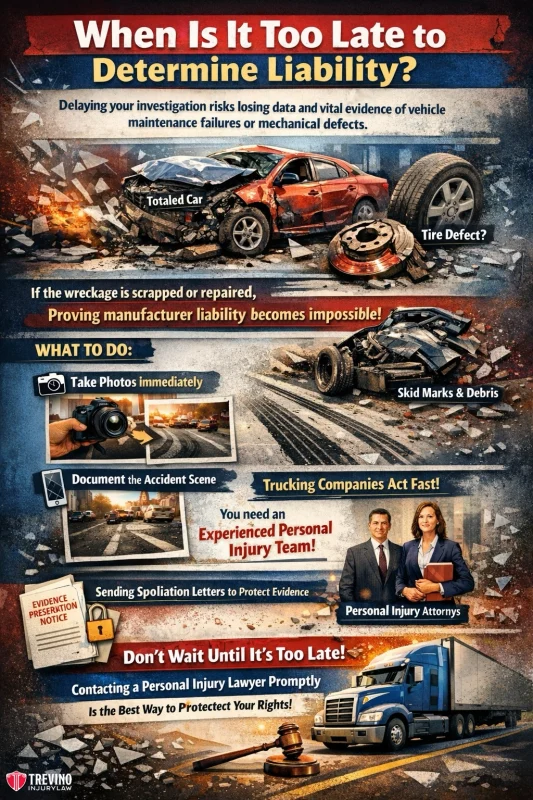
To preserve these claims, take photos of the accident immediately and document the scene to show skid marks and debris fields. Liability depends heavily on what you can still document and preserve after the collision. The steps to take after a commercial vehicle accident explain the immediate evidence-preservation sequence. When the evidence points to failures in a motor carrier’s operations, the next layer is understanding how trucking company negligence is proven.
Because commercial drivers and their employers move quickly to protect themselves, you need an experienced personal injury team to level the playing field. A personal injury attorney will send spoliation letters to prevent the destruction of evidence that could prove a party is liable under product liability laws or for negligent maintenance. If you wait, you may lose the ability to file successful personal injury lawsuits, regardless of who caused the crash.
Contacting a personal injury lawyer promptly is the best way to protect your rights in a commercial vehicle injury case.
Why Hire a San Antonio Commercial Vehicle Law Firm?
Corporate defense teams count on this destruction to hide behind the independent contractor defense and shift blame to you. While settlement mills fold early, we pierce these shields to hold the company accountable. We defeat the 51% Bar in Bexar County by securing critical evidence before it is overwritten.
Want to Protect the Full Value of Your Claim?
You’ve seen how this affects your case — but this is only one piece of the puzzle. Our Commercial Accident Lawyer page breaks down what a trial-ready firm does differently.
You need a San Antonio accident lawyer to file a spoliation letter and demand dispatch logs immediately. Call 210-TREVINO for a free case review. Se Habla Español. We fight on a strict No-Win, No-Fee basis.