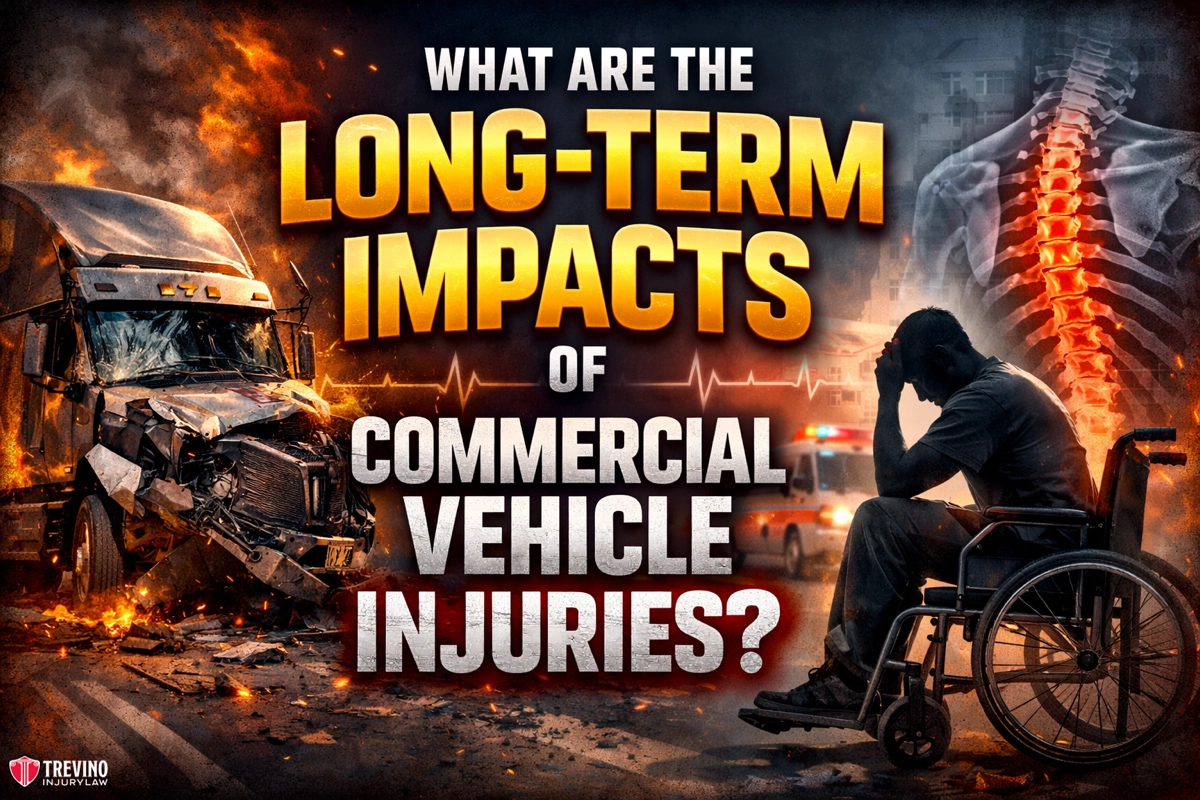
The long-term impacts of a commercial collision go far beyond initial soreness, frequently manifesting months later as severe spinal degeneration, traumatic brain injuries, and debilitating post-traumatic stress disorder.
The insurance adjuster is already weaponizing this delay. They push for a quick cash payout within days of the crash, trapping you into a binding Release of Claims before your hidden structural damage requires surgery.
Your body’s adrenaline response masks massive physical trauma. According to Bexar County data, San Antonio recorded 46 serious injury victims in 2024 from commercial crashes. These victims suddenly face a lifetime of symptom management and catastrophic medical debt.
What Could Your Commercial Vehicle Accident Case Be Worth?
Answer a few quick questions about your accident. Takes about 60 seconds.
See What My Case Might Be WorthThe insurance company offered less than $20,000. I ended up with over $1 million. — Jackie Galindo
Evidence of the impact force disappears quickly. A Spoliation Letter, a legal demand that stops the trucking company from destroying black box data, must go out immediately. Texas limits your time to act to two years. Missing this window leaves you personally liable for your ongoing care.
Trevino Injury Law, our commercial vehicle accident lawyer in San Antonio, blocks early-settlement traps and demands full accountability for your future medical needs. Call 210-TREVINO for a free case review. You pay nothing unless we win. Se Habla Español.
Can a Commercial Vehicle Accident Cause Problems Years Later?
Yes, commercial vehicle accidents frequently cause latent injuries like spinal degeneration or cognitive decline that may not manifest symptoms until months or even years after the initial crash.
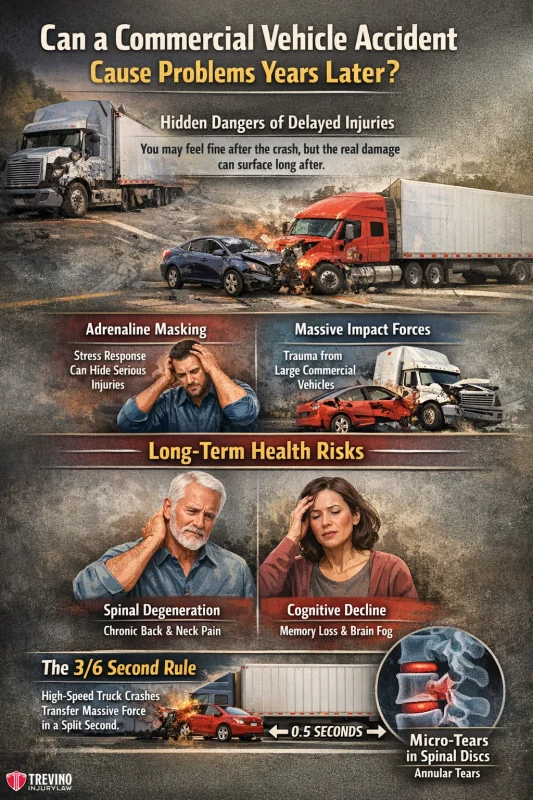
While the main hub discusses the legal tactic of fighting insurance delays, this section focuses on the medical reality that makes early settlement so dangerous: your body may be hiding the true extent of the damage. In the high-adrenaline chaos of a collision on I-35 or Loop 410, your body’s natural stress response can mask severe structural damage for days or weeks.
This “adrenaline masking” is particularly dangerous in commercial crashes because of the massive forces involved. Even if you feel fine immediately after the wreck, the physics of a tractor-trailer impact are unforgiving; the “3/6 second rule” used by safety experts to measure safe following distances is often violated, meaning the kinetic energy transfer happens faster than human reflexes can brace for, causing micro-tears in spinal discs known as annular tears.
Can an Old Injury Cause Problems Years Later?
Yes, the massive force of a commercial collision often aggravates “asymptomatic” pre-existing conditions, turning a dormant issue into a debilitating chronic problem. Insurance carriers frequently try to label this as “natural aging” or arthritis to deny your claim, arguing that the wreck didn’t cause the pain.
However, under the Eggshell Plaintiff doctrine in Texas law, you are entitled to compensation if the accident accelerated or worsened a condition that was previously manageable or painless. We use comparative MRI studies to distinguish between normal degeneration and the specific traumatic aggravation caused by the crash.
While understanding these hidden medical timelines protects you from settling too early, identifying the specific types of catastrophic damage is necessary to calculate the true value of your future needs.
What Injuries Can Cause Permanent Damage in Commercial Crashes?
In 2024, Bexar County recorded 18 fatal CMV crashes and dozens of life-altering injuries that fall into the “Big 3” catastrophic categories: TBIs, spinal cord severing, and amputations. Because the passenger compartment of a car is often crushed by the massive kinetic energy of an 18-wheeler, these injuries frequently result in permanent functional impairment.
For those among the 46 suspected serious injury victims in San Antonio last year, “healing” is often a misnomer; instead, the focus shifts to a lifetime of symptom management and rehabilitation at specialized facilities.
Expanding on the liability issues covered in our main overview, we must examine the “Big 3” injuries that can change a victim’s life forever. Unlike standard car wrecks, collisions with 18-wheelers often crush the passenger compartment, leading to injuries that medicine can manage but never fully cure.
Victims facing these injuries often require long-term care at facilities like Warm Springs Rehabilitation Hospital of San Antonio to regain basic functions. The “Big 3” catastrophic categories include:
Traumatic Brain Injuries (TBI): Ranging from concussions to severe shearing of nerve fibers that permanently alter personality and cognitive processing.
- Spinal Cord Injuries: Damage that results in partial or total paralysis, often requiring home modifications and lifetime attendant care.
- Amputation and Crush Injuries: The loss of limbs due to the sheer weight of commercial vehicles necessitates prosthetic replacements every few years for the rest of the victim’s life.
How Long Does It Take for the Brain to Heal After a Car Accident?
While a collision can cause concussions that may resolve with rest, severe traumatic brain injuries frequently result in long-term cognitive deficits and lasting emotional impacts. Sadly, accidents often involve a combination of traumas; truck accidents can also cause physical devastation beyond the brain, such as internal injuries like damage to the liver or a complex fracture. In the most tragic cases, these injuries can lead to partial or complete paralysis, resulting in limited mobility for the rest of the victim’s life.
The path to recovery is rarely simple. Different types of injuries may require multiple surgeries, long-term rehabilitation, and aggressive physical therapy. Even with ongoing medical treatment, survivors often struggle with chronic pain that fundamentally alters their quality of life.
Because injuries may require lifelong medical care and long-term therapy, treatment costs often exceed standard policy limits. This is why trucking companies and insurers work so hard to minimize claims, often ignoring the long-term effects of truck accidents on families.
What Are the Signs of PTSD From a Commercial Vehicle Accident?
Post-Traumatic Stress Disorder (PTSD) following a commercial crash manifests as debilitating driving anxiety, flashbacks triggered by large trucks, and sleep disturbances that prevent a return to normal life. While “pain and suffering” is a legal term, our clients’ medical reality often involves a fundamental inability to function on San Antonio‘s roads.
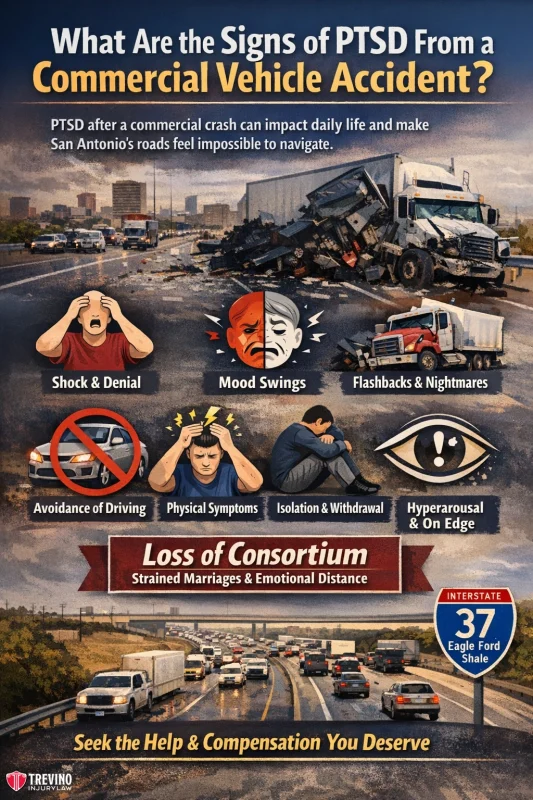
The terror of the impact can rewire the brain’s threat-response system, making a simple commute past Eagle Ford Shale traffic on I-37 a paralyzing experience.
Recognizing the clinical signs of trauma is essential for getting proper treatment and compensation. The 7 signs of trauma most frequently observed in crash survivors include intense shock or denial immediately after the event, unpredictable mood swings that strain family relationships, flashbacks or intrusive thoughts of the crash, avoidance of driving or specific locations, physical symptoms like headaches or nausea when stressed, feelings of isolation, and hyperarousal or being constantly “on guard.”
This state of constant vigilance often leads to “Loss of Consortium,” straining marriages as the victim withdraws emotionally from their spouse and children.
Do Injuries Decrease Your Lifespan?
Yes, catastrophic injuries like spinal cord damage or severe TBI are statistically proven to reduce life expectancy due to secondary complications like infections, organ failure, and mobility-related diseases. When we calculate damages, we must account for these “lost years” to ensure your family is compensated not only for the quality of your life but also for the time you lost.
This is distinct from a Wrongful Death claim; it is a recognition that the injury itself has fundamentally shortened the biological timeline of the survivor, a cost that the trucking company’s insurance must pay.
To recover these substantial costs, we must move beyond medical diagnoses and use specific legal frameworks to quantify pain and suffering in dollar terms.
How Much Money Do You Get for Pain and Suffering in a Commercial Accident?
There is no fixed calculator, but pain and suffering in commercial cases is often calculated using a “multiplier method,” ranging from 1.5 to 5 times your economic damages, depending on the severity of the permanent impairment.
While the main hub mentions settlement averages, determining the value of your specific agony requires a deeper look at how San Antonio juries evaluate non-economic damages. Because commercial policies typically carry limits of $1 million or more, unlike standard auto policies, there is actual financial room to demand compensation that reflects the true human cost of the injury.
Insurance adjusters will initially offer a “nuisance value,” a small sum intended to make you go away, arguing that your pain is subjective and unprovable. We counter this by presenting the “multiplier” argument: if your medical bills and lost wages (economic damages) total $200,000, and you have suffered a life-altering TBI, we argue for a 4x or 5x multiplier, seeking $800,000 to $1 million for the pain alone.
Calculating these damages requires precise legal distinctions. As clarified by the Texas Supreme Court in Golden Eagle Archery, Inc. v. Jackson, ‘physical impairment’ encompasses the loss of enjoyment of life and the inability to participate in activities, which is a separate category of damages from ‘pain and suffering.’ We use this precedent to ensure you are compensated not just for the physical pain you feel, but distinctly for the life activities you have lost.
To compel the insurance company to accept these high multipliers, we rely on a comprehensive medical-economic report that projects all future costs in black and white.
How Does a Life Care Plan Calculate Long-Term Costs?
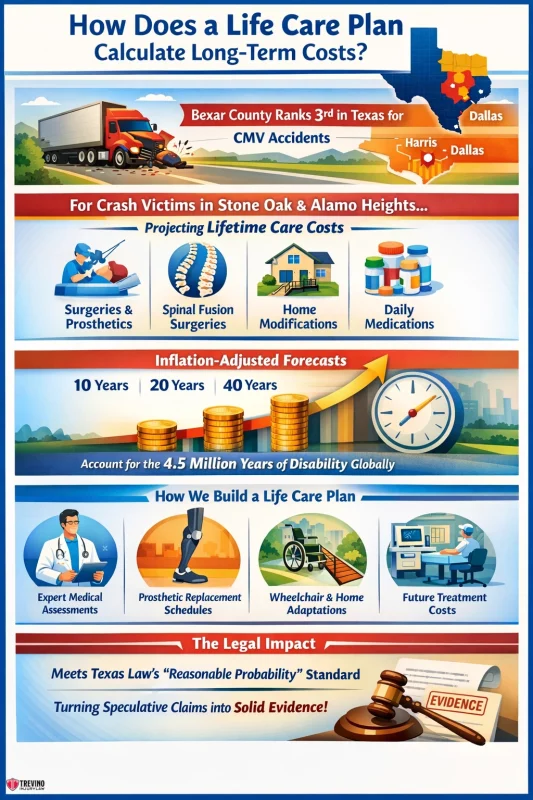
To combat the “nuisance value” offers from insurance adjusters, we utilize a Life Care Plan to quantify the long-term needs of Bexar County crash victims. This is critical, given that Bexar County ranks third in Texas for CMV accidents, trailing only Harris and Dallas.
For a victim in Stone Oak or Alamo Heights facing a lifetime of care, this plan forecasts inflation-adjusted costs for surgeries and prosthetics, ensuring the corporation remains liable for the 4.5 million years of life lived with disability that spinal injuries represent globally.
Unlike a simple stack of past medical bills, this document forecasts the inflation-adjusted cost of care you will need in 10, 20, or 40 years. It serves as the “silver bullet” against insurance low-ball offers, shifting the negotiation from vague “pain” to concrete economic data.
To build this plan, we collaborate with medical experts who map out specific needs: replacement schedules for prosthetics (which often wear out every 3-5 years), costs for future spinal fusion surgeries, home modifications like wheelchair ramps, and daily medication requirements.
Does an Accident in a Commercial Vehicle Affect Insurance?
Because of the sheer size and weight of commercial trucks compared to passenger cars, the resulting severe injuries lead to much higher claims. This creates a massive long-term financial risk for insurers. It is vital to understand your legal rights immediately following a crash involving commercial fleets, as insurance adjusters often attempt to settle quickly before the full scope of long-term consequences is known.
How Long Do Commercial Vehicle Accidents Stay on Your Record?
For a professional truck driver, these records are critical. A serious infraction can prevent a driver from returning to work for years. Furthermore, if the accident resulted in severe injuries or fatalities, the incident may stay on a background check indefinitely, impacting future employment opportunities.
What Injuries Never Fully Heal?
Injuries involving avascular tissue (like spinal discs) or the central nervous system (brain and spinal cord) do not regenerate, meaning “healing” is actually just “symptom management” rather than a cure.
While a broken bone typically heals stronger than before, soft-tissue damage to the spine or brain results in scar tissue that is weaker and less flexible than the original tissue. This biological reality means that “recovery” is a misnomer for many commercial crash victims.
Doctors use the term Maximum Medical Improvement (MMI) to indicate the point at which medical treatment can no longer improve, but this often leaves the patient with permanent limitations.
For example, a herniated disc may stop hurting acutely after injections, but the structural weakness remains, leaving you vulnerable to future re-injury from minor activities. Understanding the difference between “healing” (restoration) and “stabilizing” (stopping the decline) is critical when evaluating a settlement offer.
What Happens If You Settle Before Identifying Latent Injuries?
If you sign a release of liability before a latent injury like a TBI manifests, you are permanently barred from seeking additional compensation, leaving you personally responsible for hundreds of thousands of dollars in future medical bills.
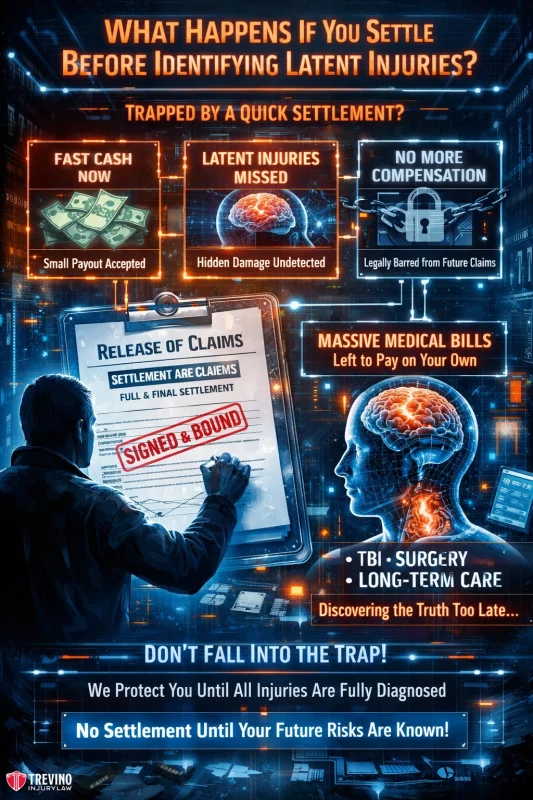
Insurance adjusters push for “quick cash” settlements within days of the crash, specifically to trap you before these slow-developing symptoms appear. Once you sign the document, it is legally binding, regardless of any new medical problems that arise a month later.
This “Release of Claims” trap is the single biggest risk for unrepresented victims. We often see clients who accepted a few thousand dollars for “soreness,” only to discover six months later that they need a $50,000 neck surgery. By then, it is too late.
We prevent this by ensuring that no settlement is considered until your doctors provide a final prognosis report confirming that your condition has fully stabilized and that all future risks have been identified. Those future medical needs are only one part of claim valuation. For the broader damages, fault, lien, and negotiation framework, see how commercial accident settlements are calculated in Texas.
In Texas, the two-year Statute of Limitations generally applies, but the “Discovery Rule” may occasionally extend this deadline if the injury was inherently undiscoverable at the time of the crash.
However, relying on this exception is incredibly risky; Texas courts are strict, and insurance defense teams will argue that you “should have known” about the injury sooner if you had sought proper medical care.
The safest legal strategy is to file suit well within the standard two-year window, even if the full extent of the injury is still being diagnosed. Waiting until the last minute and hoping for a “Discovery Rule” extension often results in dismissal.
If you are experiencing new symptoms months after a wreck involving a delivery van or semi-truck, you must act immediately to preserve your rights before the clock runs out on your claim.
Why Hire a San Antonio Commercial Vehicle Accident Lawyer?
A crash on Loop 410 masks trauma, allowing insurers to trap victims in lowball releases. Settlement mills help them by offering quick payouts. We refuse to fold. Trevino Injury Law acts as your Trial Lawyer, forcing companies to pay for your lifetime of care.
Want to Protect the Full Value of Your Claim?
You’ve seen how this affects your case — but this is only one piece of the puzzle. Our Commercial Vehicle Lawyer page breaks down what a trial-ready firm does differently.
We secured a $17 million settlement by uncovering negligence others missed. We demand total accountability in Bexar County courts. You need a San Antonio personal injury crash lawyer to immediately send spoliation letters and preserve black box data.
Call 210-TREVINO for a free case review. Se Habla Español. We work on a No-Win, No-Fee basis