Texas car accident compensation is calculated by mathematically aggregating incurred financial costs, projecting future losses, and adding a substantiated value for subjective suffering. The at-fault driver’s insurance pays this lump sum only after you sign a final release.
The insurance adjuster already uses discounted algorithms to pin most of the blame on you. Their objective is to shift the fault and deny the claim entirely. According to internal firm records, aggressive litigation strategies secure judgments 107 times higher than artificially reduced initial offers. Corporations profit by pressuring victims into cheap payouts before future surgery costs materialize.
What Could Your Car Accident Case Be Worth?
Answer a few quick questions about your accident. Takes about 60 seconds.
See What My Case Might Be WorthThe insurance company offered less than $20,000. I ended up with over $1 million. — Jackie Galindo
You must establish claim value with rigorous damage models before the adjuster dictates the terms. A Spoliation Letter, a legal demand that stops the negligent party from destroying evidence, must be sent immediately. Texas gives you two years to file a lawsuit before the claim vanishes.
Trevino Injury Law’s car accident attorney demands a forensic valuation that accounts for every future cost and forces insurers to pay your lifetime damages. Call 210-TREVINO now for a free case review. You pay nothing unless we win. Se Habla Español.
The Calculation Formula: How We Determine “Total Damages”
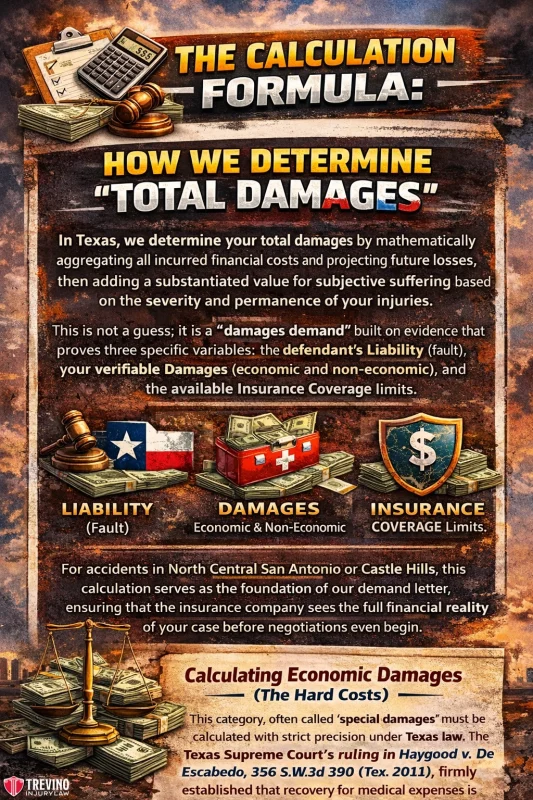
In Texas, we determine your total damages by mathematically aggregating all incurred financial costs and projecting future losses, then adding a substantiated value for subjective suffering based on the severity and permanence of your injuries.
This is not a guess; it is a “damages demand” built on evidence that proves three specific variables: the defendant’s Liability (fault), your verifiable Damages (economic and non-economic), and the available Insurance Coverage limits.
For accidents in North Central San Antonio or Castle Hills, this calculation serves as the foundation of our demand letter, ensuring the insurance company recognizes the full financial reality of your case before negotiations begin.
Calculating Economic Damages (The Hard Costs)
This category, often referred to as ‘special damages,’ must be calculated with strict precision under Texas law. The Texas Supreme Court’s ruling in Haygood v. De Escabedo, 356 S.W.3d 390 (Tex. 2011), firmly established that recovery for medical expenses is limited to the amounts ‘actually paid or incurred’, meaning the discounted rates insurers pay, not the higher ‘list prices’ hospitals bill.
Therefore, accurately determining your economic damages requires forensic verification of exactly what is legally recoverable, ensuring your demand reflects the ‘paid vs. incurred’ reality that adjusters will inevitably use against you.
Quantifying Non-Economic Damages (The Human Variable)
Non-economic damages are quantified by assigning a financial value to subjective losses such as pain, suffering, and mental anguish, often using the “Multiplier Method” (1.5x to 5x your economic damages) or the “Per Diem” (daily rate) method, whichever yields a fairer result for the client.
While economic damages cover your bills, this calculation compensates you for the intangible impact of the crash. As the Texas Supreme Court recognized in Golden Eagle Archery, Inc. v. Jackson, 116 S.W.3d 757 (Tex. 2003), non-economic damages such as pain, suffering, and mental anguish are subjective and ‘necessarily speculative,’ granting juries broad discretion to assign a monetary value to your physical and emotional trauma.
Because there is no fixed mathematical standard, we must present compelling, distinct evidence for each category of loss to substantiate your claim in the eyes of the law.
Insurance adjusters aggressively fight these numbers because they are subjective, which is why we substantiate them with testimony from family, friends, and mental health professionals who can attest to the daily reality of your trauma.
Establishing the gross value of your claim through these calculations is the first step, but understanding the legal factors that actively reduce that number is equally critical to knowing what you will actually receive.
The Reductions: Factors That Lower Your Final Payout
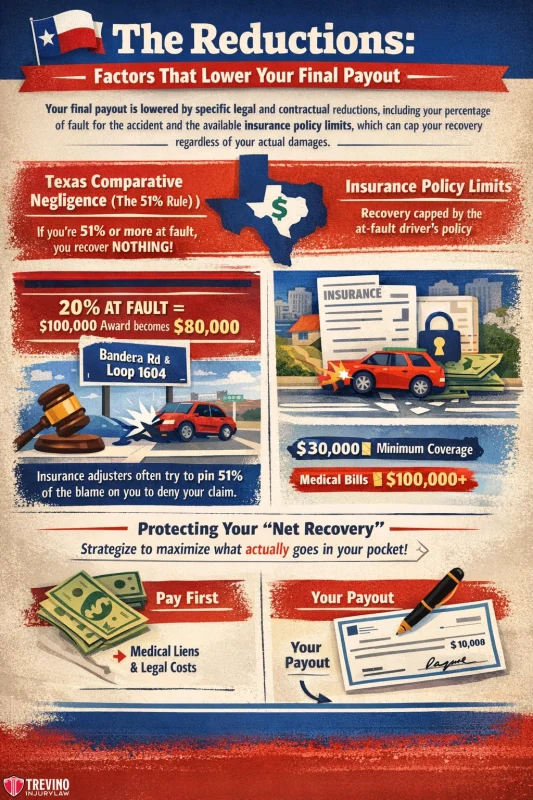
Your final payout is lowered by specific legal and contractual reductions, including your percentage of fault for the accident and the available insurance policy limits, which can cap your recovery regardless of your actual damages.
It is a harsh reality of Texas personal injury law that the “gross settlement” figure is rarely the amount printed on the check you deposit. For a family in Stone Oak dealing with a catastrophic injury, understanding these reductions is vital to managing expectations and strategizing on how to protect the “net recovery” that actually goes into your pocket.
Texas Comparative Negligence (The 51% Rule)
The Texas 51% Bar Rule mandates that your compensation be reduced by your percentage of fault, and if you are found to be more than 50% responsible for the crash, you are barred from recovering any damages whatsoever.
This means if a jury finds you 20% at fault for a collision at a busy intersection like Bandera Road and Loop 1604, your $100,000 award is immediately reduced to $80,000.
Insurance adjusters will frequently try to pin 51% of the blame on you during the initial investigation to avoid paying a dime, making it essential to have evidence that clearly establishes the other driver’s majority fault. For a specific application of comparative-fault arguments, see our Texas seatbelt-defense guide, which focuses on claims involving alleged seatbelt non-use.
Insurance Policy Limits
Insurance policy limits act as a hard ceiling on your recovery, meaning that if the at-fault driver only carries the state minimum of $30,000 for bodily injury, that is likely the maximum you can recover from their insurer, even if your medical bills exceed $100,000.
In Bexar County, where many drivers are underinsured, this often forces us to trigger your own Underinsured Motorist (UIM) coverage to bridge the gap. We meticulously investigate all potential coverage layers, including commercial and umbrella policies, to ensure that a policy limit on paper does not prevent you from being made whole.
While policy limits and liability percentages determine how much money is theoretically available, the actual logistics of who cuts the check and who gets paid back first can further complicate when and how you receive your funds.
How Are Rear-End Collision Settlements Valued in Texas?
Rear-end settlements use the same damages formula as any car accident claim, but liability is usually easier to prove. Texas Transportation Code Section 545.062 requires drivers to keep a safe distance behind the vehicle ahead, so the rear driver is often found at fault.
Fault is not automatic. Insurers may argue that the lead driver stopped suddenly, had broken brake lights, or cut in, and any share of fault assigned to you reduces your recovery under the 51 percent rule. Adjusters also point to low property damage to claim injuries are minor, which is why medical causation evidence carries so much weight.
Why Do Insurers Deny or Delay Car Accident Claims?
Insurers deny or delay car accident claims when they can question coverage, fault, or whether the crash caused your injuries. Common reasons include:
- Coverage problems: the at-fault driver’s policy lapsed, excludes that driver, or does not cover the loss.
- Disputed fault: the adjuster argues that you caused or contributed to the crash.
- Disputed causation: the insurer claims your injuries were pre-existing or too minor to result from the impact.
- Gaps in evidence: missing photos, witness statements, or medical records weaken the link between the crash and your losses.

What you say also matters. Adjusters often ask for a recorded statement soon after the crash, and comments such as “I’m fine” or a guess about your speed can later be used to reduce your claim. You are generally not required to give a recorded statement to the other driver’s insurer. If your own insurer mishandles a covered claim, Chapters 541 and 542 of the Texas Insurance Code provide remedies for unfair claim practices and late payment.
The Payment Logistics: Who Pays and When?
Payment for a car accident claim typically comes from multiple sources at different times, with immediate coverage like PIP paying initial bills and the at-fault driver’s liability insurance paying a lump sum settlement only after you sign a final release of claims.
This staggered timeline confuses many victims in Universal City and Live Oak, who assume the other driver’s insurance will pay medical bills as they come in; in reality, the insurance pays nothing until the very end. Understanding this money flow is essential to maintaining your credit score while your legal team fights for the primary settlement.
Immediate vs. Final Payments
Immediate payments for medical bills and lost wages are available through your own Personal Injury Protection (PIP) or MedPay coverage, which pays out regardless of fault, whereas the final liability settlement covers the remaining damages and is paid as a single lump sum at the conclusion of the case.
Using a PIP allows you to treat your injuries now, without waiting for the liability investigation to be resolved. Pulling from the E-E-A-T Authority Document, we advise clients to utilize these “no-fault” benefits immediately to prevent collections, knowing that these amounts do not reduce the final liability settlement you are owed by the defendant.
The Role of Subrogation and Medical Liens
Subrogation and medical liens give health insurers, hospitals like Mission Trail Baptist, and government entities the legal right to be reimbursed for medical bills they paid on your behalf out of your final settlement funds. This process, known as subrogation, can take a significant portion of your settlement if not managed correctly.
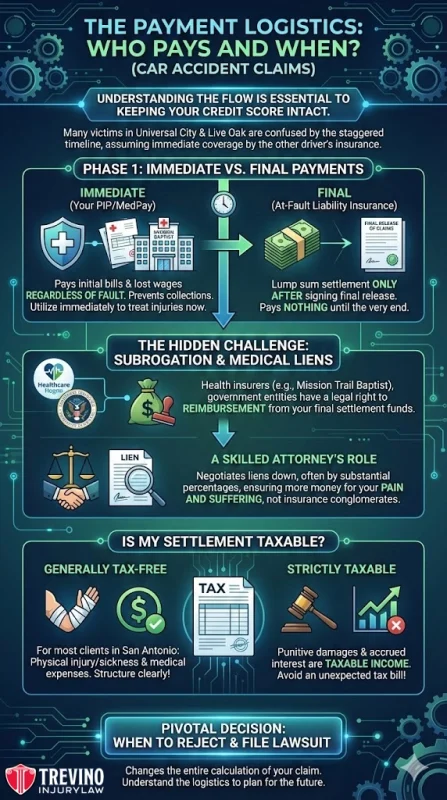
A skilled attorney’s job is to negotiate these liens down, often reducing them by substantial percentages to ensure that the money meant for your pain and suffering doesn’t just pass through your hands to an insurance conglomerate.
Who Pays for the Ambulance After a Car Accident?
The at-fault driver’s liability insurer is ultimately responsible for your ambulance bill, because emergency transport is part of your medical expenses. That payment usually arrives at settlement, so another source often covers the bill first:
- Personal injury protection (PIP): Texas insurers must offer PIP with every auto policy, and it pays regardless of fault unless you rejected it in writing.
- MedPay: optional medical payments coverage, if you purchased it.
- Health insurance: subject to your copay and deductible.

Any source that pays first may seek reimbursement from your settlement through subrogation. Emergency medical services providers can also file a lien against your personal injury recovery under Chapter 55 of the Texas Property Code, so an unpaid ambulance bill should be resolved before your case closes, not ignored.
Is My Car Accident Settlement Taxable?
Generally, the IRS does not tax settlement money designated for “physical injury or physical sickness” and medical expenses, but any portion of the award designated for punitive damages or accrued interest is strictly taxable income.
For most clients in San Antonio, the bulk of their compensatory damages will be tax-free, preserving the settlement’s value. However, it is crucial to structure the settlement agreement clearly to distinguish between compensatory and punitive damages to avoid an unexpected tax bill next April.
While understanding the logistics of payment helps you plan for the future, knowing when to reject a settlement offer and file a lawsuit is the pivotal decision that changes the entire calculation of your claim.
How Are Car Accident Settlements Handled When a Child Is Injured?
A child’s car accident settlement must be approved by a Texas court before it is final. Because a minor cannot sign a binding release, a parent or guardian brings the claim as the child’s next friend, and a judge reviews the proposed settlement at a short hearing often called a friendly suit.
The court usually appoints a guardian ad litem to confirm that the settlement serves the child’s interests. Approved funds are typically deposited in the registry of the court or placed in a court-created management trust until the child turns 18.
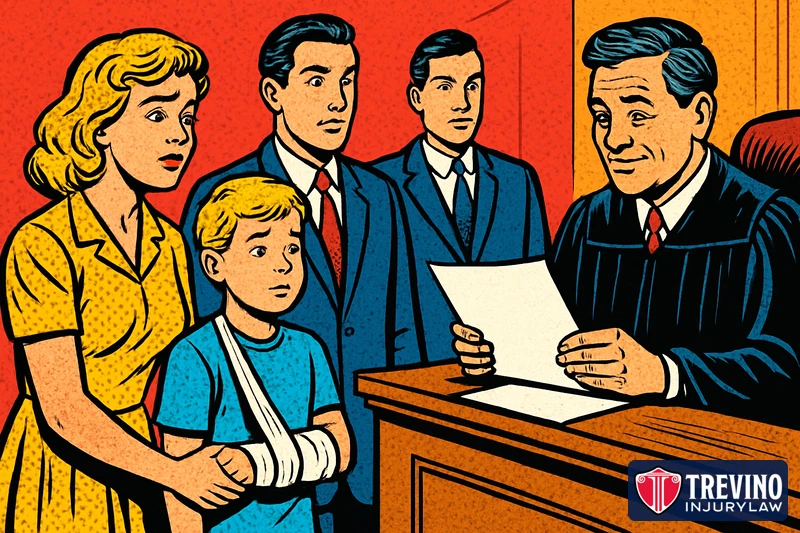
The child’s own claim covers pain, mental anguish, physical impairment, disfigurement, and loss of future earning capacity. Medical bills incurred before the child turns 18 generally belong to the parents’ claim, as our guide on who is responsible for a minor’s medical bills explains. The two-year filing deadline generally does not begin to run until the child turns 18, but evidence fades quickly, so waiting rarely helps the claim.
Settlement vs. Trial: How Litigation Changes the Calculation
Litigation fundamentally alters the compensation calculation by replacing the insurance adjuster’s “settlement offer” cap with the possibility of an unlimited jury verdict, though this increase in potential value comes with higher upfront costs, extended timelines, and the inherent risk of a courtroom trial.
When an insurer refuses to offer fair value, filing a lawsuit in the Bexar County District Courts removes their control over the process and forces them to evaluate the risk of a jury in Downtown San Antonio awarding you far more than their policy limits.
For many victims, this shift from “negotiation” to “litigation” is the only way to break a stalemate and secure compensation that truly covers lifetime damages.
The Cost-Benefit Analysis of Filing Suit
Filing a lawsuit becomes financially worth the effort when the insurance company’s “top offer” is insufficient to cover your future medical needs or lost earning capacity, effectively forcing them to spend money defending the case rather than simply denying your claim.
While litigation increases case expenses, paying for depositions, expert witnesses, and court fees, it also triggers the insurer’s duty to defend their driver, often prompting them to increase their offer to avoid the uncertainty of trial.
For a resident of Helotes facing a lifetime of back pain, the cost of hiring a forensic expert to prove those future damages is an investment that yields a significantly higher net recovery than accepting a low-ball initial offer.
How Long Until I Get Paid?
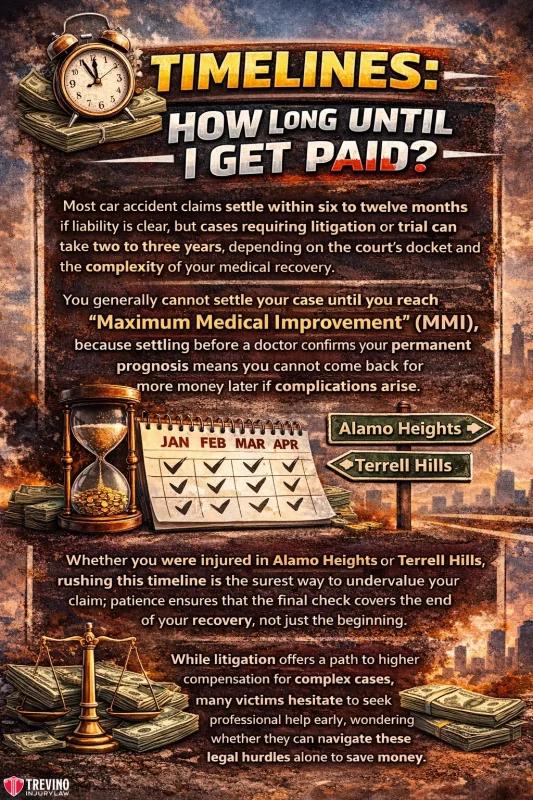
Most car accident claims settle within six to twelve months if liability is clear, but cases requiring litigation or trial can take two to three years, depending on the court’s docket and the complexity of your medical recovery.
You generally cannot settle your case until you reach “Maximum Medical Improvement” (MMI), because settling before a doctor confirms your permanent prognosis means you cannot come back for more money later if complications arise.
Whether you were injured in Alamo Heights or Terrell Hills, rushing this timeline is the surest way to undervalue your claim; patience ensures that the final check covers the end of your recovery, not just the beginning.
While litigation can lead to higher compensation in complex cases, many victims hesitate to seek professional help early, wondering whether they can navigate these legal hurdles on their own to save money.
Do I Need a Lawyer to Calculate My Claim?
Yes, you generally need a lawyer to calculate your claim because insurance adjusters use software designed to minimize payouts, whereas an attorney uses forensic experts to substantiate the full lifetime cost of your injuries.
Without professional valuation, victims in Hollywood Park or Shavano Park often accept offers that cover immediate bills but fail to account for future surgeries or lost earning potential, effectively paying for the accident out of their own retirement savings.
We counter their low estimates with “Life Care Plans” and economic reports that provide irrefutable proof of the true damages, forcing the insurer to negotiate based on reality rather than their discounted algorithms.
Does the insurance adjuster represent my best interests?
No, the insurance adjuster represents the company’s shareholders and is professionally incentivized to settle your claim for the lowest possible amount.
Their primary goal during settlement negotiations is to minimize the final settlement amount, often preventing car accident victims from getting a fair settlement that fully covers the true cost of their personal injury claim.
Are online car accident settlement calculators accurate?
No, online calculators are marketing tools that cannot account for complex legal variables like comparative negligence, policy limits, or local venue risks.
These tools often provide a generic average car accident settlement figure that fails to evaluate the specific severity of your injuries or every type of damage you incurred, such as lost income.
Furthermore, algorithms cannot properly apply the per diem method to calculate the amount of pain and suffering, resulting in a misleading settlement value that insurers will never honor.
Can I ask for more money after I accept an offer?
No. Once you accept an offer and sign a release, you permanently waive your right to seek any further compensation for that accident.
This means you cannot request additional compensation in a car accident claim later, even if you discover severe injuries that result in chronic physical pain or a permanent loss of enjoyment of life.
To avoid this, it is critical to consult a car accident attorney before signing any documents, ensuring you do not forfeit your right to file a personal injury lawsuit for the full value you deserve.
Settlement Release vs. Jury Verdict: Which Pays More?
A jury verdict generally pays more than a settlement release because it is not capped by the insurer’s negotiation tactics, but it carries the risk of receiving nothing if the jury rules against you.
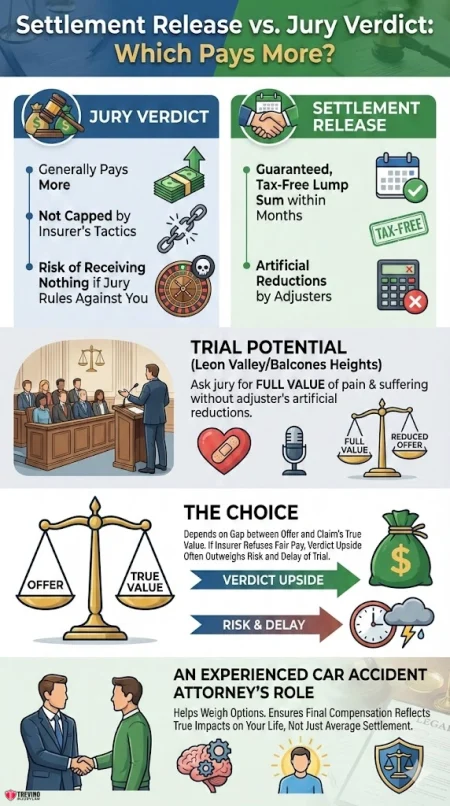
While a settlement provides a guaranteed, tax-free lump sum within months, a trial in Leon Valley or Balcones Heights allows us to ask a jury for the full value of your pain and suffering, without the artificial reductions adjusters often impose.
The choice depends on the gap between the offer and the claim’s true value; if the insurer refuses to pay a fair amount, the potential upside of a verdict often outweighs the risk and delay of trial.
An experienced car accident attorney can help you weigh these options, ensuring that the final amount of compensation reflects the true impacts of a car accident on your life, rather than just the average settlement amount the insurance company wants to pay.
What If I Don’t Have a Lawyer to Verify the Calculation?
If you do not have a lawyer to verify the calculation, you risk accepting a “nuisance value” offer that is mathematically insufficient to cover your long-term medical needs and financial losses.
Without legal counsel to identify hidden damages like lost 401(k) contributions or future arthritis treatment, victims in Windcrest often leave tens of thousands of dollars on the table, essentially subsidizing the insurance company’s profits with their own uncompensated pain.
The absence of a forensic evaluation allows the adjuster to dictate the terms, leaving you with no leverage to demand the compensation you actually deserve. Furthermore, without a personal injury law firm to advocate for you, it is difficult to accurately determine the average value of your specific claim or prove how settlement amounts can vary based on injury severity.
A personal injury attorney can help you avoid these pitfalls, ensuring you receive the compensation for your pain and suffering that you are owed.
What If I Sign a Settlement Release Too Early?
Signing a release while being treated at Brooke Army Medical Center (BAMC) is exactly what insurance adjusters want you to do. Whether you are filing a personal injury claim after an auto accident or a severe truck accident, corporate giants profit by pressuring you into cheap, early payouts before you understand exactly what your injury will require in terms of long-term care.
We don’t fold; we help you calculate the full value of your economic and non-economic damages, ensuring you receive the compensation you may be entitled to rather than accepting a low-ball first settlement offer.
Our trial strategy has secured judgments 107 times higher than the initial offer, effectively maximizing settlement potential even when insurers try to shift blame for the accident or dispute the accident date.
Hire a San Antonio car accident lawyer to manage every aspect of your car accident case, demanding a forensic valuation that accounts for every future surgery your accident injuries will necessitate.
Why Hire a San Antonio Car Accident Lawyer?
Securing compensation after a Loop 410 crash is a complex financial battle. Corporate adjusters and high-volume settlement mills profit by pressuring victims into cheap payouts. Trevino Injury Law does not fold. We fight for families and force insurers to pay your lifetime costs.
Want to Protect the Full Value of Your Claim?
You’ve seen how this affects your case — but this is only one piece of the puzzle. Our Car Accident Lawyer page breaks down what a trial-ready firm does differently.
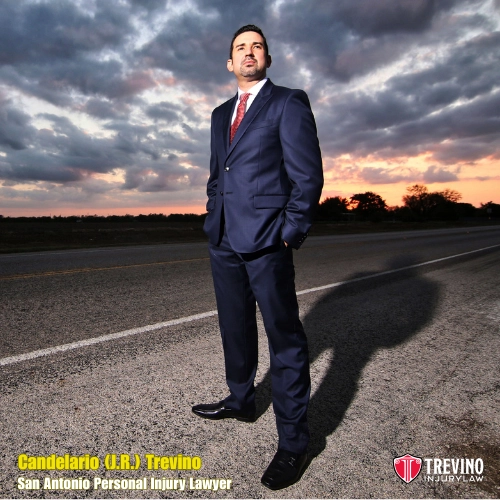
Our trial strategy secures record verdicts at the Bexar County Courthouse, achieving judgments 107 times higher than initial offers. To demand a forensic valuation of future surgeries, hire a San Antonio personal injury attorney to manage your case.
Call 210-TREVINO for a free case review. Se Habla Español. You pay nothing unless we win—our “No Win, No Fee” promise.