Yes, in Texas, failing to wear your seatbelt does not prevent you from filing an injury claim or holding a reckless driver accountable for causing a crash.
Most people start by filing an insurance claim, but when the adjuster weaponizes the seatbelt defense to devalue or deny what you’re owed, the only path to a real remedy is a lawsuit filed under Texas Civil Practice and Remedies Code Chapter 33.
Under that framework, seatbelt non-use is treated as a question of injury responsibility, not crash causation, which means you can still recover damages as long as your share of fault is 50% or less.
What Could Your Car Accident Case Be Worth?
Answer a few quick questions about your accident. Takes about 60 seconds.
See What My Case Might Be WorthThe insurance company offered less than $20,000. I ended up with over $1 million. — Jackie Galindo
According to the Texas Department of Transportation, the state recorded 1,076 unrestrained fatalities in 2025. Insurers exploit this data to automatically brand you as the negligent party, twisting shared injury responsibility into total crash causation.
Black box data proving the other driver’s speed gets erased quickly. A Spoliation Letter, a legal demand that requires the defendant to stop destroying Event Data Recorder information, must be sent immediately. Texas gives you two years to file, but waiting destroys the physical evidence needed to prove the impact forces caused your trauma.
At Trevino Injury Law, our car accident attorneys dismantle this defense and hold carriers accountable for their drivers’ recklessness. Call 210-TREVINO for a free case review. You pay nothing unless we win. Se Habla Español.
Texas Seatbelt Defense in Car Accident Lawsuits: Key Takeaways
- As your San Antonio personal injury lawyer, we dismantle the seatbelt defense used to devalue claims on corridors like Culebra Road.
- The firm uses forensic evidence to prove that the defendant caused the crash on roads such as Loop 410 in Bexar County.
- Trevino Injury Law minimizes your assigned fault percentage by proving the crash forces caused your harm, not your seatbelt choice.
- Proportionate Responsibility allows you to recover damages as long as your share of fault is 50% or less under Texas Civil Practice and Remedies Code Chapter 33.
Texas Proportionate Responsibility and the 51% Bar Rule for Seatbelt Non-Use
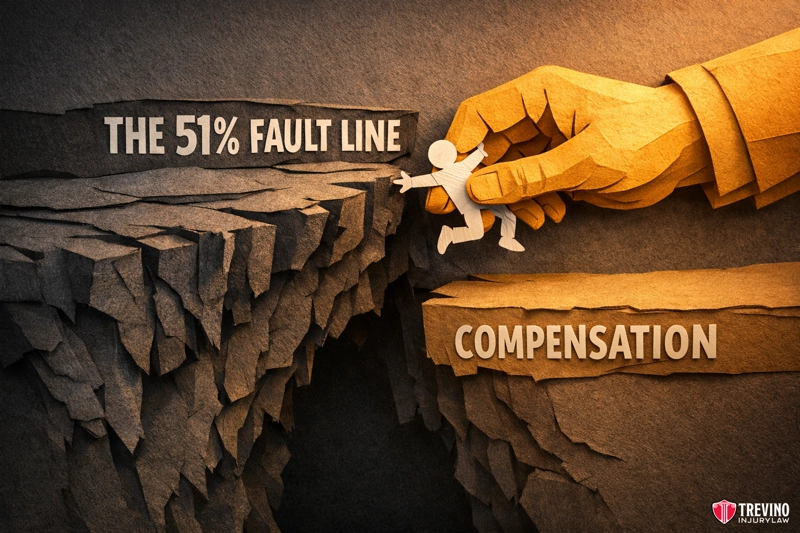
Texas applies a modified comparative negligence standard called Proportionate Responsibility, codified in Texas Civil Practice and Remedies Code Chapter 33. Under the 51% Bar Rule, you can recover damages for your medical bills and lost wages as long as your share of responsibility for your injuries is 50% or less. If a jury assigns you 51% or more, your recovery is barred entirely.
Insurance adjusters exploit this framework through what’s called the seatbelt defense, a strategy designed to push your assigned fault percentage as close to that 51% bar as possible. Insurers deploy this aggressively because the statistical correlation between non-use and injury severity is high; in 2025 alone, there were 1,076 unrestrained fatalities recorded across the state (TxDOT, 2025). They argue your injuries are your own fault simply because you weren’t wearing a belt.
Here’s how this plays out in practice: if a Bexar County jury awards you $100,000 but assigns you 30% fault for not buckling up, you receive $70,000. If they assign you 51%, you receive nothing. Our job is to keep that percentage as low as possible by proving the violence of the impact would have caused catastrophic injuries regardless of seatbelt usage.
The Texas Supreme Court cemented this standard in Nabors Well Services, Ltd. v. Romero, 456 S.W.3d 553 (Tex. 2015). The Court ruled that while evidence of seatbelt non-use is admissible to determine responsibility for the injuries, it does not absolve a negligent driver of liability for causing the accident.
This means that even if a jury finds you shared some fault for your injuries, the driver who ran the red light on Culebra Road remains liable for their reckless actions.
How Adjusters Use the “Seatbelt Defense” to Shift Liability
The “Seatbelt Defense” is a tactic in which adjusters argue that your injuries would have been minor or nonexistent if you had followed the law and worn a seatbelt. Insurance companies like Geico or Progressive use this argument to claim you “failed to mitigate damages,” effectively trying to shift blame from their negligent driver to you.
To support this defense, insurers retain biomechanical experts who testify that a seatbelt would have prevented your specific injuries. They argue that your broken bones or head trauma resulted solely from ejection or interior impact, a belt would have stopped. We counter this by retaining our own experts to demonstrate the immense forces involved in the collision, proving that the crash itself, not the lack of a belt, was the primary cause of your suffering.
Understanding how responsibility is shared is critical, but we must also distinguish between who caused the crash and who caused the injury.
Does Not Wearing a Seatbelt Mean I Caused the Accident?
No, failing to wear a seatbelt does not cause a car crash; it only potentially affects the severity of the injuries sustained during the collision. The act of not buckling up does not make a driver run a red light, speed, or text while driving, meaning the negligence that caused the impact remains with the driver who violated traffic laws.
This is the “Causation Pivot” we use in litigation. If a drunk driver runs a red light on Loop 410 and slams into your vehicle, they caused the accident. Your seatbelt status is irrelevant to the cause of the collision itself. We fight to ensure the jury understands that the defendant’s negligence is the sole cause of the crash.
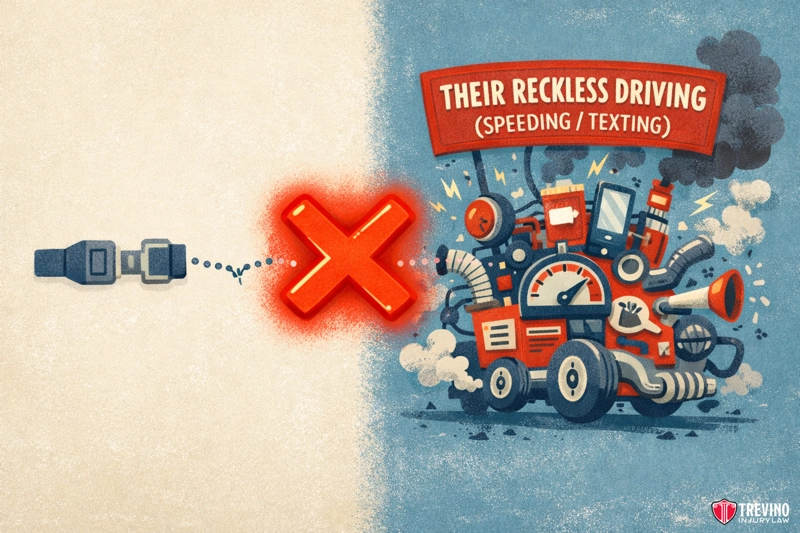
Distinguishing between “Crash Causation” (them) and “Injury Causation” (shared) is vital. Insurance adjusters try to blur this line to confuse you, but we keep the focus on the defendant’s reckless actions that led to the impact.
How Do We Prove the Other Driver Caused the Crash Despite Your Seatbelt Status?
We utilize accident reconstruction experts and electronic data to prove the defendant’s actions were the primary cause of the impact, regardless of whether you were buckled up. By scientifically reconstructing the accident sequence, we can demonstrate that the collision was unavoidable due to the other driver’s negligence.
To build this proof, we focus on preserving objective evidence immediately after the wreck. This includes:
- Black Box Data: We send spoliation letters to preserve the Event Data Recorder (EDR) information from the defendant’s vehicle, which shows speed and braking patterns.
- Physical Evidence: We analyze skid marks and debris fields on roads like I-37 to establish the point of impact.
- Witness Testimony: We secure statements from bystanders who saw the defendant’s reckless driving.
Even if you were unbuckled, if an 18-wheeler rear-ends you on a highway, their failure to stop is the primary negligence that dictates liability.
We have established that you didn’t cause the crash, but now we must address the specific financial consequences of the seatbelt argument.
How Much Does Not Wearing a Seatbelt Reduce Your Settlement?
Your settlement will be reduced by the exact percentage of fault a jury assigns to you for the failure to wear a seatbelt, known as comparative negligence. There is no fixed “ticket price” or standard deduction for this; the reduction depends entirely on how much the jury believes your non-use contributed to the severity of your specific injuries.
In a minor fender bender, the reduction might be 0% if the injuries are unrelated to seatbelt use. However, in a rollover ejection on I-35, a jury could find that the lack of a restraint contributed significantly to the harm, potentially reducing the award by 40% or more.

Trevino Injury Law aims to minimize this percentage by showing the violence of the crash would have injured you even with a belt. We use medical experts to prove that the forces involved were so severe that a seatbelt would not have prevented the primary trauma.
What Evidence Proves Seatbelt Use in a Car Accident?
Physical evidence from the vehicle’s Event Data Recorder (EDR) and specific bruising patterns often provides definitive proof of seatbelt use. Insurance companies will look for these indicators immediately to try to catch you in a lie or prove their defense.
We proactively investigate this evidence to protect your credibility. The most common forms of proof include:
- Loading Marks: Friction burns or melting on the seatbelt webbing that indicate it locked up under stress.
- EDR Data: The vehicle’s “black box” records whether the buckle switch was engaged at the time of impact.
- Seatbelt Sign: Distinctive diagonal bruising across the chest and hips caused by the restraint during a high-speed crash.
The adjuster claims you weren’t wearing it, but physical evidence is often the only way to settle the dispute definitively. For a broader guide to documenting the scene and preserving crash evidence, follow the San Antonio car accident steps guide. If a factual detail in the police report conflicts with the physical evidence you preserved, review the process for correcting a factual mistake on a San Antonio CR-3 crash report before relying on the report in an insurance dispute.
Is It Worth Hiring a Lawyer if I Wasn’t Wearing a Seatbelt?
Yes, hiring a trial attorney is even more critical when you were not wearing a seatbelt because insurance companies often attempt to deny your entire claim by unfairly shifting the blame onto you. An experienced lawyer prevents them from assigning you 51% of the fault, ensuring you remain eligible for financial compensation under Texas’s comparative fault laws.
Without a trial-ready law firm, insurers like Fred Loya or USAA (headquartered here in San Antonio) will almost certainly argue that your negligence was the primary cause of your injuries. This argument is particularly prevalent in our community, where the observed seatbelt usage rate of 86.9% trails the statewide average of 90.0%, giving insurers more opportunities to allege comparative fault here than elsewhere (TTI, 2025). Their goal is to convince the jury that you are more than 50% at fault, which would legally stop you from filing a claim or receiving a single dollar.
We use a “Scholar Warrior” approach to dismantle this strategy. By combining deep knowledge of San Antonio Bexar County court precedents with forensic crash data, we scientifically prove that the violence of the impact—caused by their driver—was the true source of your suffering. Experienced car accident lawyers can help ensure you are compensated for your medical bills and lost wages, rather than being penalized for a safety violation that didn’t cause the crash.
While securing the right representation protects your financial recovery, understanding the specific laws for passengers and children is equally important for establishing the full scope of liability.
What Are the Texas Seatbelt Laws for Passengers vs. Drivers?
Texas law requires all vehicle occupants, including drivers and passengers, to wear a seatbelt while the vehicle is in motion. While violating this statute constitutes “negligence per se” in traffic court, it does not automatically invalidate your civil claim for injuries; it merely establishes that a duty was breached, which the jury must then weigh against the other driver’s negligence.
In San Antonio, receiving a citation from the San Antonio Police Department for “Fail to ID – Seatbelt” does not mean you caused the crash. While the statutory fine for an adult offense is relatively low—ranging from $25 to $50—our job is to prevent the insurance adjuster from treating this ticket as proof that you deserve zero compensation for the life-altering injuries caused by their client’s reckless driving on Bandera Road (Texas Legislature, 2025).
When Did It Become Law to Wear a Seatbelt in Texas?
Texas first required seatbelts in 1985, when a mandatory safety belt law took effect for front-seat occupants. Back-seat passengers were not covered until September 1, 2009, when the Legislature amended Section 545.413 of the Texas Transportation Code to require every occupant, in every seating position, to be secured by a safety belt.
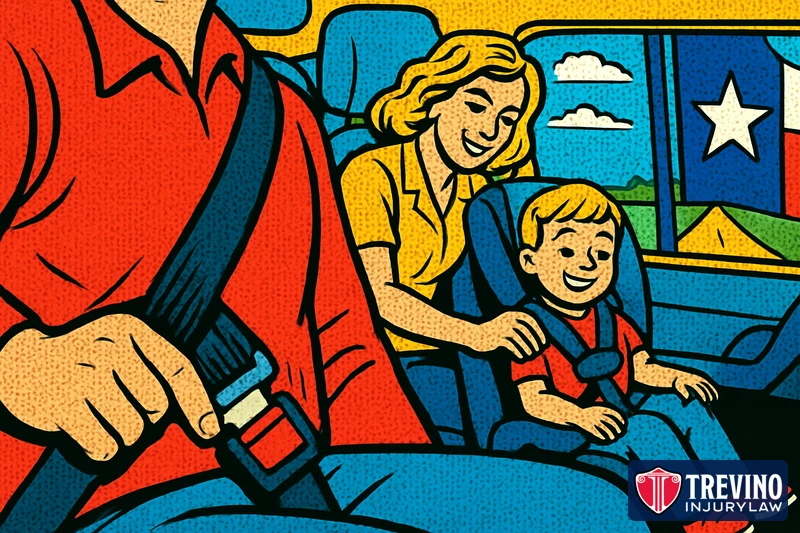
Children have separate rules. Under Section 545.412, a child younger than 8 must ride in a child passenger safety seat system unless the child is at least 4 feet, 9 inches tall. For injury claims, the bigger change came in 2015, when the Texas Supreme Court’s Nabors decision allowed juries to consider seatbelt non-use when assigning responsibility for injuries.
Is it illegal to ride in the back seat without a seatbelt in Texas?
Yes, Texas law was updated to require all passengers, including those in the back seat, to wear a seatbelt regardless of their age.
Can a passenger be fined for not wearing a seatbelt in Texas?
Yes, adult passengers (age 15 and older) can be individually fined for failure to wear a seatbelt, while the driver is legally responsible for ensuring passengers under 17 are buckled.
Can I get pulled over if my passenger isn’t wearing a seatbelt?
Yes, police in San Antonio and throughout Texas can stop a vehicle solely because a driver or passenger is visibly not wearing a seatbelt, known as a primary enforcement law.
Who Is Liable if a Child Was Not in a Car Seat During a Crash?
The driver of the vehicle is legally responsible for ensuring that all child passengers are properly secured in car seats or seatbelts appropriate for their height and weight. State law reinforces this seriousness by imposing a specific fine of $100 to $200 on drivers who fail to secure a passenger under 17 (Texas Legislature, 2025). If a child is injured in a car accident caused by another driver, the insurance company may attempt to blame the parent or guardian for the severity of the child’s injuries, effectively trying to reduce the payout for the child’s medical care.
These cases involve sensitive family liability issues. Even if the parent bears some responsibility for the lack of a car seat, the negligent driver who caused the collision—perhaps by speeding through a school zone in Leon Valley—remains the primary defendant. Trevino Injury Law handles these delicate situations carefully, ensuring that the child’s right to recovery for future medical needs is protected, even if it means navigating complex comparative fault rules involving family members.
What if the seatbelt Were Defective or Failed During the Accident?
If you were wearing a seatbelt but it unlatched, tore, or failed to restrain you during the impact, you may have a product liability claim grounded in the ‘crashworthiness’ doctrine. As discussed in Hyundai Motor Co. v. Rodriguez, 995 S.W.2d 661 (Tex. 1999), Texas law holds manufacturers strictly liable if a vehicle defect, such as a faulty restraint system, causes injuries beyond those that would have occurred in the crash alone. This shifts the focus from your actions to the manufacturer’s failure to provide a crashworthy vehicle that protects occupants as promised.
We investigate these “seatbelt failure” cases by examining the latch mechanism and the integrity of the webbing. If a manufacturer like Ford or GM produced a defective restraint system that caused your ejection during a rollover, they can be held strictly liable for your injuries. This removes the “comparative negligence” reduction from your shoulders, as you did your part by buckling up.
Does the Seatbelt Defense Apply to Parked Cars or Low-Speed Impacts?
The seatbelt defense generally does not apply if the vehicle was legally parked or if the injured person was not required to be buckled at that specific moment. The duty to wear a seatbelt typically applies only when the vehicle is being operated on a public roadway, not when it is stationary or engaged in non-driving activities.
For example, if you are struck by another vehicle while loading groceries into your car in a parking lot, or if you are resting in the sleeper berth of a parked 18-wheeler, you are not legally required to be buckled. Insurance adjusters may still argue that you should have been more careful, but legally, the “seatbelt defense” holds no water in these situations. We ensure the jury understands that you had no duty to be restrained at the time of the impact.
Why Hire a San Antonio Car Accident Lawyer?
You hire a car accident lawyer at Trevino Injury Law to neutralize the seatbelt defense before it cuts your settlement, secure the EDR data that captures the at-fault driver’s speed and braking, and stop the adjuster from pushing your fault past the 51% bar.
We file a spoliation letter, a legal demand that stops the defendant from destroying Event Data Recorder information, in the first week. We depose the at-fault driver and build a trial-ready life care plan. Settlement mills accept the comparative negligence reduction without a fight. We do not.
Want to Protect the Full Value of Your Claim?
You’ve seen how the seatbelt defense affects your case, but this is only one piece of the puzzle. Our Car Accident Lawyer page “breaks down” what a trial-ready firm does differently.
The $4 million spine and back injury settlement and the $536,007 jury verdict (107 times the $5,000 offer) prove what can happen when an experienced and highly rated San Antonio injury law firm, like Trevino Injury Law drives carriers to settle high or take comparative negligence in front of a Bexar County jury rather than letting the adjuster price catastrophic injuries into a lowball offer.
Call 210-TREVINO for a free case review. Se Habla Español. No Win, No Fee.