
Proving fault in a Texas bicycle accident involves establishing driver negligence by demonstrating a breach of the Texas Transportation Code that directly caused a cyclist’s injuries in San Antonio, a process that often requires expert evidence to overcome inherent “cyclist bias”. While insurance adjusters often reflexively blame riders, this guide provides the specific evidence and strategies from GPS forensics to accident reconstruction needed to ensure the driver is held 100% accountable.
In this guide, you’ll discover how to secure your SAPD CR-3 report, why Strava data is your best witness at Bexar County intersections like Culebra Rd, and how the “51% Bar” rule impacts your claim. Don’t let the insurance company control the narrative.
What Could Your Bicycle Accident Case Be Worth?
Answer a few quick questions about your accident. Takes about 60 seconds.
See What My Case Might Be WorthThe insurance company offered less than $20,000. I ended up with over $1 million. — Jackie Galindo
Trevino Injury Law, our San Antonio bicycle accident lawyer team, uses reconstruction, camera footage, and ride data to prove the driver caused the crash. Call 210-TREVINO for a free case review. You pay nothing unless we win. Se Habla Español.
Key Takeaways – How Do You Prove a Driver Was at Fault for a Bicycle Accident in Texas?
- Texas treats a cyclist as a vehicle operator, so a driver who violates the Transportation Code toward a cyclist can be found negligent.
- Insurers often lean on “cyclist bias” and the “I didn’t see them” defense, so objective evidence matters more than the police narrative.
- Accident reconstruction, GPS and ride-app data, and camera footage can show exactly how the driver caused the crash.
- Under the Texas 51% bar rule, any share of fault assigned to you reduces your recovery, and more than 50% ends it.
- Evidence such as surveillance video can disappear within days, so you must preserve it quickly.
How Does the Texas Transportation Code Determine Fault in a Bike Accident?
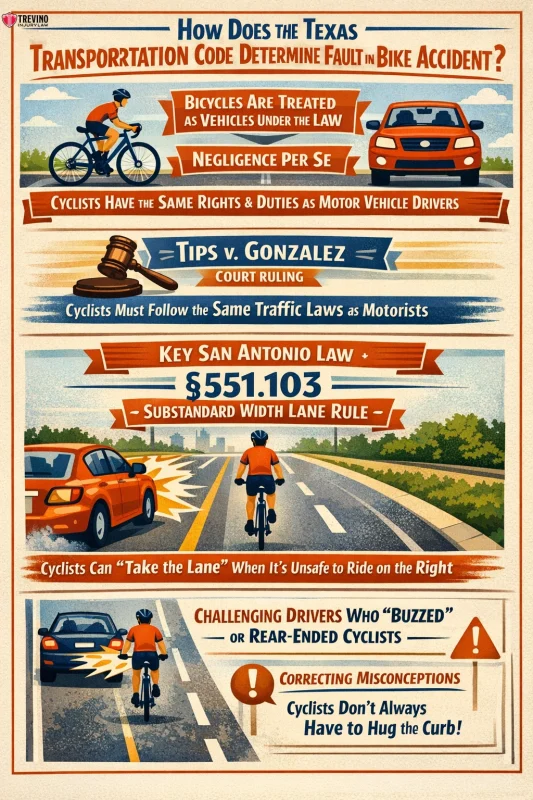
Texas law establishes fault by treating bicycles as vehicles under the Transportation Code. A driver is negligent per se if they violate a cyclist’s statutory rights, as Texas courts have long held that cyclists have the same rights and duties as motor vehicle drivers.
This principle comes from Texas Transportation Code §551.101, which gives a person operating a bicycle the same rights and duties as the operator of any other vehicle.
In San Antonio, proving fault often centers on §551.103, which allows cyclists to take the lane when a “substandard width lane” makes it unsafe to ride on the right. Many drivers and even some SAPD officers incorrectly assume cyclists must always hug the curb. We use these specific laws to turn the tables on drivers who “buzzed” or rear-ended a cyclist.
Why Is the San Antonio Police Crash Report (CR-3) Often Inaccurate?
The SAPD CR-3 report is the initial record of fault, but officers often lack specialized training in bicycle physics and may list the cyclist’s speed or position incorrectly. This document serves as the foundation for insurance adjusters, yet it is frequently marred by “cyclist bias,” where the officer assumes the rider was at fault simply for being on the road.
We treat the report as a starting point, not the final word, and often seek supplemental evidence to refute on-the-scene officer bias.
Understanding the statutory framework and the flaws in initial police reporting is essential, but moving beyond the paper record requires examining the digital trail modern technology leaves behind.
What Technical Evidence Is Needed to Overcome “Cyclist Bias”?
To overcome the “I never saw him” defense, we use Strava GPS data and GoPro footage to provide an objective reconstruction. This is critical because 91% of crash modes in San Antonio’s High Injury Network involve motor vehicles, while bicycles make up only 2.5%.
In accidents on high-traffic corridors like Bandera Rd, which saw 38 fatal or serious crashes recently, drivers frequently claim a cyclist “darted out” to hide their own failure to maintain a lookout.
Digital forensics proves otherwise. We also file FOIA requests for San Antonio city camera footage and 911 dispatch recordings to capture real-time admissions from the scene.
How Do Accident Reconstructionists Prove a Driver’s Negligence?
Accident reconstructionists use scientific principles to reconstruct the crash frame by frame, providing an objective account of how a driver’s failure to maintain proper lookout led to the collision. Our legal team employs these experts to perform the following:
- Scene Survey: Mapping skid marks and points of impact.
- Vector Analysis: Calculating speed based on throw distance.
- Visibility Studies: Proving the driver had a clear line of sight at intersections like Broadway and S. Alamo.
What Happens If You Don’t Have Video Evidence?
Without video evidence, your case relies on forensic tire mark analysis, witness testimony, and accident reconstruction to scientifically prove the driver’s negligence.
While a GoPro provides the easiest path to victory, we can still build a case by looking at the “negative space” of the accident. We use SAPD records and FOIA requests to obtain San Antonio city camera footage to obtain third-party perspectives on the collision.
When Is It Too Late to Preserve Evidence?
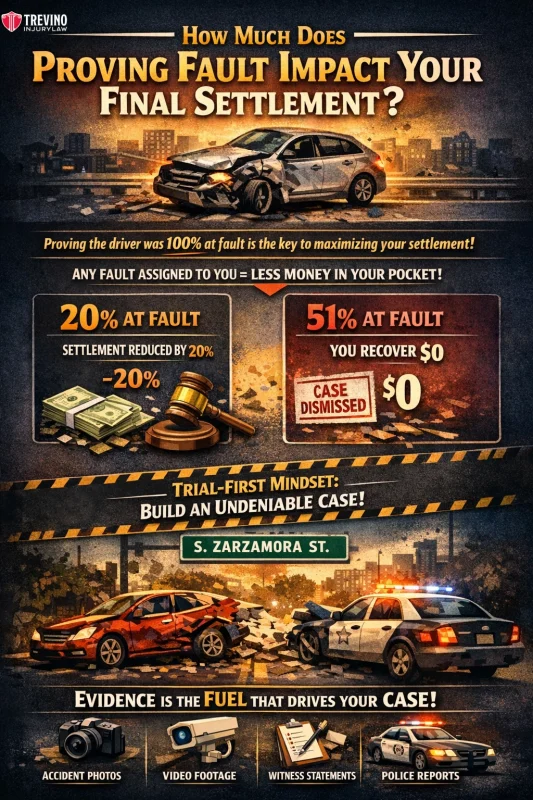
Failing to act quickly can result in losing critical evidence. Under Texas law, a party must preserve evidence when it knows or should know there is a substantial chance a claim will be filed.
The landmark ruling in Brookshire Bros., Ltd. v. Aldridge clarifies the consequences of ‘spoliation,’ or the failure to preserve evidence, emphasizing that while trial courts have discretion to provide jury instructions on missing evidence, the burden is on the victim to ensure evidence is legally ‘placed on hold’ via formal notice.
Waiting even a few weeks to begin the investigation can mean the difference between full recovery and a total claim denial. For a full checklist, see what evidence you need for a bicycle accident claim in San Antonio.
Who Is at Fault in Common San Antonio Bike Crash Scenarios?
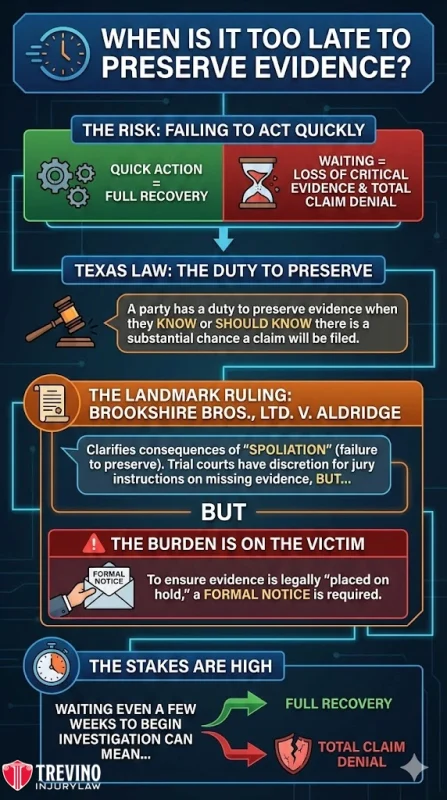
While technical and forensic evidence can clarify the physics of a crash, the outcome often hinges on how these facts fit into recognized San Antonio liability patterns. Ultimately, fault depends on the specific circumstances of the crash, but certain patterns are common.
In most “right-hook” or “Dooring” accidents, the motor vehicle driver is legally at fault for failing to check blind spots or respect designated bike lanes. This is a common crisis at dangerous intersections, where drivers fail to yield the right-of-way or ignore traffic signs governing traffic flow. These specific driver actions are often the primary cause of the collision.
Because interactions between vehicles and bicycles can be complex, we often engage accident reconstruction experts to establish how the accident occurred. These experts analyze skid marks, debris fields, and vehicle data to establish that the driver’s negligence, not the cyclist’s behavior, was the proximate cause of the crash.
How Much Does Proving Fault Impact Your Final Settlement?
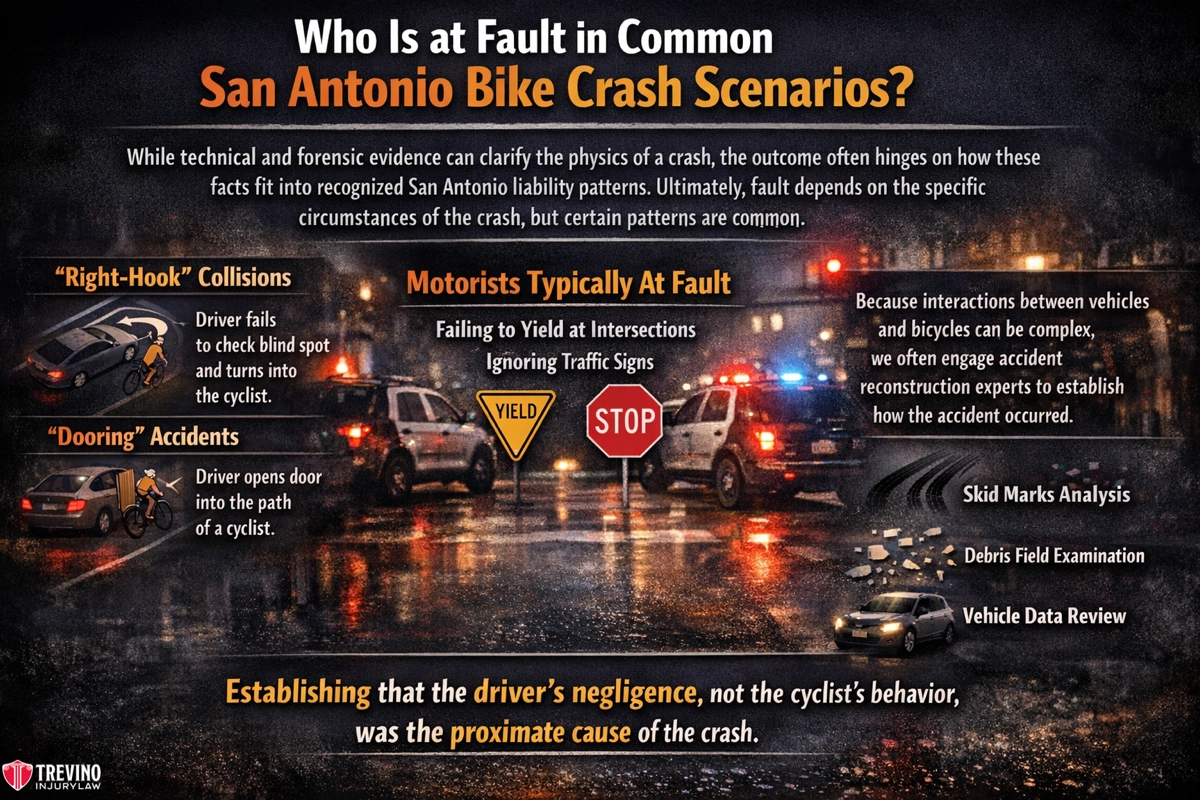
Proving the driver was 100% at fault is the single most important factor in maximizing your settlement, as any percentage of fault assigned to you directly reduces your financial recovery.
In Texas, if a jury finds you 20% responsible for an accident on S. Zarzamora St., your award is slashed by 20%. If they find you 51% responsible, you recover $0, which is why our Trial-First Mindset focuses on building an undeniable case of driver negligence from day one.
Establishing fault drives your case, but that engine cannot run without the raw fuel of evidence gathered immediately after the collision.
Can I Still Recover If I Was Partly at Fault in a Bicycle Accident?
Yes, under Texas law, you can still recover compensation for your injuries as long as your percentage of responsibility is 50% or less. This is called modified comparative negligence. However, acknowledging that you may be at fault significantly changes your claim strategy.
Your total award will be reduced by your specific fault percentage. For example, if a jury finds you 20% responsible for a crash on S. Zarzamora St. because you lacked a light, your final settlement would be reduced by 20%. However, if the defense successfully argues that you were 51% or more responsible, you recover $0.
To prevent this, you must protect your rights immediately after the crash. We aggressively gather evidence, including photos of the accident scene and statements from witnesses who saw it, to minimize your assigned liability.
Because bicycle accidents often cause catastrophic harm, minimizing your percentage of fault is the only way to ensure the final settlement covers the full severity of your injuries and the accident’s long-term impact on your life.
Will Not Wearing a Helmet Hurt My Texas Bicycle Accident Case?
Not wearing a helmet does not prevent you from filing a claim or proving the driver was at fault, but insurance companies may attempt to use it to increase your percentage of comparative negligence if you suffered head injuries. Texas has no statewide helmet law for adults, so not wearing a helmet is not a statutory violation.
We focus on proving that the driver’s negligence caused the impact itself, ensuring your safety gear doesn’t distract from their failure to share the road. Learn more about how San Antonio bicycle laws affect an injury claim.
Determining the exact breakdown of fault isn’t just a matter of legal pride; it is the key factor that dictates the dollars you will receive in a settlement.
Quick Answers About Proving Fault in Texas Bicycle Accidents
Can I Still Recover If the Driver Claims They Didn’t See Me?
Yes. A driver claiming they simply didn’t see the accident victim is not a valid legal defense; in fact, it is often an admission of negligence.
Texas law imposes a strict duty of care on all motorists to keep a “proper lookout” and act with reasonable care while operating their vehicle. When a driver breaches their duty by failing to notice a visible cyclist, they are liable for the resulting damages under state negligence laws.
Even if the defense argues that you contributed to the accident, for example, by wearing dark clothing at night, Texas follows comparative negligence law. This means you can still recover the compensation you deserve for medical bills and pain and suffering, provided you were not more than 50% responsible.
We aggressively counter “I didn’t see him” defenses by proving the driver had ample opportunity to yield but failed to maintain awareness.
Comparing “Right Hook” vs. “Left Hook” Liability
While both involve failure to yield, “Right Hook” accidents typically involve a driver passing and turning across a cyclist, whereas “Left Hook” crashes occur when a driver turns into an oncoming cyclist’s path. These patterns involve specific violations of the Transportation Code.
Why Hire a San Antonio Bicycle Accident Lawyer?
Waiting even 14 days allows insurance adjusters to delete critical surveillance footage or pave over the scene of your accident. The insurance carrier will reflexively blame you to trigger the “51% Bar” rule and pay $0. They rely on “settlement mills” to fold under pressure. Trevino Injury Law breaks this cycle with a trial-first mindset.
Want to Protect the Full Value of Your Claim?
You’ve seen how this affects your case — but this is only one piece of the puzzle. Our Personal Injury Lawyer page breaks down what a trial-ready firm does differently.
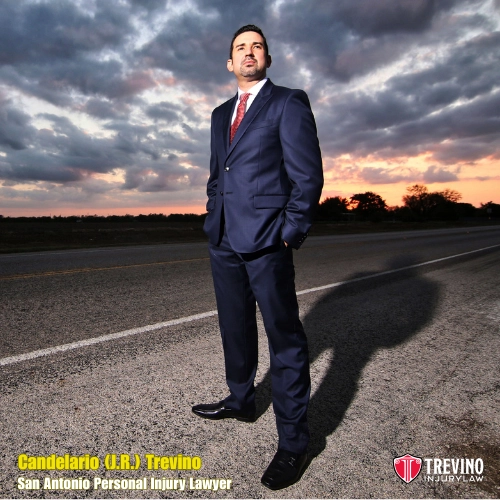
We don’t just “help”; we force them to pay. Whether we file Texas Public Information Act requests for city cameras or send immediate spoliation letters to preserve evidence, our San Antonio bicycle accident lawyer fights to keep your fault at 0%. We bring the same aggression that secured a $536,007 jury verdict after the insurance carrier offered $5,000.
Call 210-TREVINO for a free case review. Se Habla Español. No Win, No Fee.