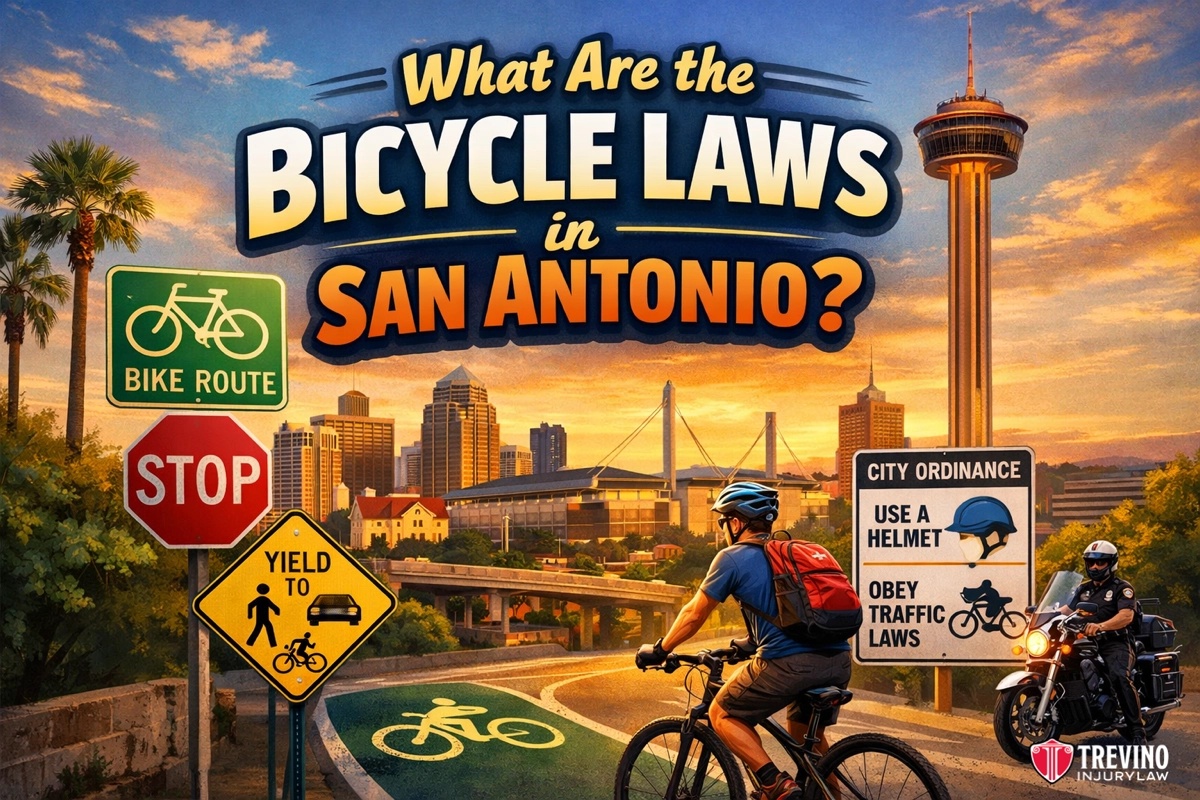
Your legal right to the road does not stop a distracted driver from hitting you. State and local laws dictate exactly where your tires belong, and a single misstep gives the defense an excuse to deny your compensation.
The adjuster handling your case is already scouring the police report for a sidewalk violation or a rolled stop sign to assign you total fault. According to the City of San Antonio, cyclists caught riding on a sidewalk face penalties of up to $200. Insurance companies weaponize that exact local ban, classifying your attempt to stay safe as illegal behavior to shift all blame onto you.
What Could Your Bicycle Accident Case Be Worth?
Answer a few quick questions about your accident. Takes about 60 seconds.
See What My Case Might Be WorthThe insurance company offered less than $20,000. I ended up with over $1 million. — Jackie Galindo
Physical evidence of the driver’s negligence vanishes within days. Skid marks fade, dash camera footage is deleted, and witnesses’ memories change. A Spoliation Letter, a legal demand that stops the property owner from destroying evidence, must go out immediately to secure the proof showing the vehicle violated your safe passing clearance. Texas gives you two years to act before the claim expires permanently.
Trevino Injury Law, bicycle accident lawyers dismantle these victim-blaming tactics and preserve the critical crash data. Call 210-TREVINO for a free case review. You pay nothing unless we win. Se Habla Español.
Are Bicycles Considered Vehicles in Texas?
Yes. Texas Transportation Code § 551.101 explicitly grants a person operating a bicycle all the rights and duties of a driver operating a vehicle. Because you are legally operating a vehicle, you are bound by the overarching duty to exercise ordinary care and maintain a proper lookout—a standard the Texas Supreme Court definitively established for all roadway users in the landmark case De Winne v. Allen, 277 S.W.2d 95 (Tex. 1955). This means negligent drivers cannot treat you as a mere obstacle; they owe you the exact same duty of care as a passenger car, and our trial lawyers use this legal baseline to hold them accountable.
In practice, this means you have a legal right to be on the road, but you must also comply with all traffic laws, such as stopping at red lights and yielding when required. Because a bicycle is a vehicle, you must follow the same rules at intersections. This leads to the most common questions we hear.
Do Bicycles Have to Stop at Stop Signs and Red Lights in Texas?
Yes, absolutely. Because a bicycle is legally a vehicle, you must come to a complete stop at all stop signs and red lights, just like a car. The “Idaho Stop” (treating a stop sign as a yield) is not legal in Texas and is one of the fastest ways for an insurance adjuster to blame you for a crash. Insurance adjusters love discovering that a cyclist rolled through a stop sign.
They will use it to argue that you are 100% at fault, even if the driver was speeding and distracted. Obeying this rule is critical for protecting your case.
Does Texas Have a “Dead Red” Law for Bicycles?
No, Texas does not have a “dead red” law that allows a cyclist to proceed through a red light that has failed to detect them and will not change. While some other states have passed this law, Texas has not.
If you are stuck at a red light, you must wait until it turns green. Your only other legal options are to make a right turn on red after a complete stop (if safe and permitted) or to dismount your bicycle and use the crosswalk as a pedestrian.
Is it Illegal to ride a Bicycle Without a Helmet in Texas?
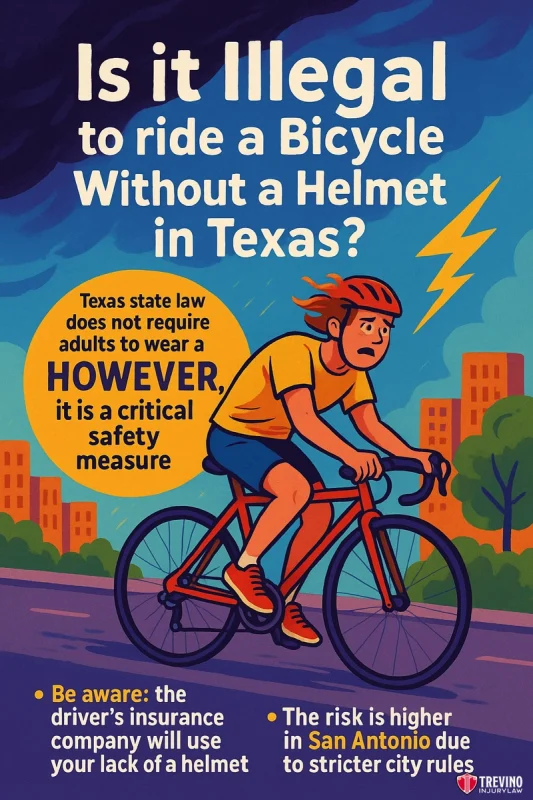
Texas state law does not require adult cyclists (18 and over) to wear a helmet. However, state law requires all riders under 18 to wear helmets. For adults, while it is not a legal requirement, it is a critical safety measure.
Be aware: if you are in an accident and suffer a head injury, the driver’s insurance company will use your lack of a helmet against you. They will argue that you were “negligent” and partially responsible for your own injuries, to reduce the compensation you deserve.
While these statewide laws set the baseline for all cyclists in Texas, the danger varies across the state. TxDOT data and fatality maps show that bicycle and pedestrian fatalities are heavily concentrated in urban areas, and San Antonio is one of those critical hotspots.
Because the risk is higher here, the City of San Antonio enforces its own ordinances under Chapter 19 of the City Code, which impose stricter, more specific rules for cyclists operating within the city limits.
What is the Official Bike Ordinance in San Antonio?
The City of San Antonio enforces its own ordinances under Chapter 19 of the City Code, which adds specific, stricter rules for cyclists operating within the city limits that supplement Texas law. Understanding a driver’s negligence is key to any bicycle accident claim, and these local ordinances are often our most powerful tool to prove that a San Antonio driver was 100% at fault.
When state and city laws conflict, cyclists must generally follow the stricter rule. These local ordinances address critical issues, including sidewalk riding, safe passing distances, and required equipment. The most important and most violated of these local rules involves where you are allowed to ride.
Is it Legal to Ride a Bike on the Sidewalk in San Antonio?
No. Unlike many other cities, San Antonio City Ordinance Sec. 19-286 explicitly prohibits bicycles on city sidewalks and imposes fines of up to $200. This is a critical point of local law that many cyclists are unaware of. This ban applies to business districts and residential areas alike.
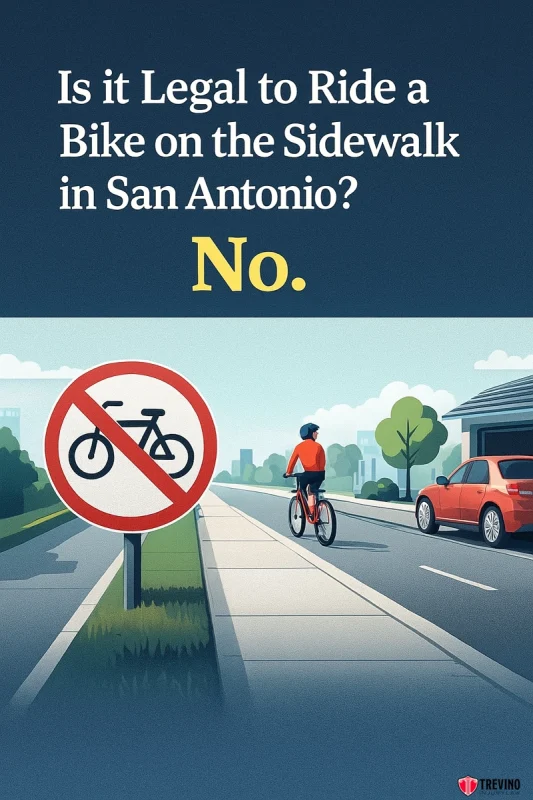
This is the #1 legal trap for cyclists in San Antonio. You may ride on the sidewalk to feel safer, but if a car pulls out of a driveway and hits you, their insurance will instantly deny your claim by citing Ordinance 19-286. They will say you were 100% at fault because you were “illegally” on the sidewalk.
What is San Antonio’s “Safe Passing” Ordinance?
San Antonio’s “Safe Passing” ordinance provides critical protection for cyclists by requiring drivers to maintain a safe passing distance of at least 3 feet for cars and 6 feet for commercial trucks.
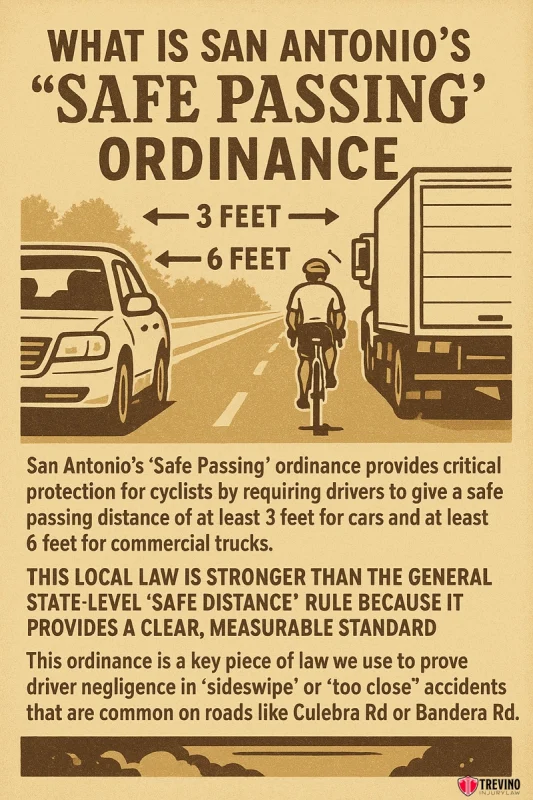
This local law is stronger than the general state-level “safe distance” rule because it provides a clear, measurable standard. This ordinance is a key legal provision we use to establish driver negligence in “sideswipe” or “too close” accidents that are common on roads like Culebra Rd or Bandera Rd.
Do You Have to Walk Your Bike Across a Crosswalk in San Antonio?
You are not legally required to walk your bike, but you must understand the change in legal status: if you ride your bike in a crosswalk, you are still a “vehicle” and must yield to pedestrians, but if you dismount and walk your bike, you become a “pedestrian” and have the right-of-way. A car turning right on red must yield to a pedestrian in the crosswalk.
However, that same driver may not expect a vehicle (a bike) to be moving quickly through that same crosswalk. Walking your bike is the safest legal option at busy intersections, as it gives you the full rights of a pedestrian.
Knowing the state and city laws is the first step, but applying them correctly in real-world driving, such as where to position yourself in a lane, is what truly keeps you safe.
Where Are Cyclists Legally Supposed to Ride?
Under Texas law, a cyclist moving slower than traffic must ride as near as practicable to the right curb or edge of the roadway. Proving a driver was at fault often comes down to where you were legally allowed to be. This section details your rights on the road, which are critical for disproving an insurer’s attempts to blame you for the crash.
“As practicable” does not mean in the gutter; it means as far right as is safe, allowing you to avoid debris, potholes, and the “door zone” of parked cars. The “as far right” rule is not absolute. The law provides several critical exceptions that allow you to move into the center of the lane.
Are Bicycles Entitled to a Full Traffic Lane? (When Can You “Take the Lane”?)
Yes, you are legally entitled to “take the lane” and ride in the center of a traffic lane in several specific situations. The law allows you to move from the right edge and take the whole lane for your safety under these conditions:
When you are passing another vehicle (including a slower cyclist).
When you are preparing to make a left turn.
When you are avoiding hazards like potholes, debris, or parked car doors.
When the lane is too narrow for a bicycle and a car to safely travel side-by-side (defined as a “substandard width lane” of less than 14 feet).
Can Cyclists Ride Two Abreast (Side-by-Side) in Texas?
Yes, Texas state law permits two cyclists to ride side by side (two abreast) in a single traffic lane. However, this right is subject to an essential legal qualifier: you may ride two abreast only if you are not impeding the “normal and reasonable flow of traffic”. On a busy, single-lane road with no easy passing, riding side-by-side may not be permitted, and it is safer to ride single-file.
What Safety Equipment is Required by Law in Texas?
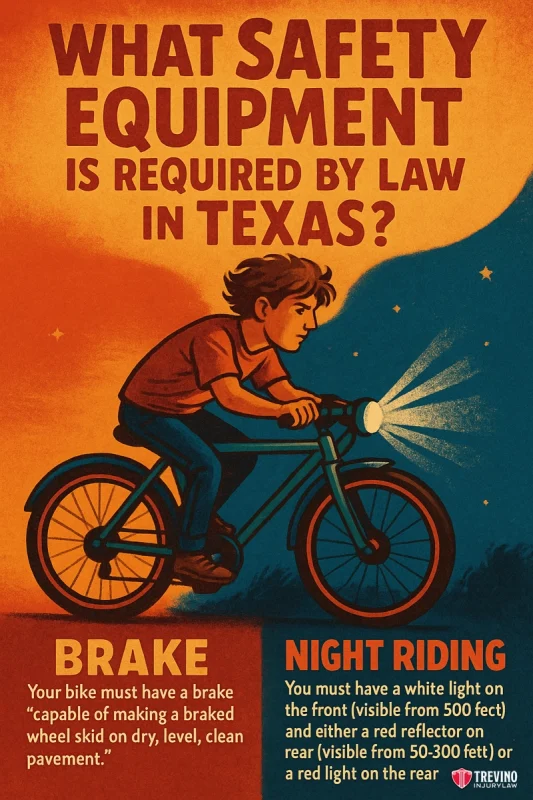
Texas law requires two key pieces of safety equipment: a functioning brake and proper lights for night riding. San Antonio’s city ordinance reinforces these rules. To be compliant, your bicycle must have:
Brakes: Your bike must have a brake “capable of making a braked wheel skid on dry, level, clean pavement.”
Night Riding: You must have a white light at the front (visible from 500 feet) and either a red reflector at the rear (visible from 50-300 feet) or a red light at the rear (visible from 500 feet).
Understanding all these specific laws, from state statutes to local ordinances, is essential for safe riding. Still, their most critical function appears after a crash when insurance companies try to use them against you.
How Do These Bicycle Laws Affect My Accident Claim?
These laws are the most critical factor in an accident claim, as insurance companies will use them to prove you were ‘negligent’ and therefore deny your compensation. Texas follows a “comparative fault” rule, which means your ability to recover money can be reduced or eliminated if you are found partially at fault for the crash. For a deeper look at how injury severity, fault, insurance, and damages combine, see what determines the value of a bicycle accident case in San Antonio.
If you are hit by a car, the adjuster’s first move will be to determine which law you broke. Were you on the sidewalk in San Antonio? Did you roll a stop sign? Were you missing a light at night? They will use any violation to assign you partial or complete blame to avoid paying.
Our job as trial attorneys is to prove that the driver’s negligence (such as violating the 3-foot safe-passing rule) was the actual cause of the crash.
While understanding how these laws underpin your claim is vital, many cyclists still have specific questions about everyday situations and potential legal pitfalls.
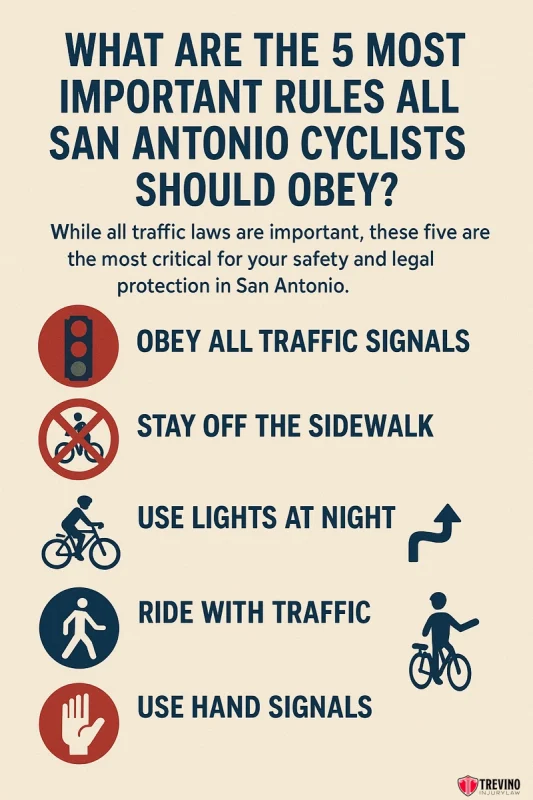
What Are the 5 Most Important Rules All San Antonio Cyclists Should Obey?
While all traffic laws are important, these five are the most critical for your safety and legal protection in San Antonio. Following them is the best way to prevent a crash and protect your rights if one happens.
- Obey All Traffic Signals: You must come to a complete stop at all red lights and stop signs, just as a car would.
- Stay Off the Sidewalk: It is illegal to ride on sidewalks anywhere within the San Antonio city limits, per Ordinance Sec. 19-286.
- Use Lights at Night: A white front light and a red rear light (or red reflector) are mandatory from sunset to sunrise.
- Ride With Traffic: Always ride in the same direction as traffic, as far to the right as practicable and safe.
- Use Hand Signals: Signal all turns and stops to clearly communicate your intentions to drivers.
Can Police Stop You on a Bicycle in San Antonio?
Yes, because a bicycle is legally considered a vehicle in Texas, a police officer can stop and issue a citation for any traffic violation. This includes common infractions such as running a stop sign, riding without lights at night, or riding on the sidewalk, all of which are violations of San Antonio’s ordinance.
An insurance company can use any ticket you receive as evidence to argue you were at fault in an accident claim.
Can You Get a DUI/DWI for Riding a Bicycle in Texas?
No, Texas’s ‘Driving While Intoxicated’ (DWI) statute, § 49.04, applies to operating a motor vehicle and does not directly apply to a person riding a bicycle. However, this does not mean it is legal or safe to ride while intoxicated.
You can still be arrested for other offenses, such as Public Intoxication, if you are in a public place and pose a danger to yourself or others. More importantly, if you are in an accident, the insurance company will use the fact that you were intoxicated to argue you were 100% at fault for the crash, regardless of what the driver did.
Why Hire a San Antonio, Texas Bicycle Accident Attorney?
An insurance adjuster will treat a ticket for “public intoxication” or a sidewalk violation as a weapon to deny your entire claim. The true villain is the insurance industry, which ruthlessly exploits anti-cyclist bias to shift 100% of the fault to you, and the high-volume “settlement mills” that are too afraid to challenge them in court.
While they look for the easiest way out, Trevino Injury Law prepares for war. We force them to acknowledge that a driver’s negligence, not a minor infraction, caused your injury.
Want to Protect the Full Value of Your Claim?
You’ve seen how this affects your case — but this is only one piece of the puzzle. Our Bicycle Accident Lawyer page explains how a trial-ready firm operates differently.
We aggressively counter these “comparative fault” tactics to protect your financial recovery. You need a San Antonio, Texas, personal injury crash attorney who will immediately preserve evidence and dismantle their attempts to blame the victim.
Call 210-TREVINO for a free case review. Se Habla Español. We fight on a contingency basis: No Win, No Fee.