
The impact of a vehicle leaves San Antonio cyclists with shattered clavicles, severe road rash, and invisible traumatic brain injuries. Your body absorbs the entire force of the crash because you have no steel frame to protect you.
The insurance adjuster is already using your adrenaline against you, waiting for a gap in medical treatment to argue your delayed pain is fake or unrelated to the collision. According to the Texas Department of Transportation, the San Antonio district recorded 312 injuries to pedal cyclists in 2023. These victims face an opponent who specifically weaponizes invisible soft tissue damage and mild concussions to deny legitimate compensation.
What Could Your Bicycle Accident Case Be Worth?
Answer a few quick questions about your accident. Takes about 60 seconds.
See What My Case Might Be WorthThe insurance company offered less than $20,000. I ended up with over $1 million. — Jackie Galindo
You must secure an objective medical evaluation immediately to validate your trauma. You also need a Spoliation Letter, a legal demand that requires the negligent driver or trucking company to preserve critical evidence. Texas gives you two years to file, but scene proof vanishes in days.
Trevino Injury Law, bicycle accident lawyers, lock down this evidence and force the insurer to pay the lifetime cost of your trauma. Call 210-TREVINO for a free case review. You pay nothing unless we win. Se Habla Español.
What Are the Most Common Injuries in a Bike Accident?
The most common injuries from a bike accident are “impact” injuries, including fractures (broken bones) in the extremities, significant skin abrasions (“road rash”), and head, neck, or back injuries. These are often considered the “normal” injuries in a collision because a cyclist has no physical protection from the force of a vehicle or the secondary impact with the pavement.
While our main guide discusses the compensation you can receive, understanding the specific medical nature of these injuries is the first step. This section provides a medical breakdown of the most frequent injuries, fractures, skin damage, and joint injuries that underlie the most common claims.
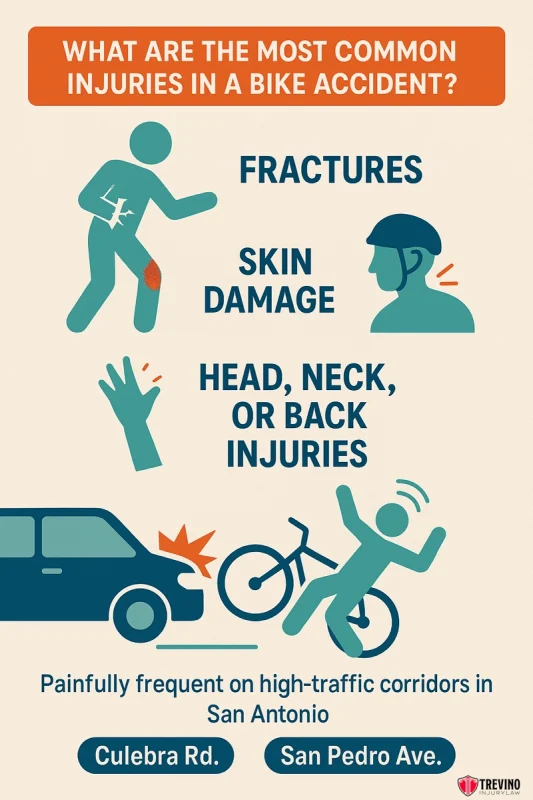
These accidents are painfully frequent on high-traffic corridors in San Antonio, such as Culebra Rd. and San Pedro Ave., where cyclists are most vulnerable. These injuries happen due to the lack of a steel frame, airbags, or seatbelts, leaving the rider’s body to absorb 100% of the crash forces.
The Texas Department of Transportation’s (2023) crash data support this, revealing that pedal cyclist injuries in San Antonio occur most frequently at intersections (56.1%) and on road segments (29.2%). These dangers are overwhelmingly found in urban areas, which account for 94.9% of intersection injuries and 92.9% of segment injuries.
Understanding Fractures and Broken Bones from a Bike Crash
Fractures are prevalent because cyclists instinctively extend their arms to brace for impact, leading to broken wrists, hands, and collarbones (clavicles). The force of the fall or the direct effects from the vehicle can easily snap bones. The most frequent fracture sites include:
- Clavicle (Collarbone): Often breaks when a rider lands directly on their shoulder.
- Wrists/Hands: Occurs from the instinct to stretch out your hands to brace for the fall.
- Leg/Femur/Pelvis: These are typically caused by a direct, high-force impact from the car’s bumper or grille.
While broken bones are apparent, the most common skin injury has hidden dangers that many victims underestimate.
What Are the Serious Risks of “Road Rash” and Skin Abrasions?
The primary risk of road rash is not the abrasion itself, but the high risk of severe, systemic infections, such as sepsis or tetanus, if debris and bacteria are not professionally removed from the wound. When your skin slides across asphalt, the wound is immediately contaminated with dirt, gravel, and chemical residue from the road. Severe road rash often requires a painful medical procedure called debridement to scrub the wound clean and prevent infection.

Furthermore, this injury carries a significant secondary risk: permanent scarring and disfigurement. Under Texas law, this is a substantial component of a non-economic damages claim. Courts have long recognized that victims are entitled to compensation for disfigurement, as affirmed in cases such as Pipgras v. Hart, 832 S.W.2d 360 (Tex. App.—Fort Worth 1992, writ denied), which explicitly uphold awards for past and future physical and mental suffering associated with permanent scarring.
These common injuries are painful, but the most severe crashes result in injuries that are permanently life-altering.
What Are the “Top 5 Worst” or Most Serious Bike Crash Injuries?
The most serious, life-altering injuries from a bike crash are: (1) traumatic brain injuries, (2) spinal cord injuries leading to paralysis, (3) internal organ damage and bleeding, (4) traumatic amputations, and (5) complex polytrauma (multiple severe injuries).
These injuries form the basis of “catastrophic injury” claims, which require immediate specialized care at a Level I Trauma Center, such as University Hospital in the Medical Center district. The medical and legal stakes are highest with these injuries, as they often require lifelong care.
Data from the Texas Department of Transportation shows that the crash location significantly affects severity. In 2023, a staggering 88.9% (8 out of 9) of all fatal pedalcyclist crashes occurred in road segments, not at intersections.
Involved in a bicycle accident? Speak with a bicycle accident lawyer today and learn how your injuries can range from minor to severe. Call 210-TREVINO for a free, no-obligation consultation. Se Habla Español.
What Are the Different Types of Traumatic Brain Injuries (Tbis)?
Traumatic Brain Injuries (TBIs) range from “mild” concussions, which can have serious long-term effects, to severe contusions (bruising of the brain) or diffuse axonal injuries (tearing of brain structures). A TBI occurs when a violent blow to the head, common in a bike crash, disrupts normal brain function. The types include:
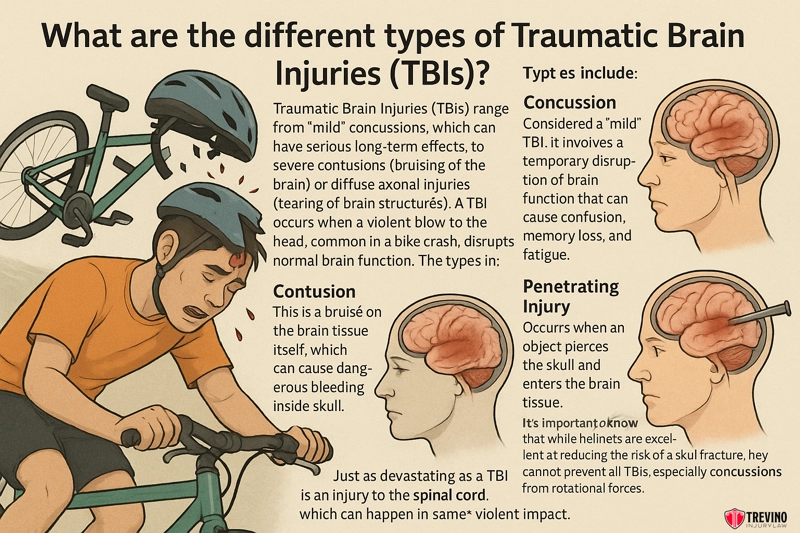
- Concussion: Considered a “mild TBI,” it involves a temporary disruption of brain function that can cause confusion, memory loss, and fatigue.
- Contusion: A bruise to the brain tissue that can cause dangerous bleeding and swelling inside the skull.
- Penetrating Injury: This occurs when an object pierces the skull and enters the brain tissue. It’s important to know that while helmets are excellent at reducing the risk of a skull fracture, they cannot prevent all TBIs, especially concussions from rotational forces.
Just as devastating as a TBI is an injury to the spinal cord, which can happen in the same violent impact.
How Do Spinal Cord Injuries from Bike Accidents Happen?
Spinal cord injuries typically occur when the violent force of the crash fractures or dislocates vertebrae, which then sever or compress the spinal cord, resulting in partial (paraplegia) or total (quadriplegia) paralysis. This is precisely why it is critical not to move a victim after a severe bicycle accident until paramedics arrive.
Moving someone with an unstable spinal injury can turn an incomplete injury (some feeling/movement) into a complete, permanent one. These injuries require a lifetime of medical care, including wheelchairs, home modifications, and constant medical support.
Catastrophic injuries are often evident at the scene. However, some of the most serious injuries are hidden, revealing themselves hours or even days later.
What Happens to the Body after a Bike Accident That Causes Delayed Pain?
Delayed pain after a bike accident is most often caused by the body’s adrenaline response masking injuries at the scene, allowing “hidden” conditions like soft tissue damage, herniated discs, or mild TBIs to surface 24-48 hours later.
Our main guide emphasizes seeing a doctor to avoid “gaps in treatment,” which is the medical rationale for this step. This H2 explains the medical causes for delayed pain: adrenaline, inflammation, and slow bleeds, which the central hub does not detail.
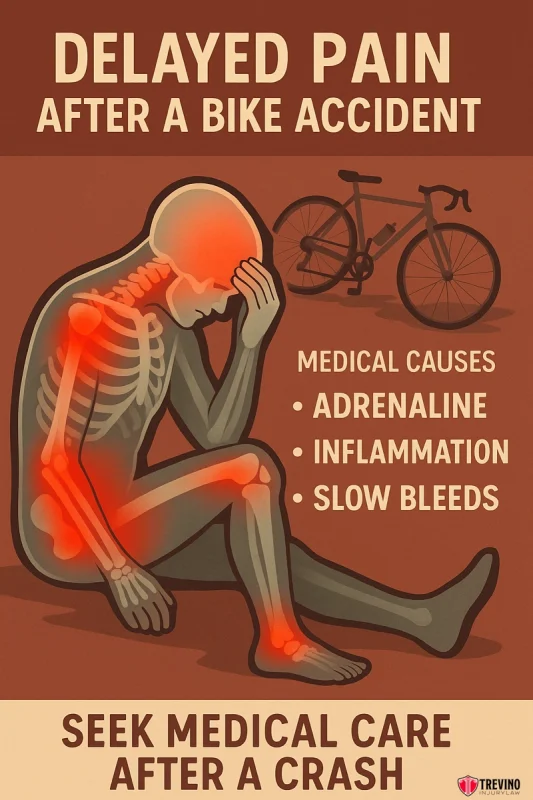
“Feeling fine” at the scene is a biological trap. The surge of adrenaline from the shock of the crash is a powerful, temporary painkiller. Once it wears off, the inflammation from a torn muscle, a bulging disc, or even a slow brain bleed begins, and the victim feels the true extent of their injuries.
This is why seeking a medical evaluation is non-negotiable, even for a “minor crash.” Insurance companies love it when victims say, “I’m fine” at the scene and will use that statement to deny your claim later, arguing the injury must have happened elsewhere.
After a bike accident, the body can suffer a wide range of injuries that don’t appear immediately, and these delayed symptoms are one of the most common causes of bicycle accident complications. Even in accident cases that seem minor, injured bicyclists can experience sprains and strains, road rash injuries, or even severe traumatic brain injuries that develop slowly as the adrenaline fades. These injuries often go unnoticed at the scene but can lead to long-term pain and a higher risk of injury if left untreated.
Because injuries can cause inflammation, nerve damage, or internal trauma, anyone injured in a bicycle crash should seek medical treatment right away to prevent conditions that may worsen over time and impact their recovery.
Why Am I so Tired after a Bike Crash?
Extreme fatigue after a bike crash is a critical warning sign that can indicate a severe concussion (TBI), the physical exhaustion of your body dealing with trauma, or the onset of psychological shock and PTSD. Many victims ignore this, believing they are just “sore” or “worn out” from the event. You must treat this symptom seriously. Fatigue is one of the most common and persistent symptoms of a mild TBI. It is your brain’s way of signaling that it is injured and needs immediate medical evaluation.
This fatigue is a symptom of “invisible” injuries, which are notoriously difficult to get insurance companies to pay for.
After a bicycle crash, this type of extreme fatigue is one of the most common injuries cyclists experience, even in accidents involving low speeds or bike lanes. Many accident victims don’t realize that serious injuries like internal bleeding, facial injuries, or mild traumatic brain injuries can develop slowly, causing pain and discomfort that worsens over time.
This is why injured cyclists should never ignore exhaustion, dizziness, or confusion after a crash. These symptoms are warning signs that the body is responding to a range of injuries, which may result in permanent scarring or long-term complications.
Getting immediate medical treatment not only protects your health but also helps document injuries that insurers often try to dispute later.
What Is the “Hardest Injury to Prove” after a Crash?
The most complex injuries to prove are “invisible” soft tissue injuries (like whiplash or herniated discs) and mild TBIs, as they don’t appear on a standard X-ray, and insurance adjusters will argue they are fake or unrelated to the crash. This is where an experienced trial attorney adds immense value. Insurance companies build their defense around denying these claims.
Proving them requires gathering objective, compelling evidence, such as MRI and CT scans, neurologist reports, and expert testimony, to definitively link the “invisible” injury to the crash and counter the insurer’s “deny and delay” tactics.
We’ve covered the injuries. The next logical question is how they impact your life in the long term, starting with your recovery.
How Long Does It Take to Recover from a Bike Crash?
Recovery time can range from a few weeks for minor road rash to a lifetime of care for a catastrophic spinal cord injury, and this timeline is one of the most significant factors in calculating your legal claim.
While our central hub discusses the value of a claim, it doesn’t detail the recovery timeline. This H2 provides that missing temporal context, linking your medical healing process directly to the financial compensation you are owed.
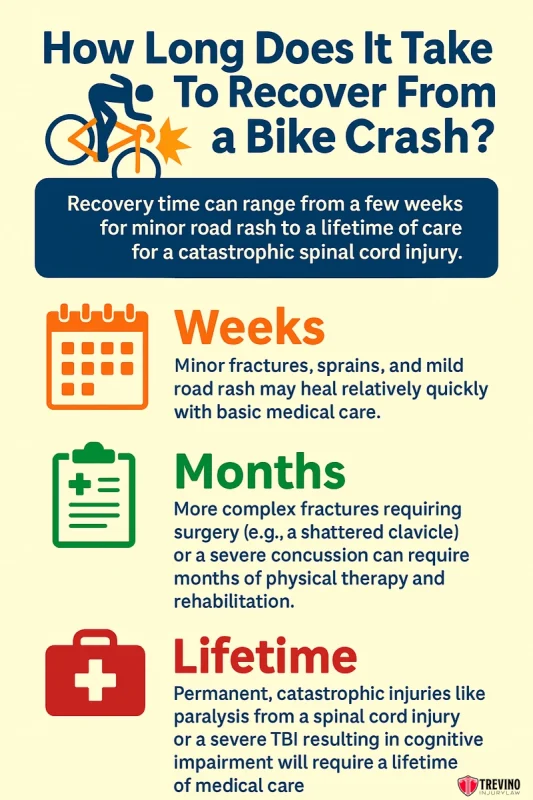
The timeline generally breaks down into three categories:
- Weeks: Minor fractures, sprains, and mild road rash may heal relatively quickly with basic medical care.
- Months: More complex fractures requiring surgery (e.g., a shattered clavicle) or a severe concussion can require months of physical therapy and rehabilitation.
- Lifetime: Permanent, catastrophic injuries like paralysis from a spinal cord injury or a severe TBI resulting in cognitive impairment will require a lifetime of medical care.
An attorney uses this medical prognosis to calculate the full value of your “future medical expenses” and “lost earning capacity.” Accepting a quick settlement before this timeline is known is the biggest mistake a victim can make.
This recovery timeline directly impacts the financial compensation you are owed. This leads to the critical questions about how injuries are valued and what specific factors—like a helmet or psychological trauma mean for your case.
What Injuries Pay the Most in a Bicycle Accident Settlement?
The “highest-paying” bicycle accident injuries are catastrophic, like traumatic brain injuries, spinal cord injuries/paralysis, and amputations, because the settlement is calculated to cover a lifetime of medical care and a total loss of earning capacity.
It is crucial to understand that this is not a “lottery” win; it is vital compensation for a lifetime of devastating loss. When our trial attorneys build a catastrophic injury case, we don’t just add up past medical bills. We work with medical and financial experts to calculate the actual value of the claim based on:
- Lifetime Medical Care: This includes all future surgeries, 24/7 in-home nursing care, wheelchairs, accessible van purchases, and home modifications (ramps, lifts).
- Lost Earning Capacity: This calculates all the income a 30-year-old victim will lose over the next 35+ years due to their inability to work.
- Pain & Suffering: This is the “non-economic” value assigned to the profound loss of quality of life, such as living with paralysis or a permanent cognitive deficit.
The value is based on the severity of the injury, but victims often have specific “what if” questions about their case.
Can I Claim for Psychological Trauma (Ptsd) after a Bike Accident?
Yes, you can and should claim compensation for psychological trauma like PTSD, anxiety, or depression, as these are recognized as serious, non-economic damages directly resulting from the crash.
To be successful, this claim cannot rest on ‘feeling anxious.’ The Texas Supreme Court, in the landmark case Parkway Co. v. Woodruff, 901 S.W.2d 434 (Tex. 1995), set a high bar for mental anguish claims. To recover damages, you must provide specific, direct evidence detailing the nature, duration, and severity of your trauma.
This is why a formal diagnosis from a psychologist linking PTSD to the crash is not just helpful—it’s legally essential to prove a ‘substantial disruption’ in your life.
Can I Still Get Compensation If I Wasn’t Wearing a Helmet?
Yes, you can still recover full compensation even if you weren’t wearing a helmet, as Texas’s comparative fault rule does not automatically bar your claim, and a helmet would not have prevented injuries to other parts of your body.
However, you must be aware that San Antonio has a local ordinance requiring helmets in some areas (like city parks). The insurance company will try to use this to argue you were comparatively at fault for your head injury to reduce their payout, but it does not prevent your claim for a broken leg or other injuries.
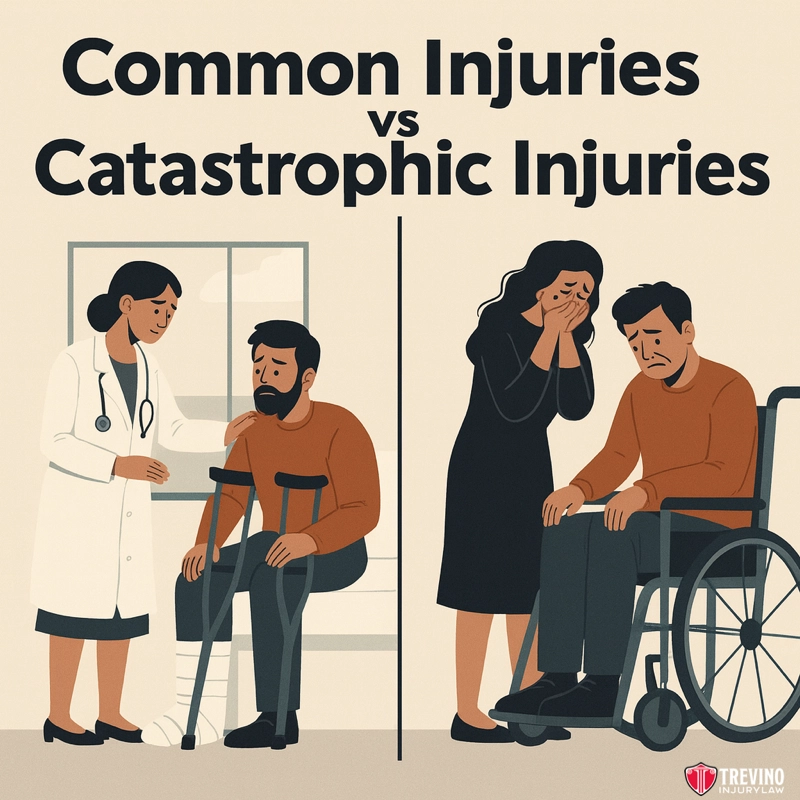
What Is the Difference Between “Common Injuries” and “Catastrophic Injuries”?
The legal and medical distinction is that “common injuries” (such as fractures) are expected to heal. In contrast, “catastrophic injuries” (like paralysis) are permanent, life-altering, and require a lifetime of medical and financial support.
This distinction is the most critical factor in determining the value and strategy for a legal case. The goals and stakes are entirely different.
Common Injury Claim: The value is calculated to cover past losses and short-term future needs. This typically includes ER bills, 6 months of physical therapy, lost wages for that period, and moderate pain and suffering.
Catastrophic Injury Claim: The value is calculated for a lifetime of permanent loss. This includes millions in future medical care, a total loss of all future potential earnings, and severe, permanent pain, suffering, and loss of quality of life. The type of injury matters, but just as important is the proof of that injury.
What Happens If My Injuries Are Not Documented Correctly?
Suppose your injuries are not documented immediately and correctly by a medical professional. In that case, the at-fault driver’s insurance company will argue that your pain is unrelated to the crash or that you are exaggerating, which can destroy your claim’s value. For the immediate medical and documentation steps discussed after a crash, see what to do after a bicycle accident in San Antonio.
This is the “gaps in treatment” concept. The insurer will pull your medical records and point to any delay in care, even waiting three days to see a doctor, as “proof” you weren’t really hurt.
Failing to see a doctor or missing your physical therapy appointments gives the insurer the ammunition they need to deny your claim. The absence of records is used as evidence against you.
What Is the “Hardest Injury to Recover From” Physically and Legally?
Physically, traumatic brain and spinal cord injuries are the hardest to recover from; legally, “invisible” injuries like mild TBIs, herniated discs, and PTSD are the hardest because they require expert legal and medical testimony to prove their severity to a skeptical insurance company.
This is where our “Trial Authority” persona is most critical. Insurance companies fight hardest to deny claims for injuries they can’t see on a simple X-ray. We are experts at proving these injuries, leveraging a network of neurologists and medical experts to build an undeniable case showing how an “invisible” injury has permanently damaged your life.
Why Hire a San Antonio Bicycle Accident Lawyer?
When the adrenaline fades after a catastrophic crash on Culebra Rd., you need relentless advocacy to secure your future. Insurance giants weaponize doubt, hoping you hire a volume-based settlement mill that folds before trial. At Trevino Injury Law, we fight for injured cyclists and force adjusters to pay the actual lifetime cost of your trauma.
Want to Protect the Full Value of Your Claim?
You’ve seen how this affects your case — but this is only one piece of the puzzle. Our Bicycle Accident Lawyer page breaks down what a trial-ready firm does differently.
We have a proven record of turning $20,000 lowball offers into recoveries of over $1 million. To protect your claim, our San Antonio personal injury crash lawyer. Act immediately to lock down critical scene evidence and secure the expert neurologist testimony needed to dominate in the Bexar County Courthouse.
Call 210-TREVINO for a free case review. Se Habla Español. We fight on a contingency-fee basis: No Win, No Fee.