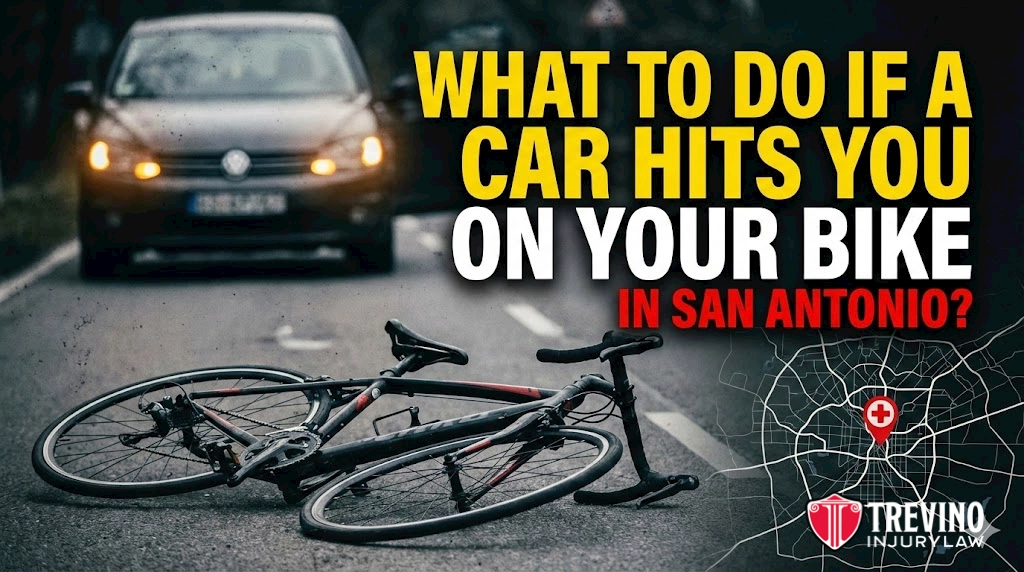
Move to safety, dial the police to create an official record, and get to an emergency room immediately. Adrenaline masks severe trauma, and failing to document your pain on day one destroys your case.
The at-fault driver’s insurance adjuster is already looking for a gap in medical treatment to argue your injuries happened after the crash. They want you to repair your damaged bicycle to erase the physical evidence of the impact. According to TxDOT data, the San Antonio district recorded 757 cyclist and pedestrian deaths in 2022 alone. Behind these impacts are negligent motorists on Culebra Road who hit riders and rely on defensive tactics to shift blame onto the victim.
What Could Your Bicycle Accident Case Be Worth?
Answer a few quick questions about your accident. Takes about 60 seconds.
See What My Case Might Be WorthThe insurance company offered less than $20,000. I ended up with over $1 million. — Jackie Galindo
Your bent frame is critical proof. A Spoliation Letter, a legal demand that stops the property owner from destroying evidence, must be sent immediately to secure nearby surveillance footage before it is deleted. Texas gives you two years to file suit.
Trevino Injury Law, a bicycle crash lawyer, takes over communication and secures the evidence before it vanishes. Call 210-TREVINO now for a free case review. You pay nothing unless we win. Se Habla Español.
San Antonio Bicycle Accident Lawyer: Key Takeaways
- As your bicycle accident lawyer in San Antonio, we preserve your rights after crashes on corridors like Culebra Rd in Bexar County.
- Our legal team stops insurance adjusters from utilizing recorded statements to twist facts and devalue your injury claim.
- Texas civil law classifies apologies as admissions by a party-opponent that a defense uses to shift blame.
- Trevino Injury Law sends preservation letters to secure video footage and trucking logs before evidence disappears.
What Are the First Steps to Take at the Accident Scene?
- Your first priority after a collision is to get to safety. If you are physically able, move yourself and your bike off the road and onto a sidewalk, curb, or nearby parking lot, away from any traffic.
- Second, call 911 immediately. This is a non-negotiable step, even if you feel fine. This call reports the crash to the San Antonio Police and creates the official legal record of the event. It also summons both police officers and medical responders to the scene.
- Third, if you are able, and while you are waiting for the police to arrive, you must gather essential information from the driver who hit you and any witnesses who saw the crash.
What Information Should You Give to the 911 Operator and Police?
Tell the 911 operator your exact location in San Antonio (e.g., “at the intersection of Bandera and 1604”), state that you are a cyclist hit by a car, and report any known injuries. When the San Antonio Police (SAPD) officer arrives, stick to the facts. State clearly what happened: “I was riding in the bike lane, and the car turned right into me”.
Crucially, do not admit any fault or apologize. Never say, ‘I’m sorry’ or ‘I didn’t see them.’ Under the Texas Rules of Evidence, these statements can be used directly against you as an “admission by a party-opponent”. As affirmed in Texas civil law (see, e.g., Bay Area Healthcare Grp., Ltd. v. McShane, 239 S.W.3d 231 (Tex. 2007)), such an admission can be powerful evidence for the defense to argue that you, not the driver, were responsible for the crash.
What Information Must You Get from the Driver and Witnesses?
You must get the driver’s full name, phone number, address, driver’s license number, insurance company, and policy number. The easiest way to do this is to ask them to take clear photos of their driver’s license and insurance card using your phone.
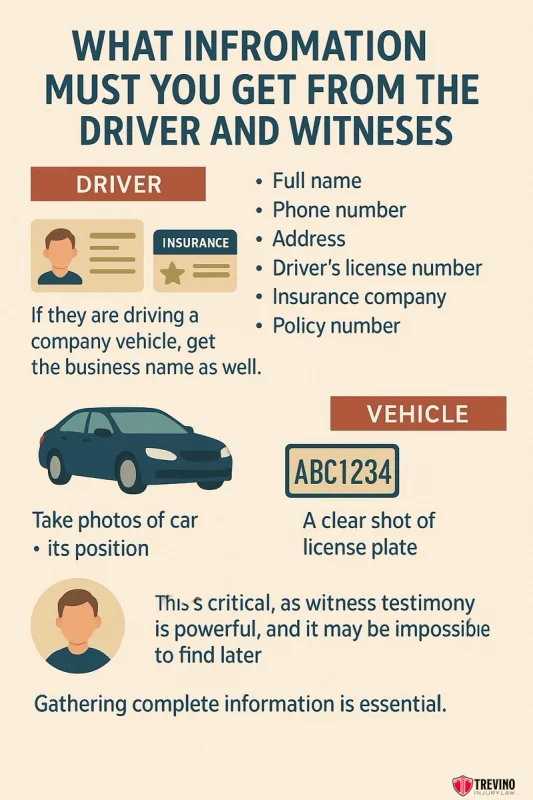
Gathering complete information is essential:
- Driver: Get all the information listed above. If they are driving a company vehicle, also obtain the business name.
- Vehicle: Take photos of the driver’s car, its position on the road, and, most importantly, a clear shot of the license plate.
- Witnesses: Get the full name and phone number of anyone who saw the crash. This is critical because witness testimony is powerful and may be impossible to obtain later.
Gathering this information is vital to your claim, but your health is your top priority, and what you do next to protect it is just as critical.
Why Is Seeking Medical Attention Immediately So Critical?
You must seek immediate medical evaluation at an ER (like University Health or a Methodist Healthcare System hospital), an urgent care clinic, or with your primary doctor, even if you feel fine, because adrenaline can hide life-threatening injuries, and it creates the primary piece of evidence for your claim.
Medically, a high-impact crash floods your body with adrenaline, which can mask the pain of severe injuries like internal bleeding, organ damage, or a traumatic brain injury (TBI).
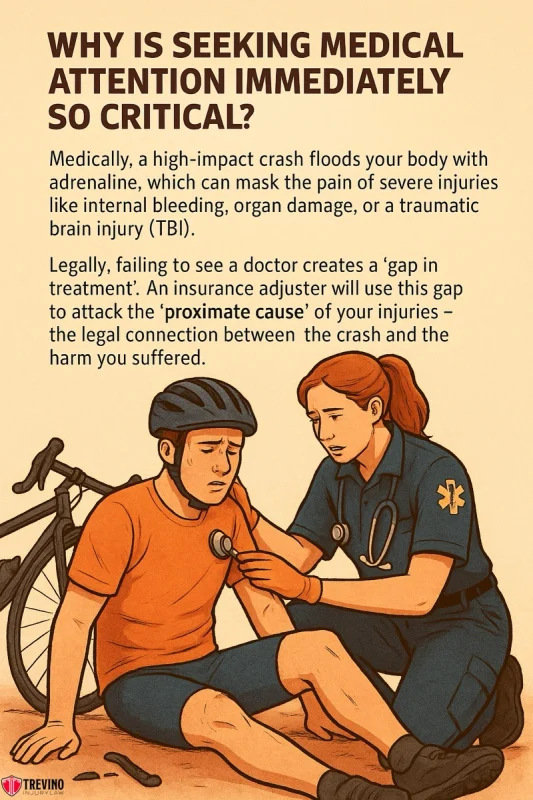
Legally, failing to see a doctor creates a “gap in treatment”. An insurance adjuster will use this gap to attack the ‘proximate cause’ of your injuries—the legal connection between the crash and the harm you suffered. Texas courts, as clarified by the Supreme Court of Texas in Guevara v. Ferrer, 247 S.W.3d 662 (Tex. 2007), require plaintiffs to provide evidence that the accident caused the injury.
A gap in treatment is a powerful tool for the defense to argue your injuries are not serious or that they happened after the bike crash, breaking the chain of causation and devaluing your claim.
If you were hit by a car while cycling, knowing the right steps to take immediately can make or break your injury claim. Always call the police and obtain a report when a vehicle hits a bicyclist, even if the injuries seem minor. This report provides essential insurance information and helps your attorney determine liability later.
Taking quick action also protects your legal options and ensures you’re entitled to compensation for your injuries and losses. A knowledgeable accident attorney can help you understand your rights, guide you through filing an insurance claim, and make sure the driver who struck you is held accountable under Texas law.
What If My Injuries Don’t Show Up Right Away?
Delayed-onset injuries, such as concussions (TBIs), whiplash, soft-tissue damage, or internal bleeding, are prevalent after a bike crash; symptoms may take hours or even days to appear. This is precisely why you must see a doctor immediately, even if you only feel “a little banged up”. This visit creates a baseline medical record.
If you feel fine on Monday but wake up with severe neck pain on Wednesday, the insurance company will argue you could have injured yourself in those two days. The immediate exam confirms the injuries were present at the time of impact.
Even if the cyclist feels fine after the crash, it’s crucial to see a doctor immediately to document the extent of your injuries and protect your right to be compensated. Under Texas law, failing to seek timely medical care or to file an insurance claim promptly can make it harder to prove liability or to connect your symptoms to the accident.
If you were hit by a car while riding a bike, you should also communicate with the insurance company carefully, or let an accident attorney handle it for you. This ensures that blame for the accident is determined correctly and that you receive the full compensation you may be entitled to for your recovery.
How Long After a Bike Accident Can I See a Doctor?
Ideally, you should be seen within 24 hours of the accident, and no later than 72 hours. From a legal perspective, every day you wait gives the insurance company more power to argue that your injuries are not severe or not related to the crash.
Waiting a week or more to seek treatment can be fatal to your claim, as an adjuster will almost certainly use it as a reason to deny your case or make an offensively low offer.
Protecting your health record is the first step in proving your case, but the next is preserving the physical evidence from the scene before it disappears.
- Question: “Is it okay to give a recorded statement to an insurance adjuster?”
- Location: H3 “What Are the Most Common Mistakes to Avoid…”, paragraph 1
- Integration: Answer it directly as one of the primary “mistakes.”
How Do You Document the Bicycle Accident Scene to Protect Your Claim?
If you are physically able, you must use your phone to take photos and videos of everything at the scene, as this physical evidence is essential for proving the driver who hit you was at fault.
This is not just a suggestion; it is critical for proving your case, especially since the scene will likely be dark. TxDOT data shows that 63% of fatal bike crashes in Texas occur at night, with the deadliest hours being between 6:00 p.m. and midnight. Use your phone’s flash to capture the following before it’s lost:
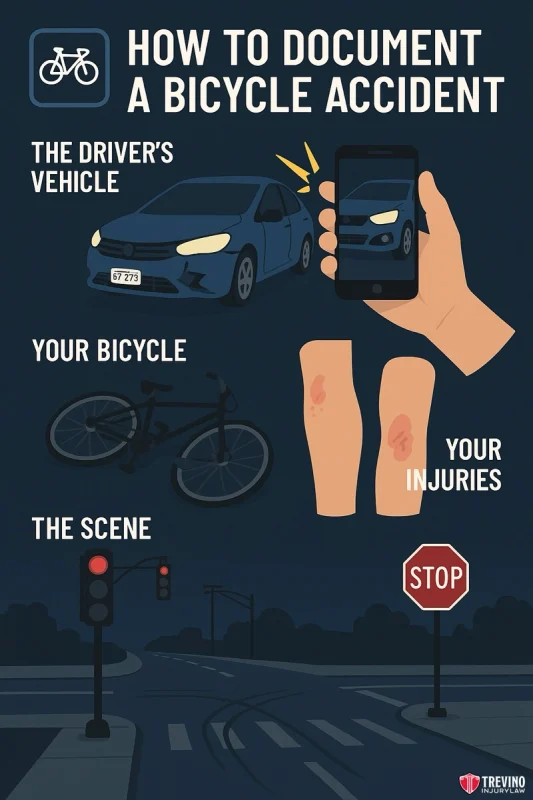
Your photos should tell the complete story of what happened:
- The Driver’s Vehicle: Obtain clear photos of the license plate, any damage to the car (e.g., dents, broken mirrors), and its final resting position relative to the road.
- Your Bicycle: Document the damage to your bike from multiple angles. Show the broken frame, bent wheels, or damaged gears.
- Your Injuries: Photograph any visible cuts, bruises, scrapes, or “road rash” immediately. These injuries heal, so capturing them at their worst is critical.
- The Scene: Take wide-angle shots of the intersection, traffic signals, stop signs, road conditions (like potholes or construction), and any skid marks on the pavement.
What Are the Most Common Mistakes to Avoid After a Bike Accident?
The biggest mistakes are admitting any fault (e.g., saying “I’m sorry”), failing to call the police to create an official report, and giving a recorded statement to the at-fault driver’s insurance adjuster. Answering the common question, “Is it okay to give a recorded statement to an insurance adjuster?” the answer is absolutely not.
The adjuster is not your friend; their job is to pay you as little as possible. They are trained to ask leading questions to twist your words and make you seem at fault. Politely decline and tell them to contact your attorney.
How to Get a San Antonio Police Report After Being Hit by a Car While Cycling
After the crash, the San Antonio Police Department will finalize the official Texas Peace Officer’s Crash Report (CR-3), which you can then order online through the SAPD’s crash report portal or request in person.
This report is the foundation of your claim. It is a critical piece of evidence that includes the officer’s opinion of fault, a crash diagram, witness information, and the other driver’s insurance details.
Once you have taken these immediate steps to preserve evidence and avoid critical mistakes, your next thought is naturally about the legal process and when to engage legal counsel.
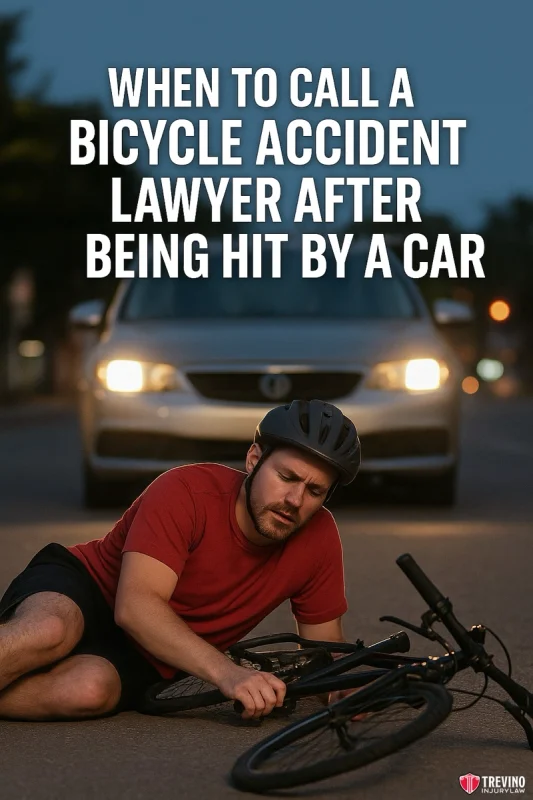
When to Call a Bicycle Accident Lawyer After Being Hit by a Car
You should call a bicycle accident lawyer immediately after you are medically stable, ideally from the scene or within 24 hours of the crash. The insurance company for the at-fault driver starts building its case against you immediately, often dispatching investigators to the scene and calling you for a recorded statement within hours. When choosing whom to call, understand the difference between a bicycle accident trial lawyer and a settlement mill.
Your attorney needs to act just as quickly. We must send evidence preservation letters to secure video footage or trucking logs, contact witnesses before their memories fade, and take over all communication with the insurance adjuster.
This single action protects you from making a critical mistake, such as giving a recorded statement that could devalue your claim. Waiting even a week can mean vital evidence is lost forever. Many victims hesitate to call because they are worried about unique or difficult circumstances, such as a hit-and-run or an uninsured driver.
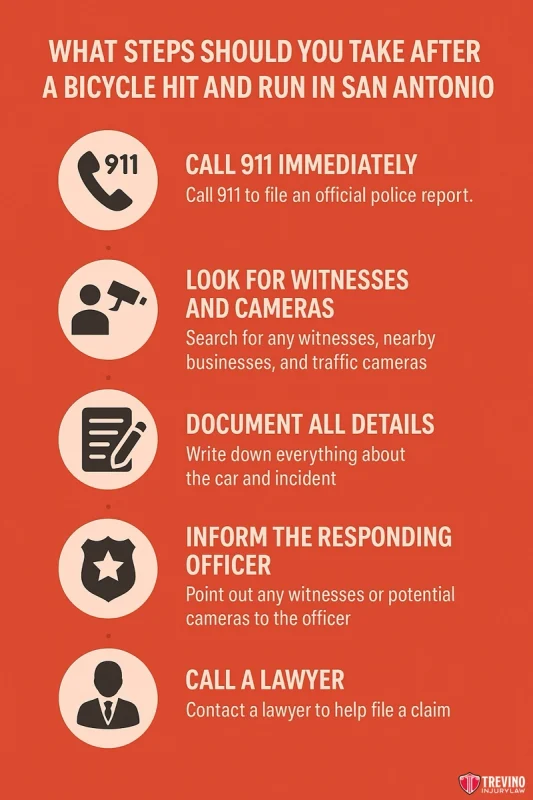
What Steps Should You Take After a Bicycle Hit and Run in San Antonio?
Step 1: Call 911 immediately. Your first step is to call 911 to file an official police report. A hit-and-run is a criminal act, so creating an official record is paramount.
Step 2: Look for Witnesses and Cameras. While you wait, look for any witnesses who saw what happened. Also, scan nearby businesses, doorbells, or traffic lights for any surveillance cameras that might have captured the vehicle.
Step 3: Document All Details Write down everything you remember about the car, including its make, model, color, and any part of the license plate you saw. Also, note the time of day and the direction the car fled.
Step 4: Inform the Responding Officer. When the San Antonio Police (SAPD) officer arrives, point out any witnesses or potential cameras you identified.
Step 5: Call a Lawyer. After you are medically stable, your next call should be to your lawyer. We can help investigate the crash and file a claim under your own Uninsured/Underinsured Motorist (UM/UIM) coverage to help pay for your injuries and damages.
What if the Driver Who Hit Me Has No Insurance?
If the at-fault driver has no insurance, you can still recover compensation by filing a claim against your own auto insurance policy’s Uninsured/Underinsured Motorist (UM/UIM) coverage. This is the exact reason you pay for this specific coverage: it protects you when a negligent driver is uninsured or flees the scene.
When you file a UM/UIM claim, your own insurance company effectively steps into the shoes of the at-fault driver. However, this often means your insurer becomes your adversary, as their goal is still to pay out as little as possible. This is why you still need an experienced trial attorney to fight for your rights, even when dealing with your own insurance company.
What Happens if I Don’t File a Police Report for a Bike Accident?
If you do not file a police report, the insurance company will have a strong basis to deny your claim entirely, as there is no official, third-party evidence that the crash happened, who was involved, or that their driver was at fault. A police report is the most critical piece of evidence from the scene.
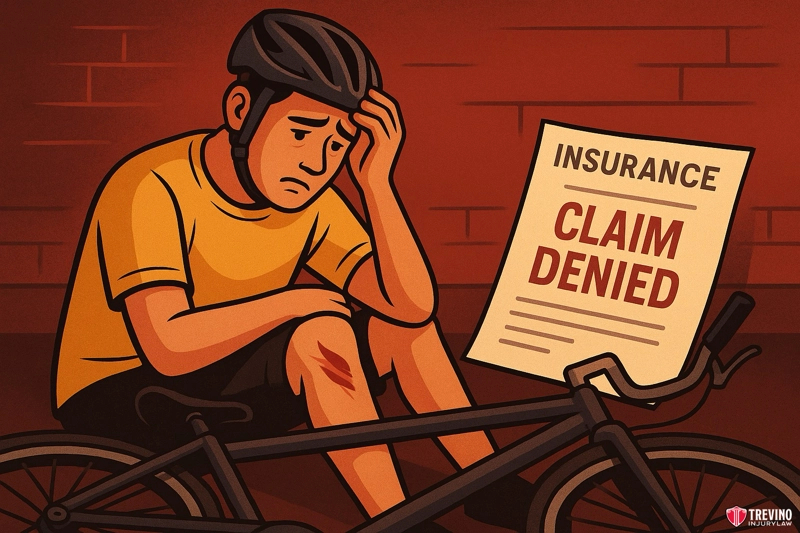
Without it, the driver can easily change their story, and the case becomes a “he said, she said” situation, which insurance companies love because it allows them to deny liability. Failing to call 911 and file a report is one of the most damaging mistakes a victim can make.
Should I Get My Bike Repaired Right Away?
No, you absolutely should not have your bicycle repaired or discarded until your attorney clears you to do so; your damaged bike is critical evidence that must be preserved. Repairing the bike or discarding it constitutes “spoliation of evidence” and can seriously harm your case.
Your attorney and an accident reconstruction expert may need to inspect the bike’s frame, tires, and components. The damage to the bike can prove the force of the impact, the angle of the collision, and help disprove any claims that you were at fault. Keep the bike in its damaged state in a safe, dry place.
Why Hire a San Antonio Bicycle Accident Lawyer?
The terrifying aftermath of a crash on Culebra Rd shifts immediately into a battle for fair financial compensation. While settlement mills want you to accept a quick payout and disappear, Trevino Injury Law operates with a trial-first mindset. We do not let insurance adjusters twist facts to devalue your injury claim. We fight for families and force defense attorneys to pay.
Want to Protect the Full Value of Your Claim?
You’ve seen how this affects your case — but this is only one piece of the puzzle. Our Bicycle Accident Lawyer page explains how a trial-ready firm operates differently.
We turn lowball offers into record-breaking jury verdicts, including a 107x verdict at the Bexar County Courthouse. To secure expert accident reconstruction and prevent spoliation of evidence, hire a San Antonio personal injury lawyer to protect the truth.
Call 210-TREVINO for a free case review today. Se Habla Español. We fight on a No-Win, No-Fee basis.