
Liability for an overloaded or fatigued 18-wheeler crash in Texas falls on the corporate dispatcher who set the schedule, the warehouse that loaded the trailer beyond the legal axle weight, and the driver who could not stop in time. The person behind the wheel is rarely the only defendant.
The negligent trucking company is already wiping electronic logging device data and shredding weight manifests under the cover of routine record retention, erasing the corporate fingerprints on the crash. Trevino Injury Law secured a $17 Million wrongful death settlement by subpoenaing dispatch records that exposed exactly this kind of corporate concealment. That outcome is impossible once the records are gone.
What Could Your 18-Wheeler Accident Case Be Worth?
Answer a few quick questions about your accident. Takes about 60 seconds.
See What My Case Might Be WorthThe insurance company offered less than $20,000. I ended up with over $1 million. — Jackie Galindo
ELD data and bills of lading disappear within weeks. A Spoliation Letter, a legal demand that stops the trucking company from destroying evidence, must go out immediately to lock down the black box, the dispatch logs, and the loading manifests. Texas gives you two years to file. The corporate retention windows close far sooner.
At Trevino Injury Law, our big rig accident lawyers classify your case on day one and subpoena the dispatch and weight records before they vanish. Call 210-TREVINO now for a free case review. You pay nothing unless we win. Se Habla Español.
How Does Excess Cargo Weight Compound the Dangers of Driver Fatigue?
Excess cargo weight exponentially increases the risk of driver fatigue because overloaded trailers require significantly longer braking distances and sharper reflexes to control, both of which an exhausted driver lacks.
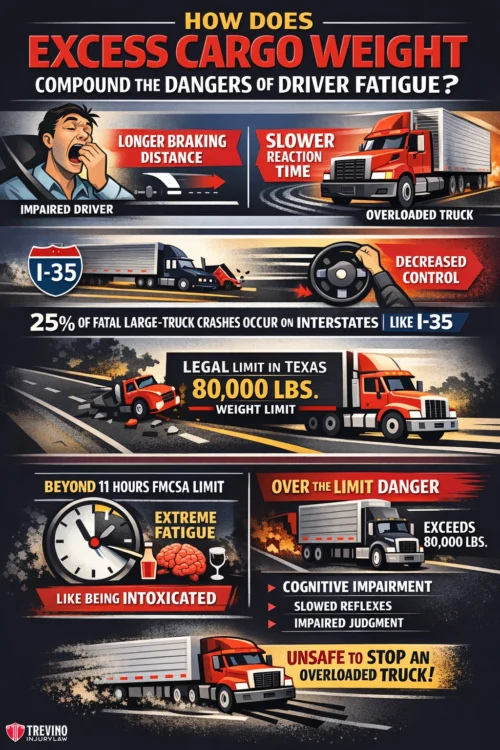
Operating a commercial vehicle on highways like I-35 requires intense focus and precision, especially considering that about a quarter of all fatal large-truck crashes occur on interstates. An exhausted driver operating an overloaded trailer is physically incapable of executing the advanced steering and braking maneuvers required to safely navigate these high-speed corridors.
The legal weight limit for a semi-truck in Texas is 80,000 pounds. Discussing how a driver operating beyond the 11-hour FMCSA driving limit experiences cognitive impairment similar to intoxication is critical, as this makes them physically incapable of executing the advanced steering and braking maneuvers required to safely stop a truck carrying more than the Texas legal limit.
Determining exactly who is responsible for the crash requires immediate action. When a victim is injured in a truck accident, our legal team utilizes a forensic approach to uncover the truth and identify all liable parties:
- Advanced Accident Reconstruction: By thoroughly analyzing the crash scene and the precise physics of the wreckage, experts can pinpoint if shifting or excessively heavy cargo directly contributed to the crash.
- Identifying the Root Cause: This mechanical analysis reveals whether the driver simply failed to react, or if negligent third-party loaders created a fundamentally uncontrollable vehicle for the driver or their employer. Under Texas law, determining fault for the accident is rarely limited to just the person behind the wheel.
- Product and Equipment Failures: Liability can extend into other complex legal domains. For instance, if a commercial cargo strap or securing mechanism fails under extreme weight, a manufacturer may be liable under product liability law.
- Corporate Negligence: Any corporate entity whose negligence played a role, from the trucking company’s dispatchers who failed to prevent truck driver fatigue, to the warehouse facility that overloaded the trailer, can be held responsible.
- Securing Full Compensation: These high-stakes claims often involve fighting a massive corporate insurer determined to minimize your payout. By holding all responsible parties accountable, we ensure the correct liable parties are held financially responsible for your catastrophic medical bills, future life care plans, and profound pain and suffering.
If you or a loved one has been injured in a truck accident, you cannot rely on the trucking company to voluntarily admit fault. Contact our trial-tested legal team for a free consultation to protect your rights before critical evidence is destroyed.
How Do Trucking Companies Violate FMCSA Weight and Hours-of-Service Regulations?
Trucking companies commit FMCSA violations by forcing drivers to meet unrealistic delivery deadlines, falsifying logbooks to hide driving hours, and bypassing San Antonio weigh stations to conceal overloaded trailers.
These systemic corporate failures shift liability from the individual driver directly to the parent company under the doctrine of respondeat superior. In Texas, this vicarious liability doctrine was thoroughly clarified in the landmark case Painter v. Amerimex Drilling I, Ltd., 561 S.W.3d 125 (Tex. 2018), which held that an employer is liable if the employee’s tortious act falls within the course and scope of their general authority and is in furtherance of the employer’s business.
Common trucking company violations include:
- Mandating strict delivery schedules that mathematically require drivers to exceed legal speed limits.
- Ignoring or falsifying pre-trip inspection reports that clearly show overweight axles.
- Compensating drivers per mile rather than per hour directly encourages illegal, continuous driving without required rest.
Once you understand how the physics of an overloaded trailer interact with physical exhaustion, the next critical question becomes how corporate policies actively force drivers into these dangerous situations.
Can You Sue a Trucking Company If Their Scheduling Policies Force Drivers to Drive Fatigued?
Yes, you can sue a trucking company directly for negligence if their internal routing schedules, compensation structures, or delivery demands mathematically force drivers to violate federal hours-of-service regulations to keep their jobs. We litigate to verdict against these negligent trucking companies to secure maximum compensation for victims.
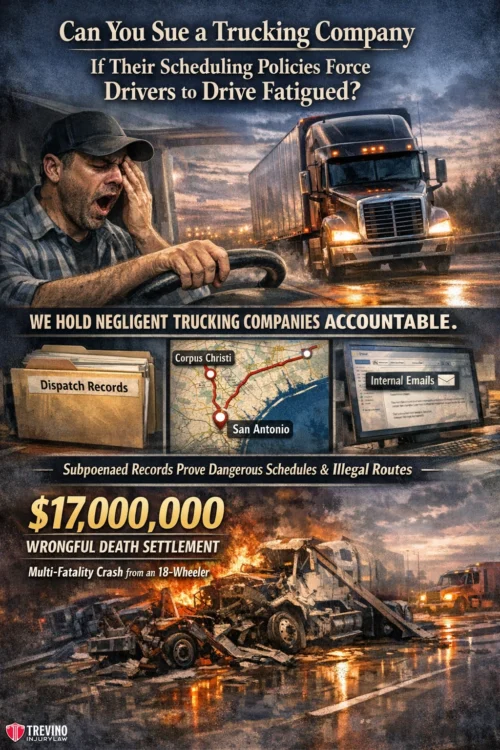
San Antonio personal injury attorneys actively subpoena dispatch records, internal emails, and GPS routing software to prove the company knew the route from the Port of Corpus Christi to San Antonio could not be completed legally without speeding or skipping mandatory rest breaks. Our firm has successfully used this aggressive approach to secure a $17 Million settlement in a wrongful death case involving multiple fatalities caused by an 18-wheeler.
What Evidence Proves a Trucking Company Ignored Driver Fatigue and Overloading?
The primary evidence used to prove a trucking company ignored safety regulations includes audited electronic logging device (ELD) data, bills of lading comparing dispatched weight versus actual weight, internal dispatch communications, and pre-trip inspection reports.
Securing this requires immediate legal action before the company is legally permitted to destroy the records. A critical step in San Antonio 18-wheeler accident evidence preservation is sending a formal spoliation letter to prevent the deletion of physical and digital logs.
The severe legal consequences for destroying such evidence were definitively established by the Texas Supreme Court in Brookshire Bros., Ltd. v. Aldridge, 438 S.W.3d 9 (Tex. 2014), which governs how trial courts assess and impose strict sanctions for the intentional or negligent spoliation of relevant evidence.
- Obtaining weigh station tickets from checkpoints near Loop 1604 or I-10.
- Subpoenaing the truck driver’s cell phone records to reveal dispatch pressure during the trip.
Establishing this chain of corporate liability lays the foundation for understanding how we use the truck’s highly technical computer systems to prove the driver failed to react.
How Do Attorneys Use Black Box Data to Prove a Fatigued Driver Failed to Brake?
Attorneys extract data from the truck’s Event Data Recorder (black box) to prove driver fatigue by demonstrating a lack of evasive steering inputs or delayed braking applications in the seconds immediately preceding the crash. This mechanical data is undeniably critical given that 5.2% of fatal truck crashes occur in construction zone environments that demand sharp reflexes and immediate braking, which a fatigued driver fundamentally lacks.
A fully alert driver will typically register hard braking and steering changes when a collision is imminent. Conversely, a fatigued or sleeping driver will show no change in cruise control speed or throttle position until the exact moment of impact.
If you need more information on securing this specific evidence, you can read our resource on the Texas spoliation letter for black box data and how it locks down the ECM before the carrier overwrites it.
Because this vital digital evidence is frequently erased or destroyed by trucking companies, understanding the specific legal timeframes you have to act is absolutely critical for your case.
In Texas, you have exactly two years from the date of the commercial truck accident to file a personal injury lawsuit against the fatigued driver, the trucking corporation, or the cargo loading company, but waiting to take action often results in the destruction of critical digital and physical evidence.
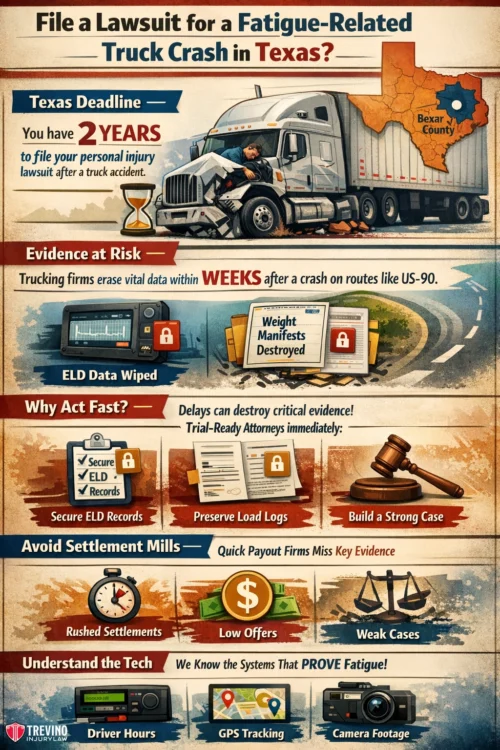
While this legal deadline applies to filing your claim in Bexar County civil courts, the reality of evidence preservation operates on a much tighter timeline. Within weeks of a severe collision on routes like US-90, trucking companies begin wiping ELD data and destroying weight manifests under the guise of routine record maintenance. This spoliation of evidence can devastate your case if you do not have a trial-ready attorney step in immediately to secure it.
High-volume settlement mills often miss these crucial early windows because they prioritize quick payouts over building trial-ready cases. We litigate to verdict, which means our first priority is to send formal preservation demands to lock down the exact data needed to force insurance companies to pay the full value for catastrophic injuries.
While filing your lawsuit on time protects your legal right to pursue compensation, understanding the specific electronic systems that record this critical evidence determines how effectively we can prove your case.
How Do Electronic Logging Devices (ELDs) Track Driver Hours and Identify Fatigue Violations?
Electronic logging devices (ELDs) automatically record driving time by synchronizing with the truck’s engine to capture movement, miles driven, and engine hours, making it difficult for drivers to easily falsify their hours of service. The Federal Motor Carrier Safety Administration mandates these devices to create a precise digital footprint of a commercial driver’s workday. Before ELDs, paper logbooks were easily altered to hide continuous driving. Now, the system logs when the engine is running and the vehicle is moving.
Our litigation team analyzes this data to uncover systemic FMCSA violations. A trial-tested 18-wheeler crash attorney knows how to cross-reference ELD data with fuel receipts, toll booth timestamps, and GPS routing data. This forensic approach reveals exactly how long a driver had been behind the wheel before a collision on congested routes like Culebra Road. We use this undeniable data to expose negligent trucking companies and secure maximum compensation for your family.
Do Electronic Logging Devices Definitively Prove Driver Fatigue?
No, while ELDs definitively prove a driver violated hours-of-service limits, they only establish a presumption of fatigue, which must be corroborated by crash data and witness testimony.
We build comprehensive cases by combining ELD violations with black-box steering data to prove complete physical exhaustion.
Can Weight Tickets Establish Trucking Company Negligence?
Yes, certified weight tickets from weigh stations provide indisputable documentary evidence that a trucking company or loading facility allowed an illegally overloaded vehicle onto public roadways. We subpoena these records from facilities across South Texas to prove intentional regulatory bypasses.
How Do San Antonio Courts Assign a Percentage of Fault Between Truck Drivers and Shipping Companies?
Texas courts use proportionate responsibility laws to assign specific percentages of fault to each party, meaning a jury might find the driver 40% liable for fatigue and the cargo loader 60% liable for overloading. Under the Texas Civil Practice and Remedies Code, multiple corporate defendants can share liability for a single catastrophic injury.
When an exhausted driver loses control of an illegally heavy trailer near the Medical Center, both the trucking employer and the third-party logistics company face strict legal scrutiny. A seasoned semi-truck collision law firm must untangle these complex multi-defendant scenarios. We litigate to a verdict against all negligent parties.
If a defendant is found more than 50% responsible, they can be held jointly and severally liable for all damages. This powerful legal mechanism is vital for securing life care planning funds for families dealing with permanent injuries.
What happens to Your Claim If the Truck Driver Was Not Technically over the FMCSA hours limits?
Even if a driver was technically operating within their legal hours of service, you can still pursue a negligence claim by proving they were visibly exhausted, impaired by medication, or driving while sick. Legal hours-of-service limits establish the absolute ceiling for operations, not the baseline for safety.
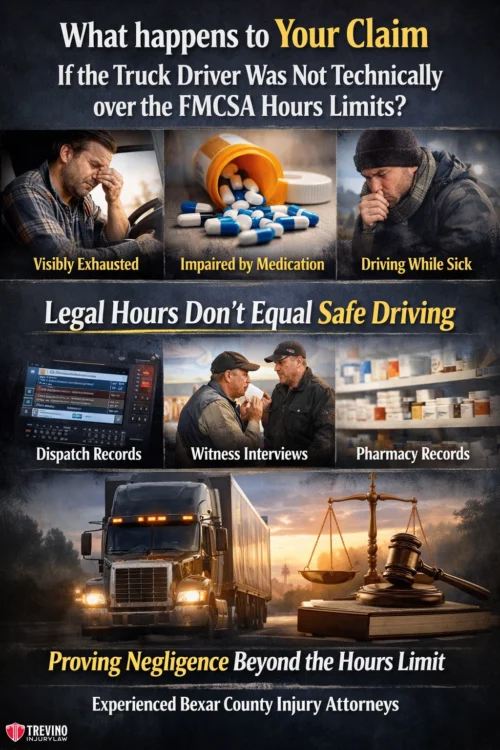
A commercial driver can log only five hours but still suffer from severe physical illness. In these situations, we pursue common-law negligence claims rather than statutory negligence claims.
We aggressively investigate dispatch communications, witness statements at truck stops, and pharmacy records to demonstrate that the driver was unfit to operate a massive vehicle. A dedicated Bexar County injury attorney knows how to hold companies accountable for dispatching visibly impaired personnel onto public roadways.
When Does Cargo Weight Not Apply as Grounds for Liability in a Commercial Vehicle Crash?
Cargo weight will not apply as grounds for liability if the crash was caused entirely by a separate mechanical failure, such as a blown steer tire, or if the trailer was hauling a legally permitted, specialized oversized load. In some cases, the sheer mass of the vehicle is legally sanctioned or completely irrelevant to the crash mechanics.
If a fully compliant truck suffers a catastrophic brake failure due to poor maintenance, the focus shifts entirely to the maintenance provider rather than the cargo loader. Similarly, hauling an authorized oversized load on designated routes requires specific escort protocols.
If those strict protocols are followed, the weight itself is not the negligent factor. We analyze the precise physics of each collision to identify the correct liability factors and compel insurance companies to pay the full value.
Why Hire a San Antonio 18-Wheeler Accident Lawyer?
When an exhausted driver crashes an overloaded trailer on I-35, your family’s future is threatened. Negligent trucking companies ruthlessly minimize payouts, while high-volume settlement mills fold quickly to avoid court. At Trevino Injury Law, we fight for families and force corporate defendants to pay full compensation.
Want to Protect the Full Value of Your Claim?
You’ve seen how this affects your case — but this is only one piece of the puzzle. Our 18 Wheeler Accident Lawyer page breaks down what a trial-ready firm does differently.
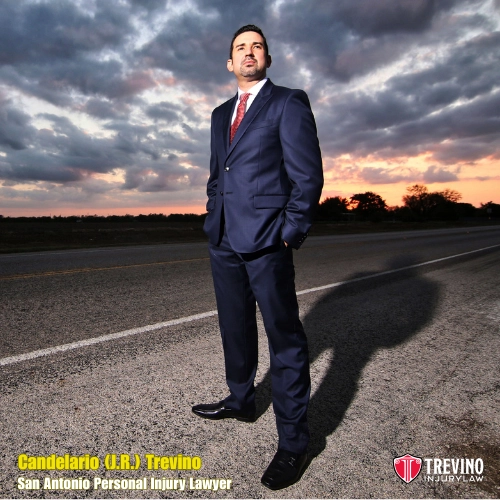
Our aggressive Trial Lawyer strategy secured a $17 million settlement in a commercial crash case. To win in Bexar County, your San Antonio personal injury lawyer will immediately send a spoliation letter to lock down critical black box data.
Call 210-TREVINO for a free case review. Se Habla Español. No Win, No Fee.