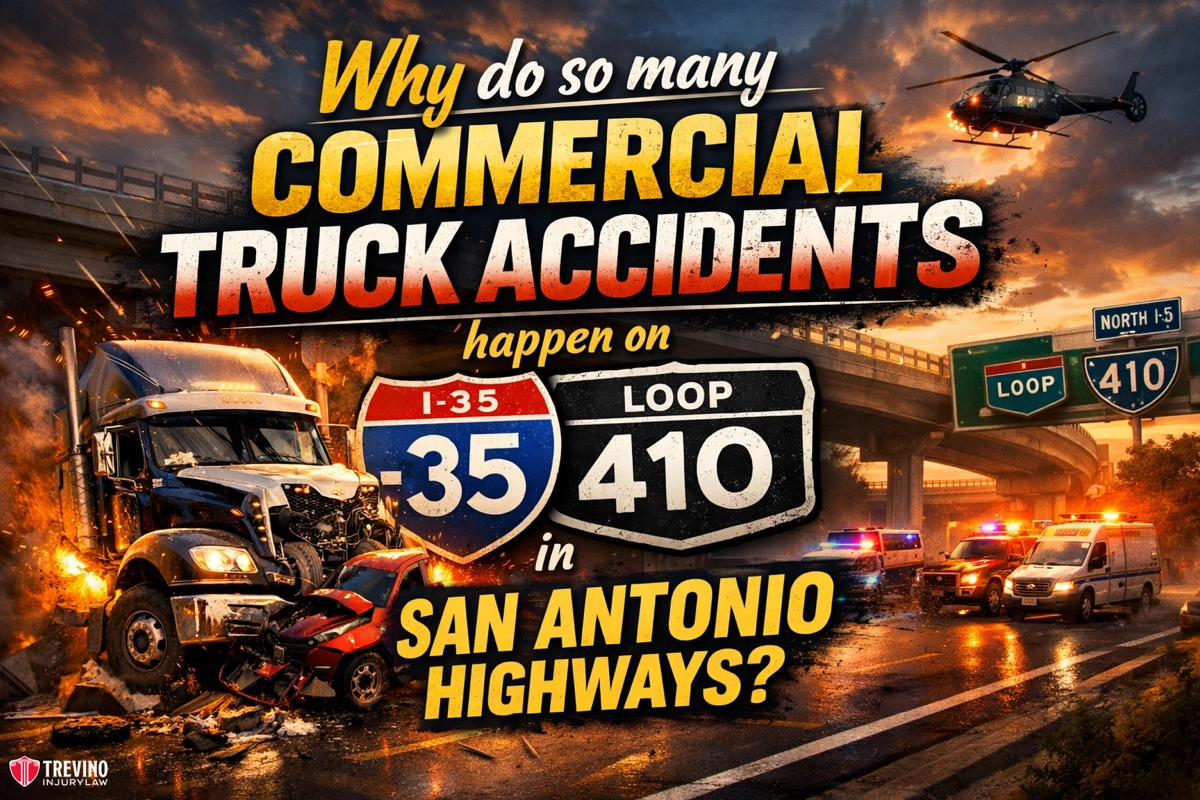
I-35 and Loop 410 force heavy freight to merge abruptly with dense commuter traffic in complex interchanges, creating dangerous driving conditions for 18-wheelers. Overloaded eighteen-wheelers entering the Mixing Bowl break their center of gravity on sharp ramps. Operators violate federal speed mandates to meet unrealistic deadlines, causing catastrophic rear-end collisions when local congestion forces sudden stops.
Negligent trucking companies immediately deploy rapid-response teams to the crash site to conceal driver fatigue and shift blame to poor highway design. They scrub the mobile dispatch logs before you leave the hospital. According to the firm’s verdict history, Trevino Injury Law secured a $17 Million settlement in a commercial wrongful death case by aggressively bypassing these exact corporate defense tactics.
What Could Your 18-Wheeler Accident Case Be Worth?
Answer a few quick questions about your accident. Takes about 60 seconds.
See What My Case Might Be WorthThe insurance company offered less than $20,000. I ended up with over $1 million. — Jackie Galindo
Critical evidence vanishes in the first week. Internal dash camera footage gets deleted. A Spoliation Letter, a legal demand that prevents the property owner from destroying evidence, must be sent immediately to lock down the vehicle data. Texas gives you two years to file suit. After that window, the claim dies.
At Trevino Injury Law, a San Antonio 18-wheeler accident lawyer subpoenas this hidden data on day one and relentlessly litigates against the insurance company. Call 210-TREVINO now for a free case review. You pay nothing unless we win. Se Habla Español.
What Makes the I-35 and Loop 410 Interchanges so Dangerous for 18-Wheelers?
The I-35 and Loop 410 interchanges are uniquely dangerous for 18-wheelers because their complex “Mixing Bowl” design requires rapid lane changes, creating massive risks. Because commercial trucks have significant blind spots, navigating San Antonio‘s highways, including highways like Loop 1604, is especially dangerous. In fact, this intersection is widely considered one of the most dangerous on all San Antonio roadways. When a catastrophic truck collision occurs here, the resulting trauma is devastating, causing victims to suffer serious injuries.
As a major transit point, San Antonio sits at a critical junction. San Antonio’s position as a major hub for NAFTA trade means heavy commercial traffic converges abruptly with local commuter traffic. The sheer volume of commercial and large commercial truck transport means that truck drivers traveling from Laredo must share tight lanes with smaller passenger cars. This convergence drastically reduces a driver’s reaction time, especially during rush hour. Because crashes often happen here, drivers must remain vigilant on San Antonio roads.
As San Antonio continues to grow, the density of trucks on its streets makes these corridors high-risk zones for severe vehicle accidents. Even on unforgiving highway infrastructure, commercial operators owe a strict duty of care under personal injury law. Unfortunately, commercial truck crashes happen regardless of the law, and a serious truck collision can permanently alter a family’s future.
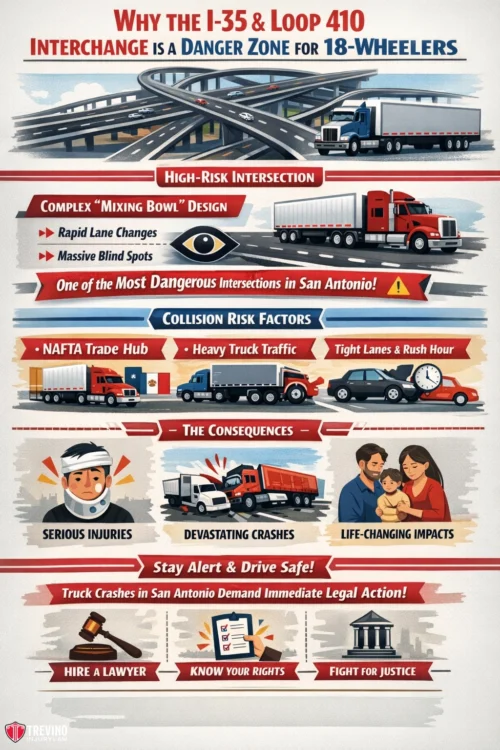
Because truck crashes often involve excessive speeds, these serious accidents occur frequently simply due to operators failing to adjust to hazardous conditions. As recently reinforced by the Texas Supreme Court in Werner Enterprises, Inc. v. Blake, 719 S.W.3d 525 (Tex. 2025), a commercial driver’s failure to adapt their speed can form the basis of severe liability, the impacts of which are felt in San Antonio and indeed throughout Texas.
When serious truck accidents occur, they often involve complex litigation to hold all liable parties accountable. Because crashes happen with alarming frequency throughout Bexar County, victims must take immediate action. If a loved one has been injured or if you were injured in a truck collision, you must not wait.
To protect your rights against the rapid-response defense teams protecting commercial truck traffic, you need to speak with a San Antonio legal team. It is crucial to hire an experienced truck accident advocate. You need a San Antonio truck accident attorney and a dedicated truck accident attorney who understands how to litigate these complex cases. Our injury attorneys are ready to fight for you.
What Are 90% of Commercial Truck Accidents Caused by on These Routes?
Despite challenging road designs, 90% of commercial truck accidents on these routes are ultimately caused by driver error, specifically speeding to meet unrealistic delivery deadlines, severe driver fatigue, and distracted driving. When an 18-wheeler crash attorney investigates these collisions, we consistently uncover specific negligent actions taken by drivers operating under corporate pressure. The leading driver errors include:
- Severe fatigue from violating federal hours-of-service regulations.
- Distracted driving due to mobile dispatch systems.
- Speeding through congested zones to bypass heavy traffic.
Where Do 40% of All Fatal Highway Crashes Occur in Bexar County?
Approximately 40% of all fatal highway crashes in Bexar County occur along the highly congested I-35 corridor and the sharp interchange ramps of Loop 410, where high-speed commercial traffic mixes with sudden traffic standstills.
These deadly zones act as chokepoints where passenger vehicles are easily trapped between speeding semi-trucks. This local danger reflects a devastating national trend; in 2023, large trucks accounted for 9% of all vehicles involved in fatal crashes nationwide, with 5,375 large trucks involved in fatal collisions, a staggering 43% increase over the last 10 years.
Recognizing these geographic patterns helps our legal team isolate the specific failures of the commercial operator. While understanding the structural dangers of the Mixing Bowl is important, knowing the physical mechanics of how these crashes occur reveals exactly why they are so devastating.
Why Do Commercial Trucks Frequently Roll Over or Rear-End Vehicles on Loop 410?
Commercial trucks frequently roll over on Loop 410 exit ramps because drivers often misjudge curve speeds, leading to severe cargo shifts in overloaded trailers that violently break the truck’s center of gravity and cause catastrophic impacts, raising the question of who is liable for an overloaded or fatigued 18-wheeler crash when corporate dispatchers and cargo loaders share fault with the driver.
The physics of a commercial vehicle demand extreme precision. The centrifugal force on the sharp ramps of the South Side requires drivers to significantly reduce their speed, yet many maintain highway speeds until it is too late. Stopping an 80,000-pound vehicle takes the length of nearly two football fields. To avoid catastrophic collisions, operators are taught specific defensive driving techniques. How does the 3/6 second following rule prevent rear-end pileups?
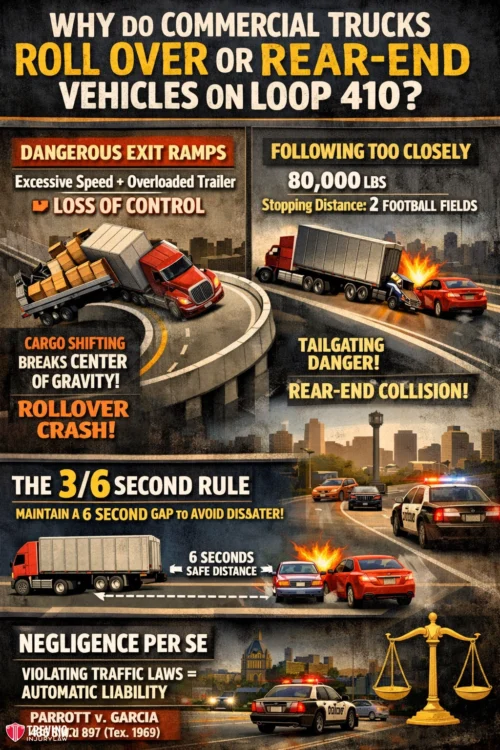
By maintaining a minimum following distance of 6 seconds, commercial drivers ensure they have adequate space to brake when traffic suddenly halts. When an 18-wheeler operator routinely ignores these safety standards in dense San Antonio traffic and violates state traffic laws (such as following too closely), they can be held liable under the doctrine of negligence per se.
The Texas Supreme Court established the foundational elements for this legal doctrine in Parrott v. Garcia, 436 S.W.2d 897 (Tex. 1969), dictating that an unexcused violation of a statute designed to prevent injury directly constitutes negligence.
What Are the Odds of Surviving a Rollover Commercial Crash?
The odds of surviving a commercial rollover crash without severe, permanent injury are incredibly low for passenger vehicle occupants, as these collisions frequently result in catastrophic roof crushes and multi-lane pileups.
Victims often suffer devastating trauma, including traumatic brain injuries and permanent spinal cord damage, requiring a lifetime of specialized medical care. Highlighting the sheer volume of these catastrophic events caused by Negligent Trucking Companies, 114,552 large trucks were involved in crashes resulting in an injury nationwide in 2023, representing a 12% increase in the number of trucks involved in injury crashes since 2016.
Victims often suffer devastating trauma, including traumatic brain injuries and permanent spinal cord damage, requiring a lifetime of specialized medical care. We have seen these catastrophic results firsthand, successfully litigating to a verdict when insurance companies attempt to minimize the victim’s suffering.
Understanding the catastrophic mechanics of these rollovers underscores the absolute necessity of obtaining the right evidence to establish liability.
What Evidence Proves Driver Negligence Caused Your I-35 Truck Crash?
Proving driver negligence in an I-35 truck crash requires immediately securing the commercial black box data (ECM) and internal dash cam footage to verify whether the trucker was speeding, fatigued, or following too closely, and deploying a legal spoliation letter to prevent the destruction of evidence.
The moment a crash occurs, negligent trucking companies mobilize rapid-response teams to protect their financial interests and conceal driver errors. To counter this, a dedicated San Antonio 18-wheeler accident attorney must aggressively intervene.
Our early investigation process includes demanding maintenance logs, securing witness statements, and retrieving electronic logging device (ELD) records to prove the driver failed to brake for a standstill traffic jam. This aggressive preservation strategy has yielded verifiable results, such as a $1.8 Million Settlement for a spinal injury caused by a commercial truck crash.
What Specific FMCSA Speed Limits Apply to 18-Wheelers on Loop 410?
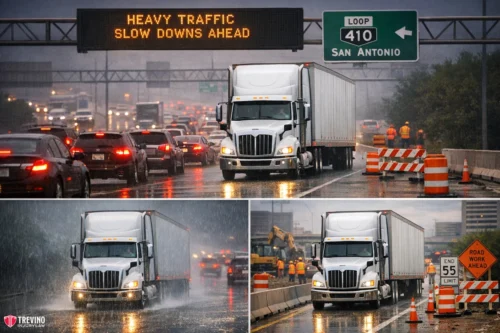
While San Antonio sets posted speed limits on Loop 410, FMCSA regulations require commercial truck drivers to drastically reduce their speed below the posted limit during heavy congestion, adverse weather, or construction zones. A semi-truck collision law firm knows that a truck traveling the official speed limit can still be legally speeding and negligent under federal rules if conditions are hazardous. FMCSA regulations mandate immediate speed reduction during:
- Heavy commuter congestion leading to sudden stops.
- Adverse weather conditions, such as heavy rain.
- Active construction zones with narrowed lanes.
Securing this vital evidence quickly establishes liability, but you must also understand how timing and traffic patterns affect your specific case.
Are Certain Days of the Week the Riskiest for I-35 Truck Accidents?
Weekdays, specifically Tuesday through Thursday during the dense morning and evening rush hours, are the absolute riskiest times for I-35 truck accidents due to the dangerous convergence of local San Antonio commuter traffic and massive interstate commercial traffic and oilfield transport.
Navigating these corridors requires extreme situational awareness. During these peak mid-week periods, the volume of 18-wheelers acting as NAFTA carriers spikes dramatically as goods move north from Laredo. Simultaneously, regional trucks returning from the Eagle Ford Shale add heavy industrial traffic to the mix.
When these massive, 80,000-pound commercial vehicles share the same tight lanes as passenger cars rushing to work or school, the probability of a devastating collision skyrockets. Fatigue often peaks midweek for long-haul drivers, and the frequent stop-and-go conditions demand braking distances that exhausted truckers simply cannot maintain.
This high-risk environment creates complex legal scenarios regarding who is ultimately at fault when different types of commercial vehicles are involved in a collision.
How Do Regional Eagle Ford Shale Trucks Compare to Interstate Carriers on These Routes?
Regional Eagle Ford Shale oilfield trucks often pose a unique danger on Loop 410 compared to long-haul interstate carriers because they frequently travel on rural exemptions, carry volatile payloads, and suffer from extreme driver fatigue due to localized round-the-clock operations.
While NAFTA carriers traveling from Laredo generally adhere to strict federal tracking requirements, oilfield operators frequently use agricultural or local exemptions that bypass standard hours-of-service electronic logging. This means a fatigued driver hauling heavy machinery or hazardous materials into San Antonio may not have verifiable digital rest records.
When an 18-wheeler wreck lawyer investigates these crashes, the legal strategy must adapt to these differing regulatory standards to uncover hidden safety violations. These differing regulations directly affect legal liability, raising specific questions about municipal road rules and basic driver negligence.
Is It Legal for Semi-Trucks to Go 40 in a 35 Mph Construction Zone?
No, it is absolutely illegal for a semi-truck to travel 40 mph in a 35-mph I-35 construction zone, violating strict federal speed standards.
The Federal Motor Carrier Safety Administration (FMCSA) demands commercial operators reduce speeds below posted limits during hazardous conditions. Failing to do so in a work zone constitutes clear negligence.
Can You Sue the City for a Truck Crash Caused by Poor Road Design?
No, you generally cannot successfully sue the city of San Antonio for poor road design at the Mixing Bowl because municipalities are protected by sovereign immunity.
Even when infrastructure is demonstrably dangerous, liability rests firmly with the commercial driver who failed to navigate it safely, making the trucking company the primary defendant in your lawsuit.
Do Certain Vehicle Colors Get into More Accidents on These Highways?
No, while dark vehicles are less visible at night, your car’s color has absolutely no legal bearing on liability when a commercial trucker causes a collision.
Negligent Trucking Companies cannot use your vehicle’s paint job as an excuse for their driver’s failure to maintain a proper lookout or safe following distance on Loop 410
What Happens If Your Truck Crash Occurs Outside the Main Loop 410 Corridor?
If your commercial truck crash occurs on non-freeway surface streets like Culebra Road rather than the main Loop 410 corridor, the trucking company is often liable for route negligence if the driver improperly navigated an 80,000-pound rig into tight, restricted residential lanes.
While highway interchanges pose massive risks, severe accidents frequently happen when lost or bypassing operators cut through neighborhoods in the West Side or near the South Texas Medical Center.
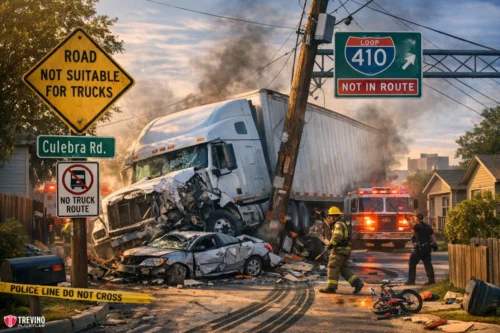
When an 18-wheeler crash attorney pursues these claims, we investigate whether the dispatcher illegally routed the massive vehicle away from designated commercial arteries, creating a preventable hazard for local families. While location determines certain liabilities, the physical environment itself cannot excuse direct safety violations.
When Does Highway Design Not Apply as Grounds for Trucking Company Liability?
Dangerous highway design does not constitute a valid legal excuse to shield the trucking company from liability when the commercial driver violates basic safety rules, such as texting while driving or operating the vehicle beyond their legal hours of service.
Defense attorneys often cite the notorious congestion on I-35 to shift blame away from their client. However, this defense completely fails if we secure dash cam footage or black box data proving the driver was violating core safety principles. These violations include instances where the operator was:
- Actively distracted by mobile dispatch systems.
- Chemically impaired by stimulants used to fight fatigue.
- Speeding aggressively just seconds before the impact.
The physical environment itself cannot excuse direct, willful safety violations by a professional trial authority firm like ours, which exposes these tactics to hold the negligent party accountable.
Why Hire a San Antonio 18-Wheeler Accident Lawyer?
When a commercial crash traps your family in the I-35 Mixing Bowl, you need a Trial Lawyer to secure maximum financial compensation. Negligent Trucking Companies rapidly deploy response teams to shift blame, while local settlement mills push for cheap payouts. Trevino Injury Law does not settle.
Want to Protect the Full Value of Your Claim?
You’ve seen how this affects your case — but this is only one piece of the puzzle. Our 18 Wheeler Accident Lawyer page breaks down what a trial-ready firm does differently.
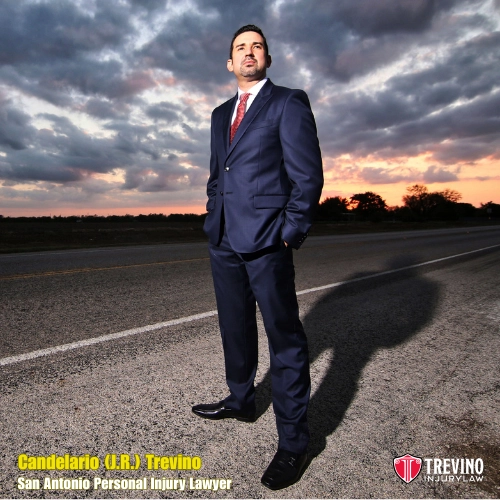
We litigate to verdict, fight for families, and force them to pay. Before evidence is destroyed, a personal injury crash lawyer in San Antonio immediately sends a spoliation letter to secure the black box data. Bringing over 80 jury trials to the Bexar County Courthouse, we secure monumental outcomes like a $17 Million Settlement for commercial Wrongful Death.
Call 210-TREVINO for a free case review. Se Habla Español. No Win, No Fee.