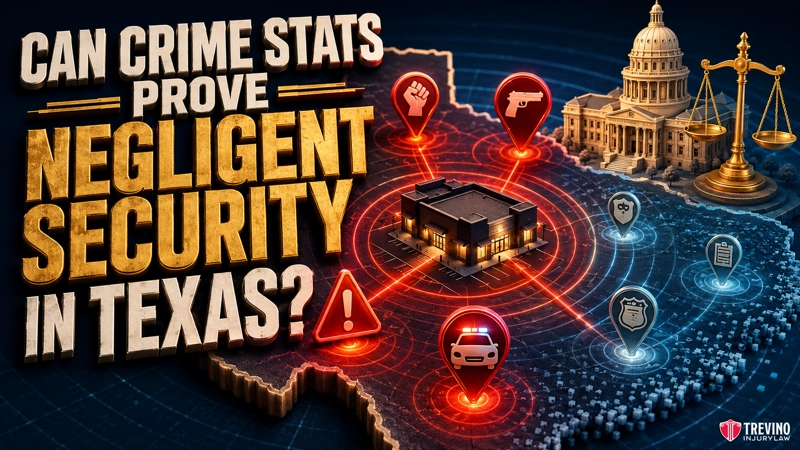
Crime statistics help establish foreseeability in a Texas negligent security claim by showing prior crimes closely connected to the premises and the later attack. That pattern can show the property owner had notice of a specific danger, but crime data alone does not prove negligence.
Texas courts weigh proximity, recency, frequency, similarity, and publicity together when evaluating foreseeability. Texas Department of Public Safety records for 2021 document 1,733 aggravated assault victims and 546 robbery instances at commercial and office buildings in a single year. Those statewide figures show the scale of the risk, while premises-specific incidents determine whether the later attack was reasonably foreseeable.
What Could Your Premises Liability Accident Case Be Worth?
Answer a few quick questions about your accident. Takes about 60 seconds.
See What My Case Might Be WorthThe insurance company offered less than $20,000. I ended up with over $1 million. — Jackie Galindo
Police incident reports, 911 calls, property incident logs, tenant complaints, and security records can connect prior crimes to the property. Public-information requests, civil discovery, and subpoenas can secure those records before evidence disappears. The strongest proof matches the location, timing, frequency, and type of prior violence to the attack at issue.
At Trevino Injury Law, our San Antonio premises liability lawyers obtain police and property records that document prior crimes, notice, and the security history tied to the attack. We use that evidence to build the foreseeability record and challenge efforts to portray the crime as unforeseeable. Call 210-TREVINO for a free case review. You pay nothing unless we win. Se Habla Español.
Texas Negligent Security Litigation: Key Takeaways
- A San Antonio negligent security lawyer can force insurers to confront prior crime patterns, police reports, and evidence showing foreseeable danger.
- Trevino Injury Law has taken 80+ cases to trial across South Texas, giving injured clients trial-tested leverage against insurers.
- Our legal team secures police reports, 911 records, and property logs across Downtown San Antonio before critical evidence disappears.
- Your attorney applies Timberwalk factors including proximity, recency, frequency, similarity, and publicity to prove foreseeability and notice.
What Crime Statistics Are Relevant to a Texas Negligent Security Claim?
Crime statistics relevant to a Texas negligent security claim include prior crime reports regarding criminal incidents sufficiently connected to the premises and the later attack to help establish foreseeability. In Timberwalk Apartments, Partners, Inc. v. Cain, 972 S.W.2d 749 (Tex. 1998), the Texas Supreme Court held that courts evaluating foreseeable third-party crime should consider the proximity, recency, frequency, similarity, and publicity of prior criminal conduct. Courts must consider those factors together rather than treating neighborhood crime rates or any single prior incident as conclusive.
It is crucial to understand the difference between crime statistics as evidence of foreseeability and negligence as a final legal conclusion. To win a negligent security case, you need to prove duty, breach, causation, and damages. To build a strong case, prior crimes must share a close location and proximity to where you were injured.

For example, if you were assaulted in a Downtown San Antonio parking garage, incidents occurring miles away in Alamo Heights lack the necessary connection. Parking facilities, especially a dark parking structure lacking proper lighting, require specific, localized security measures because they are well-known hotspots for violence based on their property type and location; data reveals there were 7,644 aggravated assault victims and 3,960 robbery instances in Texas parking lots and garages during a single year (Texas Department of Public Safety, 2021).
Under Texas Supreme Court authority governing third-party criminal conduct, cases tied to Timberwalk-related precedents require thoroughly examining the frequency, recency, similarity, and publicity of these past events.
Does Being in a High-Crime Area Make an Attack Foreseeable?
No, not automatically; while general neighborhood crime rates can provide broad background context, legal foreseeability ultimately depends on how closely the prior criminal activity directly relates to your presence on the property and the later violent attack that caused your injuries.
You cannot rely on a vague designation of a neighborhood to win your claim against the property owner. The law strictly distinguishes general neighborhood crime from premises-specific evidence. Broader crime data becomes significantly weaker when it is completely detached from the specific property. The proximity of past offenses is heavily scrutinized to ensure the owner actually had reason to anticipate security concerns and danger.
Establishing geographic relevance ensures prior incidents actually connect to the property, laying the groundwork for how your legal team secures those specific local records.
How Do You Obtain Local Crime Data for a Premises Liability Lawsuit?
Local crime evidence can be obtained through targeted Texas Public Information Act requests for official law-enforcement records, internal property management incident logs, formal civil discovery, strategic subpoenas, and appropriate commercial crime-risk analysis to comprehensively build the factual foundation of your premises liability lawsuit.

Securing the right documentation requires knowing exactly where to look to preserve evidence. Formal public-record requests to departments like the SAPD gather historical data, while civil discovery forces the property owner to hand over internal business records. These are different mechanisms, and a skilled trial attorney will use both to uncover the truth. For records controlled by businesses or other custodians, see how spoliation letters are used to preserve evidence in Texas premises liability cases. Your legal team will gather evidence from multiple sources:
- Police incident reports detailing documented reported crimes.
- 911 and calls-for-service records revealing recurring reported disturbances.
- Property incident logs showing internally documented problems, such as broken security features.
- Tenant or customer complaints proving potential notice to management.
- Security records outlining patrol, gate, lighting, or access-control history, including security cameras and surveillance footage.
- Discovery and subpoenas securing nonpublic records obtained through litigation.
- Crime-risk analysis offering broader analytical context.
How Do CAP Index Reports Compare With Police Crime Records?
Police records formally document historical reported criminal incidents in a specific area, while commercial crime-risk products such as CAP Index analyze broader demographic patterns to project relative risk; however, neither source independently proves a negligent security lawsuit in Texas without additional supporting evidence.
It is important to distinguish historical, documented data compiled by local law enforcement from analytical, predictive risk modeling data generated by private companies.
Police Records vs. Commercial Crime-Risk Analysis
| Feature | Police Crime Records | Commercial Crime-Risk Analysis |
| Data type | Historical reported incidents | Predictive risk modeling |
| Geographic scope | Specific addresses or police grids | Broader neighborhood patterns |
| Primary use | Proving exact past occurrences | Showing overall relative risk |
| Limitation | Only captures reported crimes | Does not prove specific prior events |
Ultimately, Texas courts must rigorously determine which of these records are legally relevant to your specific incident. Gathering this varied evidence is only the first step, as the legal framework dictates exactly which prior crimes matter most when evaluating a property owner’s notice.
What Types of Prior Crimes Establish Foreseeability?
Prior crimes that closely resemble the later violent attack may carry significantly more weight in establishing foreseeability, but Texas courts do not evaluate this similarity in isolation when reviewing a premises liability claim against a commercial property owner.
The nature of prior criminal activity matters immensely when building your case. Similarity is highly relevant because a history of violent assaults provides stronger notice of potential danger than isolated property crimes, indicating a failure to maintain security.
For instance, if an attack occurred at a retail location, showing a history similar to the 1,505 aggravated assaults or 1,965 robberies documented at Texas convenience stores provides much stronger evidence of foreseeability than a history of simple theft (Texas Department of Public Safety, 2021). However, prior crimes connect to the broader foreseeability analysis by evaluating whether the owner failed to provide proper security. Texas law governing the foreseeability of third-party criminal conduct prevents victims from relying on just one factor to establish notice.

A trial attorney focusing on premises liability understands how to present a complete picture of the danger that management ignored, ensuring the court sees the full context of the threat.
What Factors Do Texas Courts Consider When Comparing Prior Crimes?
Under established Timberwalk-related authority, Texas courts must consistently consider proximity, recency, frequency, similarity, and publicity when evaluating whether prior criminal activity made a later violent criminal act reasonably foreseeable to a commercial property owner before the incident.
These five factors form the cornerstone of the Texas legal analysis regarding third-party criminal conduct on commercial properties.
Texas Foreseeability Factors
| Factor | What It Examines | Concise Example |
| Proximity | Distance from the exact premises | Occurred in the same parking lot |
| Recency | How long ago incidents happened | Crimes within the last two years |
| Frequency | How often similar crimes occurred | Multiple assaults in a single month |
| Similarity | Nature of the past offenses | Previous armed robberies matching your attack |
| Publicity | Property owner’s awareness | News reports of ongoing security issues |
Judges weigh these specific factors together to objectively evaluate the property owner’s notice of the dangerous condition. While these five factors establish the essential legal framework, understanding how recency influences the timeline dictates exactly how far back your attorney must search for evidence.
How Far Back Should Crime Data Go for a Texas Negligent Security Claim?
While evaluating past crime data is critical for foreseeability, you must also consider the statute of limitations for filing your lawsuit. Texas gives you two years to file a personal injury claim, meaning you generally have exactly two years from the date of the incident to initiate legal action. Regarding the crime data itself, there is no single mandatory lookback period for every Texas negligent security claim; the relevance of older incidents depends on recency, proximity, frequency, similarity, and publicity to determine whether a property owner had reasonable notice before your violent attack occurred.
While defense lawyers often argue for a strict, universal two- or three-year cutoff for prior crimes, Texas law does not enforce such an arbitrary rule. Instead, a thorough trial attorney may examine several years of historical data depending on the specific property type, the established incident pattern, and the available law enforcement records. Keep in mind this lookback period for evidence is separate from the strict legal limitations for personal injury filings.
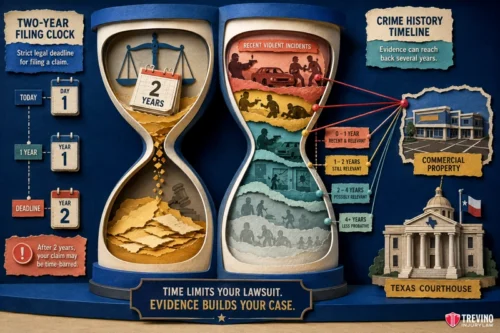
A violent assault that happened five years ago carries significantly less weight than multiple assaults occurring in the past six months. Rather than repeating a rigid checklist, courts practically assess whether the timeline of past events made the current danger foreseeable.
Once these crime data limits are established, the next critical step is integrating this historical evidence into the complete negligence claim required to prove the property owner’s liability.
How Do Crime Statistics Fit Into the Elements of a Texas Negligent Security Claim?
Crime statistics primarily support foreseeability and notice; separate evidence is still needed to establish the remaining elements of the negligent security claim, such as proving the property owner failed to provide reasonable security measures. For the broader evidentiary framework, see the evidence needed to prove a Texas premises liability case.
To win your lawsuit, your legal team must establish four distinct legal components using different forms of evidence:
- Foreseeability and Notice: Established through historical prior crime statistics and reported police incidents.
- Breach of Duty: Proven through security-condition evidence, such as broken locks, inadequate lighting, or a lack of security personnel.
- Causation: Established by proving how this failure contributed directly to the third-party attack.
- Damages: Documented through medical records showing the extent of your injuries, lost wages, diminished earning capacity, and expert testimony regarding physical pain and emotional trauma.
Can You Sue an Apartment Complex for Negligent Security if There Were Prior Shootings?
Yes, potentially; prior shootings can support foreseeability, but the plaintiff still needs evidence establishing the other required elements of the negligent security claim. Documented violent incidents on the property prove that management was on notice of dangerous conditions. However, your trial attorney must also demonstrate that the apartment complex failed to put adequate security measures in place, ignored malfunctioning security systems, and that this failure directly enabled the attack that injured you.
Do Police Crime Reports Automatically Prove Property Owner Negligence?
No; police crime reports can support foreseeability or notice, but they do not independently prove every element of negligent security. While official SAPD reports document that criminal acts occurred, they do not automatically prove that the business owner breached their legal duty of care or failed to provide reasonable security. Separate evidence is required to prove liability and secure full compensation.
How Do Violent Crimes and Property Crimes Differ as Foreseeability Evidence?
In many negligent security cases, prior violent crimes generally have greater similarity to a later violent attack than unrelated property offenses, although both can contribute to the overall factual history of the premises.
Texas courts carefully weigh the nature of prior offenses when evaluating whether an attack was predictable:
- Violent Offenses: Assaults, armed robberies, homicides, and physical fights provide strong, direct evidence of foreseeable physical danger. The scale of this danger is significant across various hospitality sectors, with recent state data tracking 1,906 aggravated assault victims at hotels and motels, along with 1,712 victims at bars and nightclubs (Texas Department of Public Safety, 2021).
- Property Offenses: Burglary, vandalism, auto theft, and vehicle break-ins establish general lawlessness but carry less weight regarding violent physical attacks.
- Escalation Patterns: A rising trend of non-violent property crimes combined with unaddressed threats, or a lack of properly trained security staff and security contractors, can demonstrate a growing security hazard that management ignored before violence escalated.
Can a Negligent Security Claim Succeed Without Prior Crimes on the Property?
A lack of documented prior crimes on the exact property can weaken a foreseeability argument, but it does not automatically resolve every claim. If you suffered a crime on unsafe property, you may have a negligent security claim even without prior identical incidents on that exact parcel.
If zero criminal incidents occurred at the exact address, your lawsuit is not automatically barred. Your legal team can establish notice by presenting evidence of violent crimes on adjacent properties, recurring internal security complaints from tenants, or known criminal threats in the immediate vicinity that should have prompted updated security policies or the hiring of professional security companies.
When a property owner knows of an impending or surrounding danger, they cannot simply rely on the lack of a past police report on their specific parcel to escape financial responsibility.
When Are General Neighborhood Crime Statistics Too Broad to Establish Foreseeability?
General neighborhood crime statistics become less persuasive when they are geographically remote, temporally stale, dissimilar, or insufficiently connected to the premises and criminal act at issue.
Broad citywide crime figures rarely satisfy the strict Texas foreseeability standard. Without a clear nexus linking the surrounding crime history directly to the defendant’s property, courts will dismiss broad statistical data as legally insufficient to prove that the business owner should have anticipated the crime.
Additionally, under the Civil Practice and Remedies Code, defense attorneys may use broad crime data to argue that the neighborhood as a whole is dangerous, attempting to assert the plaintiff is partially at fault for being there, which ties directly into Texas comparative negligence laws.
Why Hire a Premises Liability Lawyer?
You need a personal injury trial attorney in San Antonio because successfully proving these claims requires aggressively securing historical crime data, navigating complex Texas foreseeability factors like proximity and similarity, and legally demonstrating that a commercial property owner ignored known local dangers before your violent attack ever occurred. An experienced lawyer will take immediate steps to protect your claim.
Insurance companies will immediately try to dismiss your assault as an unforeseeable, isolated incident to avoid paying what you deserve. We know how to obtain the vital police reports, 911 dispatch records, and internal property logs needed to prove management knew of the danger before crucial evidence disappears.
Want to Protect the Full Value of Your Claim?
You’ve seen how this affects your case — but this is only one piece of the puzzle. Our Premises Liability Lawyer page breaks down what a trial-ready firm does differently.
Do not let a negligent business owner escape responsibility for your injuries. Trevino Injury Law has taken over 80 cases to trial across South Texas courts. Protect your family’s future and call 210-TREVINO today for a free consultation with a trial-ready legal team. Se Habla Español.
