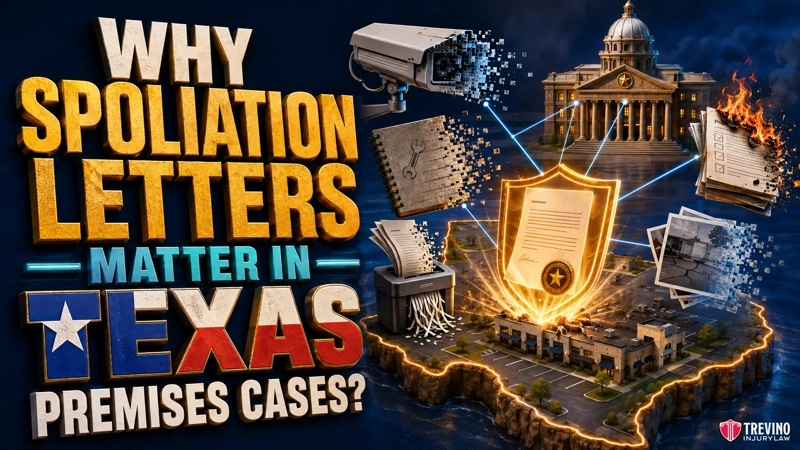
A spoliation letter helps preserve evidence in a Texas premises liability case because it formally identifies records and materials that must be protected before they are overwritten, discarded, repaired, or altered. It also creates a written record showing when preservation was requested.
Property owners, managers, tenants, security companies, and maintenance contractors can control surveillance footage, inspection logs, incident reports, photographs, and communications needed to prove what happened. A preservation demand targets that evidence before routine business practices erase proof of the dangerous condition or the property owner’s knowledge.
What Could Your Premises Liability Accident Case Be Worth?
Answer a few quick questions about your accident. Takes about 60 seconds.
See What My Case Might Be WorthThe insurance company offered less than $20,000. I ended up with over $1 million. — Jackie Galindo
A Spoliation Letter, a legal demand that stops the property owner from destroying evidence, can preserve the proof needed to establish notice, causation, and the response to the hazard. Trevino Injury Law has taken 80+ cases to trial, experience that supports early evidence preservation and trial-focused case preparation.
At Trevino Injury Law, our San Antonio premises liability lawyers identify evidence custodians, send targeted preservation demands, document delivery, and pursue preserved records through discovery. Call 210-TREVINO for a free case review. You pay nothing unless we win. Se Habla Español.
Texas Premises Liability Litigation: Key Takeaways
- A San Antonio premises liability attorney can preserve surveillance, maintenance records, and other evidence before insurance adjusters exploit routine deletion.
- Our legal team acts quickly on corridors like Loop 410 in San Antonio when surveillance footage and physical hazards may disappear.
- Trevino Injury Law has taken 80+ cases to trial, strengthening its ability to challenge corporate defendants and insurance adjusters.
- Spoliation can trigger court remedies when a party had a preservation duty, failed to preserve material evidence, and prejudiced the opposing side.
What Is a Spoliation Letter in a Texas Premises Liability Case?
A spoliation letter is a formal preservation demand that identifies evidence related to an injury and instructs the person or business controlling that evidence to preserve it for anticipated litigation. The letter creates a written record showing that preservation was explicitly requested before relevant files, records, or other evidence could be deleted.
This vital evidence may be controlled by the property owner, a property management company, a commercial tenant, a security company, a maintenance contractor, or another business connected to the premises. The preservation demand should clearly identify the incident and the specific evidence categories that may be relevant to proving fault. It can also demand that the recipient preserve all evidence related to the incident within the stated scope of the request.
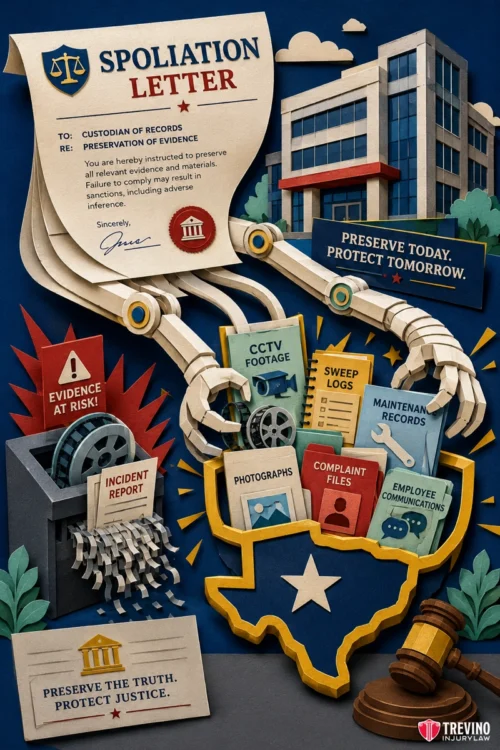
This formal legal notice creates a documented timeline showing when the property owner received a legal notice to preserve evidence. While the demand is not a court order, it makes it more difficult for a business along major commercial corridors such as Loop 410 or I-10 to later claim that requested files were simply lost during standard operations. The effectiveness of the demand depends heavily on identifying the correct evidence to protect your premises liability case.
Critical Evidence Protected by a Preservation Demand
A properly drafted preservation demand identifies the physical, electronic, and documentary evidence that may establish how the dangerous condition developed, what the property owner knew, and what happened before and after the injury. Each piece of evidence may provide a different part of the factual timeline.
- Surveillance footage
- Inspection, sweep, and maintenance logs
- Maintenance and cleaning records
- Incident reports
- Photographs or video of the accident scene
- Prior complaints or similar incidents
- Employee or management communications
Some of this evidence can disappear quickly through ordinary business practices. For that reason, evidence that may be relevant should be preserved immediately when reasonably possible to help build a trial-ready case against a negligent corporate defendant.
Understanding exactly what evidence needs protection naturally raises the question of how fast you must act to secure it.
How Quickly Should a Spoliation Letter Be Sent After a Premises Liability Accident?
A spoliation letter should be sent promptly because potentially important surveillance footage and business records may disappear through routine operations before a lawsuit is filed. Texas law does not establish a fixed deadline. Instead, Wal-Mart Stores, Inc. v. Johnson, 106 S.W.3d 718, 722 (Tex. 2003), ties the duty to preserve evidence to when a party knows or reasonably should know that there is a substantial chance of litigation and that the evidence will be material and relevant.
Commercial surveillance systems frequently overwrite older footage as a matter of routine practice. For example, in a prominent Texas Supreme Court case involving evidence destruction, the store’s surveillance system recorded continuously and overwrote older footage after approximately 30 days (Supreme Court of Texas, 2014).
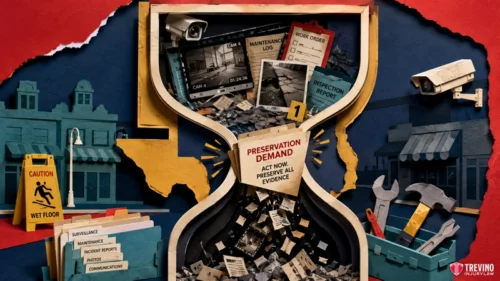
A dangerous condition may also be repaired soon after an accident occurs. Broken flooring, inadequate lighting, malfunctioning gates, missing handrails, or other physical conditions at the accident scene may change rapidly. Inspection and maintenance records may also be updated or discarded by the property management company.
Early preservation helps identify and protect this evidence while it still exists. Premises liability claims involving injuries on someone else’s property often depend heavily on records controlled by businesses connected to the premises. Rather than waiting for the insurance adjuster to evaluate the claim, a premises liability attorney will typically send a preservation demand as soon as possible when evidence is at risk of routine destruction.
How Should a Preservation Demand Be Delivered and Documented?
A preservation demand should be delivered through trackable methods that create a documented record showing when the appropriate person or business received formal legal notice regarding the incident.
- Certified Mail: Send with tracking, delivery confirmation, and proof of receipt to an appropriate corporate or business recipient.
- Direct Email: Send to property management, corporate risk management, legal personnel, or another appropriate recipient.
- Other Trackable Delivery: Use a method that creates reliable documentation of delivery and receipt when appropriate.
The primary goal is to establish a clear record of the preservation request. Evidence showing when the business received the demand can become important if a dispute later arises over what happened after receiving a spoliation letter.
Once you successfully document the delivery of this demand, it becomes necessary to understand the legal consequences if the business still allows that evidence to vanish.
What Happens If Evidence Is Destroyed After a Preservation Demand?
If relevant evidence is destroyed or materially altered after a duty to preserve it exists, the trial court may determine whether spoliation occurred and impose an appropriate remedy for the loss of material information in your Texas premises liability case.
Texas courts recognize that the destruction of material evidence can affect the fairness of the litigation process. The judge may evaluate whether the party had a duty to preserve the evidence, whether it failed to preserve it, the level of culpability involved, and the prejudice suffered by the non-spoliating party.
A preservation demand becomes especially important in this evidentiary dispute because it documents what evidence was requested and when formal notice was received. If an opposing party destroys evidence after receiving a preservation demand, the court may consider an appropriate sanction or other remedy. In circumstances permitted under Texas law, the judge may also give a spoliation instruction as part of the jury instructions.
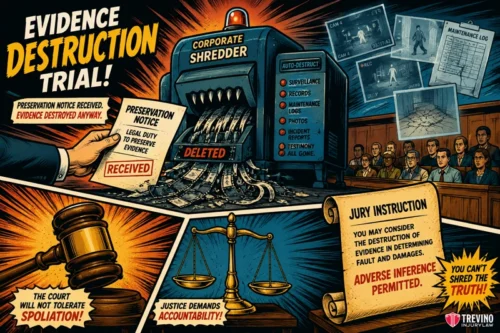
The exact remedy depends on the circumstances. A court may impose sanctions proportionate to the conduct and prejudice involved rather than automatically penalizing every instance of missing evidence. Our trial attorneys possess more than 20 years of experience in personal injury law and are prepared to litigate preservation and discovery disputes in Bexar County courts.
How Preserved Evidence Strengthens the Injury Claim
Preserved evidence can turn a disputed account of an accident into a claim supported by objective records showing what happened and what the property owner knew beforehand.
Preserved evidence may help establish how long a dangerous condition existed, when an area was last inspected, and whether employees followed required inspection procedures. It can reveal whether earlier complaints were made, whether management knew about a hazard, and whether corrective action was taken.
It can also document what occurred immediately before and after the injury. For example, inspection and maintenance logs can help establish when a specific area inside a Medical Center business was last checked.
While preserving these records is a necessary first step, the next issue is how this evidence helps prove the legal elements of the claim.
How Does Preserved Evidence Help Prove a Texas Premises Liability Claim?
Preserved evidence can help establish what the commercial property owner knew, how long a dangerous condition existed, whether there was an adequate opportunity to correct it, and other fundamental facts necessary to prove liability in a Texas premises liability case.
When pursuing an injury claim, corporate defendants and their insurance adjusters may dispute legal responsibility by arguing that they lacked knowledge of the hazard or that the condition did not cause the claimant’s injuries. Objective records can directly address these defenses.
Documented inspection and maintenance practices may reveal whether a business followed its safety procedures. By establishing the duration of a hazard, preserved footage may show whether the owner failed to take reasonable action or provide an adequate warning when given the opportunity. In negligent-security cases, prior incident reports may also provide evidence relevant to foreseeability.
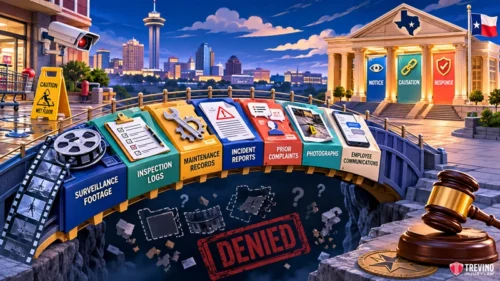
Preserving relevant evidence can therefore strengthen proof of notice, causation, and the defendant’s response to the dangerous condition.
Understanding how these records prove liability naturally leads to the realization that the specific evidence worth preserving changes depending on the type of premises liability claim being filed.
How Do Spoliation Targets Differ Between Slip-and-Fall and Negligent-Security Cases?
The specific evidence identified within a formal spoliation letter changes according to how the premises liability injury occurred and which factual elements must be established to prove negligence against a commercial property owner in a Bexar County courtroom.
| Case Type | Primary Evidence | Additional Evidence |
| Slip and Fall | Surveillance footage, inspection and sweep logs, cleaning records | Incident reports, maintenance records, work orders, prior complaints |
| Negligent Security | Surveillance footage, security logs, access-control records | Lighting maintenance records, prior incident reports, security staffing or contracts, relevant complaints |
Slip-and-fall cases typically focus more heavily on the dangerous condition itself and the property’s specific inspection history. Conversely, negligent-security cases may require broader evidence involving physical security measures, prior incidents, access-control systems, lighting, and foreseeability. For a deeper look at that prior-incident evidence, see how crime statistics can support a Texas negligent security claim.
Is a Spoliation Letter Legally Binding in Texas?
No. A spoliation letter is not a court order, but it provides formal written notice requesting preservation of specific evidence for anticipated litigation. Documented notice can become important if the commercial defendant later allows the requested evidence to disappear.
The letter helps establish a timeline showing when the business was placed on notice that particular evidence should be preserved, making it more difficult to characterize later destruction as an entirely unexpected consequence of routine business practices.
Does a Spoliation Letter Create the Duty to Preserve Evidence?
Not necessarily. The legal duty to preserve evidence can arise independently before the property owner formally receives a preservation letter. The letter serves as evidence of notice that litigation is reasonably anticipated, but it should not be viewed as the sole legal source of the preservation duty in Texas.
The duty therefore depends on the circumstances, including whether litigation was reasonably foreseeable and whether the evidence was material and relevant.
Can I Send a Spoliation Letter Without a Lawyer?
Yes. An injured person can request preservation of evidence, but an attorney can help identify the correct evidence, custodians, recipients, and scope of the demand.
An experienced premises liability attorney can also identify evidence you may not realize exists and determine which records should be preserved immediately. A law firm handling anticipated litigation may send separate preservation notices to multiple custodians when different businesses control different evidence.
What Happens If No Spoliation Letter Was Sent?
Failing to send a formal spoliation letter does not automatically destroy a premises liability claim, but it can make later disputes over missing evidence significantly more difficult when litigating against corporate defendants and their insurance companies in Texas courts.
Without this documented demand, it may be harder to establish exactly when evidence preservation was requested. A business may argue that surveillance footage disappeared through routine operations rather than because it deliberately intended to destroy evidence.
This problem was highlighted in a landmark Texas case where a claimant initially secured only about eight minutes of preserved footage. When an additional 2.5 hours of video was later requested, it could not be produced because it had already been overwritten (Supreme Court of Texas, 2014).
However, the absence of a preservation letter does not automatically mean that no legal preservation duty existed. Other surrounding facts may establish that litigation was reasonably anticipated.
Once a lawsuit begins, an attorney can help use the discovery process and the Texas Rules of Civil Procedure to request relevant records and, when appropriate, ask the court to compel production. That process cannot recover evidence that no longer exists, which is why early preservation remains important.
What If a Third Party Controls the Evidence?
Evidence controlled by an independent third party may require a separate preservation demand directed specifically to the person or company that possesses the material rather than relying solely on the primary commercial property owner where the injury occurred.
Potential third-party custodians may include external security contractors, specialized maintenance companies, third-party janitorial companies, commercial tenants, or neighboring businesses with exterior surveillance cameras capturing the incident.
A critical distinction exists between evidence within a defendant’s possession, custody, or control and evidence held independently by another entity. Preserving the evidence may therefore require separate notices to each relevant custodian before records are overwritten, discarded, or otherwise become unavailable.
Why Hire a Premises Liability Lawyer?
Property owners and insurance adjusters may investigate or evaluate a claim while critical surveillance footage and business records remain subject to routine deletion. In a single year, general-liability insurers in Texas paid more than $3.4 billion in direct losses (Texas Department of Insurance, 2025).
A plaintiff trial lawyer San Antonio can help identify potential evidence, determine who controls it, and issue a preservation notice before important proof disappears. Trevino Injury Law is a San Antonio law firm with a record of taking 80+ cases to trial across Texas state courts.
Want to Protect the Full Value of Your Claim?
You’ve seen how this affects your case — but this is only one piece of the puzzle. Our Premises Liability Lawyer page breaks down what a trial-ready firm does differently.
From one of the first steps in the investigation through the discovery process and trial preparation, our attorneys work to preserve relevant evidence and build the evidentiary record needed to pursue compensation. Do not give a recorded statement to the insurance company without understanding how it may affect your claim. Contact us for a free consultation on a contingency fee basis, where you owe nothing unless we win.