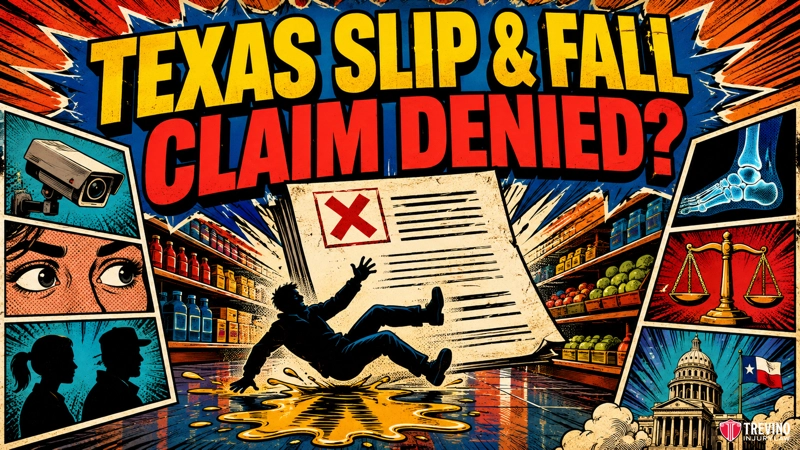
If the store’s insurance company denies your slip-and-fall claim in Texas, the denial does not end your case. You can challenge the insurer’s position with additional evidence, continue negotiations, or file a premises liability lawsuit when the facts and law support your claim.
The insurer may dispute whether the store knew about the dangerous condition, whether the condition caused your fall, whether your injuries resulted from the incident, or whether your own conduct contributed to the accident. As of 2025, 447 individual companies were writing general liability policies across Texas (Texas Department of Insurance, 2025). A denial reflects one insurer’s assessment, not a court’s determination of liability.
What Could Your Slip and Fall Accident Case Be Worth?
Answer a few quick questions about your accident. Takes about 60 seconds.
See What My Case Might Be WorthThe insurance company offered less than $20,000. I ended up with over $1 million. — Jackie Galindo
Surveillance footage, photographs, inspection records, incident reports, witness testimony, and medical records can directly address the insurer’s stated reason for denial. A lawyer can also send a Spoliation Letter, a legal demand that stops the store from destroying relevant evidence, and use formal discovery if litigation becomes necessary.
At Trevino Injury Law, our San Antonio slip and fall lawyers preserve evidence, investigate store notice, challenge unsupported defenses, and litigate denied claims when necessary. Call 210-TREVINO for a free case review. You pay nothing unless we win. Se Habla Español.
Box Truck Accident Lawyer San Antonio, TX: Key Takeaways
- As your Box Truck Accident Lawyer San Antonio, we pierce the corporate veil to hold giants like Amazon accountable for catastrophic injuries.+1
- Trevino Injury Law secured a $1.8 million settlement for spinal injuries. The firm forces insurers to pay full value.
- Our legal team stops Insurance Carriers from purging black box data on Loop 410 in San Antonio. We secure evidence within hours.
- Your attorney proves Right of Control to establish liability. This legal test shows companies directed driver metrics despite independent contractor labels.
Why Did the Store’s Insurance Company Deny My Slip-and-Fall Claim?
A store’s insurance company may deny a Texas slip and fall claim by disputing the store’s knowledge of the dangerous condition, blaming the injured shopper, challenging causation, or arguing that the available evidence does not satisfy Texas premises liability law. The reason stated in the denial helps identify which facts and legal standards must be addressed.
In retail slip and fall cases, people sometimes describe a store’s responsibility as a duty to maintain safe conditions. More precisely, Texas law requires proof of the applicable premises-liability elements. Depending on the circumstances, those elements may include whether the business had actual or constructive knowledge of a condition that posed an unreasonable risk of harm and failed to use reasonable care.

Whether your accident happened at H-E-B, a major retailer at The Rim, or a boutique in Alamo Heights, insurance companies deny claims for several different reasons:
- Lack of notice: The insurer argues the store did not know and should not reasonably have known the hazard existed.
- Open and obvious condition: The insurer argues the hazard was “open and obvious” or sufficiently visible for the shopper to recognize and avoid it.
- Claimant fault: The insurer alleges distraction, inattention, footwear, rushing, or another action contributed to fault for your fall.
- Disputed causation: The insurer argues the claimed injury existed before the collision with the floor or was caused by another event.
- Insufficient evidence: The insurer disputes whether the dangerous condition existed or challenges your version of events.
- Disputed damages: The insurer argues your injuries weren’t serious or challenges the extent, necessity, or value of your medical treatment.
How Does Lack of Notice Lead to a Texas Slip-and-Fall Claim Denial?
Lack of notice is a common defense in slip and fall cases involving spills, merchandise, debris, or other temporary conditions. The insurance adjuster may argue the store had no reasonable opportunity to discover the hazard before the fall. Texas courts apply the time-notice principles discussed by the Texas Supreme Court in Wal-Mart Stores, Inc. v. Reece, 81 S.W.3d 812 (Tex. 2002).
Establishing premises liability requires more than simply proving that a dangerous condition existed. In many cases, the injured person must prove the business had actual or constructive knowledge of that condition.
Constructive knowledge of the dangerous condition may be established through evidence showing it existed long enough that the store reasonably should have discovered it. Surveillance footage often becomes important because it can show when a spill appeared, how employees responded, and how long the condition remained before the fall. Inspection records, incident reports, employee testimony, and witness observations may also strengthen your position.
Whether the fall happened near The Pearl or at a large retailer near Loop 1604, notice remains a critical issue. Once you know why the insurance company denied your slip and fall claim, the next step is determining what evidence can address that specific defense.
What Can You Do After a Slip-and-Fall Insurance Claim Is Denied?
After receiving a denial letter, review the insurer’s stated reason, preserve relevant evidence, and determine whether additional proof can address the disputed issue. Working with an attorney can also help you understand whether you may need to file a premises liability lawsuit.
Timing matters. Texas generally has a two-year statute of limitations for personal injury claims, subject to the facts of the case and any applicable exceptions (Texas Legislature, 2026). Waiting can also make it harder to obtain surveillance footage, photographs, witness information, and other strong evidence.
A denial letter can be frustrating, especially when you are dealing with mounting medical bills. However, the denial itself should not discourage you from pursuing a legally supportable personal injury claim. Instead of simply resubmitting the same information, focus on the specific reason the insurer gave.
- Review the denial: Identify exactly why the insurer rejected or undervalued the claim.
- Identify the disputed issue: Determine whether the disagreement involves notice, fault, causation, evidence, damages, or insurance coverage issues.
- Preserve evidence: Protect surveillance video, photographs, incident reports, inspection records, and other information that could disappear.
- Gather evidence: Obtain medical documentation, witness information, photographs of the accident scene, and other proof related to your accident.
- Address the insurer’s position: Present facts and legal arguments that respond directly to the stated reason for denial.
- Consider litigation when appropriate: If a viable serious slip and fall claim remains unresolved, determine whether filing suit is necessary to protect your rights.

Be cautious before you provide recorded statements. Adjusters may ask questions designed to elicit information about your conduct, prior injuries, medical history, or other issues that could later be used to dispute liability or damages.
How Can Preserved Evidence Help Challenge the Insurance Company’s Denial?
Preserved evidence can challenge an insurance denial by showing what caused the fall, how long a hazard existed, what the store knew, and whether the fall and injuries are medically connected.
Relevant proof may include surveillance footage, photographs, incident reports, inspection records, witness testimony, medical records, maintenance documentation, and evidence of applicable building code violations. Together, these materials may help establish actual or constructive knowledge, causation, and damages such as medical expenses and pain and suffering.
A spoliation letter in a Texas slip-and-fall case may be used to demand that a store retain relevant evidence under its control. If the evidence does not resolve the dispute and the insurer continues refusing to pay, the matter may move from insurance handling into formal litigation.
What Happens If the Insurance Company Still Refuses to Pay?
If a viable Texas slip and fall claim remains unresolved after the insurer refuses to pay, a lawsuit may allow the injured person to obtain evidence through discovery, secure sworn testimony, and seek a binding legal determination. Nearly 16,000 new lawsuits were filed in Texas‘s broader “Other Injury or Damage” category during fiscal year 2025, which includes premises-related injury cases (Texas Office of Court Administration, 2025).
Litigation changes the dispute from an informal insurance claim into a formal legal proceeding. Not every denied claim goes to trial. When a lawsuit is appropriate, the parties may request documents, take depositions, obtain expert evidence, and continue settlement negotiations.

If the evidence establishes that the business is liable, recoverable damages may include medical expenses, lost income, pain and suffering, and other losses allowed by law. The ultimate recovery depends on the facts, available insurance or assets, applicable defenses, and whether the claim resolves through a fair settlement or verdict.
Why Does Trial Experience Matter When a Slip-and-Fall Claim Remains Disputed?
Why trial experience matters in a disputed San Antonio slip-and-fall case becomes especially important when an attorney must develop evidence, conduct discovery, challenge defenses, and present the case to a jury rather than depend solely on the insurance company voluntarily accepting the claim.
Trial capability may become especially important when the parties disagree about notice, causation, comparative responsibility, or the value of the injuries. Trevino Injury Law has taken more than 80 personal injury cases to trial in Bexar County and across South Texas.
For context, only 111 cases within Texas‘s broad “Other Injury or Damage” category ended in a final judgment by jury verdict during fiscal year 2025 (Texas Office of Court Administration, 2025). That statistic does not predict the outcome of any individual claim, but it illustrates that jury verdicts represent only one possible resolution.
Even when litigation becomes necessary, the insurance company’s denial does not determine whether the claimant ultimately has a legally viable case.
Does a Denial Letter Mean My Slip-and-Fall Case Is Over?
No. An insurance company’s denial letter states the insurer’s position. It is not a binding court judgment deciding whether the store or commercial property owner is legally responsible for your fall.
Additional evidence may contradict the initial denial. Settlement negotiations may continue, and litigation can provide procedures for obtaining information that was unavailable during the claim process. Texas general-liability insurers reported more than $3.47 billion in direct losses paid during 2025 (Texas Department of Insurance, 2025). Statewide insurance data does not determine the value or validity of any individual denied claim.
When an insurance carrier undervalues an injury claim, a trial-ready legal team can continue pursuing the claim rather than treating the carrier’s initial valuation as final. For example, in Jose Simon Arriaga Jr. v. Emily Montemayor, a motor vehicle collision case involving a low-back injury, the defense made an initial settlement offer of $5,000. Trevino Injury Law proceeded to trial before a Bexar County jury and obtained a $536,007 jury verdict.

Although that case involved a motor vehicle collision rather than premises liability, it illustrates that an insurer’s valuation and a jury’s determination can differ substantially. No prior settlement or verdict guarantees another case’s outcome.
Whether a denied slip-and-fall claim can proceed depends on the evidence, Texas premises liability law, comparative responsibility, causation, damages, and applicable deadlines.
How Does Comparative Fault Affect a Denied Slip-and-Fall Claim?
Texas follows a modified comparative negligence system, referred to in the statute as proportionate responsibility. An insurance company may argue that a shopper’s conduct contributed to fault for your fall.
Insurance companies often exaggerate allegations involving smartphone use, failure to notice a condition, improper footwear, or rushing through an aisle when attempting to shift responsibility to the injured person. Whether those allegations are persuasive depends on the evidence.
Under Texas‘s proportionate-responsibility statute, a claimant generally may recover damages if the claimant’s percentage of responsibility is 50% or less. If the claimant is 51% or more responsible, recovery is barred. When recovery is allowed, compensation is reduced by your percentage of responsibility (Texas Legislature, 2026).
For example, if a jury awards $100,000 in damages and assigns the claimant 20% responsibility, the recoverable amount would generally be reduced by 20%, subject to other applicable legal issues.
These rules are one reason strong evidence about the accident scene, the hazard, and the store’s conduct can matter after a denial.
Can the Insurance Company Deny My Slip-and-Fall Claim Because I Was Not Paying Attention?
Yes. An insurance company can argue that inattention contributed to the fall. However, that allegation does not automatically determine the final allocation of responsibility.
The insurer’s position must be evaluated against the available evidence. A factfinder may consider the hazard’s visibility, the claimant’s conduct, the store’s knowledge, and other circumstances when assigning responsibility under applicable Texas law.
Even when a hazard is visible, property owners may still face premises-liability questions depending on the facts and applicable legal standards. An “open and obvious” argument should therefore be evaluated in the context of the specific condition and Texas law rather than treated as an automatic result.
Can I File a Lawsuit After the Insurance Company Denies My Slip-and-Fall Claim?
Yes, potentially. An insurance denial does not prevent you from filing a lawsuit if the underlying premises-liability claim remains legally viable and is filed within the applicable deadline.
Receiving a denial letter may actually make it more important to evaluate the evidence and statute of limitations promptly. In 2025, more than 2,800 injury and damage lawsuits in Texas were dismissed for want of prosecution (Texas Office of Court Administration, 2025), illustrating why active case management matters after a lawsuit is filed.
A lawyer can evaluate your rights after a claim denial, identify the proof necessary to proceed, and determine whether litigation is an appropriate way to pursue the compensation you need.
What Evidence Is Most Useful After a Slip-and-Fall Claim Is Denied?
The most useful evidence after a slip-and-fall denial is evidence that directly addresses the insurance company’s stated reason for disputing liability, causation, fault, or damages.
| Evidence | What It May Establish | Denial It May Address | How We Obtain It |
| Surveillance footage | Hazard, fall, and timeline | No hazard/lack of notice | Preservation request/discovery / subpoena, as appropriate |
| Photographs | Condition, location, visibility, and accident scene | Disputed hazard / open-and-obvious argument | Client photographs / scene investigation |
| Inspection records | Inspection practices and timing | Lack of constructive knowledge | Formal legal discovery |
| Incident reports | Store documentation and version of events | Disputed circumstances | Formal legal discovery |
| Witness testimony | Hazard and circumstances of the fall | Disputed facts | Statements / depositions |
| Medical records | Injury, treatment, causation, and damages | Injury / causation denial | Medical authorizations and records requests |
Securing this proof may require prompt action. Commercial surveillance systems can overwrite footage, witnesses can become harder to locate, and internal records may become more difficult to identify over time. Preserving evidence early protects your rights and may strengthen your position before important evidence disappears.
When Can Evidence Undermine an Insurance Company’s Slip-and-Fall Denial?
Evidence can undermine an insurance company’s slip-and-fall denial when objective facts contradict the reason given for rejecting the claim.
For example, if an adjuster argues that a store lacked notice of a spill at a retailer in North Star Mall or La Cantera, preserved video may show how long the condition remained on the floor. That evidence could support constructive knowledge of the dangerous condition if the timeline is sufficient under Texas law.
Witness testimony may also contradict a store representative’s version of events. Medical records from facilities such as Baptist Medical Center can support a causal connection between the incident and the claimed injuries, weakening an argument that the injuries were unrelated or pre-existing.
Strong evidence does not guarantee liability or a particular recovery, but it can provide the factual basis needed to challenge an insurer’s stated defense.
When Might an Insurance Company’s Slip-and-Fall Denial Be Supported by the Evidence?
An insurance company’s slip-and-fall denial may be supported when the available evidence fails to establish a dangerous condition, legally required notice, causation, or recoverable damages.
For example, a claim may be difficult to prove if there is no reliable evidence showing the alleged hazard existed or if the evidence cannot establish that the business had actual or constructive knowledge. Medical evidence may also weaken a claim when it does not support a connection between the incident and the claimed injuries.
When the evidence strongly favors the defense, a court may resolve a case before trial. During fiscal year 2025, 410 cases in Texas‘s broader injury-and-damage category were disposed of by summary judgment (Texas Office of Court Administration, 2025).
The key question is therefore not simply whether an insurer denied the claim. It is whether the facts and law support or contradict the insurer’s stated reason.
Why Hire a San Antonio Slip and Fall Lawyer?
A denied claim can leave an injured person facing mounting medical bills while also trying to preserve evidence, respond to an insurance company, and understand Texas premises liability law.
A San Antonio injury lawyer can gather evidence, evaluate actual or constructive knowledge, address comparative-fault allegations, preserve surveillance footage, analyze medical causation, and determine whether litigation is appropriate. Legal representation can also help you avoid giving unnecessary statements or responding to questions designed to elicit admissions that may later be used against the claim.
Trevino Injury Law has taken more than 80 personal injury cases to trial in Bexar County and across South Texas. When an insurance company disputes liability or offers less than the evidence supports, our trial team can pursue fair compensation through negotiation or litigation when appropriate.
Want to Protect the Full Value of Your Claim?
You’ve seen how this affects your case — but this is only one piece of the puzzle. Our Personal Injury Lawyer page breaks down what a trial-ready firm does differently.
Contact Trevino Injury Law for a free consultation before you provide recorded statements to an insurance carrier. We handle personal injury cases on a contingency-fee basis, subject to the terms of the representation agreement.