Yes, because the insurance adjuster evaluating your claim already knows if your counsel actually tries cases or settles for a quick payout.
Major carriers use internal tracking software to monitor your representation, immediately generating lowball offers the moment they see you hired a volume firm incapable of legally proving constructive notice.
Their strategy relies on the fact that, according to the Texas Office of Court Administration, fewer than 1% of civil cases proceeded to a jury trial in 2023. Surveillance footage of your fall and daily sweep logs routinely vanish while adjusters drag out negotiations. A Spoliation Letter, a legal demand that prevents the property owner from destroying evidence, must be issued immediately. Texas gives you two years to file a formal lawsuit. After that, the claim is gone.
What Could Your Slip and Fall Accident Case Be Worth?
Answer a few quick questions about your accident. Takes about 60 seconds.
See What My Case Might Be WorthThe insurance company offered less than $20,000. I ended up with over $1 million. — Jackie Galindo
A Trevino Injury Law fall injury lawyer files suit to trigger formal discovery and force retailers to pay full value. files suit to trigger formal discovery and force retailers to pay full value. Call 210-TREVINO now for a free case review. You pay nothing unless we win. Se Habla Español.
What Is the Difference Between a Trial Lawyer and a Settlement Mill?
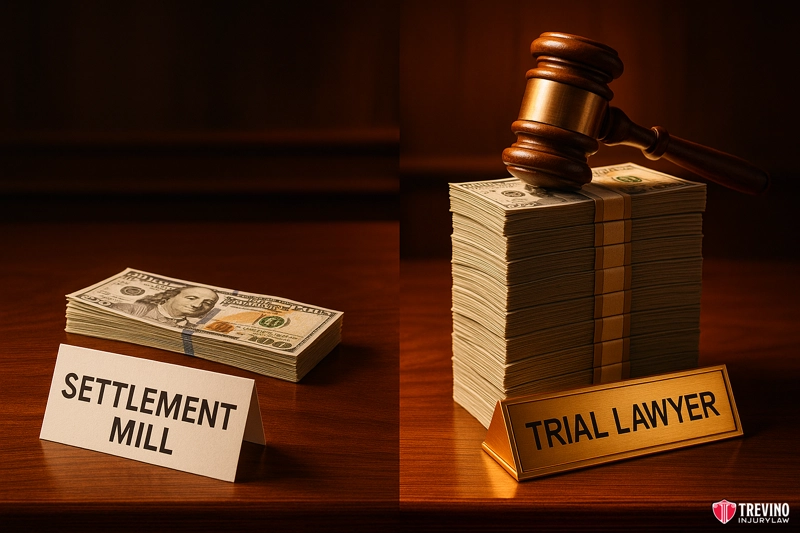
The fundamental difference lies in the firm’s economic incentive: settlement mills profit by processing thousands of cases quickly for low amounts, while a San Antonio trial lawyer profits by maximizing the value of fewer cases through aggressive litigation and detailed evidence preparation.
This volume-based model is supported by 2023 Texas Office of Court Administration data, which recorded over 28,000 civil cases filed in Bexar County while maintaining a clearance rate of nearly 100%, indicating mass settlements without trial.
While our main guide on hiring a personal injury lawyer covers general qualifications, understanding this distinction is critical. Your lawyer will help during negotiations with the insurance company and help you understand your options throughout the process. A dedicated attorney will take the time to ensure you aren’t just a file number. This approach determines whether your legal counsel views your claim as a file to be closed or a case that must be won at trial.
Settlement mills often assign 300 to 500 files to a single attorney, forcing them to rely on generic demand letters rather than customized legal strategies that account for your specific medical causation.
This “cookie-cutter” approach fails in a complex slip-and-fall case, where liability is often contested by aggressive defense teams representing retailers in Stone Oak or The Rim—areas identified by 2023 TxDOT Crash Records as high-density zones where retail foot traffic matches the high volume of vehicle crashes.

In contrast, a trial firm manages a select caseload of 40 to 60 files, allowing for the deep investigation required to prove negligence under Texas law.
Perhaps the most dangerous aspect of the mill model is the “Pre-Litigation Trap,” where high-volume firms drop clients immediately if the store’s insurance company denies a slip-and-fall claim because they simply lack the staff or expertise to file a lawsuit and conduct discovery.
How Insurance Companies Track If an Attorney Can Help You Win
Insurance giants like USAA and other major carriers maintain sophisticated internal databases that track exactly which attorneys file lawsuits and which ones have not tried a case in years.
If you hire a lawyer with no recent trial history, the insurance adjuster’s software, often a program like Colossus, calculates a lower “risk score” for your claim based on the firm’s lack of verdicts, resulting in “lowball” settlement offers because there is no credible threat of a jury verdict.

The adjuster knows they can offer pennies on the dollar to a settlement mill, whereas they must set aside significantly higher reserves for a firm known to take cases to the Bexar County Courthouse.
Warning Signs a Client Should Watch For in a Settlement Mill
- The “Case Manager” Wall: You are never allowed to speak directly to the attorney handling your case, instead being routed to paralegals or case managers for every interaction.
- Pressure to Settle Early: The firm pushes you to accept a quick check before your medical treatment is even finished, often to meet their own monthly quotas rather than your long-term needs.
- Fear of Filing: They refuse to file a lawsuit when the offer is low or liability is denied, often advising you to take a bad deal rather than fight for what you deserve in court.
Once you identify the type of firm representing you, the next critical step is understanding exactly how the litigation process itself forces insurance companies to increase their offers.
How Does Filing a Slip and Fall Case Increase Settlement Value?
Filing a lawsuit, known as an Original Petition (under Texas Rule of Civil Procedure 22), moves your claim from an insurance adjuster’s desk to a defense attorney’s desk, immediately changing the insurance company’s risk profile and forcing them to re-evaluate the potential cost of a jury verdict.
While understanding your potential damages is essential, actually filing suit is the mechanism that “breaks the cap” of an adjuster’s authority limit, compelling them to seek higher settlement authority to avoid the uncertainty of trial.
When a San Antonio trial lawyer files suit, it triggers the ‘Stowers Doctrine‘ in Texas, established in the landmark case G.A. Stowers Furniture Co. v. American Indemnity Co. This legal precedent holds that if an insurer unreasonably rejects a settlement offer within policy limits when a prudent person would have accepted it, they can be held liable for the entire verdict amount, even if it far exceeds the original insurance policy cap.
This legal pressure is unavailable to firms that only operate in pre-litigation.
Furthermore, the litigation phase allows us to build a comprehensive damages model that includes future medical costs and loss of earning capacity, supported by vocational experts. This is vital because 2024 U.S. Bureau of Labor Statistics (BLS) data shows hospital service costs in the South Region rising at 4.5% to 6.0% annually, meaning a quick settlement today will likely not cover your future surgery costs.
In cases involving commercial defendants, such as a slip and fall at a grocery store in Leon Valley, this aggressive approach is often the only way to secure a fair recovery.
Identifying Liable Parties Through Formal Discovery and Depositions
Formal discovery is the legal process (governed by Texas Rule of Civil Procedure 190) that empowers your attorney to force the defendant to answer questions under oath and produce hidden evidence they previously refused to share.
Through Written Interrogatories (TRCP Rule 197), we compel the store to answer specific questions about their safety protocols. We investigate the incident thoroughly to gather evidence, such as maintenance logs, to secure evidence to prove negligence. Liability may vary depending on the location; we determine if a landlord, a cleaning contractor, or other liable parties are responsible for the uneven surface or hazard that directly caused your injury.
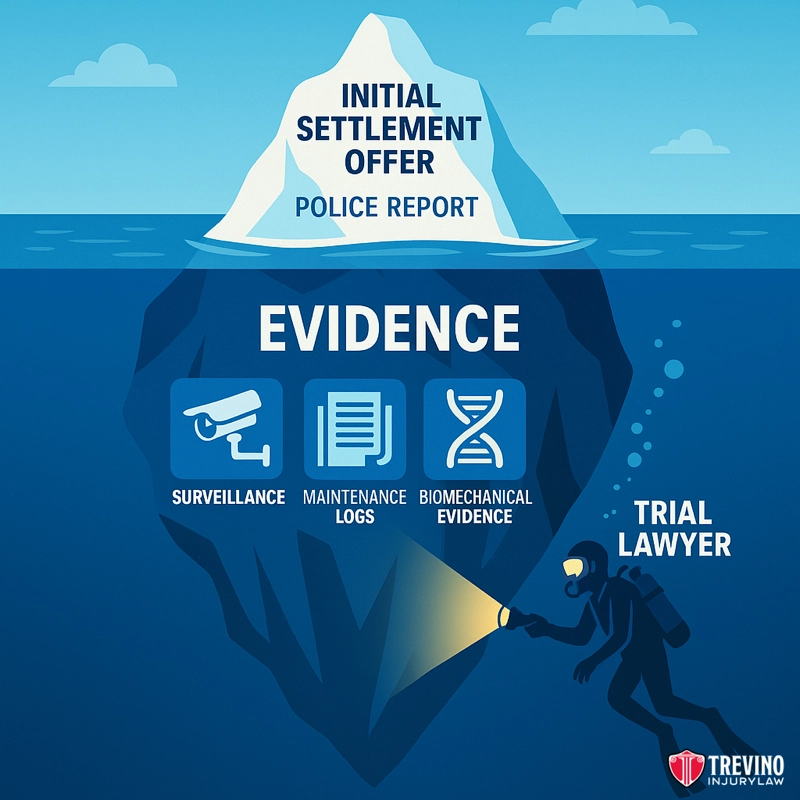
Discovery also helps sort through who may be liable for a San Antonio slip-and-fall when control is divided among an owner, tenant, contractor, or property manager.
Most critically, we conduct depositions (TRCP Rule 199), putting the store manager of the San Antonio location, whether it’s on Bandera Road or Loop 410, in the hot seat to expose inconsistencies in their safety story before a court reporter.
How a Lawyer Can Help Prove Damages with Expert Witnesses
A trial lawyer invests significant capital to hire biomechanical engineers and retail safety experts who can scientifically prove that the fall caused your specific injuries and that the business breached the standard of care.
For example, in a slip and fall case involving a spinal injury, we might retain a biomechanical expert to demonstrate how the forces of the fall resulted in a disc herniation, countering the insurance company’s argument that your condition was “pre-existing”.
This level of expert validation turns a simple claim into a scientifically supported case that commands respect from defense counsel.
Establishing this level of evidence is powerful, but presenting it effectively requires a lawyer who intimately understands the unique nuances of the local court system where your trial will take place.
Why Local Experience Matters for Your Slip and Fall Accident
Bexar County operates under a unique “Presiding Court” system where cases are assigned to available judges on the very day of trial, requiring your lawyer to be familiar with the entire bench rather than relying on a relationship with just one judge.
While broad legal knowledge is important, having a San Antonio trial lawyer who navigates the specific procedural rules and cultural expectations of the Bexar County Courthouse provides a distinct “home field” advantage over out-of-town counsel.
Lawyers from Dallas or Houston often misunderstand the local jury pool or annoy judges with procedural missteps, which can negatively impact the flow of your trial. In contrast, a local attorney with a reputation for preparedness allows the court process to move more smoothly.
This local expertise extends to knowing the specific tendencies of jurors drawn from diverse communities, from the historic West Side neighborhoods like Prospect Hill to the rapidly growing suburbs of Alamo Ranch. U.S. Census data (2023) highlights this critical economic divide: while the median household income in Stone Oak is ~$118,000, it is ~$32,000 in Prospect Hill.
Understanding San Antonio Jury Demographics
San Antonio juries are generally conservative but fair, known for punishing dishonesty while rewarding clear, credible evidence of negligence and harm.
Successfully picking a jury, a process called Voir Dire, is an art form specific to South Texas culture, requiring an attorney who can authentically connect with people from all walks of life in our community to bridge that $80,000 income gap and explain the true value of your damages.
Understanding these demographic nuances ensures that your story resonates with the specific individuals who will decide your verdict.
Now that you understand the value of a trial lawyer, a common question arises regarding the cost of this higher level of representation compared to a standard firm.
Is It Worth Paying a Higher Fee for a Trial Lawyer?
Yes, because we work on a contingency fee basis, meaning you are only paid if you win. While trial lawyers typically charge a 40% fee once we file your claim and enter litigation, compared to a settlement mill’s 33% pre-litigation rate, the “Net Recovery” to your family is often significantly higher because the gross settlement amount is maximized through the credible threat of a jury verdict. Because we operate on a contingency-fee basis, you never worry about hourly rates while we handle your slip-and-fall case.
The focus should not be on the percentage paid to the attorney, but on the final amount deposited into your bank account after all fees and expenses are resolved.
The math of quality representation is straightforward: paying a slightly higher percentage on a much larger settlement puts drastically more money in your pocket than paying a lower percentage on a “lowball” offer.
For example, if a volume firm settles your case quickly for $10,000, your net recovery might be around $6,666; however, if a trial lawyer pushes that same case to a $100,000 value through litigation, your net share would be $60,000—nearly ten times the amount.
This reality was demonstrated in the case of Jose Simon Arriaga Jr. v. Emily Montemayor, where the insurance defense offered only $5,000 to settle. Because we refused to accept that insult and took the case to trial, we secured a jury verdict of $536,007—over 100 times the original offer.
Understanding the financial value of patience and skill leads many clients to ask how long this rigorous process actually takes compared to a quick settlement.
The Timeline: How Long Does a Lawsuit Take?
The legal timeline for a slip-and-fall lawsuit in San Antonio typically spans 12 to 18 months from filing to verdict, though this duration can vary depending on the court’s docket and the complexity of the discovery required. This aligns with the average 14-18 month disposition time reported by the Bexar District Clerk (2023).
While this may seem lengthy compared to a quick settlement offer, this time is necessary to force the insurance company to pay fair value.
- Filing Suit (Months 1-2): We draft and file the Original Petition, officially starting the legal clock.
- Discovery (Months 3-9): This is the longest phase, involving written questions, document exchange, and depositions of all parties.
- Mediation (Months 9-12): Most cases settle here because the trial lawyer has successfully built the leverage needed to compel a maximum offer.
- Trial (Months 12-18): If the insurer refuses to be fair, we proceed to jury selection and verdict.
Can I Switch Lawyers If I Am Unhappy?
Yes, you have the right to fire your attorney at any time, but be aware that the fired attorney may assert a lien on your future settlement for the work they already performed.
Will I Have to Testify in Court?
Not necessarily; given that fewer than 1% of Bexar County cases reach a jury trial (Texas OCA, 2023), most settle before trial, but you will likely need to give a deposition (testimony in a conference room) during the discovery phase.
Does Trevino Injury Law Take Cases from Other Lawyers?
Yes, we frequently accept case referrals from other attorneys who do not have the resources or experience to take a complex slip and fall case to trial.
The Risk of Self-Representation (Pro Se)
Representing yourself in a Texas premises liability case is rarely successful because specialized defense attorneys will likely file a Motion for Summary Judgment (TRCP Rule 166a) to dismiss your claim before it ever reaches a jury.
Without a lawyer, you are held to the same standards as a licensed attorney, meaning you must strictly prove elements like ‘Constructive Notice.’ Under the rigorous standard set by Wal-Mart Stores, Inc. v. Reece, you must provide evidence that the hazard existed for a sufficient length of time that the store should have discovered it. Without this specific temporal evidence, the judge is legally obligated to dismiss your case.
If you fail to present evidence exactly as the rules of civil procedure require, the judge is legally obligated to dismiss your case, leaving you with zero compensation regardless of how severe your injuries are.
When Is It Too Late to Hire a Lawyer for a Slip and Fall?
If you wait until the two-year statute of limitations (Tex. Civ. Prac. & Rem. Code § 16.003) is nearly expired, many trial lawyers will decline your case because there is insufficient time to conduct the mandatory discovery needed to prove liability before the deadline.
While the law gives you two years to file, the practical limit is often much shorter, usually around 18 months, because building a trial-ready file takes time.
Furthermore, critical evidence like security footage of your fall is often deleted (‘spoliated‘), a legal issue defined in Brookshire Bros., Ltd. v. Aldridge (2014), within 30 days according to retail industry standards, meaning early action is essential to preserve the proof required to win.
Why Hire a San Antonio Fall Injury Attorney?
Insurance adjusters and settlement mills want you to fold early so they can protect their profits. They fear trial; we demand it. We fight for families by rejecting lowball offers and forcing negligent property owners to pay the full value of your injury.
Want to Protect the Full Value of Your Claim?
You’ve seen how this affects your case — but this is only one piece of the puzzle. Our Slip and Fall Lawyer page breaks down what a trial-ready firm does differently.
We proved this at the Bexar County Courthouse with a $536,007 jury verdict over an insulting $5,000 offer. To build this leverage, your San Antonio plaintiff trial lawyer immediately issues a spoliation letter to lock down security footage before it vanishes.
Call 210-TREVINO for a free case review. Se Habla Español. We work on a strict contingency basis, No Win, No Fee.