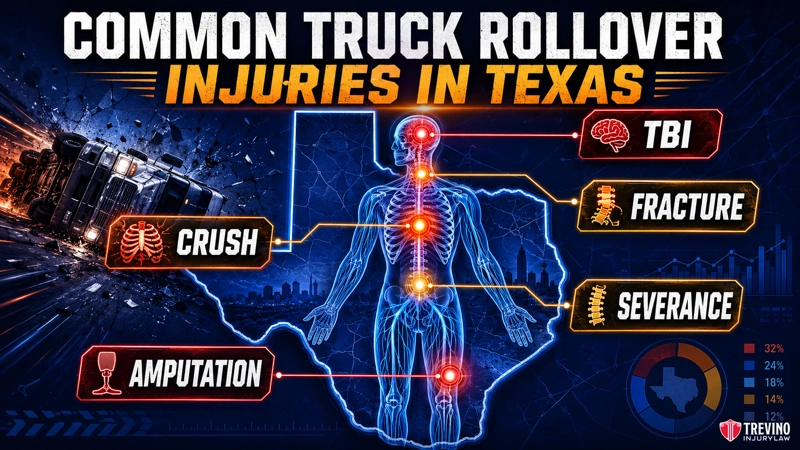
Common injuries after a commercial truck rollover include severe traumatic brain injuries, crushed chests, severed spinal cords, cervical fractures, and catastrophic amputations.
While rollovers represent a smaller share of overall collisions, accounting for 4% of fatal and 2% of nonfatal crashes involving large trucks nationally, according to the Federal Motor Carrier Safety Administration in 2022, their local impact is devastating. The Texas Department of Transportation recorded 1,524 suspected serious injuries from overturned crashes statewide in 2024, with 46 involving commercial vehicles in Bexar County alone. South Texas trauma centers document these types of injuries to mathematically prove your trauma.
What Could Your Truck Rollover Accident Case Be Worth?
Answer a few quick questions about your accident. Takes about 60 seconds.
See What My Case Might Be WorthThe insurance company offered less than $20,000. I ended up with over $1 million. — Jackie Galindo
The commercial adjuster assigned to your case is already scouring your medical history to reclassify these violent crush injuries as preexisting conditions.
A Spoliation Letter, a legal demand that stops the negligent trucking company from destroying the black box data proving their driver lost control, must go out immediately. Texas gives you two years, but vital electronic logs vanish in days.
Trevino Injury Law truck rollover accident attorneys will lock the perishable scene evidence down and force negligent corporate insurers to pay for your lifetime rehabilitation. Call 210-TREVINO now for a free case review. You pay nothing unless we win. Se Habla Español.
1. Severe Head Trauma and Traumatic Brain Injuries
Head injuries and severe traumatic brain injuries occur during a commercial truck rollover when the collision violently strikes the victim’s head multiple times. A collapsing roof or shattered side windows can cause permanent cognitive impairment.
We understand that large truck accidents are not single-impact events. The continuous rolling motion subjects the skull to repeated, violent trauma. A Traumatic Brain Injury (TBI) manifests when these violent rolling forces disrupt normal brain function. Clinical studies on rollover crash patterns highlight this severe vulnerability, revealing that subarachnoid hemorrhages in the cerebrum account for 37.1% of severe head injuries in pure rollover events (NHTSA, 2010).
Symptoms like severe headaches, profound confusion, and memory loss may be delayed for days or weeks after the initial crash. Accident victims injured amidst the high-freight traffic on I-35 require highly specialized trauma care immediately.

The daily impact of a TBI is life-changing. Victims may lose their ability to work, suffer severe personality changes, or require round-the-clock home nursing. Bringing in neuropsychologists early in the litigation process is essential.
We use these experts to medically validate these invisible internal injuries before the insurance company attempts to deny the severity of the cognitive damage. While the skull sustains blunt force trauma, the violent rolling motion simultaneously exerts massive pressure on the motor vehicle occupant’s torso.
What Are the Specific Biomechanics of Brain Trauma in a Rollover?
Understanding the specific types of brain trauma is critical, as each diagnosis requires a unique Life Care Plan and aggressive courtroom advocacy to secure proper funding.
- Diffuse Axonal Shearing: Tearing of the brain’s connective nerve fibers is caused by the violent rotational forces of the overturning vehicle.
- Coup-Contrecoup Lesions: Bruising occurs on opposite sides of the brain from violent back-and-forth movement inside the skull.
- Subdural Hematomas: Life-threatening internal bleeding requires immediate surgical decompression at a leading facility like the South Texas Medical Center.
The extreme forces that cause the brain to collide with the skull also compress the chest cavity against the vehicle’s interior.
2. Chest Crush Trauma, Broken Ribs, and Lung Injuries
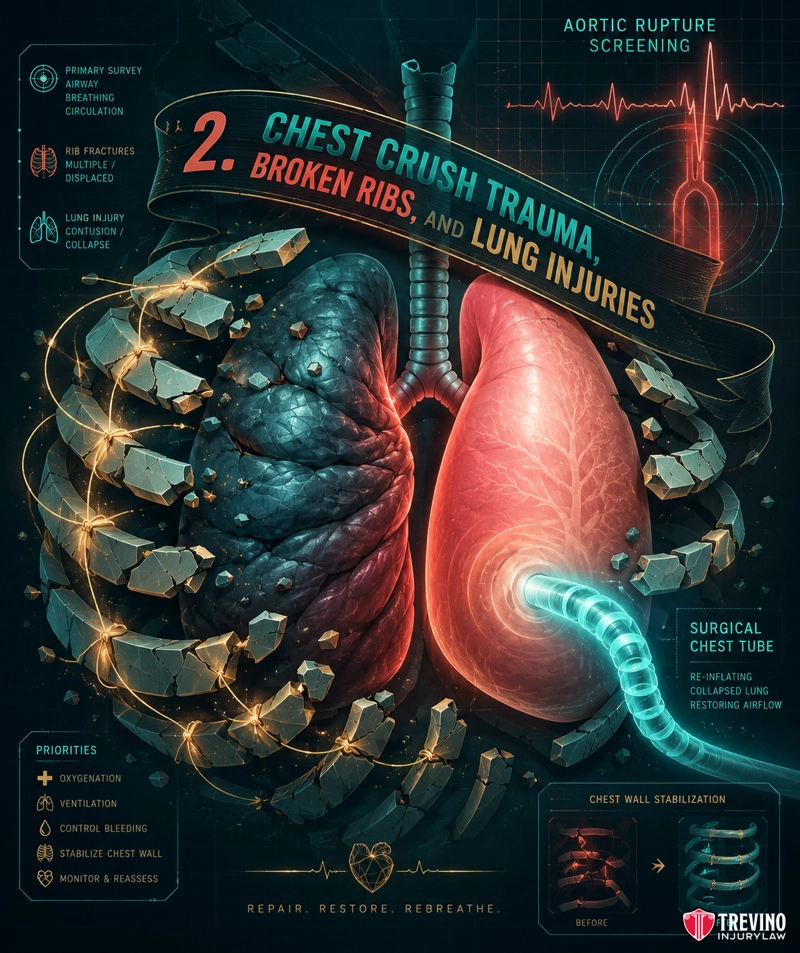
Injuries caused by truck accidents often include chest crush trauma and lung injuries when the victim is violently thrown against a locked seat belt. The collapsing side door structure also causes life-threatening sternum fractures and collapsed lungs. Beyond the standard understanding of roof crush trauma, car accident victims trapped in commercial trucking crashes on heavily congested corridors like Culebra Road frequently suffer severe thoracic trauma.
The biomechanics of this damage are directly tied to intense seat belt loading and lateral side-door impacts as the cab rolls. Sharp rib pain or coughing up blood requires immediate intervention from trauma surgeons. This specific presentation must be treated as a surgical emergency to prevent fatal respiratory failure, which is one of the most common causes of fatal injuries at the accident scene.
The lethality of these specific events is tragically high, with overturned crashes accounting for 356 fatalities across Texas in a single year (Texas Department of Transportation, 2024). Furthermore, this severe mechanical compression is a thoroughly documented outcome, as data shows that bilateral lung contusions make up 46.9% of severe thorax injuries sustained in pure rollover crashes (NHTSA, 2010). The long-term consequences of a crushed chest are severe. Victims often face permanent breathing difficulties, chronic rib pain, and a lifetime dependence on oxygen therapy.
These impairments destroy a person’s ability to perform physical labor or enjoy daily activities, resulting in extensive medical bills and lost wages. Under Texas law, to recover compensation for medical bills and this specific harm, you must prove a loss of earning capacity.
This standard, firmly rooted in the landmark Texas Supreme Court case McIver v. Gloria, 169 S.W.2d 710 (Tex. 1943), requires that we demonstrate exactly how your diminished physical capacity permanently impairs your ability to earn a living.
How Do Trauma Surgeons Identify Emergency Internal Bleeding and Respiratory Trauma?
Emergency trauma surgeons must immediately conduct advanced imaging to identify life-threatening respiratory trauma hidden beneath external bruising.
- CT Scans for Pulmonary Contusions: Medical teams utilize this imaging to identify severe lung bruising that actively impairs oxygen absorption.
- Surgical Chest Tubes: Surgeons insert these tubes to drain blood or air. This reinflates collapsed lungs caused by fractured ribs puncturing the pleural cavity.
- Aortic Rupture Screening: Specialists conduct immediate screening to rule out fatal internal bleeding caused by the extreme deceleration forces of the rollover.
While the chest absorbs frontal and lateral forces, the rollover’s twisting motion ravages the intricate structures of the back and spine.
3. Back, Shoulder, and Spinal Cord Injuries
Neck and back injuries, along with shoulder and spinal cord trauma, occur during a commercial truck rollover when the uncontrolled rolling motion twists and compresses the victim’s body. Pinning the occupant against the interior frame results in herniated discs and permanent nerve damage.
The structural dynamics of roof-crush incidents show that the back is highly vulnerable during rollovers on elevated interchanges like Loop 410. Victims frequently experience severe radiating pain shooting down into the arms or legs.
These debilitating injury cases often worsen over time without specialized and targeted intervention from orthopedic surgeons. A severed spinal cord changes a family’s life forever. Victims may require motorized wheelchairs, home modifications, and lifelong daily nursing assistance.

Our firm fights relentlessly to secure damages reflecting this physical pain and emotional trauma. We aggressively project decades of necessary physical therapy or complex surgical fusions. This approach works. We secured a $1.8 Million Settlement for a client who suffered a severe spinal injury in an 18-wheeler crash. Understanding the severity of spinal trauma requires analyzing the specific medical classifications used to litigate permanent paralysis.
How Does Complete Spinal Cord Severance Compare to Incomplete Severance?
The medical distinction between complete and incomplete spinal cord injuries determines whether a victim will experience total permanent paralysis or retain limited sensory function below the impact zone.
| Complete Severance | Incomplete Severance |
| Total loss of motor and sensory function. | Partial retention of motor or sensory function. |
| Requires maximum lifetime care funding. | Highly contested by defense experts seeking to minimize the claim. |
| Results in permanent paraplegia or quadriplegia. | Requires aggressive vocational rehabilitation forecasting to prove future losses. |
Just as the lower back is subjected to immense torque, the cervical spine is whipped violently in multiple directions.
4. Neck and Cervical Spine Fractures
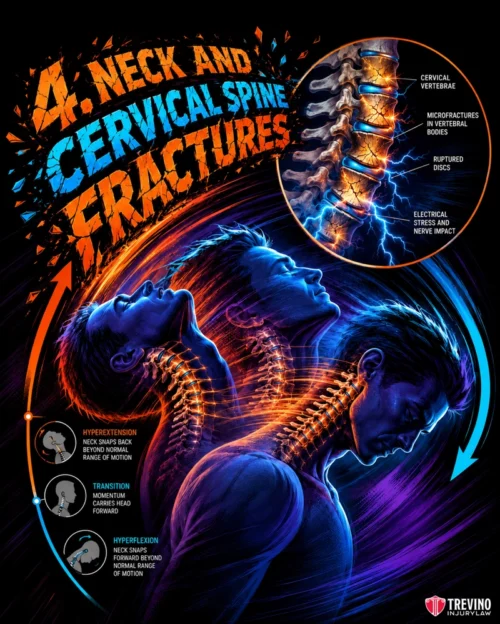
Neck and cervical spine fractures occur during a commercial truck rollover when extreme kinetic forces violently whip the head in multiple directions. This results in ruptured spinal discs and severe structural vertebral damage. Refining our understanding of general spinal impact, it is crucial to keep complex cervical injuries distinct from lower back injuries.
This ensures proper medical and legal evaluation for your truck accident claim. Research underscores the extreme fragility of the neck in these specific dynamics, demonstrating that cervical spine facet fractures represent 34.2% of severe spine injuries in pure rollover crashes (NHTSA, 2010). Victims often report immediate symptoms such as severe stiffness and agonizing numbness radiating down the arms.
We consistently warn victims that insurance adjusters will attempt to minimize these catastrophic injuries as “just soft tissue injuries”. This adversarial tactic is exactly why neurosurgeons rely on advanced MRIs. They use these scans to mathematically prove severe structural damage to the cervical vertebrae. A fractured neck limits all physical mobility.
Victims may spend months in a halo brace and face multiple high-risk surgical fusions just to stabilize their head. While the spine and neck sustain massive torque, the extremities are simultaneously vulnerable to the collapsing metal of the passenger cabin.
How Do Litigators Medically Distinguish Soft Tissue Damage From Cervical Fractures?
Trial litigators use advanced imaging to mathematically demonstrate the distinction between temporary muscle strain and permanent cervical fractures.
- Cervical Fractures: Broken bones in the neck requiring strict immobilization or emergency surgical fusion.
- Disc Herniations: Ruptured spinal discs actively compress the spinal cord, causing permanent nerve damage.
- Severe Whiplash (CAD): Cervical acceleration-deceleration injuries cause tearing of the vital stabilizing ligaments.
When the vehicle structure fails entirely, victims are subjected to the most direct, severe impact forces.
5. Broken Bones, Crush Injuries, and Internal Organ Trauma
Broken bones, crush injuries, and internal organ trauma occur during a commercial truck rollover when an 80,000-pound trailer completely crushes the passenger cabin. Pinning the victim results in catastrophic pelvic fractures and emergency amputations.
The catastrophic potential of these heavy vehicle inversions is clear on a national scale, where 682 large trucks—representing 12.7% of all large trucks in fatal crashes—were involved in rollover occurrences (NHTSA, 2023). Building on the critical need for scene evidence collection, occupants of the smaller vehicles pinned inside the mangled wreckage require immediate, life-saving intervention. Vascular surgeons must act quickly to restore blood flow and prevent permanent tissue death.
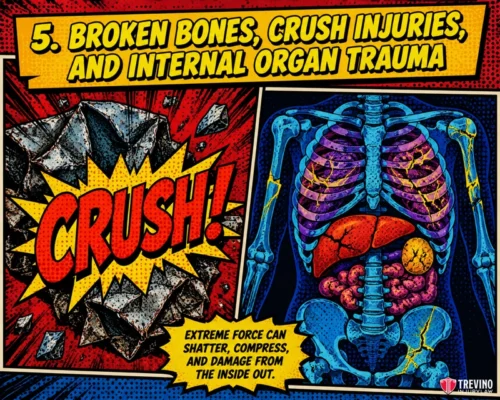
Families must watch for critical warning signs of internal organ damage, such as deep abdominal bruising and sudden fainting. Compartment syndrome and severe crush trauma often lead to permanent disfigurement and the inability to walk unassisted.
The severity of these structural crush injuries is explicitly reflected in our $7.9 Million Verdict for a client suffering a crushed foot and amputated toe. This outcome powerfully demonstrates how we litigate to verdict in Bexar County courts. The severity of these highly visible, structural injuries directly dictates our ability to fight the insurance company.
How Do Trauma Centers Document Structural Compartment Syndrome for Litigation?
South Texas trauma centers document catastrophic crush injuries through exhaustive emergency imaging and surgical operative reports that serve as the foundational evidence for your personal injury lawsuit.
- Emergency Imaging (MRI/CT): Captures objective, baseline proof of shattered bones before defense experts can argue preexisting conditions.
- Surgical Operative Notes: Details the strict physiological necessity of the amputation or complex reconstructive surgery.
- Vascular Assessments: Prove the loss of critical blood flow was directly caused by the negligent trucking company’s vehicle pinning the victim.
Once this clinical evidence is locked in, we use it to aggressively negotiate the financial recovery.
How Does the Severity of Your Rollover Injuries Affect Your Lawsuit’s Value?
The severity of your rollover injuries directly multiplies the value of your settlement. It increases the calculated totals for future medical care, lost earning capacity, and permanent physical impairment. This demands that the devastating financial impact is fully covered by the negligent trucking company. Moving from clinical medical diagnoses to aggressive legal valuation is essential, as catastrophic injuries often demand absolute policy limits.

Unlike local settlement mills, Trevino Injury Law refuses to accept lowball offers. We rely on our documented history of taking over 80 cases to trial. We secure multi-million-dollar outcomes when the defense initially offers only a fraction of the true value. This is demonstrated by our $536,007 jury verdict secured after a mere $5,000 initial offer. We force them to pay. To maximize this valuation, you must submit to specialized evaluations beyond the initial emergency room visit.
What Medical Specialists Must Coordinate Your Recovery and Litigation Plan?
Following emergency stabilization, your commercial crash injuries must be comprehensively evaluated by specialized neurologists, orthopedic surgeons, and vocational rehabilitation experts to fully chart your path to maximum medical improvement.
- Neuropsychologists: To map out cognitive deficits from TBIs and defend against adjusters who minimize mental trauma.
- Orthopedic Surgeons: To project future spinal fusions or hardware replacements.
- Life Care Planners: To calculate decades of necessary nursing care and home modifications.
This comprehensive medical evaluation clarifies the specific procedural steps victims must take during the first week of their case.
Can I claim compensation for PTSD after an 18-wheeler rollover?
Yes, you can claim compensation for injuries and post-traumatic stress disorder because the terrifying experience of a heavy commercial rollover causes compensable psychological damage alongside your physical injuries. You may be entitled to compensation for pain and suffering.
Will the trucking company voluntarily pay for my future Life Care Plan?
No, negligent trucking companies and their commercial insurers will never voluntarily pay for your future Life Care Plan, forcing your trial attorney to legally compel them through aggressive litigation.
Should I sign a medical release form from the commercial insurance adjuster?
No, you must never sign a medical release form from an opposing insurance adjuster because they will aggressively use it to scour your past medical history to blame your current rollover injuries on preexisting conditions.
How Do Delayed Onset Symptoms Differ From Immediate Trauma?
While immediate trauma symptoms like crushed limbs are obvious at the scene, delayed onset injuries such as whiplash, internal bleeding, and subtle cognitive deficits often take weeks to manifest fully.
| Trauma Type | Physical Presentation | Legal & Medical Action Required |
| Immediate Trauma | Amputations, paralysis, compound fractures. | Requires emergency surgery and immediate scene preservation. |
| Delayed Onset | Mild Traumatic Brain Injuries (concussions), soft tissue tearing, and internal organ bleeding. | Requires ongoing specialist monitoring and strict refusal to provide recorded statements. |
Failing to recognize and treat these delayed symptoms gives the defense a weapon to use against you in court.
What Happens If You Delay Seeking Level I Trauma Care After a Rollover?
Failing to immediately seek Level I trauma care after a truck rollover jeopardizes your physical survival and provides the commercial insurance company with grounds to argue that your severe injuries were caused by an unrelated event. Refusing or delaying medical care destroys the necessary causal link required in Texas courts to hold the negligent trucking company accountable.
Without unbroken documentation of your trauma, high-volume settlement mills gain leverage to drop your case because it becomes too difficult to quickly resolve. Furthermore, delaying your medical evaluations triggers strict legal deadlines that can destroy your case entirely.
For immediate post-crash priorities, including emergency care, scene documentation, and evidence preservation, see what to do after a truck rollover accident in Texas.
When Is It Legally Too Late to Link Delayed Symptoms to the Truck Crash?
It is legally too late to link your delayed medical symptoms to the commercial truck crash if you fail to file a lawsuit within the strict two-year Texas statute of limitations, permanently barring your financial recovery.
This legal expiration represents the ultimate failure of a claim, completely dissolving your right to pursue justice or compensation, regardless of how severe your physical injuries eventually become. To protect your family from this catastrophic loss, hiring an attorney—specifically an experienced truck accident attorney—immediately following the crash is imperative.
Why Hire a Truck Rollover Accident Lawyer?
You must hire a personal injury lawyer near me to aggressively litigate your catastrophic injury claim, immediately secure perishable black box evidence, and force negligent commercial trucking companies to pay maximum compensation rather than accepting a lowball settlement from an insurance adjuster. The moments after a commercial rollover are critical. While you focus on surviving traumatic injuries, the insurance company is already building a case to blame you and minimize your payout.
Want to Protect the Full Value of Your Claim?
You’ve seen how this affects your case — but this is only one piece of the puzzle. Our Truck Rollover Accident Lawyer page breaks down what a trial-ready firm does differently.
We know their playbook, and we shut it down. Do not give a recorded statement to the insurer, and do not face an 80,000-pound corporate defense team alone. Call 210-TREVINO for a free consultation. Se Habla Español.