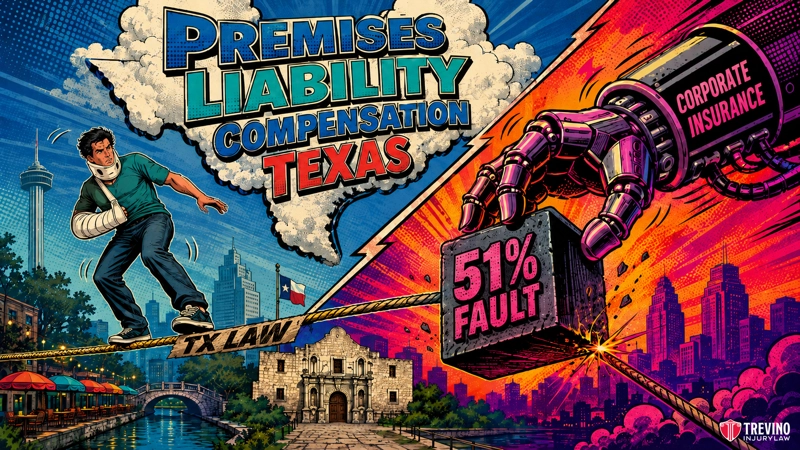
Compensation in a San Antonio premises liability lawsuit includes economic damages for your hospital bills and lost earning capacity, plus non-economic damages for your permanent physical impairment and mental anguish. It targets high-limit commercial general liability policies to force the negligent property owner to absorb the complete financial devastation of your injury.
The defense firm assigned to your claim is already leveraging Texas’s proportionate responsibility laws to shift the majority of fault onto you. Corporate adjusters actively build a false narrative that the hazard was open and obvious, aiming to bar your financial recovery entirely, so they pay absolutely nothing.
What Could Your Premises Liability Accident Case Be Worth?
Answer a few quick questions about your accident. Takes about 60 seconds.
See What My Case Might Be WorthThe insurance company offered less than $20,000. I ended up with over $1 million. — Jackie Galindo
Trevino Injury Law neutralizes these blame-shifting tactics and forces insurers to pay full value, securing a $7.9 Million verdict for a crushed foot and amputated toe. To protect your claim, a Spoliation Letter, a legal demand that stops the property owner from destroying evidence, must go out immediately before surveillance footage vanishes. Texas gives you two years to formally file suit, but corporate landlords routinely erase critical proof within days of an incident.
A Trevino Injury Law premises liability attorney will immediately lock down maintenance logs and incident reports. Call 210-TREVINO for a free case review. You pay nothing unless we win. Se Habla Español.
San Antonio Premises Liability Compensation: Key Takeaways
- As your San Antonio premises liability lawyer, we fight corporate negligence at apartment complexes on corridors like Loop 410 across Bexar County.
- Your attorney neutralizes the Texas proportionate responsibility defense to prevent corporate landlords from using the 51% bar rule to destroy your claim.
- Trevino Injury Law secured a $7.9 million verdict for a crushed foot, proving our legal team forces insurers to pay maximum compensation.
- We immediately issue spoliation letters to protect your critical evidence and shut down quick, lowball offers from adjusters at Progressive and State Farm.
Types of Recoverable Damages in Texas Premises Liability Claims
Accident victims in Texas are entitled to recover economic damages for tangible financial losses and non-economic damages for the subjective, life-altering impacts of physical impairment. Understanding your claim’s total value requires categorizing these two distinct types of recovery under the personal injury framework of Texas law.

When catastrophic injuries occur, the resulting bills quickly overwhelm families, and insurers routinely exploit this early financial panic. Establishing the property owner’s absolute legal duty is the first step, but meticulously categorizing your damages is what secures your financial future.
Under Texas Civil Practice & Remedies Code § 41.001, these compensatory damages are formally defined to cover actual economic or pecuniary loss, explicitly excluding any exemplary factors (Texas Constitution and Statutes, 2026).
Economic Damages: Medical Bills and Lost Earning Capacity
Economic damages are designed to reimburse you for the exact, calculable out-of-pocket expenses directly caused by the property owner’s negligence. These are the hard numbers associated with your recovery, covering several distinct categories of financial loss:
- Past and Future Medical Expenses: This includes emergency room visits, surgeries, hospital stays, physical therapy, and any specialized medical equipment required for your ongoing recovery. It is critical to note that under state law, the recovery of these healthcare expenses is strictly limited to the exact amount actually paid or incurred by or on behalf of the claimant (Texas Constitution and Statutes, 2026).
- Loss of Earning Capacity: If your injuries prevent you from returning to work, you are entitled to compensation for lost wages and future lost income. This is uniquely critical for high-wage South Texas industries like oilfield workers and construction trades, where physical impairment can end careers instantly. Statutorily, this future loss of earnings encompasses not just your base wages, but also total earning capacity, future income, and even potential inheritance (Texas Constitution and Statutes, 2026).
- Property Damage: Repair or replacement costs for any personal property destroyed during the incident.
Non-Economic Damages: Pain, Mental Anguish, and Disfigurement
However, hospital bills only represent a fraction of the human cost. Non-economic damages compensate victims for the profound, invisible consequences of an injury, including chronic physical pain, mental anguish, and permanent disfigurement. Texas law formally defines these non-economic damages to also include physical impairment, loss of companionship and society, inconvenience, and a severe loss of enjoyment of life (Texas Constitution and Statutes, 2026).
These damages account for the loss of your quality of life. For example, the impact of PTSD from violent assaults in negligent security cases fundamentally alters your daily existence, requiring extensive psychological care. Because these damages are subjective, they require specialized evidence and a skilled legal presentation to prove their future cost.
Trial attorneys reference major catastrophic injury precedents (such as the Mario Trevino Mendoza verdict, which secured $7.9 million for a crushed foot and amputated toe) to demonstrate to juries the immense, lifelong subjective value of physical impairment. In tragic cases of wrongful death, surviving family members facing the emotional devastation of losing a loved one can also pursue justice and accountability.
How Are Catastrophic Future Medical Needs Calculated?
We calculate your lifelong medical needs by partnering with top medical specialists and forensic economists to create an exhaustive, legally defensible Life Care Plan. Settlement mills often guess at future costs to close a file quickly, but trial lawyers prove them mathematically.

When litigating catastrophic cases in Bexar County, we understand that a severe spinal injury or traumatic brain injury will require decades of specialized care. By projecting medical inflation, calculating the cost of future revision surgeries, and estimating lifelong rehabilitation over your statistical life expectancy, we establish an unassailable record of your future requirements.
This comprehensive medical and economic proof relies heavily on expert testimony and effectively neutralizes the insurance company’s attempts to undervalue your life.
The Role of Forensic Economists in Texas Courts
Forensic economists analyze your current financial trajectory to mathematically project your lifetime loss of income and future medical inflation for a Bexar County jury. Juries require hard data, not rough estimates.
These experts calculate the “present value” of future losses. This ensures that a settlement structured today will not run out ten or twenty years down the line when a victim needs a subsequent surgery or full-time assisted living care. Once we establish this massive financial baseline, the defense will immediately attempt to reduce its liability using Texas state law.
Texas Proportionate Responsibility and the 51% Bar Rule
Under Texas proportionate responsibility laws, your final financial compensation is reduced by your assigned percentage of fault, and you recover nothing if a jury finds you more than 50% responsible for the accident.
Chapter 33 of the Texas Civil Practice and Remedies Code introduces specific defense tactics explicitly designed to destroy or diminish your claim. The statute explicitly mandates that a claimant may not recover any damages if their percentage of responsibility exceeds 50%, while any damages awarded below that threshold are proportionately reduced by the assigned percentage of fault (Texas Constitution and Statutes, 2026).
How Texas Fault Laws Affect a Hypothetical $100,000 Award:
| Victim’s Assigned Fault | Impact on Compensation | Final Payout |
| 0% At Fault | No reduction | $100,000 |
| 25% At Fault | Reduced by 25% | $75,000 |
| 50% At Fault | Reduced by 50% | $50,000 |
| 51% At Fault (or more) | Total Bar to Recovery | $0 |
Defense lawyers for corporate property owners routinely attempt to trigger this 51% bar rule by arguing the hazardous or unsafe conditions were ‘open and obvious’ or that the visitor was distracted.
This aggressive defense tactic stems directly from the landmark Texas Supreme Court ruling in Austin v. Kroger Texas, L.P., 465 S.W.3d 193 (Tex. 2015), which established that corporate landowners generally owe no duty of care to protect invitees from hazards that are open and obvious, making our early evidence preservation essential to defeat their inevitable motion to dismiss your claim.

For example, if you suffer a severe injury in a premises liability accident due to a structural collapse at an apartment complex in Leon Valley, the corporate landlord’s legal team will immediately launch an investigation aimed at proving you ignored warning signs. To successfully hold negligent property owners accountable, we counter these blame-shifting tactics by immediately securing incident reports and witness testimony before the defense can construct their false narrative.
Are There Statutory Caps on Premises Liability Settlements?
While Texas does not cap standard economic or non-economic damages in typical premises liability cases, the state enforces strict statutory limits on punitive damages. Standard compensatory damages (your medical bills, lost wages, and pain and suffering) remain completely uncapped.
However, if “Gross Negligence” is proven, meaning the property owner acted with extreme, conscious indifference to your safety, you may pursue punitive damages. To pursue this, a plaintiff must provide clear and convincing evidence that the harm resulted specifically from fraud, malice, or gross negligence (Texas Constitution and Statutes, 2026). T
hese are exemplary damages designed solely to punish the defendant. Under Texas law, punitive damages are capped at the greater of $200,000, or two times economic damages plus an equal amount of non-economic damages up to $750,000.
Furthermore, prejudgment interest may not be assessed or recovered on these exemplary damages, meaning the capped amount is absolute prior to a final verdict (Texas Constitution and Statutes, 2026). Knowing these legal limits allows experienced lawyers to target the exact insurance layers needed for your payout.
How Do Commercial General Liability (CGL) Policies Dictate Final Payouts?
The maximum compensation you can actually recover is heavily dependent on the layered Commercial General Liability (CGL) insurance policies held by the at-fault property owner. A jury can award millions in damages, but actually recovering that money requires taking legal action and navigating complex layers of corporate insurance. For the separate question of which commercial entity may actually be responsible, see who can be sued for commercial property injuries in San Antonio.

High-volume “settlement mills” often accept the first easy primary policy limit offer, leaving significant money on the table. A firm built on trial authority forces corporate landowners from upscale retail spaces at La Cantera to large apartment complexes along Loop 410 to expose and exhaust both their primary and umbrella policies to satisfy the true value of a catastrophic claim.
Commercial Policy Limits vs. Homeowner Insurance Limits
Commercial properties carry massive liability limits that frequently exceed $1 million, whereas residential homeowner policies typically cap injury payouts between $100,000 and $300,000. This fundamentally dictates the maximum financial recovery available. Commercial defendants possess layers of umbrella coverage designed to cover catastrophic losses.
| Policy Type | Typical Injury Limit | Defendant Type | Property Examples in San Antonio |
| Commercial General Liability | $1 Million+ | Corporate Entities & Businesses | River Walk businesses, La Cantera retail spaces, Loop 410 apartments |
| Homeowner’s Insurance | $100,000 to $300,000 | Private Individuals | Private residences in Alamo Heights, Terrell Hills |
Can I recover compensation if my medical bills were paid by health insurance?
Yes, under the Texas collateral source rule, you can still recover the full value of your medical expenses from the negligent property owner even if your health insurance initially paid the bills.
Do I have to pay back my health insurance from the settlement?
Yes, through a legal process called subrogation, your health insurance provider has a statutory right to be reimbursed from your final settlement for the specific injury-related bills they covered. An experienced attorney will aggressively negotiate these health liens down to maximize the net money you take home.
The Spoliation Threat: Preserving Evidence Before It Disappears
To secure maximum compensation, your attorney must legally prevent the property owner from destroying critical evidence. You cannot get compensated if you cannot definitively prove liability. This is why our First-Week Evidence Preservation Process is critical to securing your payout:
- Immediate Attorney Involvement: An actual trial attorney reviews your case on day one, not just a case manager.
- Spoliation Letters: We issue formal legal demands to prevent apartment managers from overwriting 48 to 72-hour security footage to hide their security failures.
- FOIA Requests: We rapidly secure dispatch records, dashcam, and bodycam footage from San Antonio law enforcement.
- Trial-First Preparation: We prepare the evidence for a Bexar County jury immediately, knowing that settlement mills often skip this step for a quick, low payout.
What Happens If You Delay Medical Treatment After a Premises Injury?
If you fail to seek immediate medical treatment after a premises injury, such as an assault or a structural collapse, the insurance adjuster will use the “gap in treatment” to aggressively argue your injuries were pre-existing, fabricated, or unrelated to the accident.
Delaying a visit to an emergency room or urgent care breaks the legal chain of causation. This critical mistake gives powerful insurers like Allstate or USAA the exact leverage they need to issue a zero-dollar denial and close your file.
When Is It Too Late to Demand Full Compensation for Your Injury?
Under Texas law, a strict two-year statute of limitations applies to filing a premises liability lawsuit. Statutorily, the suit must be brought not later than two years after the day the cause of action officially accrues (Texas Constitution and Statutes, 2026). However, the real expiration date for your claim often happens much sooner. It is strictly too late to recover full compensation for your future medical needs once you sign the insurance company’s initial release form, as this permanently bars you from seeking additional funds.
Adjusters know the clock is ticking on your medical bills, which is why they will often wave a quick $5,000 check in the first week before you know the true extent of your injuries. Signing this document legally releases the commercial property owner from all future liability. Accepting this early settlement mill money forfeits your right to have a Trial Authority build a comprehensive Life Care Plan for your maximum recovery and protect your legal rights.
Why hire a premises liability lawyer?
A severe premises injury threatens both your physical and financial future. Whether you were injured by a structural collapse or negligent security, corporate insurance adjusters will attempt to use Texas’s proportionate responsibility laws to diminish your claim. Do not let them.
A trial lawyer at Trevino Injury Law will protect your claim by calculating your true lifetime medical costs, exposing massive commercial policy limits, and demanding maximum economic and non-economic damages.
Want to Protect the Full Value of Your Claim?
You’ve seen how this affects your case — but this is only one piece of the puzzle. Our Premises Liability Lawyer page breaks down what a trial-ready firm does differently.
Insurance adjusters use your silence against you, but accepting early money destroys your case. Do not give a recorded statement to the insurance company. With over 80 cases taken to trial, we know their playbook, and we shut it down.
Call 210-TREVINO for a free, zero-obligation case evaluation. We work on a strict contingency fee basis; you owe us nothing unless we secure your financial recovery.