You prove negligence by forcing the property owner to hand over the internal maintenance logs and surveillance footage that confirm they knew about the danger before you were injured.
Insurance Adjusters are already building a defense to claim the hazard was open and obvious or that you caused your own injuries. According to the City of San Antonio Development Services Department, inspectors recorded 5,633 interior apartment violations in a single 2022 fiscal cycle. Behind that negligence is a corporate defendant that deferred critical repairs, ignored prior tenant complaints, and neglected regular inspections to protect its profits.
What Could Your Premises Liability Accident Case Be Worth?
Answer a few quick questions about your accident. Takes about 60 seconds.
See What My Case Might Be WorthThe insurance company offered less than $20,000. I ended up with over $1 million. — Jackie Galindo
Commercial security systems are programmed to overwrite digital video within days. A Spoliation Letter, a legal demand that prevents the property owner from destroying evidence, must be issued immediately. Texas gives you two years to file a lawsuit, but the physical evidence you need to satisfy the strict time-on-floor requirement disappears in hours.
Trevino Injury Law premises liability lawyers execute immediate preservation demands to lock down this critical footage before the corporate system wipes it clean. Call 210-TREVINO now for a free case review. You pay nothing unless we win. Se Habla Español.
Texas Premises Liability Negligence: Key Takeaways
- As your San Antonio premises liability lawyer, we aggressively fight insurance adjusters who blame victims for corporate negligence.
- Trevino Injury Law secured a $536,007 jury verdict after a lowball offer. The firm litigates to protect families.
- Our legal team preserves critical surveillance footage on corridors like I-35 in San Antonio before property owners destroy evidence.
- Your attorney uses a Spoliation Letter to establish actual notice and satisfy the strict time on the floor legal requirement.
What Are the Four Legal Elements Needed to Prove Premises Liability in Texas?
To secure a maximum settlement or verdict, a premises liability claim requires you to prove four strict legal elements. If you fail to establish even one of these pillars, the Insurance Adjuster will use it as an excuse to deny your claim.
- Duty of Care: You must establish that the property owner owed you a legal duty to keep the premises safe. Texas law assigns different levels of protection based on your legal status at the time of the injury. A customer or “invitee” is legally owed the highest duty of care.
- Breach of Duty: You must prove the property owner breached this duty. This means they failed to maintain a safe environment by ignoring a known hazard, delaying repairs, or violating safety codes.
- Causation: You must demonstrate direct causation. You have to prove that the property owner’s specific negligence was the direct and proximate cause of your injuries.
- Damages: You must prove you suffered quantifiable damages. This includes your emergency medical bills, lost wages, and permanent physical impairment.
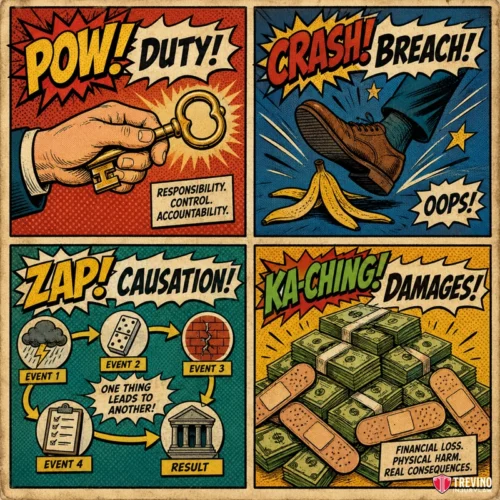
We build an undeniable narrative for Bexar County juries. This aggressive trial preparation prevents high-volume settlement mills from undervaluing your life-altering trauma.
The Evidentiary Burden for Duty, Breach, Causation, and Damages
We aggressively fight corporate defendants by using discovery to expose their negligence across all four legal pillars. These types of evidence help establish a breach of duty: internal logs, prior building code violations, and employee communications showing that the property owner failed to conduct regular checks or inspect the premises to address a known danger along major corridors such as I-35.
The prevalence of these hazards is significant; for example, records show 5,633 interior apartment violations and 927 exterior apartment violations in a single fiscal cycle in San Antonio (City of San Antonio Development Services Department, 2022).
This standard naturally lays the groundwork to support your claim, but the next critical challenge is proving exactly what they knew about the danger and when they knew it.
How Do You Prove the Property Owner Knew About the Dangerous Condition?
We prove an owner’s knowledge by compelling them to produce internal incident reports, video footage, and prior tenant complaints that confirm they either knew or should have known about a dangerous condition and failed to warn of the hazard.
Beyond standard constructive-notice definitions, victims must establish actual notice and meet strict time-on-the-floor requirements. Proving knowledge is the battlefield where these cases are won or lost. Whether the incident occurred near Loop 1604 or downtown near The Alamo, corporate defendants will routinely deny any knowledge of broken security gates or collapsing stairs.
These structural failures have devastating consequences, as evidenced by the 192 fatal falls from stairs and steps recorded by Texas trauma facilities between 2018 and 2022 (Texas DSHS / EMSTR, 2022).
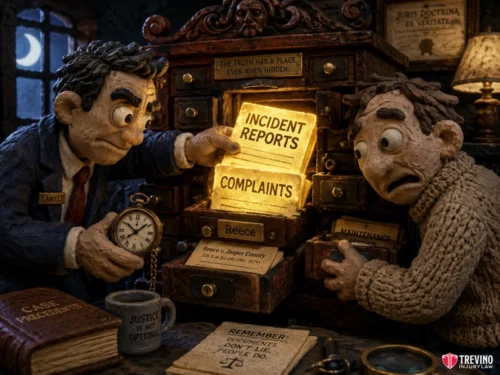
We use circumstantial evidence to show exactly how long the hazard existed, satisfying the strict time-on-floor standard. This ‘time-on-floor’ requirement is the ultimate battleground in premises liability law, cemented by the Texas Supreme Court in Wal-Mart Stores, Inc. v. Reece, 81 S.W.3d 812 (Tex. 2002). Under Reece, a victim must present specific temporal evidence showing a hazard existed long enough that the property owner had a reasonable opportunity to discover and resolve it.
How Do Spoliation Letters Prevent Evidence Destruction?
We send a Spoliation Letter: a formal legal demand that stops negligent companies from deleting photos and videos or altering maintenance records before trial. Early evidence preservation is mandatory to protect the strength of your case. If a corporate defendant destroys data after receiving this letter, the court can instruct the jury to assume the destroyed evidence would have proved the defendant’s guilt.
While securing this internal knowledge protects your evidence, knowing how insurance companies will try to twist that same evidence against you determines the outcome of your claim.
How Do Insurance Companies Try to Dispute Causation and Blame You?
Insurance companies will aggressively argue that you were not paying attention, the hazard was open and obvious, or your injuries existed prior to the accident, to avoid paying the compensation you deserve.
While defeating the open-and-obvious defense is critical, navigating comparative negligence thresholds requires specialized expert witness strategies. We know their playbook.
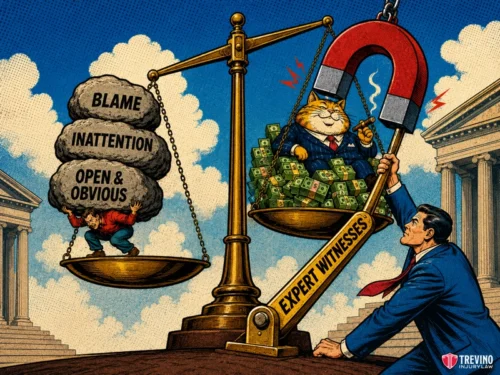
Adjusters attempt to shift the blame to protect their profits rather than accepting their responsibility to keep their premises safe. We force them to pay by utilizing safety engineers to prove the hazard was unavoidable.
Overcoming Texas Proportionate Responsibility Laws
Under Texas law, your compensation is reduced by your percentage of fault, and you recover nothing if a jury finds you are more than 50% responsible for the accident. Our law firm relies on biomechanical experts and accident reconstructionists to objectively prove the evidence holds property owners accountable for the vast majority of the liability. For the broader damages and insurance analysis, see what determines premises liability compensation in Texas.
Understanding these blame-shifting tactics prepares you for the fight, but knowing why you must launch an immediate legal investigation is what ultimately protects your right to recover.
Why Do Premises Liability Cases Require Immediate Legal Investigation?
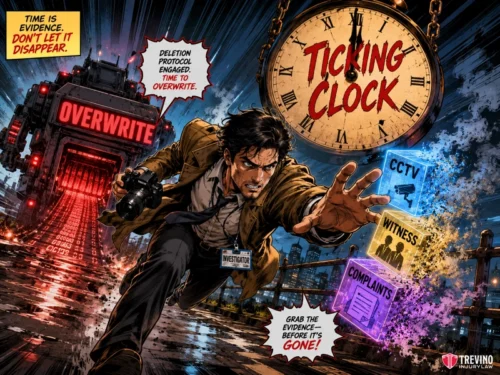
Premises liability claims are uniquely complex because personal injury law heavily protects property rights, requiring you to secure fleeting evidence like CCTV footage and witness testimony within hours of the injury before it is permanently destroyed by property owners and occupiers attempting to deny responsibility. In a standard collision on I-10, a police report often establishes fault.
These independent traffic reports are common, given that San Antonio experienced 39,805 motor-vehicle crashes in 2024 alone (TxDOT, 2025). However, in premises cases, there is rarely an independent police investigation unless the incident involves a violent crime or a catastrophic structural collapse. To successfully file a lawsuit, we must build the liability case from the ground up by hiring independent engineers and security experts to establish fault.
This independent investigation is crucial, especially given the severity of property-related incidents, such as the 50 fatal occupational injuries that occurred in business and communal areas across Texas in 2024 (TDI-DWC, 2024).
Knowing why rapid investigation matters is only the first step, but what exact actions must you take right now to ensure that your rights are protected?
What Steps Must You Take Immediately to Preserve Evidence?
To build a strong premises liability case, you must immediately secure physical proof of the hazard before the property owner attempts to fix the condition and erase liability. This requires you to meticulously photograph the scene, identify potential witnesses who saw the accident, and seek prompt evaluation at a local hospital.
To protect your claim, take these immediate actions:
- Photograph the exact defect and the surrounding area from multiple angles.
- Record the names and contact information of any eyewitnesses.
- Seek immediate medical attention at a facility in the Medical Center to legally document your injuries through medical records.
These immediate actions protect your physical health and preserve the scene, leading naturally to specific documentation questions that arise during this chaotic time.
Do I need a formal incident report to prove my case?
No, you do not strictly need a formal report, but filing one forces the property manager to officially acknowledge the event occurred and establishes the date of your injury.
Can I sue if there were warning signs posted?
Yes, you can pursue a claim if the warning sign was hidden, illegible, or failed to adequately convey the extreme danger of the specific hazard.
Evidentiary Differences: Negligent Security vs. Structural Failures
The evidence required to successfully prove a premises liability claim in San Antonio shifts dramatically depending on whether your injuries stem from a violent crime caused by inadequate security measures or a catastrophic incident resulting from collapsing commercial structures.
- Negligent Security: Requires pulling crime grids from the San Antonio Police Department (CAP Index) to prove a history of violence. The necessity of these grids becomes clear when examining local crime rates, as the city recorded 29,438 assault offenses and 1,366 robbery offenses from January to December 2025 (San Antonio Police Department, 2026).
- Structural failures: Requires uncovering building blueprints, contractor histories, and code violation records to establish systemic maintenance failures.
Understanding these complex evidentiary differences highlights the severe negative consequences of failing to act quickly. Furthermore, the Texas statute of limitations requires you to file a claim within two years from the date of the accident.
What Happens If You Don’t Document the Hazard at the Scene?
Failing to immediately photograph the hazard allows the negligent property owner to secretly repair the defect overnight and legally deny it ever existed, entirely stripping you of the critical physical evidence needed to prove they breached their legal duty of care.
Without immediate documentation, cases devolve into your word against a powerful corporation. This highlights why contacting experienced personal injury attorneys immediately is crucial for deploying investigators to the scene.
This dangerous lack of evidence emphasizes the strict expiration deadlines you face when trying to force uncooperative property owners to hand over their internal data.
When Is It Too Late to Subpoena Surveillance Footage?
It becomes legally too late to recover surveillance footage in as little as 24 to 72 hours, as many commercial security systems are intentionally programmed to automatically overwrite their digital data, permanently destroying the visual proof of your traumatic accident.
Delaying legal action destroys your strongest evidence. We execute immediate preservation requests to lock down this critical footage before the corporate system wipes it clean, thereby strengthening your case.
Why Hire a Premises Liability Lawyer?
Hiring the best personal injury lawyer San Antonio forces negligent property owners and their insurance adjusters to pay maximum compensation for your severe injuries instead of blaming you for the accident. While many cases settle, we immediately secure surveillance footage before it disappears, overcome comparative-fault defenses, and litigate your case to a verdict if they refuse to pay.
Want to Protect the Full Value of Your Claim?
You’ve seen how this affects your case — but this is only one piece of the puzzle. Our Premises Liability Lawyer page breaks down what a trial-ready firm does differently.
Corporate defendants will use your silence against you and destroy the evidence you need to win. Do not give a recorded statement to the insurer first. We know their playbook, and we shut it down. We fight to secure long-term financial stability for families, and you owe us nothing unless we win. Call 210-TREVINO for a free consultation today. Se Habla Español.