Texas House Bill Nineteen shields negligent trucking companies by splitting your lawsuit into two phases. You must prove the individual driver directly caused the crash before a jury ever hears about the corporation’s dangerous hiring practices or failed brake maintenance.
The corporate defense machine uses this procedural delay to stall your financial recovery. Insurers dispatch rapid response teams to the crash scene to sweep away physical evidence while you recover.
Refusing to passively accept weak offers, our trial team neutralized this corporate shield and previously secured a $17 million settlement in a head-on collision case involving three fatalities. We lock down driver liability early by sending a Spoliation Letter, a legal demand that stops the commercial carrier from deleting black box data from an eighteen-wheeler. Texas grants you two years to file a lawsuit, but the telematics proving the operator was fatigued vanish in thirty days.
What Could Your Truck Accident Case Be Worth?
Answer a few quick questions about your accident. Takes about 60 seconds.
See What My Case Might Be WorthThe insurance company offered less than $20,000. I ended up with over $1 million. — Jackie Galindo
Trevino Injury Law, our truck accident lawyer in San Antonio, initiated this aggressive courtroom strategy on day one. Call 210-TREVINO for a free case review because you pay nothing unless we win. Se Habla Español.
What Is the New Law for Truck Drivers and Corporate Liability in Texas?
The new law fundamentally changes Texas commercial trucking litigation by allowing corporate defendants to request a “bifurcated,” or two-part, trial, delaying their financial exposure until the plaintiff proves the truck driver was directly at fault for the crash.
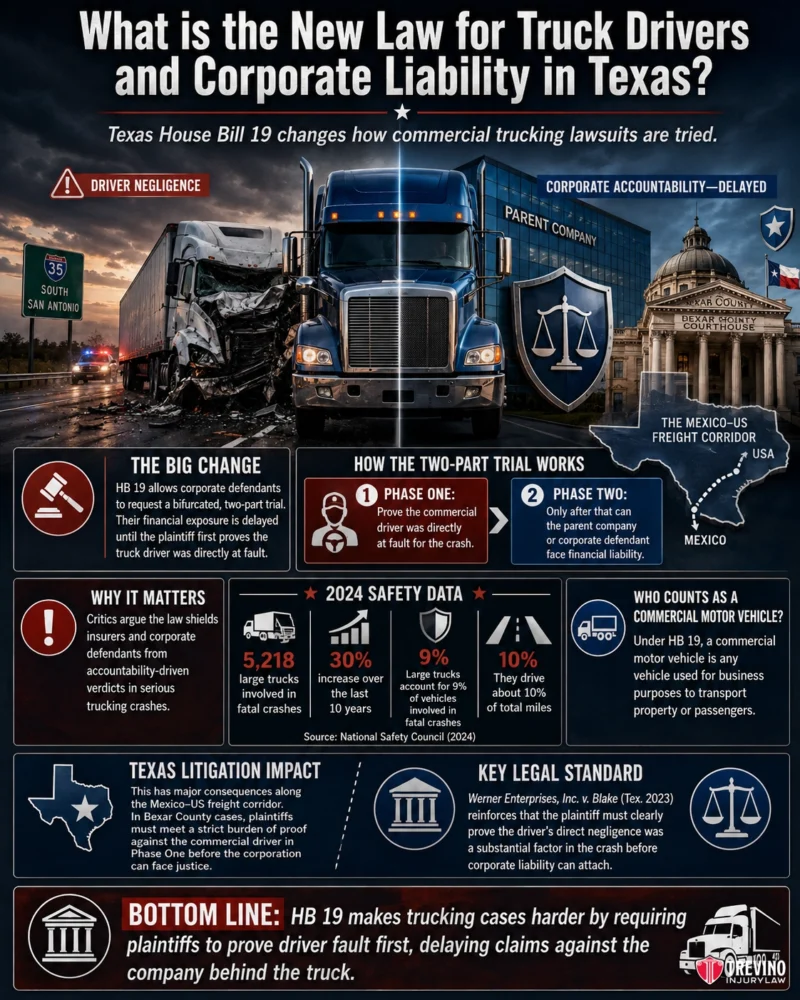
While a standard 18-wheeler collision claim might seem straightforward, insurance giants heavily lobbied for this legislative shield to protect their profit margins amid a worsening safety crisis. According to 2024 data from the National Safety Council, 5,218 large trucks were involved in fatal crashes, a staggering 30% increase over the last 10 years.
Because these commercial vehicles account for 9% of all vehicles involved in fatal crashes despite driving only 10% of total miles, insurers use Texas House Bill 19 to shield themselves from the massive, accountability-driven verdicts required to correct this deadly trend.
Under HB 19, a commercial motor vehicle is legally defined as any vehicle used for business purposes to transport property or passengers.
This definition severely impacts claims navigating the heavy commercial freight traffic along the Mexico-US commerce corridor. This means that when filing a lawsuit at the Bexar County Courthouse, our trial team must meet a strict burden of proof against the commercial driver in Phase One before the parent company can face justice.
This legislative shift exacerbates the already rigorous standards of proximate cause and corporate liability examined in landmark Texas Supreme Court decisions like Werner Enterprises, Inc. v. Blake (Tex. 2025), which mandate that a plaintiff must unequivocally prove the driver’s direct negligence was a substantial factor in the crash before attributing financial blame to the corporation’s broader systemic failures.
How Does a Bifurcated Trial Protect Negligent Trucking Companies?
Under Texas law, specific legislation exists that explicitly shields corporate defendants. On September 1, 2021, new rules took effect that amended the Texas Civil Practice and Remedies Code. This legislation allows Negligent Trucking Companies to request a two-part trial when facing lawsuits involving commercial motor vehicles. This procedural tactic is known as bifurcation.
These corporate defendants use this tactic to protect their insurance rates and hide their dangerous hiring practices from the jury. Here is a breakdown of how this legal process restricts your right to fair compensation following a severe vehicle accident:
- The First Phase of the Trial: During this phase, the jury cannot hear evidence of corporate negligence. They only review the commercial driver’s ordinary negligence or negligence per se at the time of the accident.
- Shielding the Corporation: Claims such as negligent entrustment are legally shielded from the jury during this initial stage. The core issue in the action is limited strictly to the vehicle involved in the accident and whether the driver’s actions directly caused the injury or death.
- Proving the Violation: We must prove the driver’s failure to comply with a duty of care applicable to their role. When a safety regulation or standard is specific, we use it to establish liability. This standard is specific and governs every element of a duty on the road.
- Compensatory Damages: If liability is determined in the first phase, the jury can award compensatory damages. This covers the immediate physical and financial harm.
The Second Phase of Trial: Trevino Injury Law litigates to a verdict. Only after winning the first phase can we force the trial into its second phase. In this phase, we expose the parent company’s broader regulatory violations. We use data from a six-year study, internal audits, and the Texas Department of Public Safety to require a finding of gross negligence. This allows us to pursue the maximum amount of exemplary damages.
What Evidence Proves the Commercial Driver’s Direct Negligence?
To successfully prove a commercial driver’s direct negligence, an attorney must secure irrefutable forensic evidence from the crash scene, including electronic logging device (ELD) data, onboard telematics, and police collision reports.
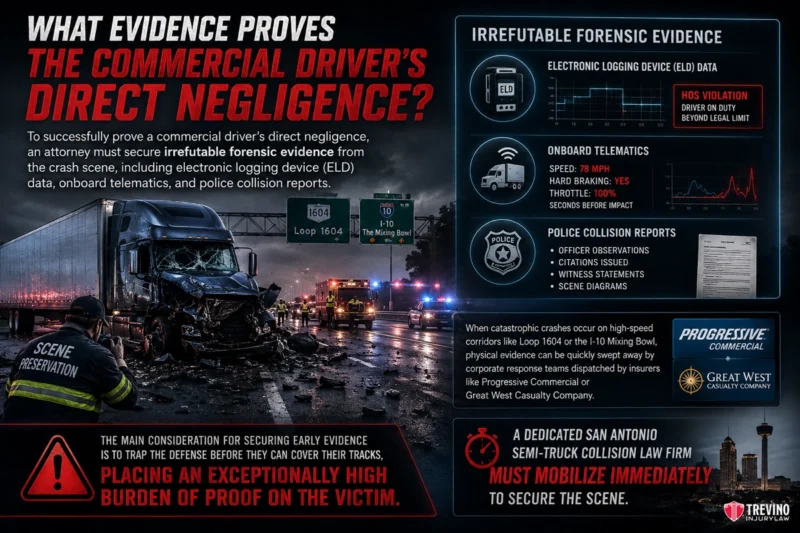
The main consideration for securing early evidence is to trap the defense before they can cover their tracks, placing an exceptionally high burden of proof on the victim.
When catastrophic crashes occur on high-speed corridors such as Loop 1604 or the I-10 Mixing Bowl, corporate response teams dispatched by insurers such as Progressive Commercial or Great West Casualty Company can quickly sweep away physical evidence. A dedicated San Antonio semi-truck collision law firm must mobilize immediately to secure the scene.
Why Are Dash Cam and Black Box Data Mandatory in Phase One?
Dash cam and black box data are mandatory in Phase One because they provide unbiased, measurable evidence of the driver’s speed, braking patterns, and steering inputs in the seconds before the violent impact.
Our trial team sends an immediate spoliation letter to legally force the trucking company to preserve this data before it is deliberately overwritten or deleted. This traps the defense and solidifies the driver’s liability early in litigation.
How Do Hours-of-Service Violations Establish Driver Fault?
Hours-of-service violations establish driver fault by proving the operator was illegally fatigued and violated strict Federal Motor Carrier Safety Administration (FMCSA) regulations at the time of the collision. We conduct rigorous driver logbook audits to uncover forged entries and driving times exceeding legal limits. This documentation removes all plausible deniability from the defense regarding driver fatigue.
While telemetry shows how the truck was driven, uncovering why the driver made dangerous errors lays the foundation for holding the parent company accountable.
When Can You Target the Parent Corporation’s Safety Failures?
You can legally target the parent corporation’s systemic safety failures only after a jury explicitly determines that the individual commercial truck driver was negligent and directly caused your catastrophic injuries.
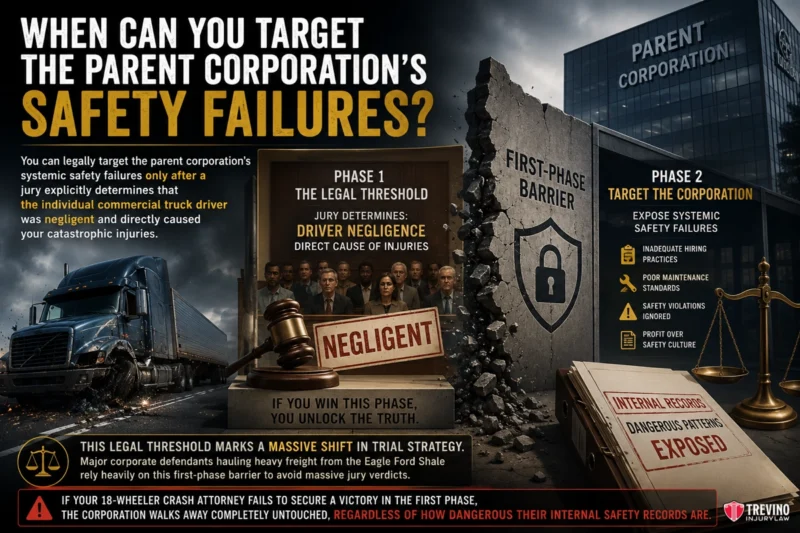
This legal threshold marks a massive shift in trial strategy. Major corporate defendants hauling heavy freight from the Eagle Ford Shale rely heavily on this first-phase barrier to avoid massive jury verdicts. If your 18-wheeler crash attorney fails to win in the first phase, the corporation walks away untouched, regardless of how dangerous its internal safety record is.
What Triggers the Second Phase of a Texas Trucking Trial?
The second phase of a Texas trucking trial is automatically triggered the moment the jury delivers a verdict holding the commercial driver liable for the crash and the resulting damages. Immediately after that decision, the court transitions to litigating corporate liability, allowing your trial lawyer to present the hidden safety violations to the jury.
How Do Negligent Maintenance and Hiring Practices Factor In?
Negligent maintenance and hiring practices become the central focus of Phase Two, allowing your trial lawyer to prove the corporation prioritized profits over public safety. We systematically expose these failures in the courtroom by demonstrating:
Inadequate background checks allowed drivers with previous safety violations to be behind the wheel.
A documented failure to repair brakes and other essential mechanical systems.
Corporate managers are pushing unrealistic delivery quotas that actively force drivers to skip mandatory rest periods.
Confronting these multi-billion-dollar corporations across both phases of trial requires an aggressive advocate who thrives in the courtroom.
How Does a Plaintiff Trial Lawyer Overcome House Bill 19 Corporate Shields?
A plaintiff trial lawyer overcomes House Bill 19 corporate shields by preparing an overwhelming, trial-ready case against the commercial driver from day one, refusing to let the defense hide behind procedural delays, and aggressively securing the forensic evidence required to force maximum payouts from the insurance company.
Unlike high-volume settlement mills that rely on quick, passive negotiations, a dedicated tractor-trailer accident attorney approaches every claim anticipating a courtroom battle. From the very first week, we aggressively lock down the crash scene and send out FOIA requests before critical evidence can disappear. This trial-first mindset neutralizes the defense’s strategy of using HB 19 to stall your financial recovery. Insurance adjusters from carriers like Allstate and State Farm know that we have taken more than 80 cases to trial.
They understand that if they refuse to pay the full value of your injuries, they will face a relentless litigator who knows how to dominate both phases of a bifurcated trial.
Executing this aggressive trial strategy requires strictly following specific procedural steps to formally initiate your claim in local courts.
Steps to File a Bifurcated Truck Accident Claim in Bexar County
procedural steps to ensure both the driver and the corporation remain legally protected. Because this process demands strict adherence to local court procedures at the Bexar County Courthouse, you need an experienced legal team to execute the following steps:
Immediate Evidence Preservation: We send a spoliation letter to legally compel the commercial carrier to lock down all black box data and onboard video before they are intentionally destroyed.
Filing the Lawsuit: We formally file your claim in Bexar County, detailing the specific acts of negligence that caused your catastrophic injuries.
Defeating Defense Motions: We anticipate and dismantle the defense’s legal motions designed to prematurely dismiss the driver from the lawsuit.
Executing the Two-Phase Strategy: We dominate Phase One to secure a liability finding, unlocking our ability to hold the parent company accountable in Phase Two.
Before filing, it is critical to determine if this specific law applies to your collision.
Does House Bill 19 Apply to All Commercial Vehicles?
Yes, House Bill 19 broadly applies to almost any vehicle operated for business purposes in Texas, including 18-wheelers, delivery vans, tow trucks, and municipal garbage trucks.
Can You Still Seek Punitive Damages Against the Trucking Company?
Yes, you can still seek punitive damages against the trucking company during the second phase of the trial if your attorney can prove gross negligence, such as intentionally ignoring severe safety violations.
Settlement Mill Approach vs. Trial Lawyer Strategy Under HB 19
The settlement mill approach severely compromises your case under HB 19 by failing to gather the rigorous driver-specific evidence required for Phase One, whereas a trial lawyer aggressively secures telemetry data to guarantee success in the courtroom. High-volume firms often process cases like an assembly line, passively waiting for the defense to offer a lowball settlement rather than preparing for litigation.
They rarely invest the substantial capital required to hire accident reconstructionists or commercial vehicle safety experts. In contrast, Trevino Injury Law’s deep investigation and trial-first mindset actively prepare for a courtroom battle from day one.
This aggressive approach—rather than passively accepting a weak offer—is what allowed our firm to secure a $17 million settlement in a head-on collision case involving three fatalities.
Relying on the wrong strategy or acting too late leads to disastrous legal consequences.
What Happens If You Cannot Prove the Individual Truck Driver Was Negligent?
If you cannot legally prove the individual truck driver was negligent during Phase One, your entire case collapses, and the corporate trucking company is entirely shielded from liability. This represents the absolute worst-case scenario for a victim under this legal framework.
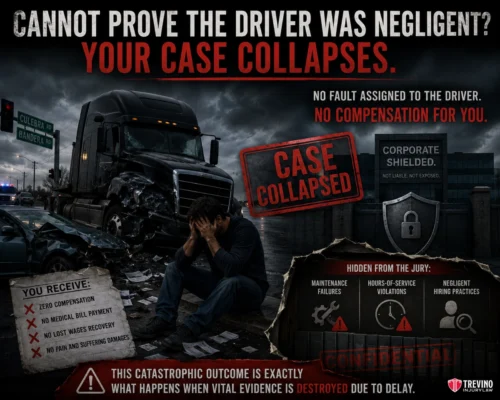
If the jury does not assign fault to the driver who hit you on Culebra Road or Bandera Road, you receive zero compensation for your medical bills, lost wages, and pain and suffering. Even worse, the corporation’s dangerous safety record, including any known maintenance failures, extreme hours-of-service violations, or negligent hiring practices, remains completely hidden from the jury.
This catastrophic outcome happens when vital evidence is destroyed by delay.
When Is It Too Late to Secure the Corporate Evidence Needed for Phase Two?
It is generally too late to secure the corporate safety records and black box data needed for Phase Two if you wait more than 30 days, as trucking companies legally overwrite this digital footprint. While the Texas statute of limitations gives you up to two years to file a lawsuit, the physical evidence you need to win it vanishes within weeks.
If you wait to hire an 18-wheeler injury lawyer until after you have finished medical treatment, the critical telemetry data proving the driver was speeding or braking too late will be permanently gone, crippling your ability to unlock corporate liability. By acting immediately, your legal team can force the carrier to preserve logbooks, maintenance logs, and telematics before they are “routinely” purged.
Why Hire a San Antonio Truck Accident Lawyer?
When response teams sweep evidence from Loop 1604, defeating House Bill 19 requires aggressive action. To secure maximum compensation, you need a relentless San Antonio trial advocate. Negligent Trucking Companies use this legal shield to stall recovery. High-volume settlement mills fold under this pressure, but Trevino Injury Law litigates to verdict. We fight for families, and we force them to pay.
Want to Protect the Full Value of Your Claim?
You’ve seen how this affects your case — but this is only one piece of the puzzle. Our Truck Accident Lawyer page breaks down what a trial-ready firm does differently.
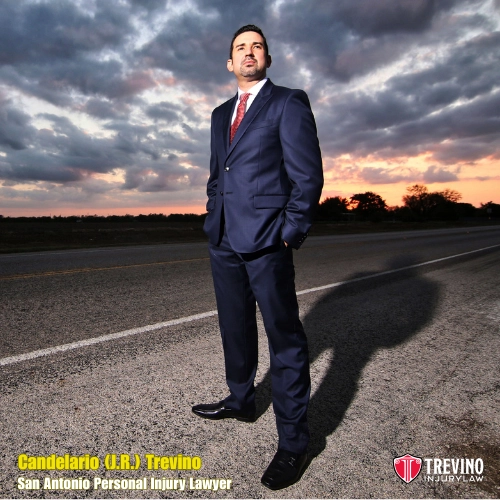
By immediately sending a Spoliation Letter to preserve telematics, your San Antonio accident attorneys secure justice at the Bexar County Courthouse. This trial-first strategy recently secured a $17 million settlement for a grieving family.
Call 210-TREVINO for a free case review. No Win, No Fee. Se Habla Español.