The homeowner or commercial landlord is legally responsible for your dog’s attack when they knew the animal was aggressive and failed to secure the premises. This legal standard forces them to answer for the severe physical trauma you suffered.
The Insurance Adjuster is already weaponizing the Texas prior knowledge requirement to deny your claim by arguing that the property owner had no warning about the dog’s dangerous history. Yet local authorities treat these incidents with increasing severity. The Bexar County Sheriff’s Office established a dedicated Animal Crimes Enforcement Unit in November 2024 to hold negligent owners accountable when their animals escape and attack others.
What Could Your Premises Liability Accident Case Be Worth?
Answer a few quick questions about your accident. Takes about 60 seconds.
See What My Case Might Be WorthThe insurance company offered less than $20,000. I ended up with over $1 million. — Jackie Galindo
Physical evidence proving prior aggression disappears rapidly in the first week. The negligent owner will repair the broken fence, remove warning signs, and relocate the animal to hide their liability. A Spoliation Letter, a legal demand that prevents the property owner from destroying evidence, must be issued immediately. If you wait, the critical evidence vanishes, and your claim collapses.
Trevino Injury Law premises liability lawyers will subpoena neighborhood surveillance footage and lock down the evidence before it disappears. Call 210-TREVINO now for a free case review. You pay nothing unless we win. Se Habla Español.
How Does Texas Law Define Liability for Dog Bites on Private Property?
Under Texas dog bite laws, liability for dog bites on private property depends on the one-bite rule and standard negligence principles. The owner could be held financially responsible if they knew or should have known the dog was dangerous or violated safety ordinances.
Texas is not a strict-liability state for every animal attack. Instead, a property owner is legally responsible if they knew or should have known the dog had dangerous propensities and failed to secure it. This liability law is rooted in the landmark Texas Supreme Court case Marshall v. Ranne, 511 S.W.2d 255 (Tex. 1974), which established that if an owner knew their dog was vicious or aggressive, the owner can be held strictly liable for injuries caused by the dog.

Alternatively, you can establish negligence per se if the owner violates local ordinances, such as San Antonio leash laws. For instance, under recent 2024 ordinance changes, a first-offense fine for an owner’s failure to prevent an unprovoked Texas dog bite in San Antonio starts at $1,000 and can rise to $2,000 for repeat violations.
For example, if a homeowner allows a known dangerous dog to roam unchained in an unfenced yard, they may be held liable for negligence. Note that while clothing may be ruined during an attack, premises liability claims strictly pursue compensation for physical trauma and medical bills, not property damage.
What Constitutes “Prior Knowledge” of a Dog’s Dangerous Propensities?
Under Texas law, prior knowledge is established when a dog owner has witnessed prior bites or aggressive lunging at neighbors or received formal complaints from local animal control.
The one-bite rule does not grant a dog one free attack. Our law firm proves prior knowledge by investigating if the dog required a specialized muzzle, had previously snapped at guests, or prompted neighbor complaints to San Antonio Animal Care Services. Establishing this historical timeline forces the homeowner’s insurance policy to accept that it must hold the homeowner responsible for injuries caused by the known hazard they permitted on their premises.
While individual homeowners are responsible for dog-ownership duties, liability shifts significantly when a third party manages the property.
Can You Sue a Landlord if a Tenant’s Dog Bites You at an Apartment Complex?
Yes, you can sue a Texas landlord if a dog bites you at an apartment complex, provided the landlord had actual knowledge of the dangerous animal and retained control over the premises to remove it. Under Texas Health & Safety Code Chapter 822, a “person’s property” explicitly includes property possessed or occupied under a lease or other agreement, reinforcing the legal basis for holding a landlord liable.
In Bexar County, holding a commercial landlord accountable requires proving they controlled the premises and ignored a foreseeable threat. If a property manager ignores repeated tenant complaints about an aggressive Pitbull in a common courtyard, the landlord breaches their duty of care.

Corporate landlords often try to shield themselves by arguing they cannot control a tenant’s personal property, hoping the owner will not be legally responsible.
However, our plaintiff’s trial firm analyzes the lease agreement to prove that the landlord had the contractual authority to evict the tenant or require the tenant to remove the animal, yet prioritized rent collection over resident safety.
For a related comparison of residential and commercial property responsibility, see swimming pool accident liability in Texas.
How Do HOA Complaints and Animal Control Records Establish Foreseeability?
Homeowner Associations’ complaints and records from local animal control or law enforcement establish foreseeability by providing timestamped proof that property management was formally warned about the dangerous dog before the attack.
Settlement mills often overlook critical paper trails. Our trial lawyers immediately subpoena HOA records or pull dispatch logs from the San Antonio Police Department. If these records show the property manager was previously cited, we establish “Constructive Notice.” This neutralizes the defense that the attack was an unforeseeable accident, making sure they are held liable for a dog attack.
Securing these records requires urgent action before the property owner can obscure the facts.
What Evidence Proves Negligence in a Residential Dog Bite Case?
To prove negligence, preserve witness statements, veterinary records, 911 dispatch audio, and neighborhood security footage to document the owner’s failure to secure the animal.
The physical evidence of private property dog bites can result in disappearing rapidly:
- Broken fences are repaired.
- “Beware of Dog” signs are removed.
- The dog is frequently relocated.
Trevino Injury Law takes a trial-first approach, deploying early evidence-preservation tactics within the first week of your case. We secure Ring doorbell footage from neighbors to verify how the dog causes the breach. We also file Freedom of Information Act (FOIA) requests to obtain police body cam footage that captures the property owner’s immediate admissions of guilt before an insurance adjuster instructs them to remain silent. This helps us build a strong case.
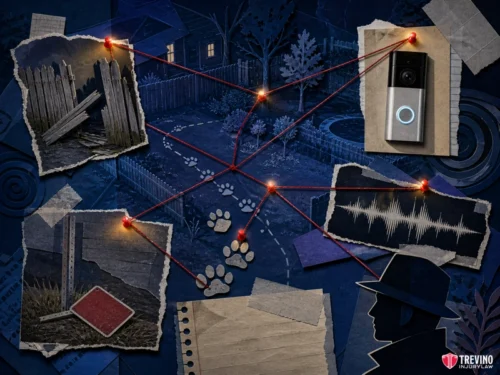
The specific type of evidence we target is entirely dependent on the physical boundaries where the attack occurred.
Securing Digital Proof Through FOIA and Surveillance
Insurance adjusters know that digital evidence wins cases. That is why our trial-first mindset requires us to secure critical evidence within the first week. We immediately canvass the San Antonio neighborhood for Ring doorbell cameras and private security footage.
At the same time, we send Freedom of Information Act (FOIA) requests to obtain police body cam footage. This early legal strategy captures the property owner’s immediate admissions of guilt before the insurance company coaches them to stay silent.
Using Spoliation Letters to Prevent Evidence Destruction
Physical evidence of private-property dog bites disappears quickly. Negligent owners will quickly repair broken fences, remove “Beware of Dog” signs, or relocate the animal to avoid liability. To stop this, we immediately sent a Spoliation Letter.
This is a formal legal demand that strictly prohibits the owner or their insurance company from destroying or altering any evidence related to the attack. With more than 80 cases taken to trial, we know their playbook, and we shut it down.
Why Does the Attack Location Dictate Your Legal Investigation Strategy?
The precise location of the attack dictates your legal strategy because a bite occurring in a private backyard triggers a homeowner’s policy under the Texas one-bite rule, whereas an attack in an apartment common area triggers corporate liability. An attack on a public sidewalk generally involves violations of a municipal leash law.

However, if the dog pulls the victim onto the private lawn, it becomes a strict premises defect case. Identifying the premises liability accident type early ensures we deploy the appropriate legal mechanisms to secure the specific evidence required. Understanding these locational variables leads directly to the precise steps to take immediately following an incident.
What Are the Procedural Steps to Document a Dog Bite Injury on Private Property?
You must immediately identify the property owner, seek emergency medical attention at a local hospital, officially report the bite to animal control or law enforcement, and document photographs of your injuries to successfully file a private property claim.
Taking immediate action preserves the integrity of your premises liability case:
- Identify the Owner: Obtain the homeowner or tenant’s name and contact information before leaving the scene to ensure the owner could be held responsible.
- Seek Medical Care: Visit a facility like University Health System to document the trauma and receive necessary prophylaxis.
- File an Official Report: Contact San Antonio Animal Care Services to create a formal government record of the attack.
- Document the Scene: Photograph the dog (if safe), the broken gate or fence, and your initial lacerations.
- Hire a Trial Lawyer: Never provide a recorded statement to the homeowner’s insurance adjuster before seeking legal counsel. Protect your rights immediately.
Even when victims perfectly execute what to take after a dog attack, property owners rely on specific legal defenses to bar recovery.
Can You Recover Damages if You Were Trespassing When the Dog Bit You?
No. In Texas, if you are illegally trespassing on private property without permission at the time of the attack, the property owner generally owes you no duty of care, meaning owners may avoid liability.
Is a “Beware of Dog” Sign a Complete Legal Defense in Texas?
No. While a “Beware of Dog” sign serves as a warning, it does not provide blanket immunity if the property owner was grossly negligent in securing a known dangerous animal.
Residential Homeowner vs. Commercial Landlord Liability Requirements
When comparing legal standards, residential liability focuses strictly on the homeowner’s direct knowledge of their pet’s aggression, whereas commercial landlord liability focuses on the property management’s broader control over common areas.
The entity responsible fundamentally shifts the legal burden:
| Liability Type | Responsible Party | Insurance Trigger | Primary Legal Focus |
| Residential Properties | Individual Homeowner or Renter | Homeowner’s or Renter’s Insurance | The one-bite rule and whether the individual owner failed to secure their perimeter when keeping dogs on their property. |
| Commercial/Apartment Properties | Property Management Company | Corporate General Liability Policies | Negligent security parameters and whether the management company ignored the risk of a dog in high-traffic communal areas. |
However, pursuing a residential claim introduces unique financial barriers when policies are lacking.
What Happens if the Dog Owner Does Not Have Homeowner’s Insurance?
If the dog owner lacks homeowner’s or renter’s insurance, recovering fair compensation becomes significantly more difficult because your attorney must pursue the owner’s personal assets directly.
Many catastrophic bites occur at properties where the owner lacks coverage or holds a policy containing specific exclusions for “dangerous breeds”. Legally, both state and local regulations strictly require owners of designated dangerous dogs to maintain a liability insurance policy or show financial responsibility of at least $100,000 to cover damages.
Exploring this negative space is critical. Trevino Injury Law conducts comprehensive asset checks to determine if the negligent party holds other real estate or assets that can be attached to ensure they are responsible for your injuries.
When Does the “One Bite Rule” Not Apply to a Victim’s Case?
The one-bite rule does not apply, and standard negligence takes precedence, even if the dog has no history, if the attack occurred because the dog owner actively violated a local municipal safety ordinance.
Texas law recognizes explicit limitations. If an owner claims ignorance, but the attack happened because they permitted the dog to roam freely in direct violation of San Antonio municipal codes, their lack of prior knowledge is legally irrelevant. This exception allows our trial attorneys to bypass the hurdle of proving historical aggression, ensuring the owner is liable for a dog attack and paving the way for maximum compensation.
What Should You Do After a Dog Attack in Texas?
The steps you take in the first hours after a dog attack protect both your health and your claim:
- Get medical care right away. Dog bites carry a high infection risk, and a doctor will assess whether you need rabies treatment.
- Identify the dog and its owner. Get the owner’s name, address, and phone number, and ask whether the dog’s rabies vaccinations are current.
- Report the bite. In San Antonio, report it to Animal Care Services through 311. Texas law requires a biting dog to be quarantined for observation, and the report creates an official record of the attack and of any prior complaints.
- Document everything. Photograph your injuries, torn clothing, the dog, and the location, including any broken fence or open gate, and collect witness contact information.
- Be careful with insurers. Dog bite claims are usually paid by the owner’s homeowner’s or renter’s insurance. Avoid giving a recorded statement before speaking with a lawyer.
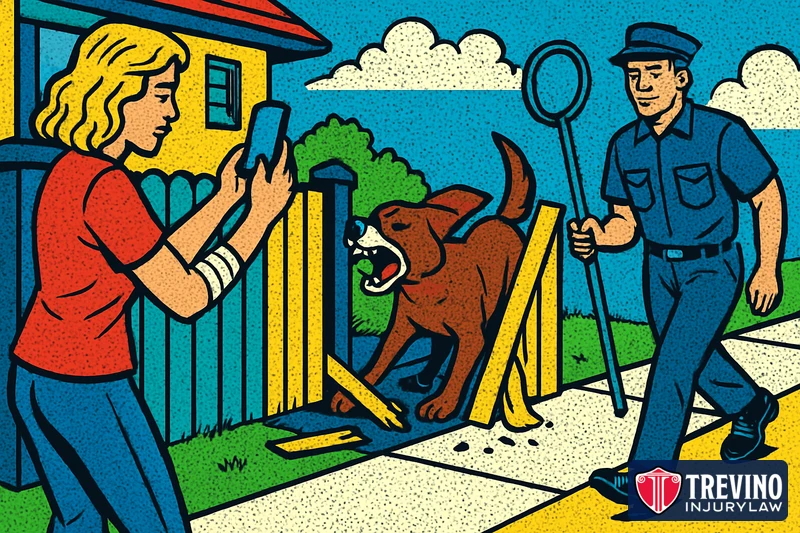
Your medical records, the animal control report, and your photos become the core evidence that shows how the attack happened and what it cost you.
Why Hire a Premises Liability Lawyer?
When it comes to dog attacks, insurance adjusters will weaponize the Texas one-bite rule to deny your claim and protect their bottom line. You need a trial-tested dog bite lawyer who secures critical evidence, proves prior knowledge, and forces negligent homeowners and corporate landlords to be held responsible. Do not give a recorded statement.
Want to Protect the Full Value of Your Claim?
You’ve seen how this affects your case — but this is only one piece of the puzzle. Our Premises Liability Lawyer page breaks down what a trial-ready firm does differently.
Our authority is proven at the Bexar County Courthouse, including a 107x verdict punishing lowball offers. By immediately issuing spoliation letters to preserve property evidence, your personal injury attorney near me San Antonio
traps the defense and locks down liability. We strictly operate on a No Win, No Fee promise. Call 210-TREVINO for a free case review. Se Habla Español.