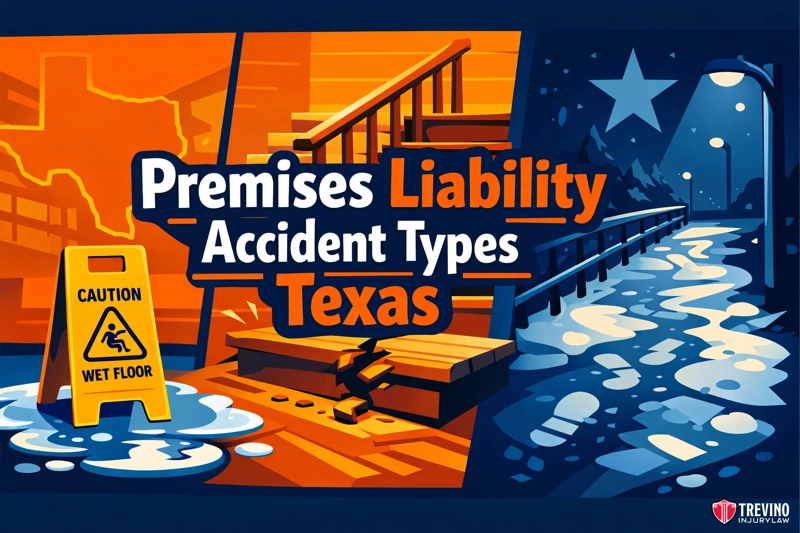
Premises liability in Texas covers more than a simple slip at a grocery store, apartment shootings, elevator drops, structural collapses, dog attacks, and Carbon monoxide poisoning in a rental. If a property owner’s negligence created the hazard and they failed to warn you, you have a claim.
The insurance adjuster is already moving to reclassify your crisis as personal clumsiness to protect corporate profits. They frame structural defects as your own failure to watch where you were going. According to the Texas Department of State Health Services, Texas trauma facilities treated 1,617 fatal falls in 2022. Most of these occur because a landlord deferred maintenance or ignored a code violation.
Evidence disappears before the first week ends. Surveillance footage is recorded over. Maintenance logs are “lost.” You must immediately send a Spoliation Letter, a legal demand that stops the property owner from destroying evidence. Texas law gives you two years to file, but your case can be lost in ten days if the proof vanishes.
What Could Your Premises Liability Accident Case Be Worth?
Answer a few quick questions about your accident. Takes about 60 seconds.
See What My Case Might Be WorthThe insurance company offered less than $20,000. I ended up with over $1 million. — Jackie Galindo
Trevino Injury Law premises liability lawyers lock the evidence down and force the insurance company to pay the full value of your injury. Call 210-TREVINO for a free case review. You pay nothing unless we win. Se Habla Español.
Structural Failures and Deferred Maintenance Defects
The most common structural and maintenance defect accidents in Texas include dangerous balcony collapses at older complexes, rapidly malfunctioning elevators in downtown high-rise buildings, and severe static trip hazards, such as uneven floors in deteriorating commercial properties that negligent landlords fail to inspect and maintain despite clear building codes. The sheer volume of these hazards is reflected in recent state medical records, which show that 1,617 fatal falls were treated in Texas trauma facilities in 2022 alone (Texas Department of State Health Services, 2024).
While the main hub covers standard premises liability, understanding specific structural failures requires analyzing transient versus static defect classifications alongside commercial hazards. Unlike a temporary spill, structural defect accidents stem from long-term neglect of a building’s physical integrity, representing a clear breach of the duty of care.
In San Antonio, this frequently involves collapsing wooden decks at older apartment complexes, poorly maintained stairwells without proper handrails, and elevator drops in downtown high-rises. These incidents are rooted in deferred maintenance, where landlords prioritize profits over basic safety codes and their responsibility to tenants. Victims in these accidents often suffer severe spinal cord injuries or traumatic brain injuries.

Our Trial Authority approach means we rigorously investigate the property’s history, pulling code violation records from the City of San Antonio to prove the owner had Constructive Notice of a deteriorating, static condition, providing evidence showing negligence.
It is important to note that simple slip and fall accidents are classified differently from structural trips, because structural defects involve permanent property deterioration. However, both conditions create catastrophic risks, as state data indicates that nearly 30% of all fatal falls logged by Texas trauma registries from 2018 to 2022 involved slipping, tripping, and stumbling on the same level (Texas Department of State Health Services, 2024).
Elevator Drops and Escalator Malfunctions
Sudden elevator drops, terrifying passenger entrapments, and rapid escalator stops are complex incidents in a premises liability case in Texas that legally hold both the negligent commercial property owner and their contracted maintenance company strictly responsible for compensating the victim’s resulting catastrophic injuries.
In downtown San Antonio office buildings and South Texas Medical Center hospitals, elevators are heavily used and require strict adherence to state inspection codes. When a cable snaps or a door crushes a patron, it is rarely a freak accident; it is usually a documented failure by maintenance contractors who owe a duty to visitors. These cases require an attorney with experience handling complex litigation who understands Res Ipsa Loquitur, the legal doctrine that establishes this type of accident can occur only through negligence.
While structural defects are physical, other premises accidents stem from human threats that property owners ignore.
Negligent Security: Criminal Assaults and Third-Party Violence
Criminal assaults, armed robberies, and tragic apartment shootings clearly fall under Texas premises liability law when they occur due to a commercial property owner’s deliberate failure to provide adequate security measures when they reasonably should have.
The Texas Supreme Court’s landmark ruling in Timberwalk Apartments, Partners, Inc. v. Cain, 972 S.W.2d 749 (Tex. 1998), held that landlords can be held liable for third-party violent crimes if a documented history of similar crimes in the immediate area made the attack objectively foreseeable, thereby establishing legal responsibility.
Focusing on the types of violent acts covered rather than just the basic legal standards, specific acts of third-party violence, including sexual assaults, armed robberies, and parking lot muggings, become premises liability accidents if the crime was foreseeable.
When you are violently attacked in a poorly lit parking garage at La Cantera or shot at a gated community on the West Side, the criminal is not the only liable party. We see this frequently when apartment complexes fire their security patrols or leave access gates broken for months to save money.

These are catastrophic events that require a legal strategy targeting the corporate landlord whose negligence invited the danger.
While property damage or theft frequently occurs during an armed robbery, premises liability lawsuits focus strictly on securing maximum recovery for the severe personal injury aspect of the attack.
Apartment Complex Shootings and Violent Crime
Severe apartment shootings are covered under Texas premises liability law when the corporate landlord actively ignored a documented history of violent crime on the residential property, failed to warn visitors, and deliberately failed to upgrade essential security protocols required to protect vulnerable tenants.
Apartment complex shootings are a prevalent type of premises case in fast-growing areas of Bexar County. These devastating incidents typically involve:
- Bystanders are hit by stray bullets due to known gang activity.
- Tenants targeted in breezeways with broken lighting.
- Violent assaults are occurring because of broken perimeter fencing.
Moving from criminal violence, we also categorize complex accidents involving dangerous environmental conditions and recreational hazards.
Recreational and environmental premises accidents in Texas include tragic swimming pool drownings, massive crowd crush injuries at large public events, severe dog bites, and dangerous exposure to toxic chemicals at rural industrial sites or unregulated residential rental properties.
Expanding on residential injuries, this category introduces specific environmental hazards and recreational accident types, logically grouped for litigation purposes. Beyond buildings and parking lots, Texas premises liability law categorizes injuries resulting from land use and environmental conditions.
This includes Attractive Nuisance accidents, where an unsecured swimming pool at a Stone Oak home lures a child, resulting in a tragic drowning. Pool incidents may require a more focused liability analysis than a general accident classification can provide. See swimming pool accident liability in Texas for the dedicated discussion. These devastating events happen far too frequently across the state, with 61 child unintentional drowning deaths reported in Texas during 2023 (Texas Department of State Health Services, 2025).
Furthermore, national reporting highlights that 37% of all emergency-department-treated nonfatal pool or spa submersion injuries among children under 15 occur specifically at residential properties (U.S. Consumer Product Safety Commission, 2025). It also covers crowd crush or trampling accidents at massive public gatherings, such as Fiesta San Antonio, where event organizers fail to manage bottlenecked exits.
Furthermore, environmental accidents, such as severe carbon monoxide poisoning at an Airbnb or chemical exposure at an industrial site in the Eagle Ford Shale, are clearly premises defect cases that require immediate preservation of evidence.
Dog Bites and the “One Bite Rule”
A vicious dog bite is strictly classified as a premises liability accident in Texas when a negligent landlord or property homeowner knows a dangerous animal is residing on the premises but fails to properly remove or safely secure it from visitors.
In Texas, an aggressive dog is treated legally much like a broken staircase: it is a known hazard. The Texas Supreme Court established in Marshcall v. Ranne, 511 S.W.2d 255 (Tex. 1974) that an owner is strictly liable for severe injuries if they possessed actual or constructive knowledge of the animal’s vicious propensities prior to the attack. The victim must prove this knowledge.
These accidents frequently occur in residential neighborhoods when an owner violates San Antonio leash laws or an apartment manager ignores documented complaints about a dangerous animal.
The resulting injuries are severe, requiring a trial lawyer to aggressively pursue the homeowner’s or renter’s insurance policy for full compensation for medical bills, lost wages, and pain and suffering.
Beyond the hazard itself, the specific circumstance of the accident fundamentally alters the required medical and financial evidence.
Advanced Application: How Accident Types Dictate Medical Evidence
The precise legal classification of a premises accident dictates the exact medical evidence required for your lawsuit, as severe crush injuries from structural collapses demand orthopedic life care plans, whereas toxic chemical exposures require long-term epidemiological monitoring and specialized neurological assessments.
Shifting focus from calculating mental anguish, it is critical to understand how specific accident categories require distinctly different objective medical evidence to successfully prove damages. High-volume settlement mills treat all injuries identically, completely missing the nuanced medical evidence required for specific accident types. If a falling object causes a catastrophic amputation—similar to our firm’s $7.9 million verdict for Mario Mendoza—the case requires immediate vocational economists and biomechanical engineers.

Conversely, environmental accidents like carbon monoxide exposure require neurologists to track latent cognitive deficits that may not surface for months. By promptly classifying the accident, Trevino Injury Law secures the precise medical experts needed to map the trajectory of the victim’s lifelong care, forcing insurance companies to pay full value rather than a generalized settlement.
Why Do Environmental Hazards Require Different Life Care Plans Than Structural Defect Injuries?
Dangerous environmental hazards require fundamentally different life care plans because they often cause progressive systemic internal damage over time, whereas sudden structural defects typically result in acute, highly predictable orthopedic fractures or severe neurological trauma requiring immediate surgical intervention.
A structural defect, such as a collapsed deck in Alamo Heights, results in static injuries with highly predictable surgical and rehabilitation costs. An environmental hazard, such as industrial chemical exposure in South Texas, demands a life care plan that accounts for progressive cellular damage, future organ failure, and ongoing diagnostic monitoring. Structuring the claim to reflect the specific physiological realities of the accident type prevents the defense from severely underestimating future medical needs.
Because different accidents leave different types of evidence, your medical evidence strategy directly dictates the broader legal investigation.
Why Does the Accident Classification Dictate Your Legal Investigation Strategy?
The exact type of premises accident dictates your legal investigation strategy because successfully proving a physical structural defect requires entirely different investigatory tools, such as securing maintenance logs, compared to proving negligent security, which heavily relies on analyzing historical police call data. The next step is identifying the evidence used to prove premises liability negligence in Texas.
Connecting these classifications back to the central theme of “The Legal Standard” covered in our main premises liability hub, the burden of proof depends entirely on the nature of the hazard. If your accident involves a falling merchandise hazard at a big-box retail store on Loop 1604, our trial lawyers immediately send Spoliation Letters to preserve store sweep logs and surveillance video before they are mysteriously erased.

Conversely, if your accident is classified as negligent security following a severe assault, the investigation instantly pivots to subpoenaing SAPD call logs and analyzing local crime grids to mathematically prove foreseeability. Identifying the exact accident category early in the first week ensures we deploy the appropriate legal mechanisms to secure the specific evidence needed to completely dismantle the insurance company’s defenses.
Understanding these specific accident requirements helps distinguish a true premises defect from other similar legal claims.
How Do We Determine if an Injury Is a Premises Defect vs. a Negligent Activity?
We accurately determine the correct legal classification of your claim by meticulously analyzing whether your severe injury was caused by a static, preexisting dangerous condition on the property or by an ongoing, active situation happening at the exact moment you were physically hurt.
This is a crucial distinction in Texas law that dictates how we build your case to maximize your compensation. A premises liability accident occurs when you are injured by a condition left behind, such as violently tripping over a heavy box left in a retail aisle. A negligent activity case arises when an employee deliberately drops the exact same box on you while you are walking. Trevino Injury Law meticulously investigates the crash dynamics and secures critical witness statements to categorize your claim correctly, as the burden of proof differs significantly between the two.
This legal distinction clarifies specific procedural questions about where exactly accidents happen.
Do Slip and Falls on City Sidewalks Count as Premises Liability?
Yes, injuries on San Antonio city sidewalks are premises liability accidents, but they require a strict 90-day notice under government tort claims rules.
Are Workplace Injuries Ever Considered Premises Accidents?
Yes, if you are injured at work by a third-party property owner’s structural defect rather than your direct employer’s actions, it is a premises liability claim.
Types of Commercial vs. Residential Accident Claims
Complex commercial accidents typically involve high-traffic hazards such as retail spills and severe negligent security incidents, whereas residential accidents focus predominantly on dangerous neighborhood dog bites and catastrophic structural housing defects in private rental homes or local apartment complexes across Bexar County.
The entity responsible changes based on the property type.
| Property Type | Common Hazards | Responsible Entity | Legal Duty Standard |
| Commercial (e.g., The Pearl, Southtown restaurants) | Retail spills, negligent security, escalator drops | Corporate General Liability Policies | High-duty invitee standard |
| Residential (e.g., rental homes, apartments) | Deck collapses, dog bites, pool drownings | Homeowner’s or Renter’s Insurance | Slightly lower licensee standard |
Commercial accidents at places like The Pearl or Southtown restaurants are covered by corporate general liability policies and high-duty invitee standards. Residential claims, such as deck collapses at a friend’s rental home, trigger homeowner’s or renter’s insurance, governed by the slightly lower licensee standard.
However, certain situations explicitly prevent you from claiming a premises accident.
Exclusions: What Does NOT Qualify as a Premises Accident?
Specific accidents that do not legally qualify as premises liability include severe injuries caused entirely by an individual’s own clumsiness without any underlying property defect, or injuries sustained while a person is actively committing a felony on someone else’s private or commercial land.
Texas law does not automatically hold a property owner liable just because an injury occurred on their land. If you trip over your own shoelaces in a perfectly level, well-lit parking lot, there is no premises defect, and therefore no claim. Exploring this negative space is critical; the insurance adjuster will actively try to reclassify your legitimate structural defect accident into a personal clumsiness event to deny your payout.
Even if the accident qualifies, there are strict time limits for pursuing it.
The Statute of Limitations and Evidence Expiration
It is completely too late to file your premises liability claim if you wait past the two-year Texas statute of limitations, or if you wait so long that the negligent property owner repairs the hazardous defect and permanently destroys the evidence.
In a premises liability accident, evidence disappears quickly. A broken lock is replaced, a faulty staircase is repaired, and security footage is recorded over. If you fail to identify the accident type and secure a trial lawyer immediately, you miss the window to issue a Spoliation Letter. Waiting allows the negligent landlord or corporate defendant to obscure the truth, permanently barring you from securing maximum compensation for your trauma.
Why Hire a Premises Liability Lawyer?
Hiring a trial-ready premises liability lawyer ensures that your complex structural defect, violent negligent security incident, or dangerous environmental hazard injury is correctly categorized and aggressively litigated, completely preventing deceptive insurance adjusters from blaming your severe trauma on personal clumsiness.
Want to Protect the Full Value of Your Claim?
You’ve seen how this affects your case — but this is only one piece of the puzzle. Our Premises Liability Lawyer page breaks down what a trial-ready firm does differently.
Our record proves we don’t back down, highlighted by a $7.9 million verdict for a catastrophic injury that settlement mills would have undervalued. To secure your future, the best personal injury accident attorney San Antonio must immediately issue Spoliation Letters to freeze evidence before maintenance logs are “lost.”
Trevino Injury Law knows its playbook. We quickly secure the vital evidence, from Spoliation Letters for maintenance logs to SAPD crime grids, to force negligent corporate property owners to pay the maximum compensation. Do not let them dismiss your suffering as a simple accident. Call 210-TREVINO for a free case evaluation. Se Habla Español.