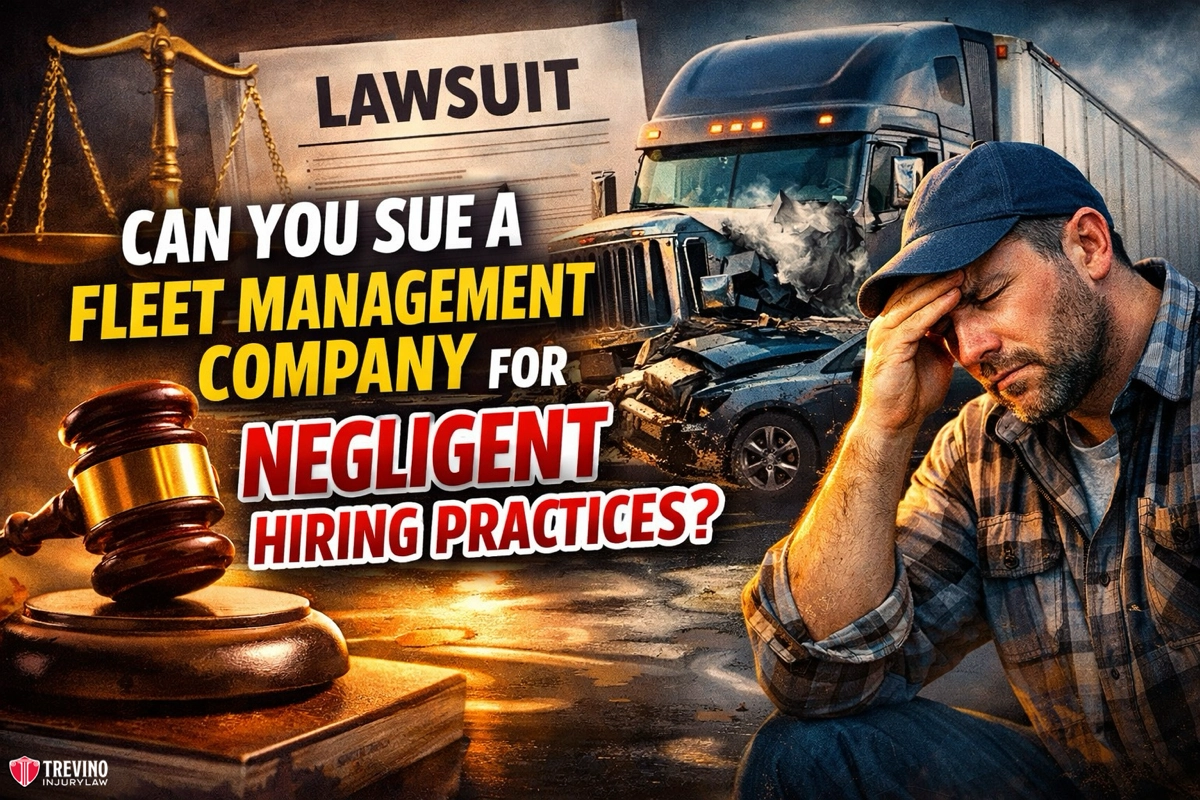
You can sue a fleet management company directly when they hand the keys to an unqualified commercial driver who shatters your life. Corporate defendants frequently bypass mandatory background checks, ignore prior DUI convictions, and push drivers with suspended licenses onto local highways to hit delivery quotas.
The commercial insurance adjuster is already deploying a rapid-response team to erase internal hiring matrices and argue you were speeding to shift the blame. This exact prioritization of profit over safety is why the Texas Department of Transportation recorded 2,684 commercial motor vehicle crashes across Bexar County in 2024. Behind those wrecks sits a fleet manager who knew their hire posed an unreasonable risk to the public but dispatched them anyway.
Their liability is hidden inside the driver qualification file. You must immediately send a Spoliation Letter, a legal demand that stops the trucking company from destroying evidence, to secure these background receipts before they vanish. Once that documentation disappears, your ability to hold the parent company accountable vanishes.
Trevino Injury Law, our commercial vehicle crash attorneys, lock these corporate records down and expose the negligent hiring shortcuts that caused your collision. Call 210-TREVINO for a free case review. You pay nothing unless we win. Se Habla Español.
What Is an Example of Negligent Hiring in a Commercial Fleet?
An example of negligent hiring in a commercial fleet occurs when a company employs a commercial driver with a documented history of DUI convictions, suspended licenses, or repeated Federal Motor Carrier Safety Administration (FMCSA) safety violations. The duty to protect the public from incompetent drivers was underscored in Texas law by landmark cases such as TXI Transportation Co. v. Hughes, 306 S.W.3d 230 (Tex. 2010), which reinforces that companies can face direct corporate liability when their hiring and retention failures lead to catastrophic highway collisions.
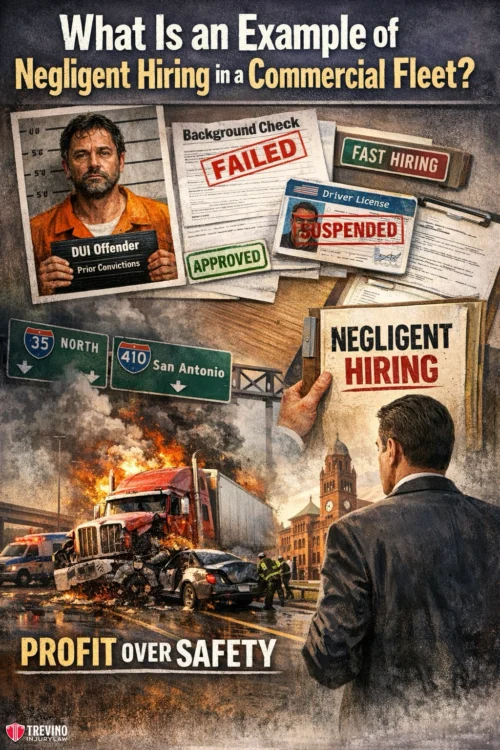
Corporate defendants frequently bypass mandatory background checks to quickly place drivers on routes such as I-35 or Loop 410 in San Antonio. A commercial vehicle crash attorney investigates these shortcuts, uncovering instances in which trucking companies ignore a driver’s prior positive drug test results or lack of proper commercial endorsements.
This is not merely an oversight; it is a calculated risk the company takes to maintain profit margins at the expense of public safety. When these unfit drivers inevitably cause a crash near major hubs such as the Bexar County Courthouse, liability traces directly back to the fleet manager’s desk.
What Are the Legal Consequences of Poor Hiring Practices?
The legal consequences of poor hiring practices include direct corporate liability for the crash, exposure to punitive damages, and severe FMCSA regulatory sanctions.
When an 18-wheeler wreck law firm proves negligent hiring, the fleet management company faces direct liability distinct from the driver’s negligence. This allows victims to target larger commercial insurance policies. The primary consequences include:
- Paying for a victim’s comprehensive life care plan.
- Undergoing strict federal safety audits.
- Facing potential out-of-service orders that halt their operations across Texas.
Once you understand the specific legal penalties imposed on negligent companies, the next critical question becomes how to uncover the evidence necessary to hold them accountable in court.
How Do You Prove a Fleet Management Company Is Liable for a Crash?
You prove a fleet management company is liable for a crash by securing the Driver Qualification File and demonstrating the employer knew or should have known the driver posed an unreasonable risk to the public. When a commercial truck crash devastates a family in Texas, victims often wonder if the company may be liable beyond just the individual driver.
Under strict federal law and FMCSA safety regulations, trucking companies must thoroughly vet and monitor their personnel. Companies have a legal duty to protect the public, and the legal doctrine of negligent hiring strictly applies when a company ignores a dangerous driving record or known substance abuse issues. Preserving hiring records is only one part of the immediate post-crash response. For the broader sequence covering scene documentation, carrier identification, medical care, and evidence preservation, see what to do after a commercial vehicle accident in San Antonio.
You have robust grounds to sue if the investigation reveals that the corporate entity prioritized profits over safety in the following ways:
- The company hired a driver it knew, or should have known, was unsafe for the public.
- The company failed to properly train drivers or ignored prior positive drug test results.
- The trucking company failed to follow its own internal company policies regarding basic hiring and training.
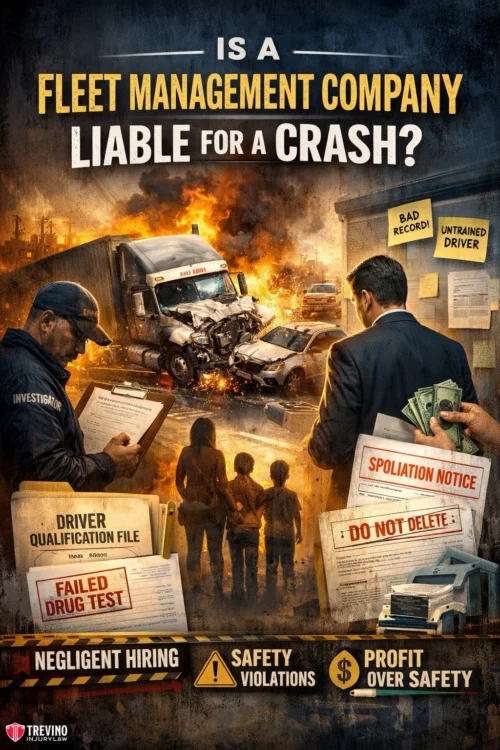
Establishing liability requires immediate action to prevent evidence spoliation before rapid-response teams erase the data. Proving that a trucking company is fully accountable requires aggressive legal maneuvering. An experienced personal injury attorney will immediately dive into the trucking company’s internal files. To build an airtight case, our actions may include:
- Deploying investigators, accident reconstruction specialists, and advanced trucking safety experts to definitively prove what contributed to the accident.
- Investigating whether the company fostered a dangerous corporate culture, knowing that trucking companies sometimes pressure drivers to bypass mandatory rest periods to hit delivery metrics.
- Sending an immediate Spoliation Letter, a legal demand that stops them from deleting evidence, to lock down the employer’s internal hiring matrices and background check receipts. Those hiring records only help if they are preserved in time. For the evidence-preservation process behind those demands, see how spoliation letters preserve truck-crash evidence in Texas, including black-box, ELD, and qualification-file evidence.
Cases involving negligent hiring require a law firm in Texas that is unafraid of the courtroom. We fight to hold trucking companies and fleet managers fully liable, ensuring that when a trucking company fails the public, families can confidently exercise their right to sue.
The company may try to shift blame onto you, but we use the law to hold the trucking industry to the highest safety standards, ensuring the company still pays maximum compensation for the harm it set in motion.
What Are the 5 Elements of a Negligence Claim?
The 5 elements of a negligence claim against an employer are duty, breach of duty, causation in fact, proximate cause, and actual damages. The foundational requirement of establishing a legally cognizable ‘duty’ was firmly established by the Texas Supreme Court in Greater Houston Transp. Co. v. Phillips, 801 S.W.2d 523 (Tex. 1990), which dictates that a company must exercise ordinary care to avoid foreseeable risks to the public.
Duty: The company must protect San Antonio drivers by vetting hires. Breach: The company ignored red flags during the hiring process. Cause in Fact: The unfit driver caused the collision. Proximate Cause: The crash was a foreseeable result of hiring a dangerous driver. Damages: The victim suffered severe injuries, such as a traumatic brain injury, requiring maximum compensation.
Establishing these five elements lays the foundation for proving absolute fault, but we must also prepare to fight the insurance adjuster‘s attempts to shift the blame back onto you.
What Is the 50 Rule for Negligence in Texas Commercial Crashes?
The 50 percent rule for negligence, legally known as the Texas proportionate responsibility rule, states that you can recover financial damages after a crash only if a judge or jury finds you are 50 percent or less at fault for causing the accident.
Insurance adjusters heavily rely on this rule to unfairly blame you for the crash on Loop 1604. They will argue you were speeding or distracted to hide the fact that their commercial driver had a revoked CDL and a history of safety violations.
A Trial Authority lawyer aggressively combats these insurance tactics by proving the fleet management company’s negligent hiring was the overwhelming proximate cause of the collision, ensuring your percentage of fault remains absolutely at zero. This protects your claim from dismissal and guarantees that you can pursue full economic and non-economic recovery.
While keeping your assigned fault at zero protects your right to pursue a claim, understanding the full scope of your potential compensation determines whether those legal efforts will genuinely secure your family’s financial future.
What Kind of Damages Can Result from Negligence?
Damages resulting from corporate negligence include comprehensive economic recovery for medical bills and lost earning capacity, as well as non-economic compensation for permanent physical impairment.
When you suffer catastrophic injuries in a commercial crash, your financial needs skyrocket. We utilize top medical experts to build a comprehensive Life Care Plan, valuating the lifetime cost of severe harm such as spinal cord trauma, traumatic brain injuries, or amputations. We fight to recover every dollar you need for surgeries, ongoing rehabilitation, and modifications to your home or vehicle.
Furthermore, unlike standard car accidents, proving a company acted with gross negligence in their hiring practices can also open the door to punitive damages in South Texas courts. These damages are designed specifically to punish the corporation for its reckless disregard for public safety and aggressively deter future dangerous behavior on our roads.
Is Suing for Negligence Worth It?
Yes, suing a fleet management company for negligence is worth it when you need to access multi-million dollar commercial policies to fund a lifetime of necessary medical care.
Can You Sue a Fleet Management Company Directly?
Yes, you can sue a fleet management company directly for negligent hiring if they failed to perform mandatory federal background checks on the driver who hit you.
How Does a Commercial Accident Vehicle Lawyer Compare to a Settlement Mill?
A Commercial Accident Vehicle lawyer litigates cases to trial to force maximum compensation, whereas a settlement mill pushes for quick, inadequate payouts that favor the insurance company.
Fleet managers and commercial insurance adjusters know exactly which law firms are afraid of the Bexar County Courthouse and which are prepared to fight. Trevino Injury Law leverages over 20 years of experience and 80+ jury trials to force the defense to respect the true value of your claim. Settlement mills will simply not spend the capital necessary to hire the premier trucking safety experts required to conclusively prove a complex negligent hiring case.
| Feature | Trial Authority Lawyer | Settlement Mill |
| Strategy | Prepares every case for trial from day one. | Pushes for fast, low-dollar settlements. |
| Evidence | Immediately sends Spoliation Letters and FOIA requests. | Waits for police reports and accepts adjuster narratives. |
| Investment | Hires top medical and trucking safety experts. | Avoids spending capital on advanced expert testimony. |
| Outcomes | Forces multi-million dollar commercial policies to pay out. | Accepts whatever the insurance company easily offers. |
What Happens If the Driver Were an Independent Contractor?
Even if the driver was classified as an independent contractor, you can still pursue the fleet management company if they exercised significant control over the driver’s routes and safety standards.
Logistics providers frequently exploit the “independent contractor” loophole to intentionally shield themselves from vicarious liability when horrific crashes occur on busy commercial corridors like I-10. However, an aggressive trial lawyer will pierce this corporate veil.
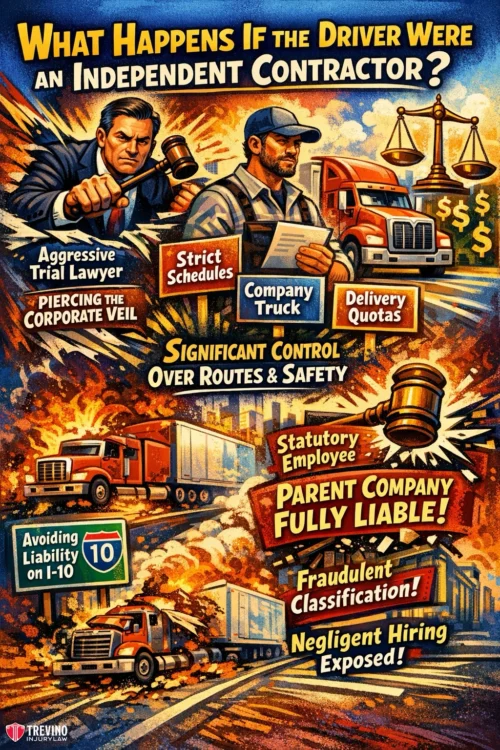
If the company mandated the commercial driver’s daily schedule, provided the specific vehicle, or strictly enforced specific delivery metrics, the court may deem the driver a statutory employee. This vital legal distinction makes the parent company fully liable for its negligent hiring, preventing it from hiding behind fraudulent employment classifications.
When Does Negligent Hiring Not Apply to a Fleet Manager?
Negligent hiring does not apply if the driver was engaged in a “frolic and detour,” meaning they were using the commercial vehicle for entirely personal, unauthorized reasons at the time of the crash.
If a driver steals a company truck completely outside of working hours and causes a devastating accident near Bandera Road, the employer may successfully argue they are not legally liable for that specific event. However, if the company had prior knowledge that the driver routinely misused company vehicles and failed to terminate them, a negligent retention claim can still be aggressively pursued to secure compensation.
To fully understand who is liable when a company driver causes an accident in Texas, and to hold these corporations accountable, you need a proven Commercial Accident Vehicle lawyer fighting to protect your family’s financial future.
Why Hire a San Antonio Commercial Vehicle Accident Lawyer?
When corporate defendants place unfit drivers on major local corridors such as Loop 1604, they devastate families. The danger on our local roads is not hypothetical. According to 2024 Texas Department of Transportation data, Bexar County experienced a staggering 2,684 commercial motor vehicle crashes in a single year, resulting in 18 fatalities and 46 suspected serious injuries. When confronting the corporate entities responsible for this level of harm, you need a trial lawyer to secure maximum compensation.
Want to Protect the Full Value of Your Claim?
You’ve seen how this affects your case — but this is only one piece of the puzzle. Our Commercial Accident Lawyer page breaks down what a trial-ready firm does differently.
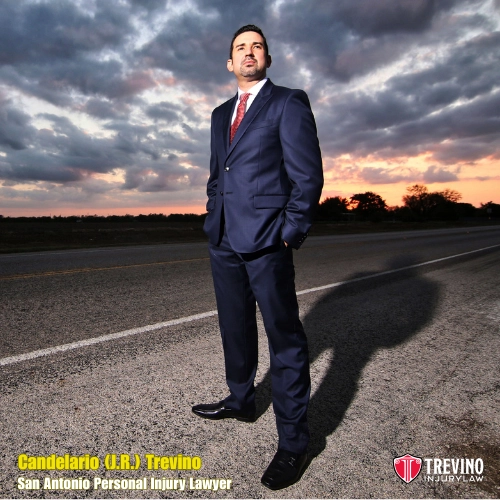
Negligent trucking companies and high-volume settlement mills want to rush cases and avoid trial. At Trevino Injury Law, we fight for families and hold responsible parties accountable.
Call 210-TREVINO for a free case review. We operate strictly on a No Win, No Fee basis. Se Habla Español.