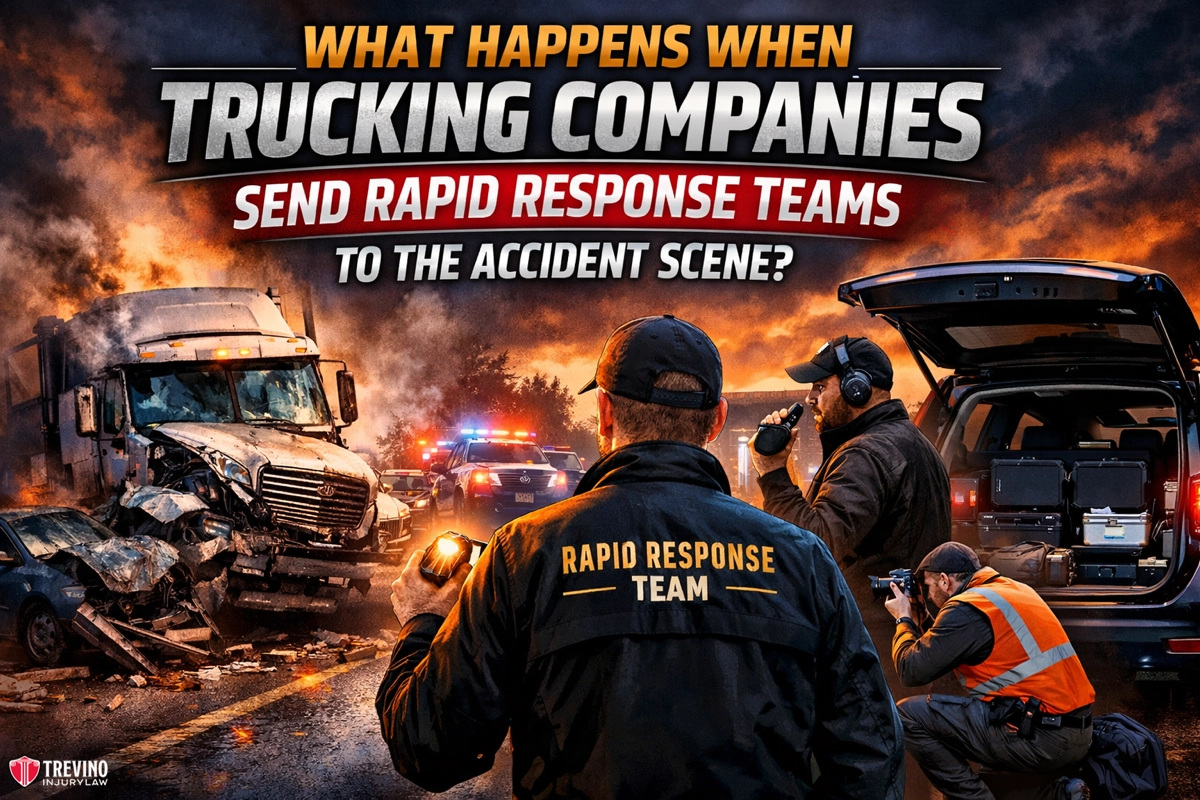
Rapid response teams arrive while you are still trapped in the wreckage. They swarm the crash site to measure skid marks, photograph debris, and interview the driver before local police finish their investigation.
The insurance adjuster at companies like Progressive or Great West Casualty Company races to download the truck’s Electronic Control Module before your lawyer can subpoena it. According to the National Safety Council, 75.08 percent of fatal commercial crashes in 2023 occurred on non-interstate roadways. When a Negligent Trucking Company causes a fatality on local San Antonio streets, their team rushes out to erase the truth and suppress liability.
What Could Your 18-Wheeler Accident Case Be Worth?
Answer a few quick questions about your accident. Takes about 60 seconds.
See What My Case Might Be WorthThe insurance company offered less than $20,000. I ended up with over $1 million. — Jackie Galindoa
Transient scene evidence washes away rapidly. A spoliation letter, a legal demand that stops the trucking company from destroying evidence, must be executed immediately. This locks down the commercial vehicle’s black box and internal dash camera footage before the negligent carrier overwrites the digital data. Waiting gives them complete control over the physical proof.
At Trevino Injury Law, an 18-wheeler crash lawyer deploys independent reconstructionists immediately to neutralize their early advantage. Call 210-TREVINO for a free case review. You pay nothing unless we win. Se Habla Español.
Why Do Trucking Companies Send Rapid Response Teams to Crash Scenes?
Corporate trucking companies dispatch rapid-response teams to secure the accident scene before local law enforcement completes its investigation, specifically to control the narrative, hide critical digital data, and protect their financial bottom line from massive liability claims following a catastrophic commercial crash.
When an 80,000-pound commercial vehicle causes a catastrophic pileup at the “Mixing Bowl” interchange at I-10 and US-90, the trucking company’s Insurance Adjuster immediately activates a rapid response team. Do not assume these horrific collisions only happen in the dead of night. In fact, 2023 National Safety Council data reveal that 62.09 percent of fatal large truck crashes occur during the daytime. These corporate defense teams are being deployed during peak commuting hours while your family is simply trying to get to work or school.
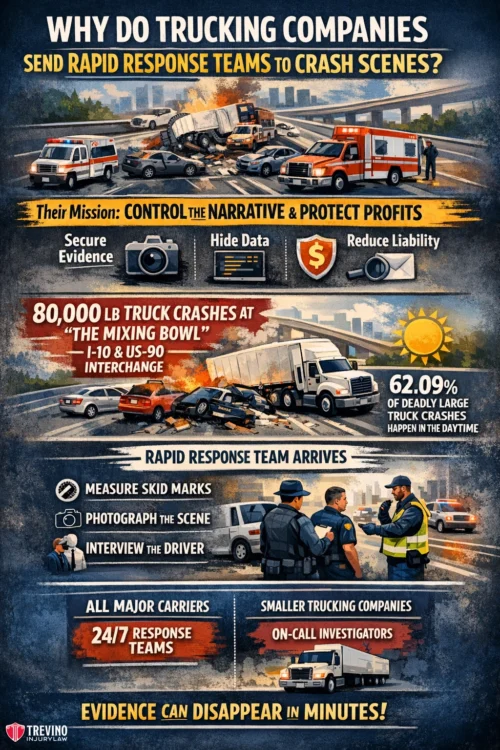
Their primary mission is to find physical evidence that shifts blame onto the passenger-vehicle driver. They measure skid marks, photograph the debris field, and quickly interview the commercial driver to align their story before San Antonio Police Department officers can fully document the area.
Do all commercial carriers use rapid response teams? Yes, major national carriers employ dedicated response teams on standby around the clock, while smaller local companies rely on on-call independent investigators dispatched by insurers like Progressive or Great West Casualty Company. These corporate investigators prioritize speed because they know physical evidence washes away rapidly.
What Critical Evidence Do Corporate Investigators Target First?
Corporate investigators immediately target transient scene evidence, unsecured digital data, and commercial logbooks that prove their truck driver acted with gross negligence. They do this to secure proof before a plaintiff’s trial lawyer can formally demand it.
The duty to preserve evidence is a critical legal doctrine in Texas. This rule was heavily shaped by the landmark case Brookshire Bros., Ltd. v. Aldridge, 438 S.W.3d 9 (Tex. 2014). The Texas Supreme Court established strict guidelines for when a trial court can punish a party for hiding or destroying evidence. If they bury the truth, we use this precedent to hold them accountable in a Bexar County courtroom.
They prioritize retrieving the truck’s Electronic Control Module to download hard braking and speed data before it can be formally subpoenaed.
They seek out surveillance cameras in surrounding businesses along high-traffic corridors like Culebra Road to secure or suppress footage. This is a critical battleground because the danger extends beyond the highways. According to the National Safety Council’s 2023 overview of fatal large-truck crashes, an overwhelming 75.08 percent of fatal commercial crashes occur on non-interstate roadways. When a negligent trucking company causes a fatality on a local San Antonio street, their team rushes to control the narrative before local law enforcement can intervene.
They carefully inspect the commercial trailer for overloaded cargo violations that could trigger severe federal FMCSA penalties.
What Are the Three Stages of an 18-Wheeler Collision Investigation?
Rapid response teams divide their defense strategy into three critical stages encompassing pre-crash perception, the exact point of impact, and the final post-crash resting positions to systematically build a defense against your injury claim and minimize their financial payout.
- Pre-crash perception analyzes when the truck driver supposedly first noticed the hazard, which adjusters frequently use to argue that the passenger vehicle cut them off.
- The point-of-impact phase calculates the exact angle and force of the collision using debris fields on local highways such as Loop 1604.
- The post-crash phase examines where the vehicles ultimately stopped, allowing defense experts to falsely claim the injured victim was speeding.
Understanding how these investigators map the physical scene highlights their technical advantage, but we must also examine the deceptive psychological tactics they use directly against victims.
What Should You Not Say to the Trucking Insurance Adjuster?
You must never admit fault, apologize for the collision, minimize your physical injuries, or provide a recorded statement to any commercial insurance adjuster following a semi-truck crash, because they will aggressively weaponize your exact words to deny liability and destroy your claim.
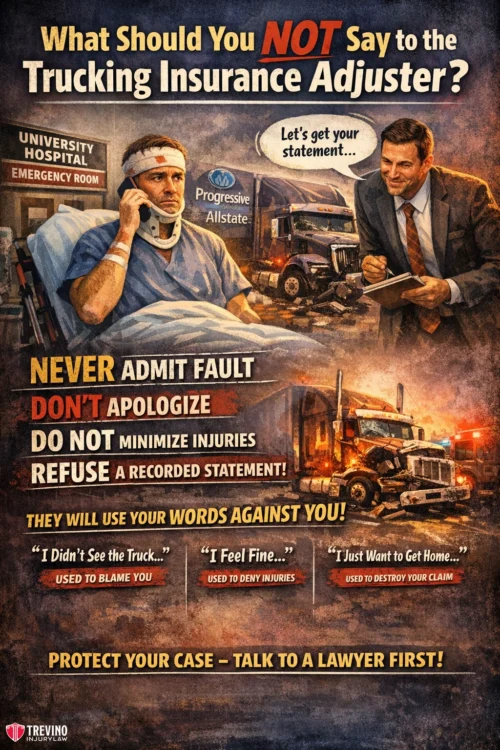
While you are still receiving emergency treatment at a local facility like University Hospital, a rapid response adjuster from Progressive or Allstate will likely call your cell phone or approach your family in the waiting room. They are highly trained in psychological tactics designed to elicit statements that ruin your personal injury lawsuit. If you say you “feel fine,” they will use that single phrase to deny future coverage for traumatic brain injuries or spinal cord damage that may not manifest symptoms for several days.
If you admit you “didn’t see the truck,” they will argue you violated Texas comparative fault laws by failing to maintain a proper lookout. A plaintiff trial lawyer strictly prohibits any unrepresented communication because these corporate adjusters are building a defense file, not trying to process your financial recovery.
How Do Adjusters Use Recorded Statements Against You?
Commercial adjusters use leading questions during weaponized recorded statements to trap you into an inaccurate timeline. Their corporate defense lawyers will exploit these answers before a Bexar County jury to minimize your compensation. They demand speed estimates while you are in shock, only to impeach your credibility later when forensic evidence proves the truck was speeding.
Under House Bill 19, trucking companies already enjoy significant legal protections in Texas. While they pressure you on the phone, the insurance adjuster deploys a biased reconstruction expert to the crash site. Their sole mission is to exonerate the driver and shift the blame to you.
They desperately want your recorded statement before a plaintiff trial lawyer secures the truck’s electronic data. This critical evidence often proves the driver violated federal FMCSA regulations or falsified logbooks. By trapping you in a recorded call, they distract from their own gross negligence.
Do not speak to corporate investigators following a commercial truck crash. Decline their requests and get a free consultation immediately. Trevino Injury Law knows its deceptive playbook. Let our team step in, protect your rights, and fight for your family.
How Does a Plaintiff Trial Lawyer Defeat the Rapid Response Team?
A trial-tested personal injury attorney actively defeats corporate response teams by immediately deploying independent accident reconstructionists. We comply with strict legal requirements to secure the physical scene before the defense team can hide liability or destroy vital commercial vehicle black box data.
Trevino Injury Law does not wait for a police report before beginning litigation. We match the trucking company’s aggression by launching our own immediate, comprehensive investigation. When a catastrophic collision involving an Eagle Ford Shale oilfield truck occurs, our firm compels the corporate defense to preserve all evidence. We immediately secure the passenger vehicle to prevent the insurance company from conducting a destructive inspection without our oversight.
By aggressively pursuing the very digital and physical data the rapid response team is trying to bury, our trial-first approach levels the playing field. This early intervention strips the commercial carrier of its early advantage in the Bexar County Courthouse and ensures we litigate to a verdict from a position of absolute strength, because trial readiness exposes hours-of-service violations and other negligence the defense desperately wants buried.
Why Is Sending a Spoliation Letter Immediately Necessary?
Sending a spoliation letter is absolutely necessary because it serves as a formal legal injunction prohibiting the rapid response team from deleting black box data, repairing the commercial truck, or destroying internal logbooks following a major highway crash.
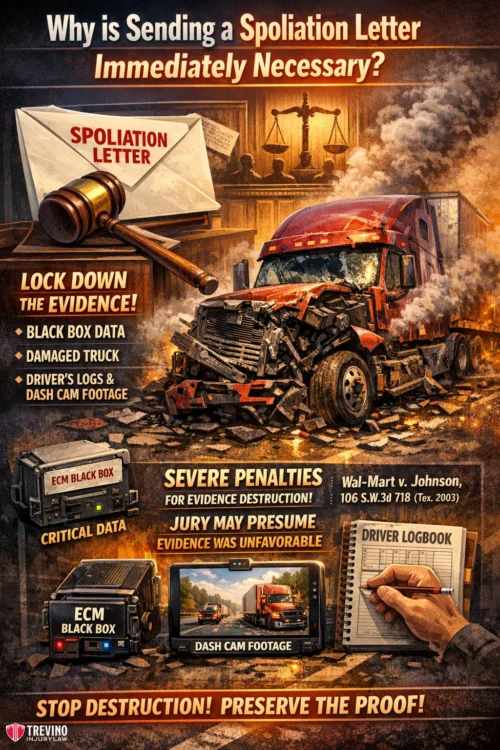
If an adjuster intentionally destroys evidence after receiving a Spoliation Letter, Texas trial courts may impose severe penalties on the defendant. The legal standard for these penalties was defined in Wal-Mart Stores, Inc. v. Johnson, 106 S.W.3d 718 (Tex. 2003). In this case, the court ruled that if a party controlling missing evidence cannot explain its failure to produce it, the jury may legally presume the evidence was unfavorable to that party. This is exactly why we lock down the physical scene early. It legally prevents the negligent trucking company from deleting the 18-wheeler’s Electronic Control Module data to hide its gross liability.
This legal demand locks down the electronic control module, the driver’s service logs, and internal dash cam footage.
Without this immediate demand, a negligent trucking company can claim that it routinely overwrote the dash cam’s memory, thereby permanently destroying the visual evidence of its driver’s negligence. We rely on these aggressive demands to retrieve the truck’s Electronic Control Module (the black box) before crucial speed and braking data disappear.
Halting the destruction of this vital evidence is our primary tactical goal, which, in turn, imposes a strict timeline for your action.
How Long Do You Have to Hire a Lawyer After an 18-Wheeler Crash?
You should hire a plaintiff trial lawyer within the first 24 to 48 hours after a catastrophic 18-wheeler crash because critical scene evidence washes away quickly, and the corporate rapid response team is already actively building a narrative against you.
While the Texas statute of limitations generally provides 2 years to file a personal injury lawsuit, waiting even a few weeks gives the insurance company a significant tactical advantage and compresses every later phase of the 18-wheeler lawsuit timeline.
Skid marks on Interstate 35 fade, witnesses forget critical details, and unrepresented victims often fall into the trap of accepting a lowball settlement offer from a predatory Insurance Adjuster.
Immediate attorney involvement ensures your medical care is documented correctly for a future Life Care Plan and shields you entirely from the trucking company’s investigators. Time is the commercial insurance carrier’s greatest weapon, and early legal intervention is your strongest defense against their strategies.
Understanding this urgent timeline transitions our focus to the specific legal boundaries that actually constrain these corporate investigators at the crash scene.
What Legal Rules Govern Crash Scene Investigations in Texas?
Texas law permits corporate investigators to observe public crash scenes, but it strictly prohibits them from interfering with local law enforcement, tampering with any physical evidence, or harassing injured victims while they are still vulnerable and receiving emergency medical care following a catastrophic semi-truck collision.
The rapid response team operates under careful legal parameters to avoid criminal tampering charges, but they aggressively push these boundaries to protect their bottom line. They are legally allowed to take photographs from public rights-of-way and speak to willing witnesses who saw the crash. However, they cannot legally compel you to cooperate with their private investigation.
Our firm utilizes the Freedom of Information Act (FOIA) to independently secure body camera footage from responding officers to verify exactly how the commercial driver and the rapid response team behaved at the scene. By knowing the limits of their legal authority, we ensure they do not overstep their bounds and compromise the integrity of your personal injury claim.
Knowing they cannot legally force your cooperation brings up specific decisions you must make if they confront you.
Can a Rapid Response Team Force You to Give a Statement?
No, a trucking company’s rapid-response team cannot legally force you to give a statement or answer questions at the crash scene or at the hospital.
Should You Sign Medical Releases at the Crash Scene?
No, you must never sign medical releases from a corporate investigator because they will exploit this access to blame your injuries on pre-existing conditions.
How Does Early Attorney Involvement Affect Settlement Value?
Early attorney involvement drastically increases your final settlement value because it prevents the rapid response team from successfully sabotaging liability and forces the insurance carrier to evaluate your claim based on trial readiness rather than relying on their deceptive manipulation tactics.
High-volume settlement mills often delay critical investigations, allowing the corporate defense to dictate the facts surrounding the wreck. Trevino Injury Law operates differently. Because we secure black-box data and send FOIA requests in the first week, we have the objective proof needed to execute aggressive Stowers Demands later in the process.
When a massive insurer like Progressive knows that a plaintiff trial lawyer has locked down the crash-scene evidence before its own team can suppress it, it is forced to offer maximum compensation rather than the typical lowball fractions it offers unrepresented victims.
Maximizing your financial recovery through early action is the primary goal, which reveals the devastating reality of fighting these corporate entities alone.
What Happens If You Do Not Hire an Attorney in the First 24 Hours?
If you do not hire an attorney immediately after the crash, the commercial rapid response team will successfully establish a false narrative that permanently damages your ability to recover maximum financial compensation for your catastrophic injuries and massive medical bills.
In the absence of a trial-tested lawyer, the trucking company will have complete control over the physical evidence. They will quietly repair the commercial vehicle, overwrite the internal dash cam footage, and aggressively pressure you into a recorded statement that shifts comparative fault entirely onto your shoulders.
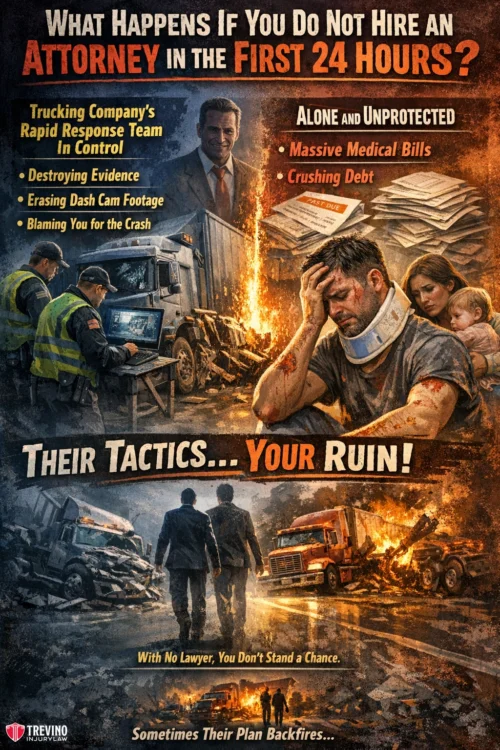
Without legal protection, you are completely exposed to sophisticated corporate tactics designed to leave your family burdened with insurmountable medical debt while the negligent trucking company saves millions.
Recognizing the severe consequences of fighting these investigators alone leads us to rare situations in which their rapid response actually fails to protect them.
When Is a Rapid Response Team Unable to Protect the Trucking Company?
A commercial rapid response team is entirely unable to protect a negligent trucking company when a relentless plaintiff trial lawyer rapidly secures objective digital evidence that explicitly contradicts the defense’s fabricated narrative and undeniably exposes their driver’s gross liability.
Even the most aggressive corporate investigators cannot alter the fundamental laws of physics or erase digital data once a spoliation letter is properly executed. When our firm successfully secures the Electronic Control Module data proving the driver explicitly violated FMCSA hours-of-service regulations, the rapid response team’s early scene manipulation becomes completely useless.
A trial-first approach strips away their corporate defenses, exposing their delay tactics to a Bexar County jury and forcing them to pay full, just compensation for your suffering.
Why Hire a San Antonio 18-Wheeler Accident Lawyer?
When rapid response teams swarm an I-35 crash to suppress evidence, you need a trial authority to secure maximum compensation. While Progressive adjusters and settlement mills avoid the courtroom, Trevino Injury Law fights for families and forces negligent trucking companies to pay.
Want to Protect the Full Value of Your Claim?
You’ve seen how this affects your case — but this is only one piece of the puzzle. Our 18 Wheeler Injury Lawyer page breaks down what a trial-ready firm does differently.
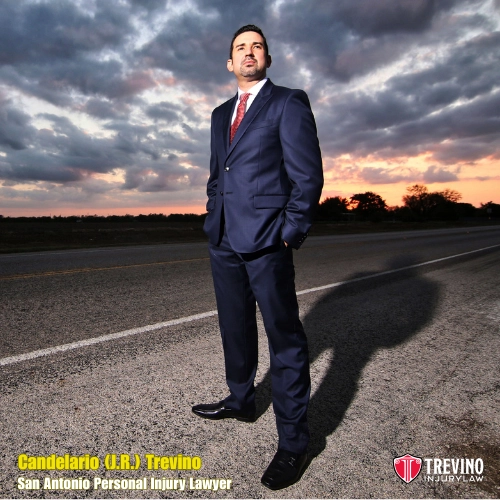
Armed with over 80 jury trials and a $17 Million settlement in an 18-wheeler wrongful death case, we command respect at the Bexar County Courthouse. By immediately issuing a spoliation letter to lock down black-box data, our San Antonio personal injury lawyers neutralize their corporate defense.
Call 210-TREVINO for a free case review. Se Habla Español. We operate strictly on a No Win, No Fee basis.