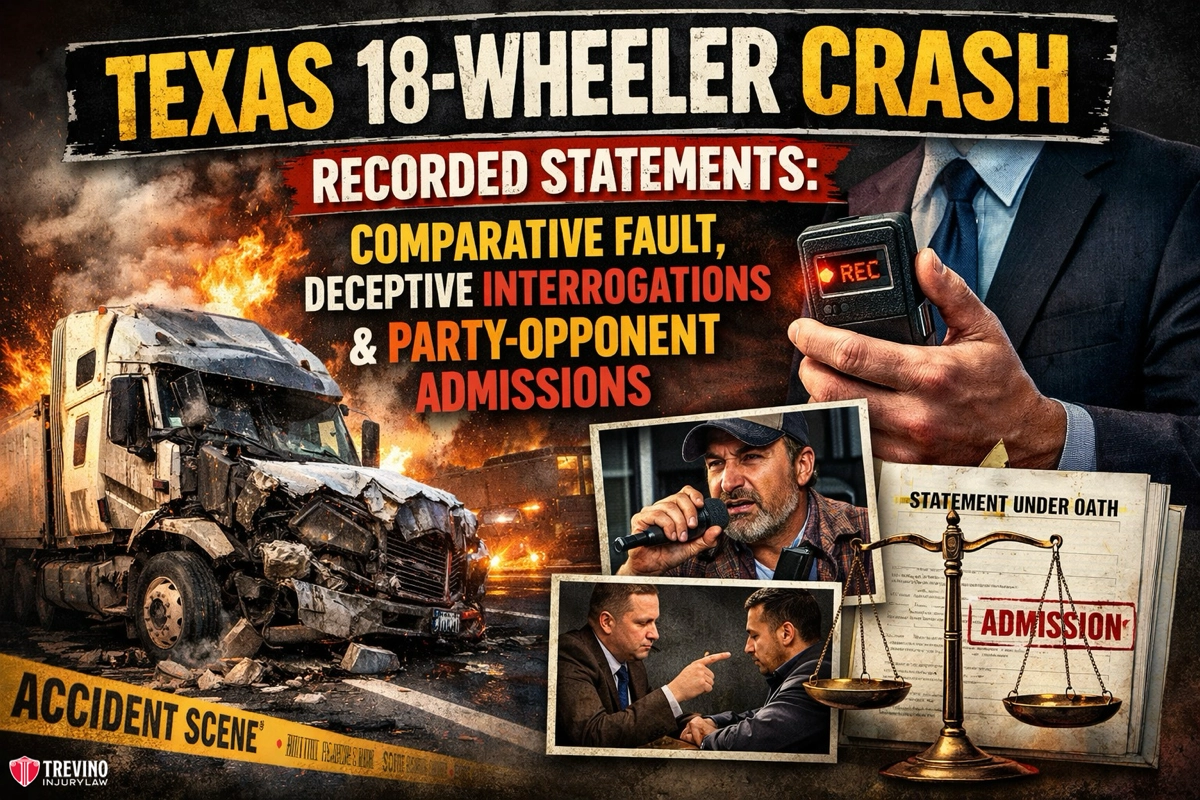
No, never give a recorded statement to the opposing insurance company. An adjuster from Progressive or Great West Casualty is calling right now to record your voice while you are in shock.
They ask deceptive questions to twist polite pleasantries into formal party-opponent admissions, legally documenting that you are uninjured to destroy your ability to claim future medical costs. According to the National Safety Council, passenger vehicle occupants accounted for 70 percent of all large-truck crash injuries in 2023. Negligent trucking companies face massive financial exposure from these wrecks. They deploy corporate investigators immediately to assign you comparative fault and protect their profit margins.
What Could Your 18-Wheeler Accident Case Be Worth?
Answer a few quick questions about your accident. Takes about 60 seconds.
See What My Case Might Be WorthThe insurance company offered less than $20,000. I ended up with over $1 million. — Jackie Galindo
Evidence disappears in the first week. You must cut off their primary psychological weapon and refuse the interrogation. A Spoliation Letter, a legal demand that stops the property owner from destroying evidence, must go out immediately to secure the black box data and dash cam footage.
At Trevino Injury Law, our 18-wheeler accident lawyers intercept corporate investigators and lock the evidence down before it vanishes. Call 210-TREVINO now for a free case review. You pay nothing unless we win. Se Habla Español.
What Do Insurance Companies Do With Your Recorded Statements?
Insurance companies meticulously analyze your recorded statements to find any slight inconsistency or polite admission that can be weaponized to shift blame onto you under Texas comparative fault laws, allowing them to drastically reduce your settlement or deny your catastrophic injury claim entirely.
Following a catastrophic commercial crash on Loop 410 or I-35, adjusters from carriers like Progressive immediately begin building a defense. They know the severe risks passenger vehicles face; in fact, 2023 National Safety Council (NSC) data show that 70% of the 5,472 fatalities and 153,452 injuries in large-truck crashes were occupants of other vehicles. Because these claims so frequently involve catastrophic damages, insurers use recorded statements to lock you into a rigid narrative before you fully understand the extent of your spinal cord injuries or traumatic brain injuries.
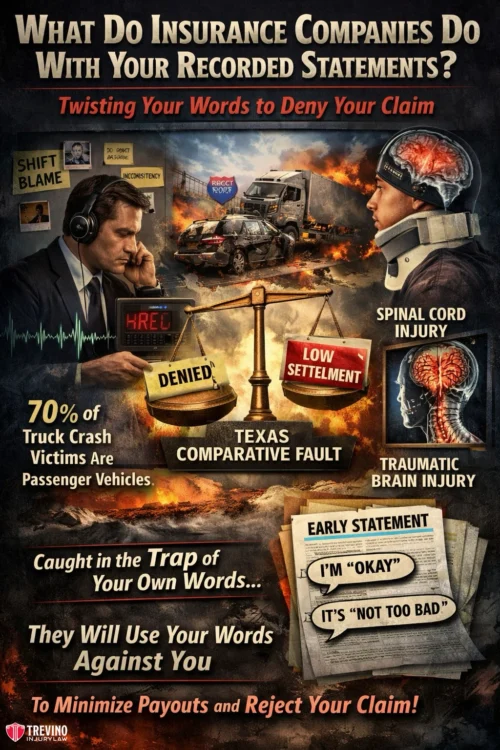
If you later require a Life Care Plan for damages you did not initially mention, the insurer will use the early recording to claim you are exaggerating or fabricating the injuries to get a payout.
How Do Adjusters Use Texas Comparative Fault to Shift Blame?
Adjusters actively seek admissions that you were distracted, speeding, or failed to brake in time, hoping to assign you more than 50 percent of the fault, which legally bars you from recovering any compensation in Texas for your medical bills and lost wages.
Corporate defense teams twist natural, conversational apologies into formal admissions of guilt. If you say you “did not see the truck until the last second,” they will aggressively argue you were not paying attention to the road. By manipulating these polite responses, negligent trucking companies protect their profit margins and leave your family burdened with insurmountable medical debt.
What Happens to the Recording if the Case Goes to the Bexar County Courthouse?
Defense attorneys will play your recorded statement before a Bexar County jury to impeach your credibility during a trial, underscoring exactly why a trial-proven attorney must intercept these communications immediately to protect the value of your personal injury lawsuit.
When a case reaches the courtroom, the insurance company’s lawyers will contrast your initial, shock-induced statement with your later medical records. If there are any discrepancies, they will paint you as untrustworthy to the jury.
In Texas, your recorded statement can be introduced as substantive evidence against you under the doctrine of party-opponent admissions, a legal principle affirmed in landmark cases such as Lorusso v. Members Mut. Ins. Co., 603 S.W.2d 818 (Tex. 1980). This means the defense does not just use your words to question your credibility; they introduce them as direct, legal evidence to destroy the foundation of your personal injury lawsuit.
Our trial team stops these recordings from happening, ensuring your case is built on objective evidence rather than manipulated conversations as we move through how long an 18-wheeler lawsuit takes in Texas, from filing through verdict.
Understanding how these recordings are ultimately weaponized in court underscores the need to recognize the specific interrogation techniques used to extract them.
What Kind of Deceptive Questions Do Commercial Insurance Investigators Ask?
Commercial insurance investigators deliberately ask leading, confusing, and multi-part questions designed to make you agree with statements that minimize the negligent trucking company’s liability, downplay your physical pain, and create permanent inconsistencies that defense attorneys will later exploit during settlement negotiations.
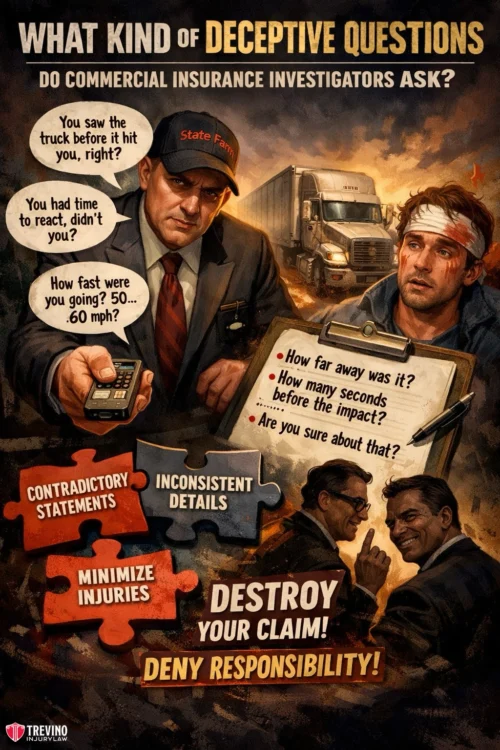
Adjusters from massive carriers like State Farm or Great West Casualty are highly trained interrogators. They will ask questions like, “You saw the truck before it hit you, right?” to establish that you had ample time to avoid the crash. They will ask for detailed estimates of time, speed, and distance. Victims in severe shock cannot accurately assess these metrics, creating permanent discrepancies in the claim file that the insurance company will use to deny responsibility.
How Do Adjusters Exploit “Polite” Responses to Minimize Injury Severity?
When an adjuster casually asks how you are feeling today, and you politely respond that you are okay, they formally document that you admitted to being completely uninjured, severely damaging your ability to claim future medical costs for delayed pain. Social conditioning makes us want to downplay our pain and avoid complaining.
Insurance adjusters ruthlessly exploit this basic human decency. They treat a conversational pleasantry like “I am fine” as a legally binding admission of perfect health. This deceptive tactic destroys the foundation for a Life Care Plan and allows the insurer to deny coverage for injuries that manifest days or weeks after the initial impact.
The effectiveness of these psychological manipulation tactics relies heavily on the adjuster reaching you before you have time to process the trauma or seek legal counsel.
Why Do Insurance Adjusters Demand Statements Within the First 24 Hours?
Adjusters aggressively demand recorded statements within the first 24 hours because they know you are likely unrepresented, heavily medicated, and in physical shock, making it the absolute easiest time to extract admissions that ruin your claim before you hire a lawyer.
The first week after a catastrophic commercial crash is critical. In 2023 alone, the National Safety Council (NSC) reported 153,452 injuries resulting from large-truck crashes, with a massive 70% of those victims being occupants of other vehicles just like yours.
While you navigate emergency rooms like University Hospital and deal with the trauma of an accident on a deadly corridor like Culebra Road, the trucking company’s rapid-response team is already managing its financial exposure from the immense volume of wrecks.
They push for a statement before you realize the true extent of a spinal cord injury or severe head trauma.
How Do Shock and Adrenaline Alter Your Memory of the Crash?
Following a crash, shock and adrenaline mask severe pain and heavily distort your memory recall, meaning any recorded statement given immediately after the collision will be factually inaccurate and fundamentally fail to capture the true devastation of your physical injuries and future medical needs.
Following a massive impact, your body releases a flood of adrenaline, which acts as a natural painkiller. You may walk away from the wreckage feeling only minor stiffness, completely unaware that you have sustained a traumatic brain injury or herniated discs. Because of this biological response, any immediate assessment of your health or the crash sequence is inherently flawed and highly dangerous to your legal claim.
Recognizing how trauma compromises your ability to communicate accurately reinforces the absolute rules about what information you must withhold from corporate defense teams.
What Should You Never Say to a Commercial Claims Adjuster?
When speaking to a commercial claims adjuster representing a negligent trucking company, you must immediately decline any requests for recorded statements and absolutely refuse to answer questions regarding fault, vehicle speeds, or the severity of your physical injuries to protect your claim’s value.
After a devastating wreck, your words are treated as legal evidence by the defense team. To protect your personal injury lawsuit, you must never:
- Apologize or admit any degree of fault for the crash.
- Guess at crash facts, distances, or estimate vehicle speeds.
- Downplay your physical injuries or politely say you feel “fine.”
- Discuss potential settlement numbers without trial-proven legal representation.
Limit your communication strictly to providing basic contact details and the official police report number. If the adjuster presses for more information regarding how the collision happened or the extent of your pain, firmly direct all of their inquiries to your San Antonio 18-wheeler crash law firm. By refusing to engage with their interrogations, you cut off their primary method of minimizing your financial recovery.
Knowing exactly what to withhold from the opposing insurance company naturally raises the question of how to fulfill your basic obligations when reporting the crash.
What is the Process for Reporting a Crash Without Giving a Recorded Statement?
You can fulfill your legal obligation to report the crash by providing only your name, contact information, and the police report number, explicitly declining to answer any questions about fault or injuries until your attorney is present. Handling this initial notification correctly prevents the opposing insurance company from baiting you into an unscripted conversation that damages your case value.
When submitting the basic initial report, ensure you provide the 5 W’s: who was involved, what occurred generally, where it happened, when it took place, and witness information, but restrict all details to the objective facts documented in the police report. You should never elaborate on your physical condition or apologize for the sequence of events.
Do You Legally Have to Give a Recorded Statement to the At-Fault Trucking Company’s Insurance?
No, you are under no legal obligation to provide a recorded statement to the negligent trucking company’s insurance carrier, and you should always refuse their requests.
Can Your Own Insurance Company Require a Recorded Statement from You?
Yes, your insurance policy likely includes a ‘cooperation clause’ requiring you to provide a statement to your carrier, but your attorney should be present during this call to protect your rights. The Texas Supreme Court addressed this contractual duty in National Union Fire Ins. Co. of Pittsburgh, PA v. Crocker, 246 S.W.3d 603 (Tex. 2008), confirming that while insured individuals must cooperate, insurers must also prove they were actually prejudiced by a lack of cooperation before denying coverage.
Having a trial-proven attorney guide your statement ensures you fulfill your policy obligations without inadvertently compromising your separate injury claim against the negligent trucking company.
How Do Trial Lawyers Intercept Adjuster Calls to Protect Your Claim?
Once you hire Trevino Injury Law, we immediately send a letter of representation to the insurance companies, which legally prohibits them from contacting you directly and requires all communication to go through our trial-tested team.
While you focus on recovery at facilities like Stone Oak Methodist or Mission Trail Baptist, our attorneys handle all interactions. Unrepresented victims face relentless, harassing calls from corporate defense teams trying to force an early, lowball settlement before the true extent of the damage is known.
By employing our protective trial-first approach and trial-ready 18-wheeler lawsuit preparation, we shut down these communications, ensuring that adjusters can no longer pressure you into a recorded admission that jeopardizes your economic justice.
What Happens to Your Claim Without a Recorded Statement to the Opposing Adjuster?
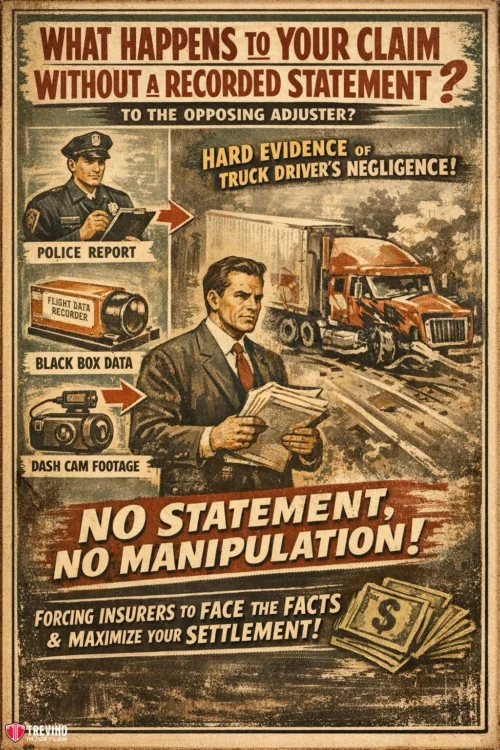
Without a recorded statement to manipulate, the opposing adjuster is forced to rely on objective evidence like the police crash report, black box data, and dash cam footage, which a trial lawyer uses to build an undeniable case for liability.
This absence of a recorded statement actually becomes your greatest advantage during settlement negotiations. Instead of twisting your polite remarks or trauma-induced confusion, the insurance company must confront the hard, physical evidence of their truck driver’s negligence.
By starving the defense of their primary psychological weapon, your 18-wheeler collision attorney forces them to evaluate the claim based strictly on the facts, maximizing your potential financial recovery.
When Are Your Statements Actually Admissible as Evidence?
Statements become admissible and highly dangerous if you post about the crash on social media, speak casually to witnesses at the scene, or discuss case details with anyone other than your personal injury attorney or medical providers.
Insurance defense teams routinely subpoena Facebook and Instagram records to find discrepancies in your timeline or photos that contradict your injury claims. Furthermore, “excited utterances” made to bystanders or paramedics at a crash scene on Loop 1604 can be introduced in court to undermine your formal testimony. To protect your rights, you must maintain absolute silence regarding the wreck and direct all inquiries to your legal representation.
Why Hire a San Antonio 18-Wheeler Accident Lawyer?
When carriers like Progressive twist your words after a Loop 410 crash, you need a trial-proven advocate to secure fair compensation. Unlike volume settlement mills that fold under pressure, Trevino Injury Law aggressively litigates against deceptive insurance adjusters and negligent trucking companies. We fight for families and force them to pay.
Want to Protect the Full Value of Your Claim?
You’ve seen how this affects your case — but this is only one piece of the puzzle. Our 18 Wheeler Accident Lawyer page breaks down what a trial-ready firm does differently.
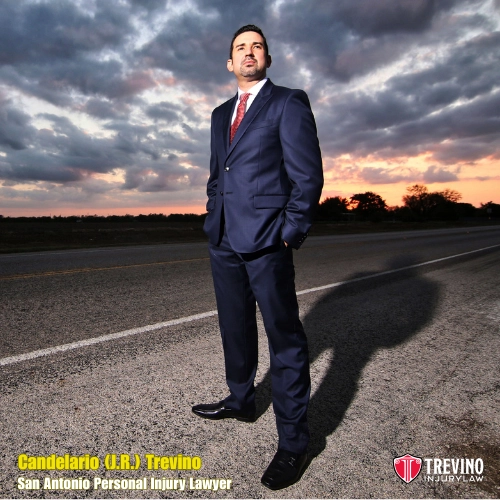
Our trial-first approach secures superior outcomes, including a $17 Million Settlement for commercial crash victims. To prevent defense teams from destroying your credibility at the Bexar County Courthouse, your personal injury attorney immediately sends a spoliation letter to secure critical black-box data.
Call 210-TREVINO for a free case review. Se Habla Español. We operate on a strict contingency-fee basis, meaning no win, no fee.