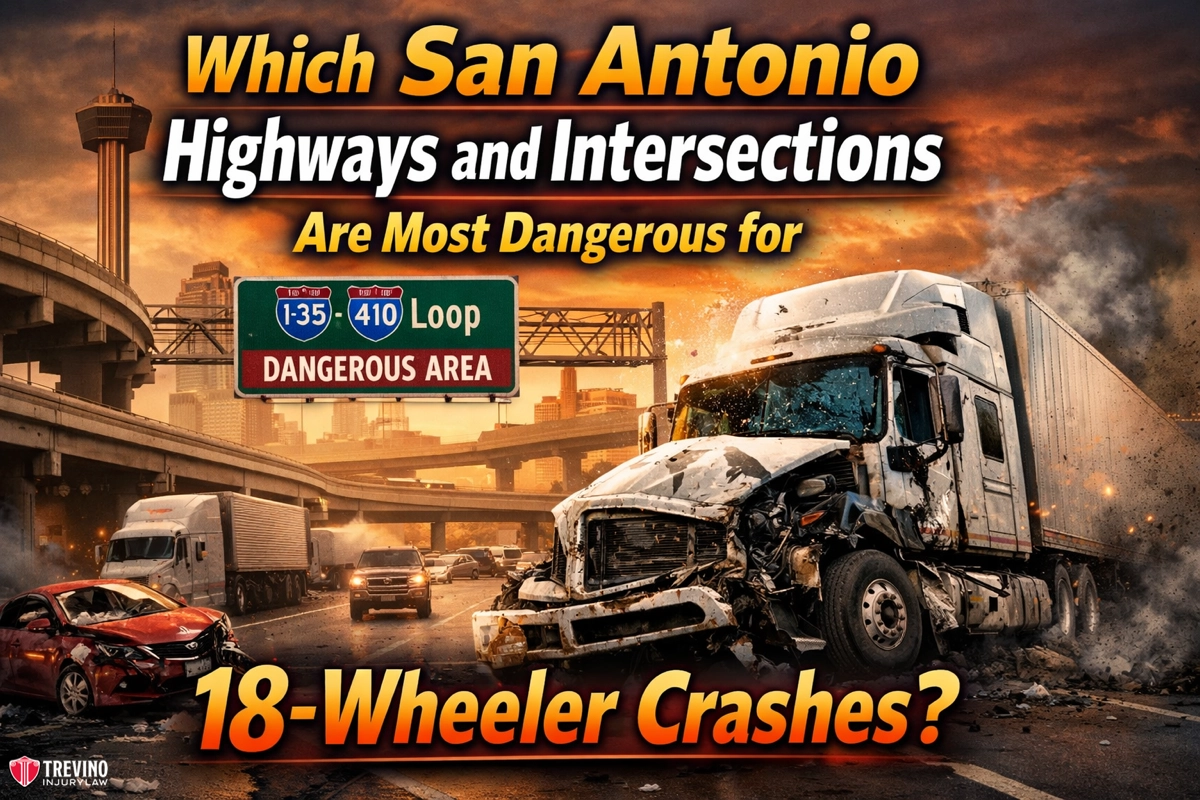
The deadliest zones for a commercial truck crash in San Antonio are Interstate 35, the “Mixing Bowl” interchange, and high-volume surface streets like Culebra Road. Heavy freight traffic funnels through these corridors, crushing passenger vehicles caught in the blind spots.
The commercial insurance carrier is already exploiting the geographical ambiguity of your crash site. They are rewriting the narrative to claim that their driver maintained their lane while you improperly merged into it. According to the National Safety Council, 75.08 percent of fatal large-truck crashes nationwide occurred on non-interstate roadways in 2023. Behind these collisions is an out-of-state driver who misjudged traffic flow or ignored safe speed limits.
What Could Your 18-Wheeler Accident Case Be Worth?
Answer a few quick questions about your accident. Takes about 60 seconds.
See What My Case Might Be WorthThe insurance company offered less than $20,000. I ended up with over $1 million. — Jackie Galindo
Critical intersection security footage gets recorded over within days. A Spoliation Letter, a legal demand to stop the trucking company from destroying evidence, must be sent immediately.
Trevino Injury Law’s San Antonio 18-wheeler accident attorney pinpoints your exact collision coordinates and forces the preservation of municipal camera data before it vanishes. Call 210-TREVINO now for a free case review. You pay nothing unless we win. Se Habla Español.
What Is the Most Dangerous Road in San Antonio, Texas, for 18-Wheeler Accidents?
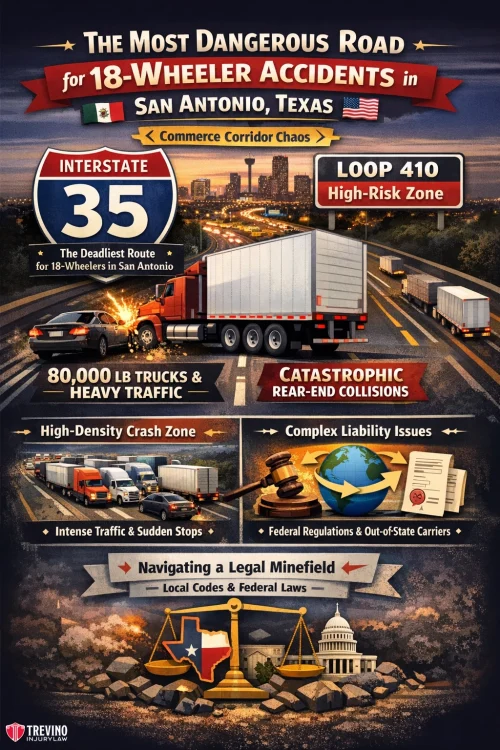
Interstate 35 consistently ranks as the most dangerous road in San Antonio for 18-wheeler accidents because of the immense volume of high-speed, heavy commercial truck traffic funneling through the Mexico-US commerce corridor.
While our main practice addresses commercial liability broadly, victims traversing Bexar County must understand how specific high-density routes fundamentally alter crash dynamics and the available evidence.
The immense density of 80,000-pound vehicles sharing I-35 and Loop 410 creates an unforgiving environment where sudden stops can cause catastrophic rear-end collisions. Furthermore, the sheer volume of out-of-state and international carriers heavily complicates liability determinations, forcing your legal team to navigate complex federal regulations alongside local municipal codes.
What Highway Has the Most Deaths in Texas Involving Commercial Trucks?
Interstate 35 and Interstate 10 contribute to the highest commercial fatality rates statewide, specifically focusing on the stretches that pass through Bexar County’s dense urban core. According to 2023 National Safety Council data, while rural routes see a high volume of incidents, a staggering 44.33% of all fatal large-truck crashes nationwide occur in urban areas.
This massive concentration of urban trucking fatalities makes heavily populated commercial zones like San Antonio incredibly dangerous, leaving passenger vehicles highly vulnerable to fatigued truck drivers navigating complex city traffic.
These deadly corridors cut directly through heavily populated residential and commercial zones, significantly increasing the likelihood of fatal multi-vehicle pileups.
When a massive commercial truck fails to brake in time on these high-speed stretches of interstate, the resulting impact often leads to devastating wrongful death claims against the trucking company. However, successfully litigating these claims requires proving that the commercial driver’s specific negligence was a ‘substantial factor‘ in causing the crash. This strict standard comes from the Texas Supreme Court in Lear Siegler, Inc. v. Perez, 819 S.W.2d 470 (Tex. 1991), which holds that a defendant is not liable if their involvement was a mere happenstance of place and time.
While I-35 has the highest volume and statewide fatality metrics reveal broader interstate dangers, the complexity of San Antonio’s interchanges creates distinct crash risks.
What Part of San Antonio Has the Worst Traffic for Commercial Vehicles?
The worst commercial traffic in San Antonio is concentrated at the “Mixing Bowl” interchange, where I-10, I-35, and US-90 converge. This chaotic bottleneck is notorious for heavy traffic that forces massive 18-wheelers to make sudden lane changes, severely compromising daily commuters’ safety.
Building on general collision dynamics, navigating this specific geographical bottleneck introduces severe, hyper-local architectural road hazards. When determining which areas to avoid, it becomes clear why this is one of San Antonio’s most perilous zones for a motor vehicle:
- Unforgiving Infrastructure: Confusing exit ramps and sudden turn lanes force 18-wheelers to adjust quickly, creating dangerous conditions that lead to commercial motor vehicle accidents.
- High-Speed Blind Spots: Out-of-state truckers relying on GPS often misjudge heavy traffic or ignore safe speed limits, barreling into blind spots and causing devastating side-impact or rear-end crashes. The combined I-35 and Loop 410 interchange is where this freight density turns lethal. Understanding why 18-wheelers crash so often on I-35 and Loop 410 reveals the specific FMCSA speed-violation and rollover physics behind these wrecks.
- Dangerous Spillovers: The chaos isn’t confined to the highways; commercial traffic frequently spills into intersections on surface streets such as San Pedro Avenue, which ranks among San Antonio’s most dangerous roads and busiest non-freeway crash corridors.
- Catastrophic Consequences: Because commercial braking distances are severely compromised in these zones, accidents in San Antonio involving heavy rigs consistently result in serious injuries to local accident victims.
If you are injured in an accident on the roads of Texas, these are not standard accident cases. Accidents often require an aggressive legal strategy because powerful trucking companies will immediately try to shift the blame.
How Do Complex Interchanges Cause Catastrophic 18-Wheeler Jackknife Accidents?
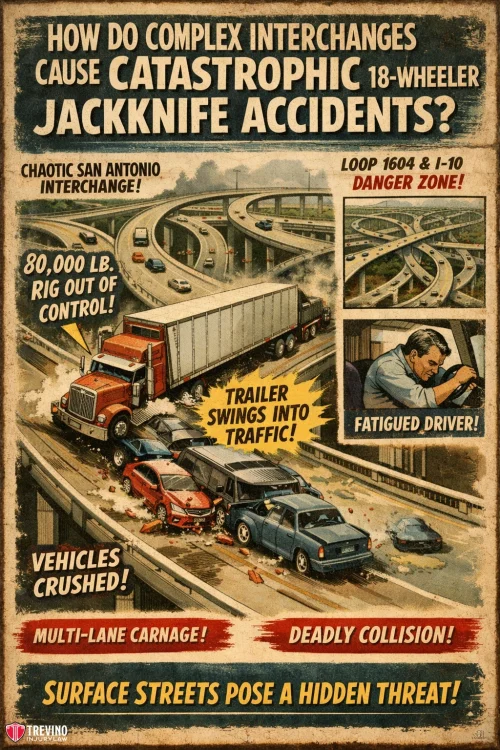
Complex interchanges cause catastrophic 18-wheeler jackknife accidents because massive commercial rigs attempting to navigate the sharp curves and sudden braking required at major San Antonio interchanges experience violent trailer swings that sweep across multiple lanes.
The physics of an 80,000-pound vehicle navigating the Loop 1604-I-10 exchange leaves no margin for error. If a fatigued driver brakes too aggressively on these sweeping elevated ramps, the trailer loses traction and jackknifes, crushing any passenger vehicles trapped in its destructive path.
The same destructive forces explain why I-35 and Loop 410 are so dangerous for 18-wheelers in San Antonio, where overloaded commercial rigs entering the Mixing Bowl break their center of gravity on sharp ramps and trigger catastrophic rollovers.
This severe congestion directly leads to specific types of collisions at merging points, but while highway interchanges are deadly, surface streets pose a unique threat to local passenger vehicles.
What Type of Intersection Has the Most Accidents Involving Semi-Trucks in Bexar County?
High-volume, multi-lane surface street intersections, particularly along Culebra Road and Bandera Road, experience the most semi-truck accidents, as commercial vehicles make wide right turns and crush vehicles caught in their massive blind spots. Even when a commercial driver believes they have the right-of-way during a turn, Texas law imposes a strict duty on all drivers to maintain a proper lookout to avoid collisions, a foundational legal doctrine established in Lynch v. Ricketts, which frequently dictates liability in catastrophic right-hook intersection crashes.
While high-speed highway crashes often receive the most attention, National Safety Council data show that in 2023, a staggering 75.08% of fatal large-truck crashes nationwide occurred on non-interstate roadways. Because most fatal commercial crashes occur on surface streets, these collisions require a fundamentally different liability analysis, focusing heavily on municipal right-of-way negligence rather than solely on federal highway regulations.
Culebra Road is San Antonio’s deadliest non-freeway road, where massive rigs must navigate tight, congested lanes alongside vulnerable pedestrians.
These intersections frequently see severe “right-hook” accidents and devastating red-light-running incidents involving heavy trucks that cannot stop in time for changing traffic signals. Because the physical location of your crash dictates the mechanics of the collision, it also fundamentally alters how your attorney builds your case.
How Does the Location of Your San Antonio 18-Wheeler Crash Impact Your Legal Claim?
The exact location of your 18-wheeler crash in San Antonio dictates which law enforcement agency generated the report, what surveillance footage is available, and whether local municipal codes or federal high-speed interstate regulations take primary precedence when your attorney establishes liability.
Understanding where the collision occurred transforms how your legal team approaches the investigation. For example, a severe commercial-vehicle collision on the lower level of Interstate 35 involves the Texas Department of Transportation (TxDOT) and, potentially, the Department of Public Safety (DPS).
In contrast, a devastating right-hook accident on South Zarzamora Street falls under the immediate jurisdiction of the San Antonio Police Department (SAPD). Each entity uses distinct protocols for evidence retention, archiving traffic camera footage, and accident-reconstruction reporting.
You need a localized plaintiff trial lawyer who has actually litigated against major insurance companies across Bexar County to quickly identify these shifting jurisdictional boundaries. Without aggressive legal representation fighting for your family, crucial municipal or highway data will vanish before you even realize which agency controlled the intersection cameras. Successfully navigating these localized hurdles requires immediate, precise steps to preserve evidence.
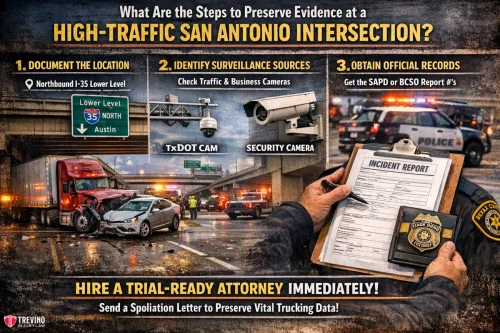
What Are the Specific Steps to Preserve Evidence at a High-Traffic San Antonio Intersection?
To preserve critical evidence at a high-traffic San Antonio intersection, you must safely photograph the vehicles’ final resting positions relative to lane markers, identify nearby commercial security cameras, and immediately hire a trial-ready truck accident lawyer to send a spoliation letter preventing the destruction of vital trucking data.
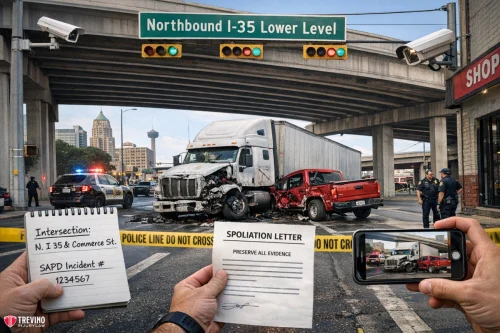
Taking immediate action at the scene locks down the facts on the ground before insurance adjusters can manipulate them. If you are physically able, follow these exact steps:
- Document the exact location: Record the specific cross-streets and lane identifiers, such as “Northbound I-35 lower level”.
- Identify surveillance sources: Look for TxDOT traffic cameras or local businesses’ security cameras facing the intersection.
- Obtain official records: Get the SAPD or Bexar County Sheriff incident numbers before leaving the scene so your legal team can pull the reports immediately.
Does TxDOT automatically save Traffic Camera Footage of Commercial Crashes?
No, TxDOT does not automatically save or archive live-stream traffic camera footage of commercial crashes, which means your attorney must quickly subpoena local feeds before they are deleted.
Do Local Police Always Determine Liability Accurately at Complex Highway Interchanges?
No, responding officers at complex San Antonio interchanges often lack the specialized accident reconstruction training required to accurately assign fault in complicated 18-wheeler collisions. However, you cannot rely solely on the government to document your crash perfectly.
Highway Crashes vs. Surface Street Collisions: How does liability differ?
Liability differs significantly because high-speed highway crashes prioritize federal FMCSA hours-of-service violations and commercial braking data, whereas lower-speed surface street collisions focus heavily on local San Antonio municipal traffic law violations, pedestrian-zone awareness, and intersection right-of-way negligence.
Your trial attorney must adapt their investigation strategy depending on these specific jurisdictional environments to maximize your compensation.
| Legal Factor | Highway Crashes (e.g., Loop 1604) | Surface Street Collisions (e.g., Marbach Road) |
| Primary Liability Focus | FMCSA hours-of-service logs and high-speed electronic braking data. | Local municipal traffic law violations and right-of-way negligence. |
| Common Crash Scenario | An overloaded commercial trailer is failing to stop during sudden highway congestion. | A driver is taking a wide turn too fast in a tight, pedestrian-heavy zone. |
| Investigating Agency | Typically, TxDOT and the Department of Public Safety (DPS). | Typically, the San Antonio Police Department (SAPD). |
Regardless of whether your crash occurred on a highway or a surface street, failing to act quickly can have devastating consequences.
What Happens If You Don’t Precisely Document the Crash Location on San Antonio Highways?
If you do not precisely document the exact mile marker or intersection of your San Antonio crash, powerful commercial insurance carriers will aggressively exploit that geographical ambiguity to argue their truck driver was not actually in the specific lane where the collision initiated.
Exploring the negative space of this missing evidence reveals how quickly a strong claim can collapse. In notoriously chaotic areas like the “Mixing Bowl,” moving your vehicle off the road without photos lets the defense rewrite the narrative of who merged into whom. Without visual proof anchoring the commercial rig to a specific lane violation, the insurance company will falsely shift the blame onto you, severely damaging your claim.
This ambiguity becomes permanent if you allow critical time limits to expire.
When Is It Too Late to Secure Highway Camera and Commercial Black Box Data?
It is frequently too late to secure critical highway surveillance video within 72 hours, and commercial black box data can be legally overwritten by the trucking company within mere weeks if your San Antonio personal injury lawyer does not immediately force its preservation.
This is the ultimate failure in commercial crash litigation: letting the evidence vanish. We know from trial experience what evidence persuades juries, so we act quickly in the first week to secure video and data. Our trial-first advocacy relies heavily on the immediate issuance of spoliation letters and the preservation of black box data and traffic camera footage before massive insurers destroy them.
Why Hire a San Antonio 18-Wheeler Accident Lawyer?
When a catastrophic collision at the “Mixing Bowl” occurs, the clock starts ticking to preserve vital evidence. You need a Trial Lawyer to secure financial compensation. Powerful trucking companies and ruthless insurance adjusters will manipulate the narrative to deny your Truck Accident claim. We are not a settlement mill that folds under pressure. Trevino Injury Law fights for families, and we hold negligent corporations accountable.
Want to Protect the Full Value of Your Claim?
You’ve seen how this affects your case — but this is only one piece of the puzzle. Our 18 Wheeler Accident Lawyer page breaks down what a trial-ready firm does differently.
Bringing trial authority to Bexar County, we recently secured a $17 Million settlement against commercial carriers. Before data vanishes, your personal injury attorney near me will immediately issue spoliation letters to seize the truck’s black-box data.
Call 210-TREVINO for a free case review. Se Habla Español. No Win, No Fee.